Review
Aorus 15 review
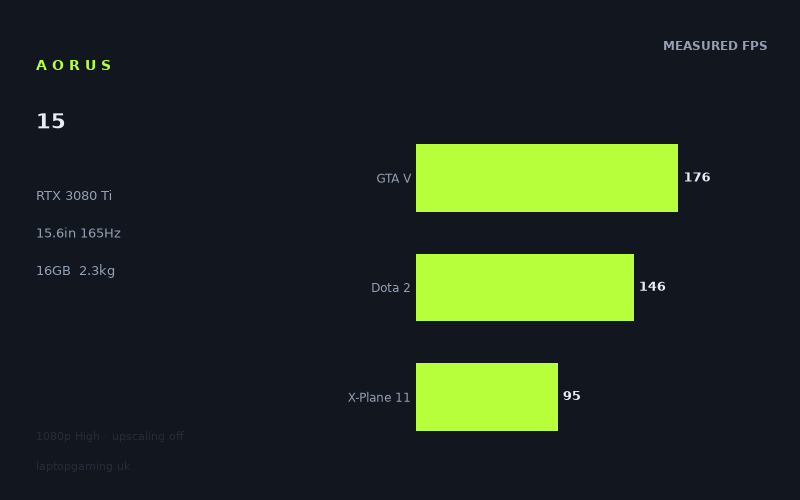
Frame rates
1920×1080, High preset, upscaling off.
Measured on this machine. Source: Notebookcheck, 2023-12-20.
Not scored: incomplete benchmark suite
Every scored laptop on this site is averaged over the same 5 games, and this one is short of Cyberpunk 2077, Baldur's Gate 3. A mean over 4 games is not comparable to a mean over 5, so we publish the figures we have and leave the score blank rather than rank it against machines tested on a different set. The numbers below are real - the suite is just incomplete.
How these numbers were produced
Frame rates here are not measured by us, and we label how each one was arrived at. A figure marked measured comes from a published run on that exact machine. A figure marked representative is derived from the GPU and its power limit (TGP) and cross-referenced against published reviews - a sound estimate of what that configuration delivers, but not a measurement of that specific laptop. Unless stated otherwise, numbers are 1920x1080, High preset, upscaling off. Where a laptop ships in several power configurations we use the wattage of the exact SKU listed, because a 140W RTX 5070 and a 115W one are not the same product.
In use
The short version
The Aorus 15 (YE5-54DEB34SH) is a difficult laptop to summarise with a simple “fast” or “slow” label. Its published benchmark data is strong in several games, with Notebookcheck measuring 222fps in The Witcher 3 and 176fps in GTA V at 1920x1080 on the High preset with upscaling disabled. It is also much less convincing if the expectation is that every game will make full use of its 165Hz screen: Dota 2 reaches 146fps, while Far Cry 5, Final Fantasy XV and X-Plane 11 are lower again at 131fps, 119fps and 95fps respectively.
That is not an indictment of the RTX 3080 Ti on its own. The more useful conclusion is that this is a laptop with a wide performance spread depending on the game. The measured results range from 95fps to 222fps, despite all figures being taken at the same 1920x1080 High preset with upscaling off. The Aorus is plainly capable of very high frame rates in some older or lighter titles, but it is not a machine for buyers who assume an RTX 3080 Ti badge guarantees 165fps in everything.
The benchmark data gives an average of 134fps across the four games used in the available scoring suite: GTA V, Dota 2, Final Fantasy XV and X-Plane 11. That is a respectable average, but it should not be mistaken for a complete performance ranking. We do not have a figure for Strange Brigade, so the suite is incomplete. Every laptop with a published ranking is averaged across the same five games, and a partial result cannot be ranked fairly against those machines. The Aorus therefore has no comparable overall score here, and it would be misleading to pretend otherwise.
The central practical issue is not whether 134fps sounds high in isolation. It is whether the frame rates fit the particular hardware around them. This is a 15.6in laptop with a 2560x1440 IPS display running at 165Hz. Notebookcheck’s figures are at 1920x1080 rather than the panel’s native 2560x1440 resolution. That means the available data establishes what the Aorus can do at 1080p High without upscaling, not what it will deliver at native 1440p. The distinction matters. Buyers attracted by the 1440p screen should not treat these 1080p results as proof that the laptop will hold the same frame rates at its native resolution.
There is also an important unknown around the RTX 3080 Ti implementation. The fact sheet confirms the GPU model, but it does not confirm the Aorus 15’s GPU power limit. That prevents a proper watt-for-watt assessment against other RTX 3080 Ti laptops. It also means there is no basis for claiming that the GPU is running at a particularly high or low power level, nor for assigning a specific shortfall to its power configuration. The benchmark figures show the final outcome; they do not, on their own, reveal exactly why the Aorus lands where it does.
For the right buyer, the Aorus 15 still makes sense. It suits somebody who wants a 15.6in 1440p IPS machine, values a 165Hz panel, and plays a mixture of games rather than one demanding title exclusively. It is especially suitable for someone content to choose settings and resolution according to the game, rather than insisting on one fixed target in every title. The measured 222fps in The Witcher 3 and 176fps in GTA V show that the screen’s high refresh capability is not wasted across the board.
It makes less sense for a buyer who wants an uncomplicated answer to native-resolution gaming, or who is paying a premium solely because the chassis says RTX 3080 Ti. There is no confirmed UK price in the available information, so a value verdict is impossible. Until a real UK price is known, the sensible judgement is about capability rather than deal quality: the Aorus 15 has strong measured 1080p performance, an appealing display specification, and too many unanswered questions about native-resolution output, GPU power configuration and battery life to recommend without qualification.
Performance
What the measured figures actually show
Notebookcheck measured the Aorus 15 at 1920x1080, using the High preset with upscaling turned off. Those conditions are useful because they avoid the confusion created when one result uses frame-generation or an upscaling mode and another does not. They also make the wide gap between games more meaningful. This is not a result set where every title clusters around the same frame rate. The Aorus is highly game-dependent.
- The Witcher 3: 222fps
- GTA V: 176fps
- Dota 2: 146fps
- Far Cry 5: 131fps
- Final Fantasy XV: 119fps
- X-Plane 11: 95fps
The standout result is The Witcher 3 at 222fps. That is comfortably beyond the display’s 165Hz refresh rate, so the panel is not the limiting factor in that particular measured scenario. It establishes that the laptop can deliver genuinely high frame rates when the game and settings line up with the hardware. For a buyer whose library includes games that behave similarly, the 165Hz screen is not merely an attractive specification on paper.
GTA V at 176fps tells a similar story. It is above 165Hz, so the Aorus can exceed the screen refresh rate in this measured High-preset 1080p run. That matters because it provides a second example rather than leaving the Witcher 3 result looking like an outlier. Two of the six published figures are above the panel refresh rate, and both show that the laptop can operate in the high-frame-rate territory buyers expect from a machine with this display.
The next result, however, changes the picture. Dota 2 reaches 146fps. That remains a high frame rate, but it is below 165Hz. The difference is not a reason to dismiss the result: 146fps is still well above what many buyers would consider a basic smoothness target. It does mean that “165Hz gaming” should not be interpreted as “165fps in every game”. Even a title such as Dota 2, measured here at 1080p High with upscaling disabled, does not reach the panel refresh rate.
Far Cry 5 follows at 131fps. Again, this is a substantial result and it is close enough to the four-game average of 134fps to feel representative of the middle of the Aorus’s available data. It is not a 165fps result, though. Someone buying the laptop specifically for a locked high-refresh experience in games of this type needs to recognise that the benchmark data does not support that expectation at the tested settings.
Final Fantasy XV comes in at 119fps. The number is still high in absolute terms, but it is a clear step down from the results in The Witcher 3, GTA V and Dota 2. This is where the average becomes more informative than the headline maximum. A review that only repeated the 222fps result would give the wrong impression of how broad the machine’s performance range is. The Aorus can be extremely quick, but the benchmark data does not show a uniform 165fps-class machine across the tested titles.
X-Plane 11 is the slowest published result at 95fps. That is the figure buyers should keep in mind when deciding whether a single number can describe this laptop. It cannot. There is a very large practical difference between a game running at 222fps and one running at 95fps, even though both results were obtained at the same resolution and preset. The Aorus 15 is therefore better understood as a laptop that requires game-by-game expectations.
The 95fps result is not evidence that the system is weak. It is evidence that the measured games make different demands and that the complete system, rather than the GPU badge alone, determines the final frame rate. A buyer who mainly plays titles resembling X-Plane 11 should base a purchase decision on the lower end of the published range, not on the fastest outlier. Conversely, a buyer focused on games that resemble the faster results has a much stronger case for the Aorus.
The four-game average is useful, but limited
The available scoring-suite average is 134fps across GTA V, Dota 2, Final Fantasy XV and X-Plane 11. It is a useful shorthand for the machine’s performance in those four titles, particularly because it includes both high and lower results. It avoids overstating the Aorus on the basis of one game and avoids understating it on the basis of X-Plane 11 alone.
But the average should be used carefully. It does not include The Witcher 3 or Far Cry 5, despite both being published measurements. It also cannot be turned into a full five-game score because the Strange Brigade result is missing. That is why the Aorus cannot be ranked alongside laptops with complete scoring-suite data. A partial suite is not the same thing as a complete suite, and the missing game may affect where the laptop would land.
The practical takeaway is straightforward. The 134fps average says that the Aorus has substantial 1080p High performance in the four available suite games. It does not say that it is definitively faster or slower overall than every other RTX 3080 Ti laptop. It does not say that it will average 134fps at 2560x1440. It does not say that every game will feel the same. Those limits are not caveats added for the sake of caution; they are directly relevant to a buying decision.
Why the game-to-game spread matters
The difference between 222fps in The Witcher 3 and 95fps in X-Plane 11 is the most important performance characteristic in the available data. A laptop that delivers similar numbers across a range of games can be described with a single broad performance class. The Aorus cannot be described so simply. It can push beyond the 165Hz display refresh rate in some titles, yet sit well below that level in others.
That variation changes how settings should be approached. In the faster titles, the evidence suggests that the Aorus has room for a high-frame-rate focus at 1080p High. In titles closer to 119fps, 131fps or 95fps, the buyer should think in terms of balancing image quality and frame rate rather than assuming there is enough performance headroom for every preference at once. The benchmark conditions already use the High preset and have upscaling disabled, so the figures are a clean baseline rather than an artificially boosted result.
It also changes how meaningful the RTX 3080 Ti label is. The label establishes the GPU family, but the published data shows that the laptop’s behaviour cannot be reduced to that badge. A prospective owner should look at the individual games closest to their own library. Someone spending most of their time in a title that behaves like GTA V has a different reason to buy this laptop from someone focused on simulation games resembling X-Plane 11.
The unconfirmed GPU power limit
GPU power limits matter in gaming laptops because the same GPU name can appear in machines with different configurations. That is especially relevant here because the comparison list includes an RTX 3080 Ti laptop with a confirmed 175W GPU configuration: the MSI Raider GE77 HX. The Aorus 15’s own GPU power limit is not confirmed in the fact sheet, so there is no honest route to a direct wattage comparison.
This matters because it would be tempting to look at the Aorus’s position against the Raider and declare that its RTX 3080 Ti must be configured at a lower power limit. The benchmark data alone does not prove that. The Raider is ahead by 19fps across four shared games, but laptops differ in more than the label on the GPU. The available information does not provide enough detail to isolate the reason for that gap.
For the same reason, it would be wrong to state that the Aorus is power-limited, underpowered, or unusually efficient. None of those conclusions is supported by the supplied specification. What can be said is narrower and more useful: the Aorus has an RTX 3080 Ti, its exact GPU power limit is not confirmed here, and its published 1080p High performance ranges from 95fps to 222fps depending on the game.
Buyers who regard GPU power configuration as a deciding factor should not make a purchase from the RTX 3080 Ti name alone. They need confirmation of the Aorus 15’s actual GPU power limit from a reliable specification source before deciding whether it is the right implementation of this GPU for them. Until then, Notebookcheck’s measured results are the stronger evidence.
What the data does and does not prove about 1440p gaming
The Aorus has a 2560x1440 screen, but every published frame rate here is at 1920x1080. That is not a minor footnote. Resolution is one of the main settings affecting graphics workload, and the native panel resolution is higher than the benchmark resolution. The available figures are therefore not native-resolution results.
There is no 2560x1440 benchmark figure in the fact sheet for The Witcher 3, GTA V, Dota 2, Far Cry 5, Final Fantasy XV or X-Plane 11. There are also no upscaling-on figures. It would be inappropriate to estimate them, invent likely performance, or promise that a particular setting adjustment will reach a particular frame rate. Buyers interested primarily in 1440p should treat this as an evidence gap rather than filling it with assumptions.
That does not make the 1080p results useless. They show a useful ceiling under the stated test conditions, and they show which games are likely to be more demanding for the machine than others. They also show that the 165Hz display can be exceeded in some games at the benchmarked resolution. They simply cannot confirm the experience at the panel’s native resolution.
The screen
The Aorus 15 pairs its gaming hardware with a 15.6in IPS panel at 2560x1440 and 165Hz. On specification alone, that is a sensible display direction for a performance laptop: the resolution is higher than the benchmark resolution, while the refresh rate is high enough to benefit from the strongest measured results. The key question is whether the available frame-rate data supports the screen specification rather than merely sounding impressive beside it.
At 1920x1080 High with upscaling off, the answer is mixed but broadly positive. The Witcher 3 at 222fps and GTA V at 176fps are both above 165Hz. In those measured scenarios, the laptop can supply frames faster than the panel refreshes. The high-refresh display therefore has a real purpose in the fastest part of the benchmark set.
Dota 2 at 146fps is below 165Hz but still close enough to show why a high-refresh panel is appropriate for the machine. It is not a full-refresh result, yet it remains firmly in high-frame-rate territory. Far Cry 5 at 131fps and Final Fantasy XV at 119fps sit further away from the panel maximum, while X-Plane 11 at 95fps demonstrates that the display refresh rate should not be used as a guarantee of performance in every game.
The screen is therefore best viewed as capability rather than a promise. It gives the Aorus 15 the headroom to display very high frame rates when the game allows them. It does not force every title to reach 165fps, and the benchmark figures make that clear. Buyers who play a varied library should appreciate the flexibility; buyers who demand that the display be saturated in every game need more evidence than this machine provides.
The more significant limitation is the mismatch between the panel’s native 2560x1440 resolution and the published 1920x1080 benchmark results. The Aorus may be bought because the buyer wants a 1440p display, but we do not have 1440p figures. It would be wrong to say that The Witcher 3 reaches 222fps at native resolution, that GTA V maintains 176fps there, or that X-Plane 11 achieves 95fps there. None of those statements is supported by the data.
This should affect purchasing priorities. If the purpose of the 2560x1440 panel is to run games at native resolution, seek native-resolution benchmark evidence before buying. If the purpose is to have a higher-resolution panel while retaining the option of 1920x1080 gaming in titles where frame rate is the priority, the published figures are more relevant. The fact sheet confirms the panel specification, but it does not confirm how the Aorus behaves at native resolution.
The IPS panel type is also confirmed, but there are no supplied measurements for brightness, colour coverage, contrast, response behaviour or any other panel characteristic. There is no basis for describing it as especially bright, colour-accurate, quick, dim or slow. The information available supports a judgement on size, resolution, refresh rate and panel technology only.
Build, size and portability
The Aorus 15 weighs 2.314kg. That figure places a clear constraint on how it is likely to be used: this is a laptop that can be moved, but it is not a specification that suggests effortless portability should be its defining strength. A buyer considering regular travel should take the weight seriously rather than focusing only on the 15.6in screen size.
There are no dimensions in the available fact sheet, so there is no basis for describing the Aorus as thin, compact, bulky or unusually large for its screen. Weight is the only supplied physical measurement. It tells us that the machine is not a lightweight option in absolute terms, but it does not reveal the shape of the chassis, its thickness, the footprint in a bag or how it compares physically with a particular rival.
The battery is rated at 99Wh. That is the battery capacity, not a battery-life result. We do not have a measured runtime for web use, video playback, idle use or gaming, and it would be irresponsible to translate 99Wh into a claimed number of hours. Gaming battery life in particular should not be assumed from capacity alone. Buyers who need long unplugged use should wait for measured battery data rather than treating the capacity figure as a guarantee.
There is a useful distinction between transportability and unplugged gaming. The weight affects carrying the laptop; the 99Wh battery describes the size of the energy store; neither fact confirms how long the system will run away from mains power. The Aorus may be suitable for someone moving between rooms, desks, classes or work locations, but the available data does not establish whether it is a good all-day portable.
The 15.6in display makes the Aorus a more conventional gaming-laptop size than a very large desktop-replacement format, but the 2.314kg weight means it should still be considered a performance machine first and a travel machine second. That is not a criticism. It is simply the sensible way to read the physical information supplied.
How it compares
The comparison data is deliberately limited to games both machines have in common, with preference given to the scoring-suite titles. That is the right basis for comparison. It prevents a laptop being declared faster merely because it was measured in an easier or different game. Even so, these are shared-game averages rather than complete rankings, and the Aorus cannot receive an overall score because its own scoring suite is incomplete.
Against the MSI Prestige 15
The Aorus averages 80fps more than the MSI Prestige 15 across four shared games. The Prestige 15 uses an RTX 3050 Ti at 105W. This is the clearest performance separation in the comparison set. The Aorus is not merely fractionally ahead here; the available shared-game data shows a substantial advantage.
For a buyer choosing between these two machines primarily for gaming, the Aorus has the stronger case on published frame-rate evidence. The GPU classes differ, and the measured gap reflects that. The Aorus also has the higher-resolution 2560x1440, 165Hz IPS display specification, while the fact sheet does not provide a confirmed UK price for either machine. Value therefore cannot be settled by performance alone, but the gaming-performance direction is unambiguous.
The Prestige 15 may still suit a different kind of buyer, but the supplied comparison data does not support choosing it over the Aorus on frame rate. The Aorus’s 80fps shared-game advantage is the largest positive gap listed here.
Against the HP Omen 16-b1090ng
Against the HP Omen 16-b1090ng with an RTX 3070 Ti, the Aorus averages the same frame rate across four shared games. That near-zero difference is a real result, not a typo and not something to brush aside because the Aorus carries the more prestigious GPU name.
The explanation supplied with the comparison data is important: at 1080p, lighter titles in the shared set can be CPU-bound, compressing genuine GPU gaps. In other words, where the processor or other parts of the system limit the frame rate, moving to a higher-tier GPU does not necessarily produce a large advantage. The Aorus uses a Core i5-12500H, but the available information does not provide the Omen’s processor configuration or enough detailed data to assign the tie to one component with certainty. The careful conclusion is that the shared 1080p results are effectively level.
This is exactly why buyers should not purchase solely by GPU label. In these shared games at the stated settings, the Aorus’s RTX 3080 Ti does not create an average advantage over the RTX 3070 Ti Omen. That does not prove the two systems are identical in every title, at every resolution or under every setting. It proves that the measured shared-game average is level, and that is the evidence that should guide this comparison.
Against the MSI Creator Z16P
The MSI Creator Z16P also has an RTX 3080 Ti, and the Aorus again averages the same frame rate across four shared games. This is another near-zero result that needs to be read carefully. It does not show that every RTX 3080 Ti laptop performs identically. It shows that, in the shared 1080p games available for comparison, neither machine establishes an average lead.
The same CPU-bound caution applies. At 1080p, lighter titles can compress genuine GPU differences because the GPU is not necessarily the only limiting factor. The Aorus and Creator Z16P may differ in ways not represented by the available comparison data, but those differences cannot be inferred from the same shared-game average.
For a buyer deciding between these two, the published frame-rate figures do not provide a reason to prefer one over the other. The decision would need to turn on confirmed price, display preferences, physical design, ports, storage, battery testing or other evidence not included in this fact sheet. There is no confirmed UK price for the Creator Z16P or the Aorus, so there is no defensible value comparison either.
Against the MSI Raider GE77 HX
The MSI Raider GE77 HX is the strongest listed rival in the shared-game comparison. It uses an RTX 3080 Ti at 175W and averages 19fps ahead of the Aorus across four shared games. That is the largest deficit for the Aorus in the comparison list.
The Raider result is useful because it shows that the RTX 3080 Ti badge does not define a fixed level of laptop performance. The Raider is ahead in the shared titles despite using the same GPU designation. Its confirmed 175W configuration is part of the specification picture, but the Aorus’s own GPU power limit is not confirmed, so the comparison cannot fairly become a direct power-limit diagnosis.
What can be said is that the Raider has the better published shared-game average. A buyer whose priority is extracting the highest available frame rate from this GPU generation should treat the Raider as the stronger comparator in the supplied data. Whether that advantage justifies choosing it depends on price and other practical factors, neither of which can be settled here because there is no confirmed UK price for either machine.
The Aorus should therefore not be presented as the definitive RTX 3080 Ti performance choice. It is level with the HP Omen 16-b1090ng and MSI Creator Z16P in the listed shared-game averages, far ahead of the MSI Prestige 15, and behind the MSI Raider GE77 HX. That is a more useful and more honest position than claiming that all RTX 3080 Ti laptops are broadly the same.
Who it’s for
The Aorus 15 is for buyers who want a 15.6in gaming laptop with a 2560x1440 IPS display, a 165Hz refresh rate and strong published 1080p performance. It is best suited to someone who understands that different games will produce very different results and who is willing to choose settings according to the title rather than expecting one fixed experience everywhere.
It is particularly well suited to players whose games resemble the faster end of the data. Notebookcheck’s 222fps result in The Witcher 3 and 176fps result in GTA V show that the machine can make meaningful use of the 165Hz display at 1080p High without upscaling. A buyer interested in high-frame-rate play in titles that behave similarly has concrete evidence in the Aorus’s favour.
It also suits someone who sees the 165Hz panel as headroom rather than a minimum promise. The 146fps result in Dota 2, 131fps in Far Cry 5 and 119fps in Final Fantasy XV remain substantial frame rates even though they are below the display maximum. For this buyer, the panel can accommodate a wide range of game performance rather than serving only one narrow target.
The Aorus is less suitable for someone who wants confirmation of native 2560x1440 gaming before buying. The display is 2560x1440, but the supplied benchmark figures are all at 1920x1080. There is no native-resolution data here. A buyer who considers 1440p performance non-negotiable should seek measured 2560x1440 figures rather than extrapolating from 1080p.
It is also not the obvious choice for someone who wants the strongest shared-game result among the listed RTX 3080 Ti machines. The MSI Raider GE77 HX is ahead by 19fps across four shared games, and its GPU is confirmed at 175W. That does not make the Raider automatically better for every buyer, particularly without confirmed UK prices, but it does mean the Aorus is not the performance leader in this specific comparison.
Buyers looking for a clear gaming-performance advantage over an RTX 3070 Ti laptop should be especially careful. The Aorus is level with the HP Omen 16-b1090ng across four shared games. At 1080p, lighter titles in the shared set can become CPU-bound and compress GPU differences, so the RTX 3080 Ti name does not automatically translate into a meaningful advantage in the measured comparison.
Those looking for a lighter travel-focused laptop should also pause. The Aorus weighs 2.314kg. That is manageable for moving the laptop, but it is not a specification that supports calling it lightweight. Its 99Wh battery is substantial in capacity, yet there are no runtime figures. Anyone who needs dependable unplugged use should not buy on the battery capacity alone.
Finally, the Aorus is not a machine to buy on value without a confirmed UK price. There is no price in the fact sheet, so there is no evidence-based way to decide whether its performance and display justify what it costs. If it is competitively priced, its strong 1080p results, 165Hz IPS panel and 15.6in 1440p specification could make it attractive. If it is priced close to better-performing alternatives, the missing native-resolution data and the Raider’s shared-game lead would matter more.
The disciplined conclusion is that the Aorus 15 has real strengths, but it needs the right buyer. Buy it for the measured high-frame-rate potential at 1080p, the 165Hz 1440p IPS display specification, and a willingness to judge performance game by game. Buy something else if native 1440p benchmark proof, maximum RTX 3080 Ti performance, low weight, confirmed battery life or a verified UK price is essential to the decision.