Review
MSI Stealth 15M review
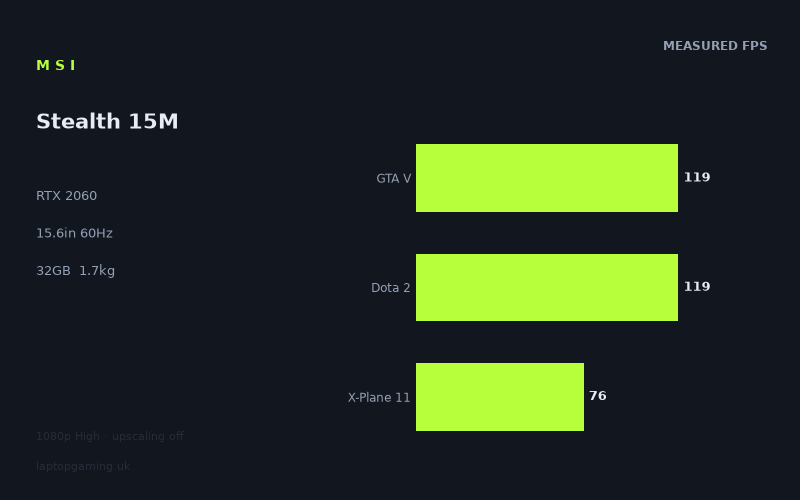
Frame rates
1920×1080, High preset, upscaling off.
Measured on this machine. Source: Notebookcheck, 2021-02-24.
Not scored: incomplete benchmark suite
Every scored laptop on this site is averaged over the same 5 games, and this one is short of Cyberpunk 2077, Baldur's Gate 3. A mean over 5 games is not comparable to a mean over 5, so we publish the figures we have and leave the score blank rather than rank it against machines tested on a different set. The numbers below are real - the suite is just incomplete.
How these numbers were produced
Frame rates here are not measured by us, and we label how each one was arrived at. A figure marked measured comes from a published run on that exact machine. A figure marked representative is derived from the GPU and its power limit (TGP) and cross-referenced against published reviews - a sound estimate of what that configuration delivers, but not a measurement of that specific laptop. Unless stated otherwise, numbers are 1920x1080, High preset, upscaling off. Where a laptop ships in several power configurations we use the wattage of the exact SKU listed, because a 140W RTX 5070 and a 115W one are not the same product.
In use
The short version
The MSI Stealth 15M (A11SEK) is a slim, relatively light 15.6in gaming laptop built around an RTX 2060, 32GB of memory and a 1TB SSD. The important performance result is straightforward: Notebookcheck’s 1920x1080 High-preset figures show that it has enough graphics performance for consistently playable full-HD gaming, and enough headroom in several games to exceed its 60Hz screen refresh rate. It is not a machine whose panel asks more of the GPU than the measured results can supply. In Dota 2 and GTA V, the measured figures are 119fps; Strange Brigade reaches 106fps; The Witcher 3 manages 89fps; and X-Plane 11 records 76fps. Those are comfortable numbers for a 60Hz display.
The qualification is Final Fantasy XV. Notebookcheck recorded 56fps at the same 1920x1080 High setting with upscaling off. That is still close to the screen’s 60Hz target, but it is the one result in the published set that does not clear it. Anyone buying this laptop specifically for demanding games should take that seriously. The Stealth 15M is not a guarantee of 60fps in every game at a High preset, even at full HD. Its results are better understood as a strong baseline for a 60Hz laptop rather than as a route to maximum settings without compromise.
The broader benchmark picture is healthy. Across the five scoring-suite games, the measured mean is 95fps. That is a useful figure because it includes both the very high results from Dota 2 and GTA V and the more demanding 56fps result in Final Fantasy XV. It says the laptop is generally well matched to 1920x1080 gaming, while also showing why an average must not replace the individual game results. A buyer playing Dota 2 will see a very different performance envelope from one concentrating on Final Fantasy XV or X-Plane 11.
This is therefore a sensible choice for somebody who wants a lighter 15.6in machine, does not need a high-refresh display, and mainly wants reliable full-HD gaming from an RTX 2060-class system. The 1.695kg weight is a meaningful part of the appeal. It gives the Stealth 15M a different use case from a large desktop-replacement machine: it is easier to justify as a laptop that moves between rooms, goes to work or study, or travels in a bag, while still delivering credible gaming frame rates when it is set down.
It is less compelling for someone who sees 60Hz as a limitation rather than a target. Several measured games run well above 60fps, but this particular screen cannot display more than 60 refreshes per second. The GPU performance is there in Dota 2, GTA V and Strange Brigade; the panel does not turn that performance into a high-refresh experience. Equally, a buyer who wants the strongest performance available from this GPU generation should look beyond the Stealth 15M. The MSI GT76 Titan DT with RTX 2080 graphics is substantially quicker in the shared games, although it belongs to a very different kind of machine.
There is no confirmed UK price for this exact configuration. That means a value judgement cannot be calculated for it here, not because there is anything incomplete about the benchmark set or unusual about the laptop’s frame-rate ranking, but because price is required for value. The performance evidence is complete enough to judge the machine as a gaming laptop; it is not enough to call it cheap, expensive, good value or poor value.
Performance
What the measured results say
Notebookcheck measured the MSI Stealth 15M at 1920x1080 using the High preset with upscaling off, with the results dated 2021-02-24. That test condition matters. These are native full-HD figures rather than results assisted by an upscaling mode, and they describe performance at a preset that aims higher than the minimum settings often used to chase a headline frame rate. They are also not a claim that every setting in every game is maximised. High is a useful real-world target because it tends to preserve visual quality without assuming that an RTX 2060 laptop should behave like a substantially more powerful system.
Dota 2 reaches 119fps. For a 60Hz panel, that is far beyond the level needed to feed the display at its full refresh rate. The result does not mean the screen becomes a 119Hz screen; it does mean that the laptop has considerable performance headroom in this game at the published settings. That headroom matters if a match becomes more demanding, if other software is running in the background, or if a player prefers to alter settings, although the published data does not quantify those situations. The firm conclusion is narrower and more useful: Dota 2 is not a difficult workload for this configuration at 1920x1080 High.
GTA V also records 119fps. Again, the result is comfortably above the display’s refresh ceiling. For a buyer whose gaming time is split between older or less GPU-intensive titles and newer, heavier releases, GTA V shows why the Stealth 15M should not be characterised only by the RTX 2060 label. At the stated test settings it produces a result that is well beyond ordinary 60fps play. It also reinforces an important point about this laptop’s screen: the GPU can sometimes deliver more frames than the 60Hz panel can show. That is not wasted performance in a purely technical sense, but it does mean the display is the visible limit rather than the graphics processor in this game.
Strange Brigade comes in at 106fps. This remains comfortably over 60fps and places it with Dota 2 and GTA V as one of the titles where the Stealth 15M has more than enough measured performance for its own display. There is a practical distinction between 106fps and 119fps in the data, but neither figure changes the buying conclusion for this particular panel. Both are high enough that the 60Hz screen, not the benchmark result, defines the upper limit of what can be displayed. If the laptop had a faster screen, the difference between the games would be more central to the buying decision. With this screen, both results count as a clear success.
The Witcher 3 measures 89fps. This is lower than the three fastest results, but still clearly above 60fps. It is a valuable result because it sits between the very high figures in Dota 2, GTA V and Strange Brigade and the more demanding end represented by Final Fantasy XV. It demonstrates that the Stealth 15M is not dependent on only the lightest games to look convincing. At the stated full-HD High setting, the benchmark data indicates enough headroom above the screen refresh rate for The Witcher 3 as well. For a buyer who wants a laptop for substantial single-player games rather than only competitive or older titles, that is reassuring evidence.
X-Plane 11 records 76fps. This is the last of the scoring-suite results above the panel’s 60Hz refresh rate, but it is closer to that line than Dota 2, GTA V, Strange Brigade or The Witcher 3. It should be read as a comfortable result rather than an extravagant one. There is enough measured performance to meet the screen’s native refresh target under the published conditions, but less spare capacity than in the titles that reach well into three figures. For someone particularly interested in X-Plane 11, that distinction is more useful than the overall average. The laptop appears capable at the tested setting, yet the result does not suggest the same margin for raising demands as the lighter games do.
Final Fantasy XV is the cautionary result at 56fps. It is not a disastrous number, and it is close to 60fps, but it is below the display’s refresh rate at 1920x1080 High with upscaling off. This is exactly why a review should not describe a machine as a universal 60fps laptop purely because its average looks good. The scoring-suite mean of 95fps is useful, but it is not a substitute for the individual low point. A buyer who primarily plays Final Fantasy XV should expect that the tested High configuration falls a little short of the panel target. The benchmark data does not show what changes to settings would do, so it would be wrong to promise a particular adjustment or a particular resulting frame rate.
Taken together, the figures run from 56fps in Final Fantasy XV to 119fps in Dota 2 and GTA V. The range is not evidence of an inconsistent laptop; it is evidence that games make very different demands. Some titles are light enough at this resolution and preset to deliver far more frames than a 60Hz display can present. Others place a much greater burden on the graphics system. X-Plane 11 and Final Fantasy XV make the latter point especially clearly. A purchaser should not buy on the basis of the best result, nor assume the worst result represents every game. The correct reading is that full-HD High gaming is generally strong here, but game choice still matters.
The scoring-suite average and its limits
The mean across the five scoring-suite games is 95fps. The five games behind that figure are Dota 2, GTA V, Strange Brigade, X-Plane 11 and Final Fantasy XV. It is a favourable average for a laptop with a 60Hz full-HD screen, because it sits well above the refresh rate of the panel. However, averages are particularly easy to misuse when the individual results have such a broad spread. Dota 2 and GTA V at 119fps lift the mean substantially, while Final Fantasy XV at 56fps shows that the same configuration can land just below the 60fps display target in a different game.
For ordinary buying decisions, the average answers one question: is the Stealth 15M broadly in the right performance class for 1920x1080 gaming? The answer is yes. It does not answer the more specific question of whether it will meet a particular player’s preferred target in a particular game. If the aim is a steady experience on the internal 60Hz screen across a mix of games, the results are encouraging. If the aim is to maintain 60fps or more regardless of title at High settings, Final Fantasy XV prevents that stronger claim. If the aim is to take advantage of a high-refresh external display, the high figures in some games are relevant, but the figures near the panel target in others show that this will depend heavily on the game.
It is also worth separating the benchmark setting from a promise about all visual options. The data is explicitly for the High preset with upscaling off. There is no published result here for another preset, another resolution or another upscaling setting. There is no basis for saying which individual graphics option matters most, whether a particular game can be made to run at a chosen frame rate, or how the laptop behaves in titles not listed. The measured numbers are strong evidence within their test conditions; they should not be stretched into advice that the source does not support.
That restraint matters more with a laptop than with a desktop graphics card, because laptop GPU names alone do not tell the whole story. This MSI uses an RTX 2060, but the fact sheet does not provide a GPU power limit for this configuration. As a result, there is no sound basis for claiming a particular wattage, describing the graphics processor as a high-power or low-power RTX 2060, or attributing its results to a specific power setting. The evidence to use is the observed benchmark performance: 119fps in Dota 2 and GTA V, 106fps in Strange Brigade, 89fps in The Witcher 3, 76fps in X-Plane 11 and 56fps in Final Fantasy XV.
That missing power-limit figure does not make the published frame rates less useful. It simply changes how they should be interpreted. Rather than treating the RTX 2060 name as a guarantee, buyers should treat this particular Stealth 15M as a measured implementation with a known outcome in the listed games. The numbers establish that it is considerably ahead of the 35W RTX 2050 configuration in the Acer Aspire 17 across the shared games, essentially level with one RTX 2060 rival, narrowly ahead of another, and well behind an RTX 2080 system. That is more decision-useful than guessing at a power limit that has not been supplied.
What the graphics performance means in practice
The internal display gives the Stealth 15M a clear and realistic performance target: 60fps. On the available results, Dota 2, GTA V, Strange Brigade, The Witcher 3 and X-Plane 11 all exceed that target. The margins differ sharply. Dota 2 and GTA V have very large measured headroom. Strange Brigade also clears the display limit convincingly. The Witcher 3 remains above it with a smaller but still useful margin, while X-Plane 11 is closer to the line. Final Fantasy XV is the only listed game below it.
This makes the MSI a more straightforward recommendation for a player who is content with the laptop’s own screen than for someone who regards every frame above 60fps as essential. A 60Hz panel is not automatically unsuitable for a machine that can exceed 60fps, but it shapes the benefit that can be seen. In the games recorded at 119fps or 106fps, the system’s output exceeds what the panel can refresh. In the games around 76fps or 89fps, the same is true, though with less room to spare. In Final Fantasy XV, the panel is not the constraint at the tested setting: the measured game performance is.
The practical conclusion is not that the Stealth 15M is either “fast” or “slow”. It is fast enough for its supplied display in most of the measured games, and not fast enough to make that statement universal at High settings. That is a better description than a broad claim about RTX 2060 laptops. Buyers should decide whether their own library resembles the titles above the refresh target or whether it resembles Final Fantasy XV. The answer changes the recommendation more than the mean alone does.
The 32GB of memory is also a notable specification for a gaming laptop of this type. It avoids the concern that the machine is being presented as a gaming system with an unusually small memory allocation. The benchmark data does not isolate memory performance or prove how much memory any individual game uses, so there is no basis for assigning a frame-rate benefit to the 32GB figure. What can be said is that the configuration combines its measured graphics results with 32GB of memory and a 1TB SSD, rather than asking the buyer to accept a cut-down memory or storage headline alongside the RTX 2060.
The 1TB SSD is similarly useful as a capacity specification, but it should not be converted into claims about load times, responsiveness or upgradeability. No storage benchmarks, internal layout details or expansion information are provided. For a buyer comparing complete configurations, 1TB is part of what this model includes. For a buyer looking for evidence of unusually fast storage, the fact sheet does not provide it. The key reason to consider the Stealth 15M remains the combination of its measured game performance, 60Hz full-HD screen and low 1.695kg weight.
The screen
The MSI Stealth 15M has a 15.6in IPS panel with a 1920x1080 resolution and a 60Hz refresh rate. This is a conventional full-HD gaming display specification rather than a high-refresh proposition. Its strongest fit is with the actual benchmark data. The RTX 2060 configuration is not being asked to drive a higher-resolution panel, and Notebookcheck’s figures indicate that it can exceed 60fps in five of the six games listed at the High preset with upscaling off.
That alignment matters. A laptop can look unbalanced in either direction: a demanding screen may leave the GPU struggling to supply enough frames, while a very fast panel may expose performance limits in heavier games. Here, the panel target is modest enough that the Stealth 15M clears it in Dota 2, GTA V, Strange Brigade, The Witcher 3 and X-Plane 11. The machine does not have to rely on low settings or upscaling in the published measurements to do so. Final Fantasy XV remains just below the panel target, which is the important exception.
The display also places the highest frame-rate results in context. Dota 2 and GTA V each measure 119fps, and Strange Brigade measures 106fps. Those are excellent frame rates for a system connected to a faster display, but the built-in panel refreshes at 60Hz. On this laptop’s own screen, the purchase case is not that it delivers an ultra-high-refresh competitive gaming experience. It is that it has enough graphics performance to keep a standard 60Hz full-HD display well supplied in a number of games.
For some buyers, that is a perfectly rational balance. A 60Hz screen gives a clear target, and the Stealth 15M reaches or exceeds it in most of the available data. A player who values a lighter chassis, 32GB of memory and a 1TB SSD may prefer this balance to a larger machine built around a faster panel. For others, the 60Hz refresh rate is the deciding reason to look elsewhere, particularly when the games they play often run well above 60fps on this hardware. The benchmark data supports both views; the right one depends on whether the buyer values portability and sufficient performance more than the possibility of displaying higher frame rates.
The IPS panel type is useful context, but the fact sheet does not provide measurements for brightness, contrast, colour coverage, response times or outdoor visibility. It would therefore be wrong to call the screen vivid, colour-accurate, fast, dim, slow or suitable for a particular kind of creative work. The available specification establishes the panel technology, size, resolution and refresh rate. The gaming evidence establishes that the GPU generally suits the resolution and refresh target. It does not establish the rest of the screen experience.
The 1920x1080 resolution is central to the results and should not be treated as a minor detail. All published frame rates are recorded at that resolution. They demonstrate the performance a buyer can expect from the tested games on the laptop’s native full-HD class of display, at the stated High preset and without upscaling. They do not demonstrate what happens at a higher resolution, and they should not be presented as evidence that the system is designed for one. The Stealth 15M’s screen and benchmark data tell a coherent story: this is a full-HD machine first.
Build, size and portability
The most concrete portability figure is the 1.695kg weight. That is a meaningful advantage for a gaming laptop intended to be moved regularly. It does not turn the Stealth 15M into a tiny device, because it remains a 15.6in laptop, but it does distinguish it from the kind of larger machine represented by a model such as the MSI GT76 Titan DT. The comparison is not only about frame rates. A buyer deciding between a lighter 15.6in system and a much more performance-focused alternative is choosing between different patterns of use.
At 1.695kg, the Stealth 15M makes sense for someone who needs gaming capability in a machine that can also be carried routinely. That might mean moving between home and another location, taking it to study or work, or simply avoiding the commitment of a large desktop-replacement laptop. The benchmark data reinforces that portability argument. This is not a light machine whose gaming credentials rest only on a graphics-card badge; it has published full-HD results of 119fps in Dota 2 and GTA V, 106fps in Strange Brigade, 89fps in The Witcher 3 and 76fps in X-Plane 11.
There is an unavoidable trade-off in the buyer’s priorities. The Stealth 15M is not the fastest system in the comparison group, because the RTX 2080-equipped MSI GT76 Titan DT is ahead by a large shared-game margin. But raw performance is not the only sensible criterion for a laptop. A person who wants a machine to live on a desk and prioritises the highest frame rates may reasonably accept a larger design. A person who needs to carry the laptop regularly may reasonably prefer the Stealth 15M’s 1.695kg figure and accept that it does not match the GT76 Titan DT in gaming performance.
No dimensions are provided in the fact sheet, so there is no basis for claims about footprint, thickness, bag fit or desk space. Likewise, there is no information on chassis materials, keyboard feel, trackpad quality, port selection, webcam quality, speakers, cooling design or fan noise. Those omissions matter because build quality and usability often shape the ownership experience as much as benchmark results. They simply cannot be filled with assumptions. The Stealth 15M can be judged as a 1.695kg, 15.6in gaming laptop; it cannot be credibly described in more physical detail from the supplied information.
The 52Wh battery is another specification that needs careful handling. It gives the battery capacity, but not battery life. There are no runtime measurements for browsing, video playback, office work, idle use or gaming. There is also no basis for saying whether it lasts well, poorly or somewhere in between away from mains power. Gaming frame-rate figures should not be read as battery-gaming figures either: the supplied benchmark data does not state a battery test condition. Buyers who need a specific unplugged runtime need further evidence before treating the Stealth 15M as suitable for that requirement.
That leaves a relatively clear portability judgement. The machine is light for the category on the only supplied weight measurement, and its 15.6in full-HD screen makes it a conventional size for a general-purpose gaming laptop. It has a 52Wh battery, but no documented battery-life result. It should be considered by buyers who value the low weight and can use it with realistic expectations about what has and has not been measured. It should not be chosen on an assumed all-day battery claim, silent operation claim or compact-dimensions claim that the data does not support.
How it compares
Against the Acer Aspire 17 with RTX 2050 at 35W
The Acer Aspire 17 uses an RTX 2050 at 35W, and the MSI Stealth 15M averages 22fps ahead across five shared games. This is the largest positive comparison provided for the Stealth 15M, and it gives the RTX 2060 configuration a clear performance advantage over a lower-tier, lower-power rival in the same GPU generation. The shared-game result matters more than a simple specification comparison because it is based on the games both machines hold in common rather than a guessed hierarchy.
An average lead of 22fps is substantial in the context of a 60Hz screen, but its meaning still depends on the underlying game. In a game where both systems are already comfortably above 60fps, the practical difference on the Stealth 15M’s internal panel may be limited by the screen refresh rate. In a game nearer to 60fps, the lead can be much more valuable because it can determine whether the laptop reaches the panel target with room to spare. The fact sheet does not provide each shared-game result in this comparison, so it would be wrong to assign the advantage to particular titles. The correct conclusion is simply that the MSI has a decisive average performance lead across the shared set.
The Acer comparison also highlights why raw GPU naming is less useful than measured outcomes. The Aspire 17’s RTX 2050 is explicitly listed at 35W. The Stealth 15M’s GPU power limit is not provided, so there is no need to speculate about the source of the gap. The observed result is enough: on five shared games, the MSI is ahead by 22fps on average. For someone choosing between these two systems principally for gaming, the evidence favours the Stealth 15M strongly on performance.
Against the HP Omen 15-en0375ng with RTX 2060
The HP Omen 15-en0375ng also uses an RTX 2060. Across three shared games, the Stealth 15M averages 3fps ahead. This is a real lead, but it is a small one. It should not be exaggerated into a claim that the MSI is categorically faster in every meaningful sense. A 3fps average gap across a limited shared set is much more useful as confirmation that the two laptops occupy a similar performance tier than as a reason to choose one on graphics speed alone.
The small difference is especially understandable at 1920x1080 because lighter titles in the shared set can become CPU-bound and compress genuine GPU gaps. In that situation, two machines with ostensibly similar graphics hardware may produce nearly the same frame-rate result even if their wider configurations differ. The near result is not meaningless; it tells the buyer that there is no sizeable measured performance advantage for the Stealth 15M against this Omen across the available shared games. But it also does not prove that every game, setting or workload will be separated by only the same narrow margin.
For a buyer comparing these two RTX 2060 systems, other confirmed specifications should carry substantial weight. The Stealth 15M brings a 15.6in 1920x1080 60Hz IPS screen, 32GB of memory, a 1TB SSD and a 1.695kg weight. The fact sheet does not provide corresponding specifications for the HP beyond its RTX 2060, and no confirmed UK price is available for either system. It is therefore not possible to make a full value or portability comparison. What the performance data says is modest but clear: the MSI is slightly ahead on average in the three shared games, not meaningfully separated by a large gaming-performance gulf.
Against the Acer Predator Triton 300 with RTX 2060
The Acer Predator Triton 300 is the closest match in the supplied comparisons. Across three shared games, the average difference is 0fps. This should be treated as a meaningful result rather than dismissed because it lacks a dramatic headline. On the available shared-game evidence, neither machine has a measured performance advantage. The Stealth 15M and the Triton 300 are effectively tied in that comparison.
A tie does not mean the two laptops are identical products. It means the shared benchmark set does not separate them on average. At 1920x1080, the lighter titles in a shared set may be CPU-bound, compressing genuine GPU differences and producing near-identical results even where the machines differ in other ways. That is precisely why the result should be interpreted carefully. It is strong evidence against choosing the Stealth 15M solely because it is expected to be faster than the Triton 300. It is not evidence that every unmeasured game, setting, screen characteristic or physical feature is the same.
For the MSI buyer, the tie has a practical implication. If the Acer is available in a configuration with a screen, weight, memory, storage or price that better matches a buyer’s needs, the Stealth 15M’s published performance does not provide an argument to override those priorities. Conversely, if the MSI’s 32GB memory, 1TB SSD, 15.6in IPS display or 1.695kg weight is the better fit, the tie means a buyer is not obviously sacrificing shared-game performance by selecting it. There is no confirmed UK price for either exact configuration, so value remains unresolved rather than assumed.
Against the MSI GT76 Titan DT with RTX 2080
The MSI GT76 Titan DT is the performance ceiling in this comparison set. With RTX 2080 graphics, it averages 56fps ahead of the Stealth 15M across five shared games. That is a very large deficit for the Stealth 15M, and it should be stated plainly. A buyer whose first priority is the highest gaming performance from the listed alternatives should not expect this RTX 2060 Stealth to compete with the GT76 Titan DT.
The comparison is valuable because it prevents the Stealth 15M’s strong full-HD results from being oversold. It can run Dota 2 and GTA V at 119fps, Strange Brigade at 106fps, The Witcher 3 at 89fps and X-Plane 11 at 76fps, but there is still a major gap to a stronger RTX 2080 machine across the shared games. The Stealth 15M is capable, not class-leading within the provided spread.
That does not automatically make the GT76 Titan DT the better purchase for every buyer. The Stealth 15M weighs 1.695kg, and portability is a legitimate reason to choose a lower-performing laptop. No weight for the GT76 Titan DT is provided here, so no numerical portability comparison should be invented. The sensible qualitative distinction is that the Stealth is the option for someone prioritising a lighter 15.6in system with capable full-HD gaming, while the GT76 Titan DT is the option for someone willing to prioritise substantially higher shared-game performance. With no confirmed UK price for either exact configuration, the performance gap cannot be converted into a value conclusion.
Who it’s for
The MSI Stealth 15M is for the buyer who wants a portable 15.6in gaming laptop and has a realistic full-HD target. Its 1.695kg weight is central to that recommendation, as are the 1920x1080 60Hz IPS panel and the measured frame rates that generally suit it. The strongest fit is someone playing a mixture of games like Dota 2, GTA V, Strange Brigade, The Witcher 3 and X-Plane 11, where the published results all exceed 60fps at High with upscaling off. Such a buyer is not buying unused theoretical performance; they are buying a machine whose GPU output broadly matches its own display.
It is also for someone who values a complete configuration rather than focusing only on the graphics processor. The 32GB memory allocation and 1TB SSD are substantial accompanying specifications. The supplied information does not establish component quality beyond capacity, but it does show that the Stealth 15M is not configured around an RTX 2060 while making obvious cuts to memory capacity or storage capacity. For a buyer who wants one machine for gaming and general use, that combination may be more attractive than a faster GPU paired with specifications that do not suit their broader needs.
The laptop suits players who are content with 60Hz gaming. That phrase is important. It does not mean the Stealth 15M only manages 60fps. It exceeds 60fps by a wide margin in several measured games. It means the laptop’s internal screen is designed around a 60Hz ceiling, so the visible benefit of 119fps in Dota 2 and GTA V or 106fps in Strange Brigade is limited by the panel’s refresh rate. Buyers who see a stable, well-fed 60Hz display as sufficient should find the balance sensible. Buyers chasing the feel and visible output of a faster screen should not.
It is a reasonable choice for a buyer who wants evidence rather than assumptions. The Notebookcheck data provides a complete set of results for the scoring suite and a clear set of additional game figures. It shows a 95fps mean across the scoring games, but it also provides the vital exception of 56fps in Final Fantasy XV. That transparency allows a buyer to make a better judgement than a generic claim that an RTX 2060 is “good for gaming”. The laptop is capable in the measured workload, with a known limitation in one demanding title at the stated settings.
Someone should buy something else if a high-refresh screen is non-negotiable. The Stealth 15M’s 60Hz panel is a fixed part of the experience. The GPU can exceed that rate in several of the measured games, but the screen cannot show those higher refresh rates. A buyer mainly playing Dota 2, GTA V or Strange Brigade who specifically wants to see frame rates above 60fps on the built-in display should choose a laptop with a faster panel rather than assuming the MSI’s benchmark figures solve that problem.
Someone should also look elsewhere if they need the highest possible gaming performance from the listed group. The MSI GT76 Titan DT is 56fps ahead on average across five shared games. There is no ambiguity in that result: the Stealth 15M is not the performance leader here. A buyer who mostly uses the laptop in one place, prioritises graphics speed over low weight, and accepts the different character of a larger performance-oriented system should put greater emphasis on the GT76 Titan DT comparison.
A buyer focused on Final Fantasy XV should be cautious. The measured 56fps result at 1920x1080 High with upscaling off is close to 60fps, but it is not 60fps. This does not rule the MSI out, especially for someone who is willing to make settings decisions that are not covered by the supplied data. It does mean the laptop should not be bought on a promise of meeting the panel refresh rate in that game at the tested preset. The published figure is the correct expectation to use until further attributable data says otherwise.
A buyer choosing between the Stealth 15M, HP Omen 15-en0375ng and Acer Predator Triton 300 should avoid paying a premium for an assumed major gaming lead from the MSI. The MSI is only 3fps ahead of the HP on average across three shared games and tied with the Acer across three shared games. Those comparisons place the machines in the same broad performance territory. The decision should therefore turn on confirmed configuration differences, display preference, portability requirements and price when a confirmed UK price exists, not on the expectation that the Stealth 15M will run away with the benchmarks.
Finally, someone who needs documented battery endurance, panel-quality measurements, noise data, temperatures, dimensions or detailed build information should wait for evidence rather than treating the available specifications as answers. The fact sheet gives a 52Wh battery, but no runtime. It gives an IPS panel, but no brightness, colour or response-time data. It gives a 1.695kg weight, but no dimensions. The right conclusion is not that these aspects are good or bad; it is that they are unverified here.
The MSI Stealth 15M makes its strongest case as a light 15.6in full-HD gaming laptop with a well-specified memory and storage configuration, a 60Hz IPS screen, and benchmark results that are usually above that screen’s refresh target. Its weakness is not a lack of basic gaming capability. Its weakness is that the display does not capitalise on the highest measured frame rates, while the demanding Final Fantasy XV result shows that High settings do not guarantee 60fps in every title. For the buyer who understands and accepts those boundaries, the published performance is convincing. For the buyer who needs high-refresh gaming, maximum frame rates, confirmed battery life or a confirmed UK price before deciding, there is not enough evidence to make this the automatic choice.