Review
Schenker XMG Core 15 review
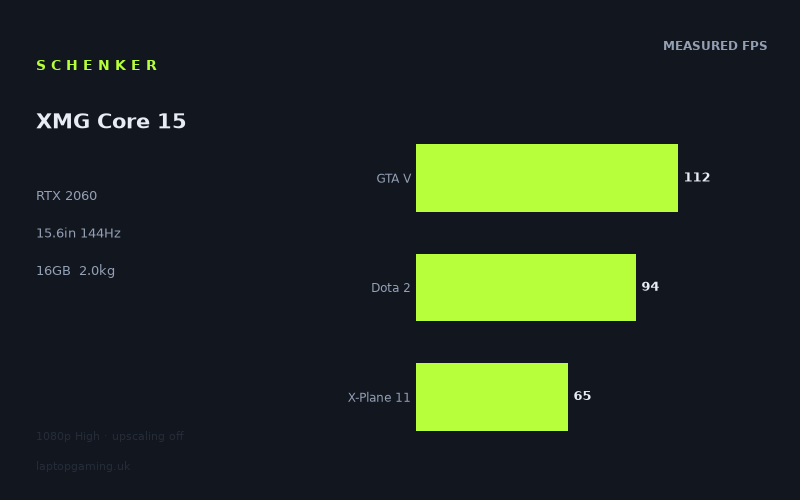
Frame rates
1920×1080, High preset, upscaling off.
Measured on this machine. Source: Notebookcheck, 2020-09-27.
Not scored: incomplete benchmark suite
Every scored laptop on this site is averaged over the same 5 games, and this one is short of Cyberpunk 2077, Baldur's Gate 3. A mean over 3 games is not comparable to a mean over 5, so we publish the figures we have and leave the score blank rather than rank it against machines tested on a different set. The numbers below are real - the suite is just incomplete.
How these numbers were produced
Frame rates here are not measured by us, and we label how each one was arrived at. A figure marked measured comes from a published run on that exact machine. A figure marked representative is derived from the GPU and its power limit (TGP) and cross-referenced against published reviews - a sound estimate of what that configuration delivers, but not a measurement of that specific laptop. Unless stated otherwise, numbers are 1920x1080, High preset, upscaling off. Where a laptop ships in several power configurations we use the wattage of the exact SKU listed, because a 140W RTX 5070 and a 115W one are not the same product.
In use
The short version
The Schenker XMG Core 15 is a straightforward 1080p gaming laptop built around an RTX 2060, a Ryzen 7 4800H, 16GB of memory and a 144Hz IPS display. The published Notebookcheck benchmark data shows a machine that can deliver convincingly smooth frame rates in a broad range of games at the stated High preset, with upscaling disabled. GTA V reaches 112fps, The Witcher 3 reaches 105fps, Dota 2 reaches 94fps, Far Cry 5 reaches 81fps, Battlefield V reaches 68fps and X-Plane 11 reaches 65fps.
That is a useful spread of results because it shows both sides of the laptop. In its more favourable games, the XMG Core 15 gets close enough to the screen’s 144Hz refresh rate to make the panel feel worthwhile, even if it does not fully saturate it in the published results. In the more demanding games, it remains clearly playable at the tested 1920x1080 High setting, but it is operating in a different class from a machine that can make a 144Hz display work at full pace in every title.
The main limitation is not that the RTX 2060 cannot game at 1080p. The figures show that it plainly can. The limitation is that the available benchmark data does not establish how aggressively Schenker configured the GPU. No GPU power limit is included in the fact sheet, so it would be wrong to assume that this RTX 2060 performs like every other RTX 2060 laptop. Laptop GPUs with the same name can be configured differently, and the published frame rates are more useful here than the GPU badge alone.
The other major caveat is price. There is no confirmed UK price for this configuration, and that prevents a complete buying verdict. The XMG Core 15 could be sensible if found at an appropriate price for an RTX 2060 machine with a 144Hz IPS panel and a Ryzen 7 4800H. It could also be poor value if priced too close to newer or substantially faster gaming laptops. Without a confirmed UK price, the performance case can be assessed, but the value case cannot be settled responsibly.
There is also no overall ranking for this machine on the available data. The scoring suite is incomplete because there are no figures for Final Fantasy XV or Strange Brigade. Every ranked laptop is averaged over the same full set of scoring games, so a partial result cannot be placed fairly alongside laptops with complete results. The available mean is 90fps across GTA V, Dota 2 and X-Plane 11, but that is not a substitute for a full like-for-like ranking.
Buy the XMG Core 15 if you want a portable 15.6in gaming laptop whose published results support solid 1080p High-preset gaming, and if the eventual UK price reflects that it is an RTX 2060 model rather than a newer high-refresh gaming powerhouse. It is especially plausible for someone playing a mixture of competitive games, older games and mainstream single-player titles rather than expecting every new demanding release to run close to the display’s maximum refresh rate.
Look elsewhere if your priority is making full use of 144Hz in demanding games, if you want clear evidence of battery life, acoustics, temperatures or screen quality beyond panel type and refresh rate, or if you need a machine that can be ranked cleanly against a wider field using a complete benchmark suite. The XMG Core 15 has enough measured performance to be interesting. It does not have enough published evidence to justify broad claims beyond that.
Performance
What the published figures say
Notebookcheck measured the Schenker XMG Core 15 at 1920x1080, using the High preset with upscaling switched off. That matters. These are native-resolution-style results rather than figures boosted by an upscaling mode, and they are therefore a useful indication of what the RTX 2060 can do with conventional image-quality settings on the laptop’s own screen.
The highest result in the available set is GTA V at 112fps. That is the clearest example of the XMG Core 15 approaching the territory where its 144Hz panel becomes meaningful rather than merely aspirational. It is still below the panel’s maximum refresh rate, so the data does not show the game fully exploiting 144Hz at the tested setting. But 112fps is close enough that the display’s higher refresh capability is relevant, particularly compared with a standard lower-refresh gaming panel.
The Witcher 3 follows at 105fps. Again, that is comfortably beneath 144Hz but well above the level where a high-refresh display is wasted. The important point is not that the laptop exactly matches the screen refresh rate; it does not in the measured result. The point is that the game is running fast enough for the panel’s 144Hz ceiling to leave room for the frame rate rather than immediately becoming the limiting factor.
Dota 2 records 94fps. This is a strong result in absolute terms, but it is also useful as part of the wider pattern. The XMG Core 15 is not presenting a flat, fixed frame-rate experience across every game. There is a meaningful range between the faster GTA V and The Witcher 3 results, the mid-range Dota 2 and Far Cry 5 figures, and the lower Battlefield V and X-Plane 11 figures. A buyer should treat 144Hz as display headroom, not as a promise that every measured game will run at anything like 144fps on High settings.
Far Cry 5 reaches 81fps. That places it firmly in the middle of the available results. It is not close to filling the 144Hz panel, yet it is far from suggesting that 1080p High gaming is beyond the laptop. The same general conclusion applies to Battlefield V at 68fps and X-Plane 11 at 65fps. Those are the results that matter most when deciding whether the XMG Core 15 is a high-refresh machine first or a capable 1080p gaming laptop first. The evidence supports the latter description more strongly.
Battlefield V at 68fps and X-Plane 11 at 65fps are close enough to underline the point. In the more difficult part of the published set, the RTX 2060 is delivering frame rates that suit conventional smooth 1080p play, but not frame rates that make a 144Hz panel look effortless. The screen remains beneficial because its refresh rate is above the measured output, but it is not being driven near its maximum capability in these games at the stated settings.
The available scoring-suite mean is 90fps across GTA V, Dota 2 and X-Plane 11. That is a useful shorthand for the three measured scoring titles, but it should not be mistaken for an overall performance rating. The three games are not the complete scoring suite, and the missing Final Fantasy XV and Strange Brigade results prevent the XMG Core 15 from being ranked alongside laptops with complete data. The 90fps mean shows that the machine can produce a healthy average across the available trio; it does not prove where it belongs in a full table.
The spread matters more than a single average
Averages are convenient, but the spread between individual games is more valuable when choosing a gaming laptop. GTA V at 112fps and X-Plane 11 at 65fps are very different experiences on the same hardware at the same resolution and broad preset category. The XMG Core 15 is therefore not a laptop where one number tells the whole story. Its published figures show a machine whose practical behaviour depends heavily on the game being played.
That variability is exactly why it would be misleading to describe the RTX 2060 here as simply a “144Hz GPU” or simply a “60fps GPU”. Neither label fits the measured data. In GTA V and The Witcher 3, the laptop operates much closer to high-refresh territory. In Dota 2 and Far Cry 5, it sits in a strong middle ground. In Battlefield V and X-Plane 11, it is delivering substantially lower figures, though still at levels that make the 1080p High preset viable according to the published measurements.
The result is a machine that rewards sensible expectations. If a buyer’s games resemble the faster end of the measured set, the XMG Core 15 can make good use of its 144Hz IPS panel. If their games resemble the lower end, the display is still a good match in the sense that it will not cap the laptop’s output, but the experience will be defined by the GPU’s frame rate rather than by the panel’s maximum refresh rate.
There is no reason to assume that every game will land neatly between the published high and low figures. These are measurements from a limited game list, not an exhaustive catalogue. The responsible conclusion is narrower: at 1920x1080 High with upscaling off, the XMG Core 15 has published results ranging from 65fps to 112fps across the available titles. That is the range a buyer should keep in mind rather than treating the 90fps scoring-suite mean as a universal prediction.
The settings also matter. The measurements use High rather than a lower preset, and upscaling is off. That makes the faster results more impressive than they would be if they had relied on reduced visual settings, but it also explains why the machine does not reach 144fps in the available titles. There is no measured lower-preset data in the fact sheet, so there is no basis for publishing guessed frame rates for people willing to trade image quality for speed. The sensible interpretation is simply that High at 1080p is a realistic operating point for this configuration.
What the RTX 2060 means here
The RTX 2060 name tells only part of the story in a laptop. The GPU’s power limit is particularly important, but no specific power limit is provided for the XMG Core 15. That missing specification should change how the machine is discussed. It would be easy to compare its RTX 2060 directly with another RTX 2060 laptop and assume a predictable outcome. The available data does not justify that shortcut.
Instead, the published frame rates should take priority. They show what this particular Schenker configuration achieved in Notebookcheck’s measurements. That is more useful than repeating a generic statement about the GPU. The XMG Core 15 reaches 112fps in GTA V and 105fps in The Witcher 3, while Battlefield V and X-Plane 11 sit at 68fps and 65fps. Those figures are the practical performance profile of this laptop as measured, regardless of what another RTX 2060 laptop might do under a different power configuration.
The absence of a stated GPU power limit also means it is not possible to attribute the performance spread to any one design choice. The Ryzen 7 4800H, the RTX 2060 configuration, the games themselves and the tested settings all form part of the final result. The fact sheet does not include per-game CPU or GPU utilisation, clock behaviour, thermal data, fan noise data or detailed power information. Any confident claim that one component is solely responsible would go beyond the evidence.
What can be said is that the XMG Core 15 is not behaving like a laptop that is universally constrained to modest frame rates. Its strongest results are well beyond the lower end of the set. Equally, it is not behaving like a machine that can assume 144fps at High settings simply because it has a 144Hz display. The measured results are too varied for that. The GPU and the rest of the platform are capable enough for strong 1080p gaming, but the available data does not support treating the laptop as a full-refresh-rate solution across the board.
This matters particularly for buyers comparing laptop model names rather than complete benchmark tables. A faster-looking specification can sometimes create false confidence, while a less glamorous specification can perform well in a particular title. The XMG Core 15’s results against the listed RTX 2050 rivals make that clear: despite having an RTX 2060, it is effectively tied with one and narrowly behind another across the shared-game comparisons. That does not make the RTX 2060 irrelevant. It means the actual benchmark data must lead the buying decision.
Comfortable gaming versus full-refresh gaming
The XMG Core 15’s measured numbers support a distinction between games that are comfortable at the tested setting and games that are likely to feel like a compromise if the goal is to push the display as hard as possible. GTA V at 112fps, The Witcher 3 at 105fps and Dota 2 at 94fps are the stronger end of the set. None reaches 144fps, but all sit close enough to the display’s refresh ceiling for the 144Hz panel to have practical value.
Far Cry 5 at 81fps is still a strong 1080p High result, but it is further from the display’s limit. Here, the 144Hz screen should be viewed as a capable panel with plenty of unused headroom rather than a target the laptop nearly reaches. Battlefield V at 68fps and X-Plane 11 at 65fps are further still. Those figures remain above the level suggested by a basic low-frame-rate experience, but the data does not support presenting them as high-refresh gaming results.
This is not a criticism of the panel. A 144Hz IPS screen gives the laptop a better ceiling than a lower-refresh display would. The issue is matching expectations to the measured output. A buyer who wants a screen that will not hold back the laptop in faster games gets that here. A buyer who expects the screen’s headline refresh rate to be a realistic result in every demanding game does not get that from the published evidence.
The display also makes more sense because the laptop’s best results are not isolated from normal gaming use. GTA V, The Witcher 3, Dota 2 and Far Cry 5 cover a range of game types, and the XMG Core 15 stays well above its lowest recorded results in several of them. The frame-rate range does not suggest an all-or-nothing machine. It suggests a gaming laptop that can feel notably fast in the right games while remaining conventional rather than exceptional in the tougher ones.
There is no measured frame-time information, no minimum frame-rate data and no detail on the laptop’s display response behaviour. That means smoothness cannot be analysed beyond the published average frame-rate figures. A higher average does not answer every question about consistency, and a 144Hz IPS label does not by itself establish response quality. Buyers who regard those details as essential should treat them as unconfirmed rather than filling the gaps with assumptions.
The screen
A sensible resolution for the measured hardware
The Schenker XMG Core 15 uses a 15.6in IPS display with a 1920x1080 resolution and a 144Hz refresh rate. On the evidence available, 1920x1080 is an appropriate match for the RTX 2060 configuration. The benchmark data is all collected at that resolution, at High settings and with upscaling off, and it shows the laptop ranging from 65fps to 112fps across the measured games.
That does not mean every game is close to the panel’s 144Hz maximum. None of the published figures reaches 144fps. But it does mean the screen resolution is not obviously excessive for the hardware. The XMG Core 15 is not being asked to drive a higher-resolution panel without sufficient measured performance behind it. Instead, the panel’s 1920x1080 resolution aligns with the benchmark conditions in which the laptop has demonstrated credible results.
The strongest match between screen and performance appears in GTA V and The Witcher 3. At 112fps and 105fps respectively, these results leave the panel with enough refresh capacity to display the laptop’s output without the screen itself becoming the obvious ceiling. Dota 2 at 94fps works on similar logic, though with more distance between frame rate and refresh rate.
Far Cry 5, Battlefield V and X-Plane 11 demonstrate the other side. At 81fps, 68fps and 65fps, the laptop is not close to driving the screen at its full 144Hz rate. The panel still has value because it is not restricting these results, but the experience is governed by game performance rather than by the maximum refresh specification. Buyers should therefore see 144Hz as useful overhead, especially in faster titles, rather than as a performance guarantee.
IPS is a useful specification, not a full panel review
The screen is listed as IPS, which is welcome in a gaming laptop specification because it identifies the panel technology. But the fact sheet does not include brightness, contrast, colour coverage, response-time measurements, PWM information, adaptive-sync details or outdoor visibility data. There is therefore no basis for claiming that this is an excellent display beyond its basic IPS, 1920x1080 and 144Hz specification.
This distinction matters because a gaming display is more than its refresh rate. The 144Hz figure tells a buyer the maximum update rate supported by the panel. The IPS label tells them the panel type. Neither number establishes whether the display is especially bright, unusually dim, colour-accurate, fast in pixel response or well suited to colour-sensitive work. Those points remain unconfirmed in the supplied information.
For gaming specifically, the published frame rates are the more important part of the screen analysis. The laptop has enough measured performance to make a 144Hz panel more than decorative. It reaches 112fps in GTA V, 105fps in The Witcher 3 and 94fps in Dota 2. At the same time, the lower figures make clear why a buyer should not choose it solely because they expect a locked high-refresh experience in every title.
The best description is that this is a well-targeted screen specification for a 1080p RTX 2060 laptop, with performance that sometimes approaches high-refresh gaming and sometimes sits in a more conventional range. That is a better fit than pairing the measured GPU performance with a resolution that the available benchmark data does not cover. It is also more honest than implying that 144Hz alone transforms every game into a high-frame-rate experience.
Build, size and portability
The XMG Core 15 weighs 2.0kg. That places it in a practical middle ground for a gaming laptop: substantial enough that it should be considered a proper computer to carry rather than an ultra-light travel machine, but not so heavy on the available specification that it must be treated as a permanently desk-bound system.
The 15.6in screen size reinforces that role. This is a conventional portable gaming format rather than a larger desktop-replacement design. A 15.6in panel gives the XMG Core 15 a screen size that suits gaming, everyday work and transport better than a much larger chassis would, while the 2.0kg weight means it remains plausible as a laptop that moves between home, work, study and occasional travel.
That said, the fact sheet does not provide physical dimensions. There is no published width, depth or thickness in the supplied information, so it is not possible to say how easily the XMG Core 15 fits into a particular bag, how much desk area it occupies or whether it is unusually thin for its class. Weight is only one part of portability. Without dimensions, the most responsible conclusion is that 2.0kg is manageable for a gaming laptop, while the full travelling experience remains unconfirmed.
The supplied information also does not include the charger size or weight. That is important because a gaming laptop’s carry weight is not just the laptop itself when mains power is required. There is no basis for stating whether the XMG Core 15’s power supply is compact, bulky or especially convenient for travel. Anyone choosing between this and another portable gaming machine should not assume that the 2.0kg figure tells the entire story.
Its 62Wh battery gives a useful indication of battery capacity, but there are no measured battery-life figures. It would be wrong to turn 62Wh into a claimed number of hours for web use, video playback, office work or gaming. Battery capacity is a specification; battery life is a measured outcome affected by workload, screen behaviour, power settings and other factors not provided here.
The same caution applies to heat and noise. No temperature or acoustic measurements are supplied. A buyer cannot responsibly be told that the XMG Core 15 runs cool, runs hot, stays quiet or becomes loud under gaming load. The 2.0kg weight and gaming-focused specification may invite assumptions about cooling, but the published facts do not support them.
What can be said is that the laptop’s physical proposition is coherent. A 15.6in 1920x1080 144Hz IPS screen, RTX 2060 graphics, Ryzen 7 4800H processor and 16GB of memory form the basis of a conventional gaming laptop rather than a compact low-power notebook. The 2.0kg weight makes it more portable than a larger heavyweight gaming system, while still signalling that it is intended to deliver more than casual graphics performance.
For someone who mainly plays at a desk but wants the option to move the machine, that balance is likely more appealing than for someone who travels every day with a laptop. The XMG Core 15 is not specified as an ultra-portable device, and there is no battery-life evidence to support that use case. It is better understood as a gaming laptop that can travel, not a travel laptop that happens to game.
How it compares
Against the Acer Aspire 17 with RTX 2050 graphics
Across three shared games, the Schenker XMG Core 15 averages 2fps ahead of the Acer Aspire 17, which uses an RTX 2050 configured at 35W. That is a very small margin. It is a real published result, but it is not the kind of gap that should decide a purchase by itself.
The obvious temptation is to look at RTX 2060 versus RTX 2050 and expect a decisive victory for the Schenker. The shared-game data does not show that. Instead, it shows the XMG Core 15 only narrowly ahead. The explanation provided with the comparison is important: at 1080p, the lighter titles in the shared set are CPU-bound and compress genuine GPU gaps. In other words, the games used for the comparison can reduce the visible advantage that might otherwise be expected from the graphics specification alone.
That is why the 2fps lead should not be spun into either a triumph for the Schenker or a failure for the RTX 2060. It is simply a reminder that laptop buying should be based on measured outcomes rather than neat product-tier assumptions. The XMG Core 15 is ahead in this shared comparison, but only narrowly enough that other factors would matter greatly if both machines were available at suitable prices.
There is no confirmed UK price for the Acer Aspire 17 either. That means a value comparison cannot be completed. A 2fps average lead would matter more if the Schenker were similarly priced, and less if it commanded a significant premium. As neither price is confirmed, the responsible verdict is restricted to performance: the XMG Core 15 is marginally faster in the available shared-game comparison, but not by enough to claim a clear class advantage.
Against the Acer Aspire 5 with RTX 2050 graphics
The comparison with the Acer Aspire 5 is even more revealing. Across three shared games, the Schenker XMG Core 15 averages 1fps behind the Acer Aspire 5, another RTX 2050 laptop configured at 35W. This is effectively a tie in practical terms, but the published average technically favours the Acer.
Again, this does not prove that an RTX 2050 is generally a better choice than the RTX 2060 in the XMG Core 15. It proves only what the shared benchmark set shows. The near-zero difference is specifically the sort of result that can occur when lighter games at 1080p become CPU-bound and compress genuine GPU differences. The shared games are not exposing a large graphics-performance separation, so the product names alone are not enough to settle the contest.
For a buyer, the useful conclusion is that the XMG Core 15 should not be bought on the assumption that its RTX 2060 automatically gives it a decisive measured lead over all RTX 2050 laptops. In this particular comparison, it does not. The difference is just 1fps in the Acer Aspire 5’s favour across the shared games.
That small deficit also makes price especially important, yet the Acer Aspire 5 has no confirmed UK price in the supplied information. If the machines were priced similarly, the decision would need to turn on their wider specifications, display details, portability, warranty and other evidence not included here. If one were much cheaper, that could matter more than a 1fps shared-game difference. Since those prices are not confirmed, the comparison should remain performance-focused and modest in its conclusions.
Against the MSI GT76 Titan DT with RTX 2080 graphics
The MSI GT76 Titan DT is the opposite end of the comparison spread. Across three shared games, the XMG Core 15 averages 54fps behind the RTX 2080-equipped MSI. Unlike the near-ties with the RTX 2050 Acer machines, this is a substantial gap that cannot be dismissed as noise or compressed into an insignificant difference.
The MSI’s advantage demonstrates what the XMG Core 15 is not. It is not a substitute for a far more performance-led RTX 2080 gaming laptop when frame rate is the overriding concern. A 54fps shared-game average deficit is large enough to change what a buyer should expect from a high-refresh display, demanding games and long-term performance headroom.
That does not make the Schenker a bad gaming laptop. The XMG Core 15 still posts 112fps in GTA V and 105fps in The Witcher 3, and it stays at 68fps in Battlefield V and 65fps in X-Plane 11 at the tested settings. But the comparison with the GT76 Titan DT places those figures in context. There is a meaningful difference between a capable 1080p RTX 2060 laptop and an RTX 2080 system that is substantially faster in the shared data.
The MSI GT76 Titan DT has no confirmed UK price in the supplied information, so this is not a value verdict. It is a performance verdict only. Buyers who care most about getting closer to the limits of a 144Hz panel in a wider range of games should recognise the significance of the MSI’s shared-game lead. Buyers who do not need that level of performance may find the XMG Core 15’s 2.0kg weight and 15.6in format more aligned with their needs, but there is no supplied weight or display information for the MSI that would support a direct portability comparison.
What the rival spread tells us
The three rival comparisons are more useful together than separately. Against the Acer Aspire 17, the XMG Core 15 is ahead by 2fps across three shared games. Against the Acer Aspire 5, it is behind by 1fps. Against the MSI GT76 Titan DT, it is behind by 54fps. That creates a clear picture: the Schenker sits much closer to the published shared-game performance of the two RTX 2050 Acer machines than to the RTX 2080 MSI.
At first glance, that may seem surprising given the XMG Core 15’s RTX 2060 graphics. But the fact sheet explicitly explains why the near-zero Acer gaps should not be over-read: lighter games at 1080p can be CPU-bound, compressing genuine GPU differences. The correct response is not to ignore the data, nor to pretend that a 1fps or 2fps gap proves broad equivalence in every game. The correct response is to understand that the shared set is limited and its lighter titles can conceal larger graphics differences.
The MSI result is different because the gap is large enough to remain meaningful despite that limitation. A 54fps average advantage across the three shared games shows a clear performance separation. The XMG Core 15 therefore occupies a sensible but clearly bounded position: it is a competent 1080p gaming laptop, not a performance leader among the named rivals.
None of the rival comparisons should be turned into a price recommendation because no confirmed UK prices are available for the Schenker, the Acer Aspire 17, the Acer Aspire 5 or the MSI GT76 Titan DT. Price can completely change the meaning of a small performance lead or deficit. What the data can establish is performance context, and that context is unusually valuable here because it prevents the RTX 2060 label from doing too much work on its own.
Who it’s for
The Schenker XMG Core 15 is for the buyer who wants measured evidence of capable 1080p gaming rather than a promise based only on specifications. The available Notebookcheck figures support that case. GTA V at 112fps, The Witcher 3 at 105fps and Dota 2 at 94fps show that the laptop can produce high frame rates in several games at 1920x1080 High with upscaling off.
It is also for someone who sees 144Hz as useful display headroom rather than as an expectation that every game will run at 144fps. The screen is a good fit for the laptop’s stronger results, and it remains a sensible panel when the frame rate is lower. But the buyer needs to be comfortable with the fact that Far Cry 5 reaches 81fps, Battlefield V reaches 68fps and X-Plane 11 reaches 65fps in the published tests.
The 15.6in size and 2.0kg weight make it most suitable for a mixed desk-and-travel role. It is a gaming laptop that can be moved around rather than a machine defined by extreme portability. Someone taking it occasionally between rooms, homes, study spaces or workplaces has a more convincing case than someone who needs a light all-day travel laptop and depends heavily on battery operation away from mains power.
It may also suit a buyer who values the Ryzen 7 4800H and 16GB memory configuration alongside gaming capability. The fact sheet does not include productivity benchmarks, so no performance claims should be made about rendering, compiling, editing or other work. But the processor and memory specifications are appropriate considerations for someone who wants a gaming laptop that will also be used for general computing, provided they do not mistake the specification list for published workload proof.
The XMG Core 15 is not for the buyer who wants an evidence-backed guarantee of full 144Hz gaming in demanding titles. The measured results do not support that expectation. None of the listed games reaches 144fps at the stated High preset with upscaling off, and the lower end of the range sits at 65fps.
It is not for the buyer who wants a clear overall benchmark ranking. The scoring suite is incomplete because Final Fantasy XV and Strange Brigade are missing. The available 90fps mean across GTA V, Dota 2 and X-Plane 11 is informative, but it cannot fairly be used to rank the laptop against machines with complete five-game results.
It is also not for the buyer who needs confirmed battery-life, temperature, fan-noise or display-quality measurements before spending. The laptop has a 62Wh battery, but no battery-life result is supplied. It has an IPS 144Hz panel, but no brightness, colour or response measurements are supplied. It has a 2.0kg weight, but no dimensions or charger weight are supplied. Those are not minor omissions for every buyer, especially for people working away from mains power or gaming in quiet shared spaces.
Finally, it is not for someone choosing purely by GPU label. The rival data shows why. The XMG Core 15 is only 2fps ahead of the RTX 2050 Acer Aspire 17 across the shared games and 1fps behind the RTX 2050 Acer Aspire 5, while it trails the RTX 2080 MSI GT76 Titan DT by 54fps. The small Acer differences are explained by CPU-bound lighter titles at 1080p, but they still demonstrate the danger of assuming that RTX 2060 automatically means a dramatic benchmark lead.
The sensible buying position is therefore conditional. If the eventual UK price is appropriately modest for an RTX 2060 laptop, the XMG Core 15 has published performance that makes it a credible 1080p gaming choice. If it is priced close to substantially faster alternatives, the 144Hz screen and respectable 65fps to 112fps benchmark range will not be enough to make it compelling. Until that price is confirmed, the machine is best understood as a capable, evidence-backed 1080p gaming laptop with a good screen specification, incomplete ranking data and several important unmeasured ownership details.