Review
Acer Aspire 16 review
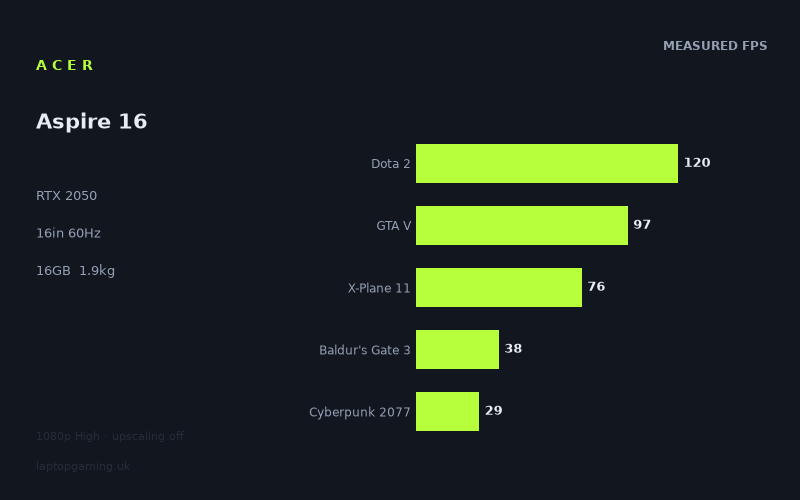
Frame rates
1920×1080, High preset, upscaling off.
Measured on this machine. Source: Notebookcheck, 2024-10-04.
Not scored: incomplete benchmark suite
Every scored laptop on this site is averaged over the same 5 games, and this one is short of Cyberpunk 2077, Baldur's Gate 3. A mean over 5 games is not comparable to a mean over 5, so we publish the figures we have and leave the score blank rather than rank it against machines tested on a different set. The numbers below are real - the suite is just incomplete.
How these numbers were produced
Frame rates here are not measured by us, and we label how each one was arrived at. A figure marked measured comes from a published run on that exact machine. A figure marked representative is derived from the GPU and its power limit (TGP) and cross-referenced against published reviews - a sound estimate of what that configuration delivers, but not a measurement of that specific laptop. Unless stated otherwise, numbers are 1920x1080, High preset, upscaling off. Where a laptop ships in several power configurations we use the wattage of the exact SKU listed, because a 140W RTX 5070 and a 115W one are not the same product.
In use
The short version
The Acer Aspire 16 (A16-51GM-77G2) is a sensible laptop for someone who wants a fairly portable 16in machine that can also play a meaningful range of games, but it is not a substitute for a purpose-built gaming laptop with a stronger graphics chip. Its Core 7 150U processor, 16GB of memory, 1TB SSD and RTX 2050 give it a credible mixed-use specification, while the 1.866kg weight is notably less burdensome than many large gaming-focused systems.
The important qualification is performance ambition. Notebookcheck’s benchmark data shows that the Aspire 16 is good at lighter and older games at 1920x1080 on the High preset with upscaling switched off. Dota 2 reaches 120fps, GTA V manages 97fps, X-Plane 11 records 76fps and Strange Brigade reaches 72fps. Those are useful results for a laptop with a 60Hz display: in those games, the GPU has enough measured performance to supply at least as many frames as the panel can show, subject to the usual variation between scenes and settings.
The picture changes sharply with more demanding games. Final Fantasy XV is measured at 39fps, Baldur’s Gate 3 at 38fps and Cyberpunk 2077 at 29fps. That is the central fact about this machine. It is capable of gaming, rather than being a gaming-first laptop. The RTX 2050 can produce very playable results when the game is light enough, well suited to the hardware, or old enough for the GPU to stretch its legs. It is much less convincing when a game needs sustained graphics throughput at the stated High preset.
The five-game scoring-suite mean is 81fps, but that average should not be read as a universal expectation. It is lifted substantially by Dota 2 at 120fps and GTA V at 97fps. Those results matter because they describe real games people play, but they do not cancel out the 29fps result in Cyberpunk 2077. Anyone choosing the Aspire 16 should treat the game-by-game figures as the useful guide, not the headline mean.
This is therefore a better fit for a student, home worker or general user who wants one laptop for ordinary computing and selective gaming than for someone buying principally for new, graphically heavy releases. The 16in 1920x1200 IPS display, 16GB memory and 1TB SSD are all reasonable foundations for a general-purpose machine. The 60Hz refresh rate, however, makes clear that Acer’s priorities are not competitive high-refresh gaming. The measured results reinforce that reading: the Aspire 16 can exceed 60fps in several games, but it does not do so consistently across demanding titles.
There is no confirmed UK price for this exact configuration, so a price-led value judgement cannot be made. The missing price does not affect the benchmark data: the gaming suite is complete and the machine can be considered normally on frame-rate grounds. It does mean that prospective buyers should not treat this review as a declaration that it is cheap, expensive or good value without checking the actual UK listing for this exact A16-51GM-77G2 configuration.
The strongest case for the Aspire 16 is straightforward. Buy it if you value a 1.866kg 16in laptop, want a 1TB SSD and 16GB of memory, and mainly play games that look more like Dota 2, GTA V, X-Plane 11 and Strange Brigade than Cyberpunk 2077. It is also a defensible choice if you are content to manage settings in demanding games rather than expecting the stated High preset to be comfortable everywhere. Do not buy it on the assumption that the RTX 2050 label alone makes it equivalent to a dedicated gaming model. The benchmark spread shows exactly why that assumption would be costly.
Performance
What the measured figures say
Notebookcheck measured the Acer Aspire 16 at 1920x1080 using the High preset with upscaling off. That is an important, clean baseline. There is no hidden assistance from upscaling in these figures, and the results therefore show what the laptop can do in the tested games without leaning on that kind of image-reconstruction feature. They are also all at the same resolution and general quality target, making the spread between games more revealing than a single average would be.
- Dota 2: 120fps
- GTA V: 97fps
- X-Plane 11: 76fps
- Strange Brigade: 72fps
- Final Fantasy XV: 39fps
- Baldur’s Gate 3: 38fps
- Cyberpunk 2077: 29fps
The result in Dota 2 is the easiest to interpret. At 120fps, the Aspire 16 produces twice the frame rate of its 60Hz panel in the benchmark. That does not mean the built-in screen can display 120 distinct updates each second; it cannot, because its stated refresh rate is 60Hz. It does mean there is substantial measured performance headroom for this game at the benchmark settings. A buyer whose main interest is Dota 2 is not buying a machine that merely scrapes past a minimum threshold. The laptop’s result leaves room for the normal variation that comes with busy matches, changing scenes and personal settings choices, while still showing that this title is well within the Aspire 16’s reach.
GTA V at 97fps tells a similar, if slightly less emphatic, story. The measured result is still well above the panel’s refresh rate. On the supplied screen, the practical limit is 60Hz rather than the 97fps benchmark figure. That does not make the extra frames meaningless. It indicates that, at 1920x1080 High with no upscaling, the Aspire 16 has enough performance in this game that the screen, not the measured average frame rate, is the more obvious ceiling. For someone playing GTA V on the internal display, this is one of the Aspire 16’s reassuring results.
X-Plane 11 reaches 76fps. That is not as far above 60Hz as Dota 2 or GTA V, but it remains above the display’s stated refresh rate. The distinction matters. A result of 76fps suggests that the Aspire 16 is capable of feeding its own panel fully in the benchmark run, yet it offers less spare performance than the 120fps Dota 2 figure. That makes it sensible to view X-Plane 11 as a good match for the laptop under the measured conditions, rather than treating it as an unlimited-performance scenario. The figure is strong enough to be encouraging, but the margin is not vast.
Strange Brigade at 72fps sits in much the same category. It clears 60fps and therefore matches the panel’s refresh-rate target in the measured result. Again, it is not an enormous margin. The Aspire 16 is not generating a huge surplus of frames that makes the 60Hz screen seem obviously restrictive in every circumstance. Instead, this is a case where the internal display and the machine’s measured gaming capability are reasonably aligned. The game is playable at the stated settings according to the benchmark data, and the panel is not demanding more than the GPU can provide.
Those four results are why it would be wrong to dismiss the Aspire 16 as incapable of gaming. A machine that can record 120fps in Dota 2, 97fps in GTA V, 76fps in X-Plane 11 and 72fps in Strange Brigade has a real gaming role. It can cover a range of established games at a respectable quality setting without requiring upscaling in the test. That is valuable for a user who wants gaming as one part of a broader laptop brief.
It would be equally wrong, however, to stop the analysis there. Final Fantasy XV falls to 39fps, Baldur’s Gate 3 to 38fps and Cyberpunk 2077 to 29fps. These are not tiny differences around the same experience. They show a machine whose performance is highly title-dependent. The gap between 120fps in Dota 2 and 29fps in Cyberpunk 2077 is 91fps, but the more meaningful point is qualitative rather than numerical: the laptop moves from comfortably exceeding its panel’s refresh rate to falling well short of it.
Final Fantasy XV at 39fps is below the 60Hz display target. That does not automatically make the game unusable, and the figure should not be confused with a claim about every moment of gameplay. It does show that the stated High preset at 1920x1080 is too demanding for this laptop to maintain a 60fps-class result in Notebookcheck’s measurement. A buyer who regards 60fps as a requirement should not approach Final Fantasy XV on this machine expecting the benchmark configuration to deliver it. Settings management would be the realistic approach, but the fact sheet does not provide alternative-preset results, so there is no sourced basis for promising a particular outcome after adjustments.
Baldur’s Gate 3 at 38fps is very close to the Final Fantasy XV result. That similarity should not be turned into a claim that the two games behave identically, because the benchmark data only gives the published averages. What it does establish is that both lie in the same broad performance tier on the Aspire 16 under the stated conditions: below the panel’s refresh rate and far behind the machine’s results in the lighter games. For buyers who spend most of their gaming time in Baldur’s Gate 3, the result is not disastrous, but it is a warning against buying the Aspire 16 with an expectation of high-settings fluidity comparable to its Dota 2 or GTA V showing.
Cyberpunk 2077 is the decisive cautionary result at 29fps. It is the lowest figure in the supplied data, and it sits below half of the display’s 60Hz refresh rate. The Aspire 16 can run the game in the tested configuration, but the measurement does not support describing that configuration as a comfortable 60fps experience. This is where the distinction between “has a discrete GPU” and “is designed for demanding modern games at High settings” becomes unavoidable. The machine belongs in the first category, not the second.
The average is useful, but the spread matters more
The five-game scoring-suite mean is 81fps, calculated from Dota 2, GTA V, X-Plane 11, Strange Brigade and Final Fantasy XV. It is a useful comparative measure because it puts the Aspire 16 on the same basis as other machines with results from the same suite. But it is not the best way to decide whether this laptop suits a particular buyer.
An 81fps mean can sound like evidence of broad high-refresh gaming ability. The individual figures show otherwise. The Aspire 16 reaches or exceeds 60fps in four of the five scoring-suite games, but one of those results is 120fps and another is 97fps. Those high results pull the mean upwards. Final Fantasy XV at 39fps remains part of the same scoring suite, and it is a much more relevant number for somebody whose library includes visually demanding games.
The non-scoring figures reinforce the point. Baldur’s Gate 3 at 38fps closely resembles Final Fantasy XV rather than the faster four games. Cyberpunk 2077 at 29fps is lower again. The Aspire 16 is therefore not a laptop that delivers one predictable performance class across all games. It is a laptop with a wide spread between favourable workloads and difficult ones.
That spread is useful purchasing information. It says that game choice matters more here than it would on a substantially more powerful system. If your regular games are closer in demand to Dota 2 or GTA V, the RTX 2050 can look surprisingly capable in this chassis. If the games you care about resemble Cyberpunk 2077 in their demand at these settings, the same laptop becomes a compromise before any consideration of future games enters the discussion.
It also means that prospective owners should resist broad statements such as “it gets around 80fps”. The laptop does not get around 80fps in every game. It gets 120fps in Dota 2, 97fps in GTA V, 76fps in X-Plane 11, 72fps in Strange Brigade, 39fps in Final Fantasy XV, 38fps in Baldur’s Gate 3 and 29fps in Cyberpunk 2077. The reason to list the figures is not to overwhelm the reader with numbers; it is to avoid allowing a neat average to obscure the actual trade-off.
GPU power limits: what can and cannot be concluded
GPU power limits matter because the same named GPU can appear in different laptops with different performance characteristics. The relevant question is not merely whether a machine says RTX 2050, RTX 2060 or RTX 2080 on its specification sheet. The cooling design, processor pairing and GPU power configuration can all affect where a laptop lands in published benchmarks.
For this Acer Aspire 16, the fact sheet does not provide a GPU power limit. It would therefore be inaccurate to attach a wattage to this machine or to claim that its RTX 2050 is configured for a particular power class. The benchmark data is the reliable evidence: under Notebookcheck’s 1920x1080 High, upscaling-off test conditions, the Aspire 16 returns the listed figures. That is the performance buyers should use when judging the configuration, rather than assuming a result from the GPU name alone.
The available comparison with the Acer Aspire 17 illustrates why this discipline matters. The Aspire 17 also uses an RTX 2050, and its stated GPU power limit is 35W. The Aspire 16 averages 8fps ahead across five shared games. That is a meaningful advantage for the Aspire 16 in the published shared-game comparison, but it does not prove a specific explanation. The Aspire 16’s own power limit is not supplied, so the evidence does not permit a firm claim that power configuration alone caused the gap. It may reflect the total platform, the processor, cooling behaviour, memory configuration or other differences outside the facts provided.
What can safely be said is that the RTX 2050 badge does not determine a single performance result. Here, the Aspire 16 is ahead of another RTX 2050 laptop by an average of 8fps in the shared set. At the same time, it sits only a small distance behind two RTX 2060 rivals in shorter shared-game comparisons, while it is far behind an RTX 2080 system. The results make more sense when viewed as laptop implementations rather than as a simple hierarchy of GPU names.
This is especially important for buyers tempted to use the Aspire 16 as an inexpensive route into gaming. If a retailer presents the RTX 2050 as the headline feature, the sensible response is to ask which games it has been measured in and at what settings. Notebookcheck’s numbers answer that question here. They show a competent result in some games and a clear ceiling in others. They do not support treating the machine as a high-power gaming laptop simply because it has a discrete RTX GPU.
What settings expectations should look like
The supplied measurements are all High-preset results at 1920x1080 with upscaling off. For Dota 2, GTA V, X-Plane 11 and Strange Brigade, that is a favourable picture. The laptop is at or above 60fps in each case, so the test settings are sensible for the Aspire 16’s 60Hz screen. There is no need to invent a lower-preset result in order to make those games look viable; the published High-preset figures already do that.
For Final Fantasy XV, Baldur’s Gate 3 and Cyberpunk 2077, the same settings are much harder for the machine. The sensible conclusion is not that the laptop cannot run these games at all. It plainly recorded 39fps, 38fps and 29fps respectively. The more precise conclusion is that the supplied data does not support a 60fps expectation at 1920x1080 High with upscaling off. Buyers who are willing to trade image quality or use other settings may find an arrangement they prefer, but there are no alternative figures in the fact sheet and no promised frame rate should be inferred.
That distinction is particularly important because the Aspire 16’s screen is 1920x1200 rather than 1920x1080. The benchmark results were not recorded at the screen’s native 1920x1200 resolution. It would be wrong to state that the listed frame rates are what the machine will achieve at native resolution. The extra vertical pixels are a separate consideration, discussed below, but the immediate practical point is simple: the published figures are a 1080p guide, not a native-panel guarantee.
As a gaming machine, then, the Aspire 16 rewards a selective approach. Play the games it handles well at the tested settings and it can make good use of its discrete graphics. Buy it for the games where it measures below 60fps at those settings and the purchase becomes more conditional. The data supports confidence in lighter titles, moderation in mid-range demand, and caution in the heaviest game listed.
The screen
The Aspire 16 has a 16in IPS panel with a 1920x1200 resolution and a 60Hz refresh rate. The proportions are useful for a machine that is not solely aimed at gaming. A 1920x1200 display has more vertical pixels than the 1920x1080 benchmark resolution, which can be welcome for documents, browser windows and general work. The fact sheet does not provide brightness, colour coverage, response-time or contrast measurements, so no judgement should be made about those aspects of panel quality.
For gaming, the key limitation is the 60Hz refresh rate. This is not a high-refresh screen, so the Aspire 16 is not trying to deliver the display experience associated with faster gaming notebooks. That does not make it unsuitable for games. It simply changes what performance matters most.
In Dota 2, GTA V, X-Plane 11 and Strange Brigade, the measured results of 120fps, 97fps, 76fps and 72fps exceed 60fps. The screen can display up to 60 refreshes per second, so it cannot fully show the numerical peak represented by the 120fps and 97fps figures. In those games, the panel is the clearer constraint than GPU throughput under the benchmark conditions. A faster external display may be relevant to someone who specifically wants to pursue frame rates beyond 60fps, but the fact sheet does not provide information about the Aspire 16’s display outputs or external-display behaviour.
Final Fantasy XV at 39fps, Baldur’s Gate 3 at 38fps and Cyberpunk 2077 at 29fps are different. Here, the GPU is not reaching the screen’s 60Hz ceiling in the benchmark configuration. A 60Hz panel is not the reason those games sit below 60fps. The limitation shown by the figures is performance at the stated High preset and resolution.
The mismatch between the panel’s native 1920x1200 resolution and the 1920x1080 benchmark resolution deserves care. It is tempting to translate the published 1080p numbers directly into native-screen expectations, but that would go beyond the supplied evidence. The screen has a different native resolution from the test resolution, and Notebookcheck’s figures should be treated exactly as labelled: 1920x1080, High preset, upscaling off. This is especially relevant for the lower results. Cyberpunk 2077 at 29fps is already a warning at the benchmark resolution; there is no basis for presenting it as a native-resolution result.
The IPS panel type is a useful specification, but it should not be expanded into unsupported claims about image quality. The fact sheet confirms IPS and nothing more about its measured visual characteristics. Likewise, the 60Hz specification does not tell us whether the panel supports any particular synchronisation technology, so that should not be assumed.
Overall, the display suits the Aspire 16’s actual performance profile better than a high-refresh panel would. There is no evidence that the laptop can sustain very high frame rates across demanding games, so a 60Hz screen is not wildly out of step with the GPU. It does leave Dota 2 and GTA V owners with performance that the internal panel cannot show in full, but those users are at least getting the benefit of strong headroom in the benchmark data. For the heavier games, the screen is not the issue; the measured graphics performance is.
Build, size and portability
The only supplied physical measurement is the Aspire 16’s 1.866kg weight. That is the number that should shape expectations about portability. It is not an ultra-light machine, but it is also not presented here as an exceptionally heavy desktop-replacement system. For a 16in laptop with discrete graphics, 16GB of memory and a 1TB SSD, 1.866kg suggests a machine that can reasonably move between home, work, study and occasional travel rather than one that should remain permanently on a desk.
Weight is only one part of portability, and the fact sheet does not provide dimensions, charger weight, battery-life figures or charging information. It would therefore be misleading to claim that it fits a particular bag, lasts a particular working day away from a socket, or is convenient for a specific commute. Those are meaningful buying questions, but they cannot be answered from the available data.
What the 1.866kg figure does establish is that the Aspire 16 occupies a different practical niche from a large, heavyweight gaming machine such as the MSI GT76 Titan DT in the comparison list. The fact sheet does not give the MSI’s weight, so there is no basis for a numerical physical comparison. Still, the Aspire 16’s own specification and 60Hz display indicate a machine intended to balance general laptop duties with modest discrete-GPU gaming rather than to pursue the most extreme gaming hardware configuration.
That balance is one of the Aspire 16’s main attractions. A Core 7 150U processor, 16GB memory and 1TB SSD make it a more rounded proposition than a gaming-only reading of the RTX 2050 would suggest. The storage capacity is generous enough on paper for a mixed collection of applications, files and games, while 16GB of memory avoids the immediately restrictive specification sometimes seen in lower-cost systems. The fact sheet does not provide memory speed, SSD benchmark results, upgrade access or internal layout, so those details should not be assumed.
There is also no published information here about chassis materials, keyboard feel, trackpad quality, port selection, webcam, speakers, fan noise or temperatures. Those omissions matter. A laptop can have sensible specifications and published frame rates while still differing greatly from rivals in everyday ergonomics. The right conclusion is not to imagine either a premium build or a cheap-feeling one. It is to recognise that the supplied data supports a performance and portability assessment, not a hands-on quality judgement.
For buyers whose laptop will spend most of its time on a desk but occasionally travel, 1.866kg is likely to be more appealing than a much larger gaming-first design. For buyers who carry a laptop all day, the number is still substantial enough that dimensions and charger weight should be checked before purchase. For buyers who never move their system, the Aspire 16’s portability advantage has less value, and a more gaming-focused alternative may make more sense if it offers stronger measured frame rates.
How it compares
The comparison set is useful because it includes neither only the nearest rival nor only a dramatic flagship comparison. It places the Aspire 16 against another RTX 2050 machine, two RTX 2060 systems and an RTX 2080 system. The shared-game averages are not all based on the same number of games, so they should be read carefully rather than treated as one universal league table.
Against the Acer Aspire 17 with RTX 2050 at 35W
The closest comparison is the Acer Aspire 17, another machine with an RTX 2050. The Aspire 17’s GPU is specified at 35W, while no GPU power limit is supplied for the Aspire 16. Across five shared games, the Aspire 16 averages 8fps ahead.
An 8fps shared-game advantage is meaningful in this part of the market. It suggests that the Aspire 16 is not merely matching another RTX 2050 implementation; it is ahead in the available like-for-like comparison. The result is also a useful warning against assuming that two laptops with the same GPU name will deliver the same gaming experience.
However, the figure should not be oversold into a single-cause story. Because the Aspire 16’s GPU power limit is not given, it cannot be claimed that it runs above 35W, that it has a particular cooling advantage, or that wattage explains the entire result. The fair conclusion is narrower and stronger: on the measured shared-game evidence, this Aspire 16 is the faster of the two RTX 2050 Acers by an average of 8fps.
For someone choosing specifically between these two machines, other factors would still matter, including price, display details, physical dimensions and battery behaviour. None of those is available here for a complete side-by-side decision. On gaming performance alone, though, the Aspire 16 has the better published result.
Against the HP Omen 15-en0375ng with RTX 2060
The Aspire 16 averages 4fps behind the HP Omen 15-en0375ng across three shared games. At face value, this is a surprisingly small deficit given that the HP carries an RTX 2060 rather than an RTX 2050. It would be a mistake to present the result as proof that the two GPUs are generally equivalent. The comparison covers only three shared games, and laptop performance depends on the implementation as well as the label.
The near result also needs the context supplied with the rival data: at 1080p, lighter titles in the shared set can become CPU-bound, compressing genuine GPU gaps. In other words, when a game is limited more by the processor or another part of the system than by raw graphics throughput, a stronger GPU does not necessarily translate into a proportionally larger lead. A 4fps average gap in that situation is a real benchmark outcome, but it is not evidence that the Aspire 16 would match the Omen in every more demanding game.
For buyers, the practical takeaway is that the Aspire 16 is closer to the HP Omen in this limited shared sample than the GPU names alone might suggest. That is encouraging for the Acer. But the Aspire’s own low figures in Final Fantasy XV, Baldur’s Gate 3 and Cyberpunk 2077 remain the more relevant warning for demanding-game buyers. A small gap in a three-game shared comparison does not erase the Aspire 16’s title-by-title limitations.
Against the Acer Predator Triton 300 with RTX 2060
The Acer Predator Triton 300 is another RTX 2060 rival, and the Aspire 16 averages 5fps behind across three shared games. This is very close to the 4fps deficit against the HP Omen 15-en0375ng. The pattern is clear: in the available shared games, the Aspire 16 is competitive enough with these RTX 2060 laptops that the margin is small rather than overwhelming.
Again, the right reading is not that an RTX 2050 Aspire 16 has somehow invalidated the need for stronger graphics hardware. The shared set is short, and the stated CPU-bound behaviour in lighter 1080p titles can narrow a genuine GPU performance separation. It is entirely possible for a laptop to be close in lighter shared benchmarks while still struggling more in a demanding title. The Aspire 16’s 29fps Cyberpunk 2077 result is a useful reminder that its strengths are conditional.
Still, the 5fps gap is a good result for the Aspire 16 on the evidence available. It means a shopper should not automatically write it off just because another listing has an RTX 2060 badge. The actual shared-game data puts the Acer closer than that simple label comparison implies. If the buyer’s games resemble the lighter shared workloads, the Aspire 16 may be a more plausible option than the specification sheet first suggests. If the buyer wants stronger confidence in demanding games, the Aspire’s own individual results should carry more weight.
Against the MSI GT76 Titan DT with RTX 2080
The MSI GT76 Titan DT provides the opposite end of the comparison spread. Across five shared games, the Aspire 16 averages 70fps behind the RTX 2080-equipped MSI. This is not a marginal result, nor is it one that can be explained away by CPU-limited lighter titles. The gap is substantial and establishes that the Aspire 16 belongs in a very different performance class from this kind of high-end gaming machine.
This comparison is useful precisely because it prevents the small gaps to the RTX 2060 systems from being misunderstood. The Aspire 16 can be close to those machines in a limited, lighter shared set, yet it is nowhere near the GT76 Titan DT’s level across five shared games. There is no contradiction. Laptop gaming performance depends on the games being compared and on the hardware class involved. The Aspire 16 is capable for its role, but it is not designed to chase the performance available from an RTX 2080 gaming laptop.
For a buyer considering a powerful desktop-replacement-style system principally for demanding games, the MSI’s lead makes the Aspire 16 the wrong category of purchase. For someone who values a 1.866kg laptop and only needs selective gaming capability, the comparison mainly serves as a useful boundary: do not expect Aspire 16 portability with GT76-class frame rates.
Who it’s for
Buy the Aspire 16 if your gaming is selective
The Aspire 16 makes most sense for a buyer whose gaming library contains lighter, older or less graphically punishing games, and who also wants a conventional 16in laptop for general use. The measured results make Dota 2 a particularly good fit at 120fps. GTA V at 97fps is similarly strong. X-Plane 11 at 76fps and Strange Brigade at 72fps also fit the machine’s 60Hz panel well in the benchmark data.
That buyer is not necessarily a casual player. Someone can care deeply about Dota 2, GTA V or X-Plane 11 without needing a flagship gaming laptop. What matters is that their priority games align with the Aspire 16’s demonstrated strengths. In those titles, the laptop has enough measured performance to avoid making the 60Hz display feel like an unrealistic target.
The machine also suits someone who values a broader specification than the GPU alone. A 16in 1920x1200 IPS screen, Core 7 150U processor, 16GB memory and 1TB SSD form a coherent general-use package on paper. The 1.866kg weight helps the case for a laptop that moves around rather than living permanently beside a monitor. If gaming is important but not the only reason for buying, that combination is more persuasive than it would be in a heavier, more specialised gaming system.
It may also suit a buyer who is comfortable treating graphics settings as a trade-off rather than as a fixed entitlement. The High-preset, no-upscaling measurements are already good in several games, but they are not universally good. A user who understands that demanding titles may require a different settings approach can get more out of the laptop than someone expecting every new game to behave like GTA V.
Choose something else if demanding games are the priority
The Aspire 16 is not the right purchase for someone whose main goal is to play graphically heavy games at 60fps or more on high settings without compromise. Cyberpunk 2077 at 29fps is the clearest evidence. Final Fantasy XV at 39fps and Baldur’s Gate 3 at 38fps point in the same direction. These are measured results at 1920x1080 High with upscaling off, and none reaches the 60Hz screen’s refresh rate.
It is also a poor fit for the buyer who specifically wants a high-refresh gaming display. The panel is 60Hz. Dota 2 and GTA V both exceed that refresh rate in the benchmark, but the built-in screen cannot show more than 60 refreshes per second. If fast-refresh competitive play is the primary reason for buying a laptop, the Aspire 16’s display specification is a limitation even where its GPU produces high frame rates.
Buy something else if you want performance that is less dependent on the title. The Aspire 16’s results range from 120fps down to 29fps. That is not a criticism of the faster results; they are genuinely good. It is a warning that this laptop does not provide a consistent performance floor across the supplied games. A buyer who wants more certainty across a broad modern library should look for a machine with stronger published results in demanding titles, rather than relying on a favourable average.
It is also not the machine for someone shopping solely on GPU branding. The comparisons show why. The Aspire 16 is 8fps ahead of the RTX 2050 Aspire 17 across five shared games, only 4fps behind the RTX 2060 HP Omen across three shared games, and 5fps behind the RTX 2060 Predator Triton 300 across three shared games. Yet it is 70fps behind the RTX 2080 MSI GT76 Titan DT across five shared games. The badge helps establish a broad category, but the actual benchmark data tells the more useful story.
The buying decision
The Acer Aspire 16 is best understood as a portable all-round laptop with a discrete GPU that gives it credible gaming ability in the right games. Its measured performance is not a reason to call it a replacement for a dedicated high-end gaming notebook. It is a reason to take it seriously if the games you play are among those it handles well.
For Dota 2, GTA V, X-Plane 11 and Strange Brigade, Notebookcheck’s figures are encouraging and broadly well matched to the 60Hz panel. For Final Fantasy XV, Baldur’s Gate 3 and Cyberpunk 2077, they are a reason for restraint. The difference between those groups is too large to gloss over with the 81fps scoring-suite mean.
Before buying, confirm the exact UK configuration, including that it is the A16-51GM-77G2 with the stated Core 7 150U, RTX 2050, 16GB memory and 1TB SSD. Then judge it against the games you actually play, using the published 1920x1080 High-preset, upscaling-off results as the evidence. If those games look like the Aspire 16’s stronger results, it is a practical and comparatively portable option. If they look like its 39fps, 38fps and 29fps results, spend the budget on a laptop whose measured performance is stronger where it matters.