Review
MSI Katana GF66 review
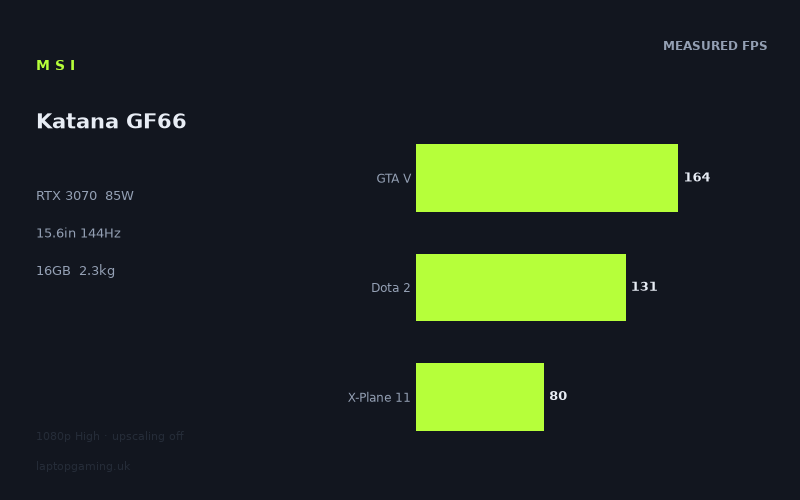
Frame rates
1920×1080, High preset, upscaling off.
Measured on this machine. Source: Notebookcheck, 2021-09-14.
Not scored: incomplete benchmark suite
Every scored laptop on this site is averaged over the same 5 games, and this one is short of Cyberpunk 2077, Baldur's Gate 3. A mean over 5 games is not comparable to a mean over 5, so we publish the figures we have and leave the score blank rather than rank it against machines tested on a different set. The numbers below are real - the suite is just incomplete.
How these numbers were produced
Frame rates here are not measured by us, and we label how each one was arrived at. A figure marked measured comes from a published run on that exact machine. A figure marked representative is derived from the GPU and its power limit (TGP) and cross-referenced against published reviews - a sound estimate of what that configuration delivers, but not a measurement of that specific laptop. Unless stated otherwise, numbers are 1920x1080, High preset, upscaling off. Where a laptop ships in several power configurations we use the wattage of the exact SKU listed, because a 140W RTX 5070 and a 115W one are not the same product.
In use
The short version
The MSI Katana GF66 (11UG-220) is a compelling budget-minded gaming laptop because its listed UK price is £539 while the published benchmark data shows that it can still deliver substantial 1920x1080 gaming performance. Its RTX 3070 is configured at an 85W GPU power limit rather than at the much higher limits seen in some larger machines, but Notebookcheck’s figures still show a laptop that is comfortably quick enough for a broad range of games at the screen’s native resolution and High preset.
The important qualification is that this is not a machine that turns every game into a 144fps experience simply because the specification says RTX 3070 and the display is 144Hz. The benchmark spread is wide. GTA V reaches 164fps, Strange Brigade reaches 163fps, F1 2021 reaches 161fps and F1 2020 reaches 158fps. Those are genuinely high results for the built-in 1920x1080, 144Hz panel. But Dota 2 reaches 131fps, The Witcher 3 reaches 122fps, Far Cry 5 reaches 113fps, Far Cry New Dawn reaches 103fps, X-Plane 11 reaches 80fps, Final Fantasy XV reaches 76fps and Cyberpunk 2077 1.0 reaches 62fps.
That range is exactly why this laptop needs to be judged as a package rather than as a simple RTX 3070 purchase. The lighter and more scalable games can make excellent use of the 144Hz display. Heavier games still run at useful frame rates at High settings, but they do not consistently match the panel’s refresh rate. Buyers expecting every demanding title to sit at 144fps without compromises should look elsewhere, or be prepared to reduce settings where a particular game matters more than image quality.
At the listed price, though, the Katana GF66’s limitations are easier to accept than they would be at a premium price. There is a 15.6in IPS screen, 16GB of memory, a 512GB SSD, a Core i7-11800H and a 90Wh battery. That is a sensible core specification for a gaming laptop of this type. The 2.253kg weight means it is portable enough to move around, but it should be regarded as a laptop to transport with intent rather than a machine that disappears into a bag.
The central buying case is straightforward. Buy the Katana GF66 if you want the strongest possible gaming performance for £539, primarily play at 1920x1080, and can accept that its 85W RTX 3070 does not perform like every higher-power RTX 3070-class gaming laptop. The measured figures show real strengths in GTA V, Strange Brigade and the F1 games, while the results in Cyberpunk 2077 1.0, Final Fantasy XV and X-Plane 11 show where High settings become more about a stable, playable experience than exploiting all 144Hz of the panel.
It is less suitable for someone buying specifically for demanding games at very high refresh rates, someone who needs proven battery-runtime figures, or someone who wants confidence about the display beyond its 1920x1080 resolution, 144Hz refresh rate and IPS panel type. There are no published battery-life, brightness, colour, response-time, temperature or noise figures in the information available here. Those omissions do not make the laptop poor in those areas, but they do mean they should not be assumed to be strengths.
Performance
What the benchmark data says
Notebookcheck measured the MSI Katana GF66 at 1920x1080 using the High preset with upscaling off. That matters because it gives the figures a clear meaning: these are native-resolution results without leaning on upscaling to raise the frame-rate figure. The mean across the five scoring-suite games is 123fps, but the average is only the starting point. The useful buying decision comes from looking at the individual games and understanding which results are likely to matter to the person buying the laptop.
The fastest measured result is GTA V at 164fps. Strange Brigade follows at 163fps, while F1 2021 reaches 161fps and F1 2020 reaches 158fps. In those games, the Katana GF66 is not merely producing acceptable performance. It is supplying frame rates above the display’s 144Hz refresh rate. That gives the panel real purpose: these are games where the machine has enough performance headroom at High settings for a high-refresh experience rather than merely a conventional 60fps target.
Those results also make the laptop particularly attractive to buyers whose regular games resemble the lighter end of this measured group. Racing games are represented by both F1 2021 and F1 2020, and both results are strong. Strange Brigade also sits in the same high-performance range. GTA V is similarly far above 144fps. A buyer whose library is concentrated around games with similar demands can reasonably expect the Katana’s screen refresh rate to be more than just an unused specification line.
Dota 2 reaches 131fps. That is a strong result in absolute terms, and it is close enough to the display’s 144Hz refresh rate that the experience should still be well suited to a fast panel. But it is not the same as reaching or exceeding 144fps in the measured run. Buyers who care about matching the panel’s refresh rate precisely should recognise the difference. The Katana GF66 is near the screen’s ceiling in Dota 2, not beyond it in the way it is in GTA V, Strange Brigade and the F1 titles.
The Witcher 3 reaches 122fps. That remains well above a conventional 60fps level and indicates that the laptop has substantial capacity for a visually demanding game at the stated 1920x1080 High settings. It is also a useful reminder that a frame rate below 144fps is not automatically disappointing. A 122fps result is still high-performance gaming. The point is simply that the Katana’s 144Hz panel is not fully saturated in every game, even before moving to the more demanding titles in the benchmark list.
Far Cry 5 reaches 113fps, while Far Cry New Dawn reaches 103fps. These are both clearly playable figures and both are above 100fps, but they show a different class of result from the 158fps to 164fps group. Here, the machine is delivering a high-frame-rate experience without reaching the display’s maximum refresh rate. For many buyers, that will be an excellent compromise: the games are still running comfortably at High settings and native resolution, but the panel’s 144Hz ceiling is no longer the level the GPU is consistently feeding.
X-Plane 11 reaches 80fps. Final Fantasy XV reaches 76fps. These results are still substantial, especially considering that the benchmark settings are 1920x1080 at High with upscaling off, but they establish the lower part of the Katana GF66’s measured performance range. A buyer who mainly plays these kinds of demanding games should not buy on the assumption that the laptop is a 144fps machine. It is better described as a machine that can run them at high settings with frame rates well above 60fps, while leaving a considerable gap to the screen’s maximum refresh rate.
Cyberpunk 2077 1.0 is the clearest example of that distinction, at 62fps. This is the result that prevents any simplistic conclusion that an RTX 3070 label guarantees high-refresh gaming at High settings in every title. Cyberpunk 2077 1.0 is measured above 60fps, which is useful and credible performance at the stated settings, but it is nowhere near the 144Hz panel limit. Buyers for whom this sort of demanding game is the priority should treat the display as having headroom for less demanding titles rather than as a refresh target that will be reached across the board.
The importance of the 85W GPU power limit
The Katana GF66 uses an RTX 3070 with an 85W GPU power limit. That figure is important because the GPU name alone does not tell the full performance story. Laptop GPUs with the same name can be configured with different power limits, and those configurations can produce meaningfully different results. The published figures for this Katana should therefore be treated as the performance of this specific 85W implementation, not as a promise of what every RTX 3070 laptop can achieve.
There is no need to speculate about performance the machine does not show. The benchmark data already makes the practical result clear. At 1920x1080 High settings, the 85W RTX 3070 is quick enough to exceed the 144Hz display refresh in GTA V, Strange Brigade, F1 2021 and F1 2020. It comes close in Dota 2, remains strongly above 100fps in The Witcher 3 and the two Far Cry games, and remains above 60fps in X-Plane 11, Final Fantasy XV and Cyberpunk 2077 1.0.
That is a useful performance profile, but it is not an unlimited one. The laptop’s GPU power limit is most relevant when the game becomes more demanding and the gap between a high-refresh target and the measured result widens. A result of 164fps in GTA V leaves room beyond the panel’s refresh rate. A result of 62fps in Cyberpunk 2077 1.0 does not. The same RTX 3070 branding covers both situations, but the game workload determines whether the 85W configuration feels abundant or merely sufficient.
For a buyer, the practical lesson is to match expectations to the games being played. If the priority is competitive, older, lighter or more scalable games, the Katana GF66’s results show that its 144Hz display can be put to effective use. If the priority is graphically demanding games at High settings, then the laptop is better viewed as a strong 1920x1080 machine rather than a guaranteed high-refresh machine. That distinction is more useful than treating the mean of 123fps as though it describes every game equally.
The power limit also makes this particular price especially notable. At £539, the Katana is not asking the buyer to pay a premium for an 85W RTX 3070 and then excuse the resulting compromises. Instead, it presents a clear value proposition: accept a lower-power RTX 3070 configuration, understand where that matters, and receive benchmark results that remain very competitive for the money. The figures are not perfect, but the relationship between the listed price and the measured gaming output is hard to ignore.
Why the frame-rate spread matters more than the average
The 123fps mean across the scoring-suite games is useful for comparing broad gaming performance, but it cannot describe the experience in each game. The measured range runs from 164fps in GTA V to 62fps in Cyberpunk 2077 1.0. That is a large spread, and it means the Katana GF66 should not be purchased on the assumption that a single average frame rate will translate directly into a particular game.
At the top end, GTA V, Strange Brigade, F1 2021 and F1 2020 all land above the display’s 144Hz refresh rate. These games make the strongest case for the Katana’s combination of 1920x1080 resolution and 144Hz panel. The GPU has enough throughput at the stated High settings to produce more frames than the panel can display each second. The machine therefore has performance reserve in these titles rather than just scraping past a lower baseline.
At the middle of the range, Dota 2, The Witcher 3, Far Cry 5 and Far Cry New Dawn show a different kind of strength. Their figures of 131fps, 122fps, 113fps and 103fps are all high enough to make a 144Hz panel worthwhile, even if they do not consistently reach its ceiling. These are the games where the Katana GF66 looks balanced rather than excessive: strong native-resolution High performance, smooth enough to benefit from a fast display, but not enough spare performance to treat settings choices as irrelevant.
At the lower end, X-Plane 11, Final Fantasy XV and Cyberpunk 2077 1.0 tell the buyer to be more selective. At 80fps, 76fps and 62fps respectively, the Katana is still providing useful results at High settings without upscaling. But these figures are fundamentally closer to a 60fps experience than to a 144fps experience. That is not a criticism of the laptop in isolation; it is an explanation of the kind of expectation the buyer should bring to more demanding games.
The difference also explains why the screen’s 144Hz refresh rate should be seen as an opportunity rather than a guarantee. A 144Hz panel does not require every game to run at 144fps to be worthwhile. The Katana’s results above 100fps in Dota 2, The Witcher 3, Far Cry 5 and Far Cry New Dawn still sit in a range where a fast panel is relevant. But buyers who are specifically shopping for a machine to maintain the panel’s maximum refresh in demanding titles need more than the RTX 3070 name and a 144Hz label. They need benchmark results in the games they actually play.
Performance for different game libraries
For players focused on GTA V, the Katana GF66 is an easy recommendation from the available data. Notebookcheck’s measured figure of 164fps is above the panel’s 144Hz refresh rate at 1920x1080 High settings with upscaling off. It is the kind of result that makes the laptop feel appropriately matched to its display. The screen is not holding back the GPU in that measured scenario, because the benchmark result is already beyond the panel’s stated refresh limit.
For racing-game players, the evidence is similarly persuasive. F1 2021 reaches 161fps and F1 2020 reaches 158fps. Both are above 144fps at the stated settings. That makes the Katana GF66 particularly appealing to buyers who care about fast motion and who want the hardware to make practical use of a 144Hz panel rather than merely include one. The figures do not establish performance in every racing game, but they do show a strong result in both measured F1 titles.
For players focused on games such as Dota 2, the Katana is still strong but less absolute. The measured 131fps is high, close to the display’s maximum refresh rate, and well ahead of the more demanding game results in the list. Yet it is still below 144fps. This is a minor distinction for someone whose priority is simply high frame rates, but it is worth making for someone who is specifically buying a 144Hz laptop and expects to see a benchmark figure that reaches the panel limit.
For players who spend more time in open-world action games, the evidence is mixed in a useful way. The Witcher 3 at 122fps, Far Cry 5 at 113fps and Far Cry New Dawn at 103fps show that the Katana GF66 can run these games strongly at 1920x1080 High settings. At the same time, their results make clear that the machine is not delivering the same high-refresh headroom seen in GTA V or the F1 games. The appropriate expectation is fluid performance with a clear benefit over 60fps, not a fixed 144fps target.
For buyers who prioritise heavier games, the data advises caution but not rejection. X-Plane 11 at 80fps and Final Fantasy XV at 76fps are respectable outcomes at the stated settings. Cyberpunk 2077 1.0 at 62fps is the most demanding result listed and is still above 60fps. A buyer who wants these games to run without immediately dropping below a 60fps-class result has evidence in the Katana’s favour. A buyer who wants them to run close to 144fps at High settings does not.
This is why the Katana’s value is strongest for someone who plays a mixture of games rather than only the toughest titles. In a mixed library, the lighter games can exploit the 144Hz panel, the middleweight games can run at high frame rates, and the heavier games can remain playable at High settings. The price then becomes the decisive factor. At £539, that spread is easier to accept than it would be in a machine priced as a no-compromise gaming laptop.
The screen
The Katana GF66 has a 15.6in IPS display with a 1920x1080 resolution and 144Hz refresh rate. On paper, that is an appropriate screen specification for the measured gaming performance. The resolution is exactly the benchmark resolution used by Notebookcheck, so there is no need to guess how the GPU performs at the panel’s native pixel count. The published results directly describe gaming at 1920x1080, High settings and with upscaling off.
The 144Hz refresh rate is meaningful in several of the measured games. GTA V at 164fps, Strange Brigade at 163fps, F1 2021 at 161fps and F1 2020 at 158fps all exceed the display’s refresh rate. In those titles, the screen is not an aspirational specification that the laptop cannot approach. The GPU can provide frame rates above 144fps under the benchmark conditions.
Dota 2 at 131fps is close to the 144Hz target, while The Witcher 3 at 122fps, Far Cry 5 at 113fps and Far Cry New Dawn at 103fps sit below it but remain clearly within a high-frame-rate range. These results support the choice of a 144Hz panel even when the machine is not reaching the full 144fps figure. A display with that refresh rate is not only useful at exactly 144fps; it also suits games running materially above 60fps.
The heavier results demonstrate the other side of the screen-and-GPU relationship. X-Plane 11 at 80fps, Final Fantasy XV at 76fps and Cyberpunk 2077 1.0 at 62fps do not come close to filling a 144Hz panel at the stated High settings. In these games, the screen offers potential headroom rather than performance the GPU is currently using. Lowering settings may change the result in individual games, but there are no measured figures here for alternative presets, so that should not be presented as a guaranteed route to a particular frame rate.
The IPS panel type is a positive baseline specification, but the available facts do not include brightness, colour coverage, contrast, response time, adaptive-sync support or any outdoor-use assessment. That means it is not possible to make a responsible claim that the screen is especially vivid, colour-accurate, fast-reacting or suitable for a particular kind of professional work. Buyers who need those qualities should seek panel measurements before committing.
For gaming buyers, the evidence supports a narrower and more useful conclusion. The 1920x1080 resolution is well matched to the RTX 3070 at 85W because the measured performance ranges from 62fps to 164fps on High settings without upscaling. Moving to a higher-resolution target would require different benchmark data, and none is available here. At the built-in resolution, however, the screen is a sensible fit: high enough refresh to reward the laptop in lighter games, without asking the GPU to drive more pixels than the published performance figures cover.
The display is therefore neither the Katana’s main reason to buy nor an obvious mismatch for the hardware. Its strongest role is as a practical 1920x1080 gaming screen. It lets the machine show its best results in GTA V, Strange Brigade and the F1 titles, while still being appropriate for the 103fps to 131fps range achieved in Dota 2, The Witcher 3 and the Far Cry games. Buyers should simply avoid assuming that 144Hz means 144fps in every game.
Build, size and portability
The MSI Katana GF66 weighs 2.253kg. That places it firmly in the category of a laptop that can be transported, but not one that should be chosen primarily for minimal carrying weight. It is realistic to take between home, work, study or a regular gaming location. It is less naturally suited to buyers who want their gaming laptop to feel inconspicuous or effortless to carry every day.
Weight is particularly relevant here because the Katana’s value comes from combining a Core i7-11800H and RTX 3070 with a £539 price. A buyer accepting 2.253kg is making a trade: this is a machine built around gaming performance first, with portability as a practical secondary consideration. That does not make it unsuitable for travel. It means the buyer should be honest about whether the laptop will mostly sit on a desk, move occasionally, or be carried frequently.
No dimensions are available in the specification provided here, so there is no basis for claiming that the Katana GF66 is especially slim, compact or easy to fit into a particular bag. The same applies to the charger, which is not described. The weight is the reliable portability figure available, and 2.253kg is enough to indicate that this is not an ultralight machine.
The 15.6in display gives the laptop a conventional gaming-laptop screen size rather than a compact small-screen format. Combined with the 2.253kg weight, it suggests a machine best used as a transportable desktop replacement: capable of moving where needed, but likely to spend much of its time on a desk or table. That reading fits the hardware too. The RTX 3070, Core i7-11800H, 16GB of memory and 512GB SSD are a gaming-focused specification, not a configuration aimed solely at light office work.
The 90Wh battery is a meaningful capacity figure, but battery capacity is not battery life. There are no published runtime measurements in the supplied information, so it would be wrong to turn 90Wh into a claim about browsing, video playback, work use or gaming away from mains power. Gaming performance figures are also normally most relevant when a gaming laptop is operating in the conditions used for those benchmarks; there are no battery-powered frame-rate figures here.
Buyers who mainly use the Katana GF66 near a mains socket should focus on its gaming performance and price rather than trying to infer runtime from the battery capacity alone. Buyers who need long unplugged use should not make a purchase decision until they have battery-life measurements from a relevant source. The presence of a 90Wh battery is useful information, but it is not a substitute for an actual endurance result.
There are also no measured temperature or noise figures in the available data. That means the review cannot responsibly describe the Katana GF66 as cool, hot, quiet or loud. This is especially important with an 85W RTX 3070 configuration, because buyers may reasonably want to know how the machine behaves under sustained gaming load. The published benchmark data establishes performance, but not acoustic or thermal character.
How it compares
Against the MSI Prestige 15 with RTX 3050 Ti
Against the MSI Prestige 15 with an RTX 3050 Ti at 105W, the Katana GF66 averages 59fps ahead across four shared games. That is a substantial performance advantage, and it is the largest positive gap among the listed comparisons. It shows that the Katana’s 85W RTX 3070 is not held back to the point where it loses its class advantage over a laptop using an RTX 3050 Ti, even where that rival has a 105W GPU power limit.
The result matters because it reinforces the argument for the Katana as a gaming-first purchase. A 59fps shared-game lead is large enough to change what sort of display refresh rates and settings expectations are realistic in many games. The Katana’s individual results already show performance above 144fps in GTA V, Strange Brigade, F1 2021 and F1 2020, while the lower end remains above 60fps in Cyberpunk 2077 1.0. The comparison with the Prestige 15 supports the conclusion that the Katana is the substantially stronger option where gaming frame rate is the priority.
There is no confirmed UK price for the Prestige 15 in the supplied comparison data. That prevents a direct value judgement between the two machines based on price. It is possible to say that the Katana is listed at £539 and is substantially faster across the shared games. It is not possible to say whether it is cheaper or more expensive than that rival, or to calculate how much extra performance a buyer receives per pound.
Against the Schenker XMG Core 15 with RTX 3060
The comparison with the Schenker XMG Core 15 (M22) is more interesting because the shared-game average is +0fps across five shared games. The Schenker has an RTX 3060 at 140W, while the Katana has an RTX 3070 at 85W. On paper, that pairing might encourage assumptions in either direction: the Katana has the higher-numbered GPU, while the Schenker has the higher GPU power limit. The shared benchmark result says that, across the games compared, neither machine establishes a meaningful average lead.
A near-zero result is not a typo and should not be dismissed. At 1920x1080, lighter titles in the shared set can be CPU-bound, which compresses genuine GPU differences. In other words, when the game is not limited primarily by GPU throughput, a higher-power GPU configuration does not necessarily produce a proportionately higher frame rate. That is why the shared-game outcome can be level even when the GPUs and their power limits differ.
This does not prove that the Katana GF66 and the XMG Core 15 will perform identically in every game or at every setting. It only establishes that the shared benchmark set produces a level average. Buyers should be careful not to turn that result into a blanket claim that an 85W RTX 3070 and a 140W RTX 3060 are interchangeable. The individual games, settings, resolution and workload remain important.
There is no confirmed UK price for the XMG Core 15 in the supplied data. That means the Katana’s £539 price cannot be directly translated into a value win over the Schenker. What can be said is that the Katana delivers a level shared-game average against it while carrying a particularly low listed UK price. If the Schenker were available at a similar price, the choice would need to turn on factors not provided here. If it were materially more expensive, the Katana’s case would become stronger, but that is not a comparison the facts allow.
Against the Gigabyte A7 X1 with RTX 3070
The Gigabyte A7 X1 is another close comparison, and again the shared-game outcome is +0fps for the Katana GF66 across four shared games. Both machines use an RTX 3070, but the comparison should still be read carefully. The result does not say that every RTX 3070 laptop performs the same in every title. It says that in the available shared-game data, neither machine takes a measurable average advantage.
This is useful because it puts the Katana’s 85W RTX 3070 result in context. The 85W limit should not automatically lead a buyer to assume that the laptop is uncompetitive against every other RTX 3070 machine. In the shared games against the Gigabyte A7 X1, the average difference is effectively absent. As with the Schenker comparison, 1920x1080 lighter titles can be CPU-bound, compressing GPU differences that may appear more clearly in other workloads.
The correct interpretation is not that GPU power limits never matter. The Katana’s own benchmark spread shows that demanding games can place much more pressure on the hardware than lighter games. Instead, the Gigabyte comparison shows why buyers should look at published shared-game figures rather than relying solely on the GPU badge or assuming that every nominal specification difference produces the same visible outcome in all games.
There is no confirmed UK price for the Gigabyte A7 X1. That limits the comparison to performance. On the performance evidence provided, the Katana is level across four shared games. On value, the only firm figure is the Katana’s £539 listing. The Gigabyte may be attractive for other reasons, but those reasons cannot be established from the available facts.
Against the MSI Raider GE77 HX with RTX 3080 Ti
The MSI Raider GE77 HX is the machine that beats the Katana GF66 by the largest listed margin. Across five shared games, the Katana averages 46fps behind the Raider. The Raider uses an RTX 3080 Ti at 175W, while the Katana uses an RTX 3070 at 85W. This is the comparison that most clearly shows the limits of treating all gaming laptops as broadly equivalent once they have a high-end GPU name.
A 46fps shared-game deficit is significant. It is large enough to alter the discussion from “can this laptop benefit from a 144Hz screen?” to “how consistently can it drive that kind of screen in demanding games?” The Katana’s own 62fps result in Cyberpunk 2077 1.0 and 76fps result in Final Fantasy XV show that it has limits in heavier titles. A substantially faster machine can create more room for high refresh rates, higher settings choices or tougher workloads, depending on the games involved.
However, the Raider comparison does not undermine the Katana’s purpose. It clarifies it. The Katana is a £539 laptop with an 85W RTX 3070. The Raider is a different class of hardware configuration, with an RTX 3080 Ti at 175W. Buyers should not expect the Katana to match it. The point of the Katana is not to compete with the most powerful listed rival on raw frame rate; it is to offer strong 1920x1080 High performance at a far more accessible listed price.
There is no confirmed UK price for the Raider GE77 HX in the facts provided, so a direct price-to-performance calculation is not possible. Still, the performance hierarchy is clear. Buyers who require the greatest frame-rate headroom should prefer the Raider-class result. Buyers who are constrained by a £539 budget should recognise that the Katana’s measured gaming output remains very strong for that price, even while it sits materially behind the 175W RTX 3080 Ti machine.
Who it’s for
The MSI Katana GF66 is for the buyer who wants a serious gaming laptop at £539 and is willing to make decisions based on measured performance rather than on a GPU name alone. The RTX 3070, Core i7-11800H, 16GB memory and 512GB SSD make it a clearly gaming-oriented specification, while the Notebookcheck figures show that the GPU remains capable of strong results at the screen’s native 1920x1080 resolution.
It is particularly well suited to someone whose regular games resemble GTA V, Strange Brigade, F1 2021 or F1 2020. Those measured results of 164fps, 163fps, 161fps and 158fps all exceed the panel’s 144Hz refresh rate. This is the clearest use case for the machine: games where the GPU can actually make the most of the built-in display rather than simply running adequately below its refresh limit.
It also suits someone with a mixed library. Dota 2 at 131fps, The Witcher 3 at 122fps, Far Cry 5 at 113fps and Far Cry New Dawn at 103fps show that the Katana can remain firmly in high-frame-rate territory without necessarily hitting 144fps. For a buyer who values fluid gaming more than a fixed refresh-rate target, this is a very usable performance band. The laptop is not limited to lightweight games; it simply becomes less likely to fill the whole 144Hz panel as game demands rise.
It can also suit a buyer who plays demanding games but is realistic about the target. X-Plane 11 at 80fps, Final Fantasy XV at 76fps and Cyberpunk 2077 1.0 at 62fps are not high-refresh results, but they are still meaningful native-resolution High-preset figures with upscaling off. Someone who wants playable performance in those titles at the stated settings, rather than expecting 144fps, can make a sensible case for the Katana at its listed price.
The laptop is less suitable for buyers whose main goal is to maximise performance in the most demanding games without compromise. Cyberpunk 2077 1.0 at 62fps makes that limitation plain. The Raider GE77 HX comparison makes it plainer still: the Katana averages 46fps behind the RTX 3080 Ti at 175W across five shared games. If sustained frame-rate headroom matters more than price, a more powerful GPU configuration is the appropriate direction.
It is also not the right choice for someone who treats a 144Hz panel as a promise that every game will run at 144fps at High settings. The measured data does not support that expectation. It supports 144fps-plus performance in several games, near-144fps performance in Dota 2, strong sub-144fps performance in The Witcher 3 and the Far Cry games, and much lower results in X-Plane 11, Final Fantasy XV and Cyberpunk 2077 1.0.
Buyers who need a very light daily-carry laptop should consider something else. At 2.253kg, the Katana GF66 can travel, but weight is not its strongest selling point. It makes more sense for someone who will use it primarily in fixed locations and transport it when necessary. Without dimensions, charger information or battery-runtime measurements, there is no evidence that it should be selected as an especially convenient travel machine.
Buyers who need verified display quality for colour-critical work should also look for more information before buying. The panel is IPS, 15.6in, 1920x1080 and 144Hz, which is enough to assess gaming resolution and refresh-rate fit. It is not enough to assess brightness, colour accuracy, contrast or response behaviour. The same caution applies to buyers who prioritise quiet operation, low temperatures or long battery life: those measurements are not available in the facts provided.
For everyone else, the Katana GF66 is a strong value-led gaming option. It does not need to be presented as a flawless machine to be attractive. The evidence shows exactly what it is: a 2.253kg, 15.6in 1920x1080 gaming laptop with a 144Hz IPS screen, a Core i7-11800H, 16GB of memory, a 512GB SSD and an 85W RTX 3070. At £539, it delivers frame rates ranging from 62fps in Cyberpunk 2077 1.0 to 164fps in GTA V under Notebookcheck’s stated 1920x1080 High, upscaling-off conditions.
That is enough to make it a recommendation for budget-conscious players who want substantial 1920x1080 gaming performance and understand the difference between high frame rates and guaranteed 144fps. The low price is the decisive advantage. The measured performance shows that the price is not being achieved by reducing the machine to entry-level gaming capability. The Katana GF66 remains a capable laptop, provided the buyer chooses it for what the benchmark data actually shows rather than for what the RTX 3070 name might suggest on its own.