Details
Product prices and availability are accurate as of the date/time indicated and are subject to change. Any price and availability information displayed on Amazon.co.uk at the time of purchase will apply to the purchase of this product.Review
Alienware m17 R4 review
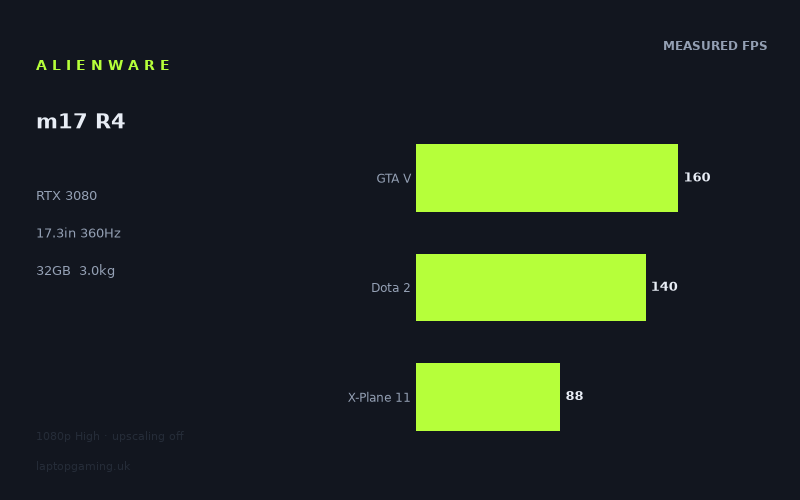
Frame rates
1920×1080, High preset, upscaling off.
Measured on this machine. Source: Notebookcheck, 2021-04-20.
Not scored: incomplete benchmark suite
Every scored laptop on this site is averaged over the same 5 games, and this one is short of Cyberpunk 2077, Baldur's Gate 3. A mean over 5 games is not comparable to a mean over 5, so we publish the figures we have and leave the score blank rather than rank it against machines tested on a different set. The numbers below are real - the suite is just incomplete.
How these numbers were produced
Frame rates here are not measured by us, and we label how each one was arrived at. A figure marked measured comes from a published run on that exact machine. A figure marked representative is derived from the GPU and its power limit (TGP) and cross-referenced against published reviews - a sound estimate of what that configuration delivers, but not a measurement of that specific laptop. Unless stated otherwise, numbers are 1920x1080, High preset, upscaling off. Where a laptop ships in several power configurations we use the wattage of the exact SKU listed, because a 140W RTX 5070 and a 115W one are not the same product.
In use
The short version
The Alienware m17 R4 is a large, high-refresh gaming laptop built around an RTX 3080, a Core i9-10980HK and a 17.3in 1920x1080 IPS display with a 360Hz refresh rate. The benchmark data shows that it is still extremely quick at its native resolution in a wide range of games, but the important qualification is that “quick” is not the same thing as “able to fill a 360Hz panel in every game”. None of the measured games reaches 360fps at 1920x1080 on the High preset with upscaling disabled. That does not make the screen pointless, but it does define the machine properly: this is a very fast 1080p laptop, not a machine that can be assumed to run every demanding game at 360fps.
Notebookcheck’s measured figures range from 88fps in X-Plane 11 to 240fps in Strange Brigade. That is a substantial spread, and it is the right way to understand this laptop. In lighter or better-scaling titles, it can produce frame rates well above 100fps and, in the best case here, well above 200fps. In demanding games, simulation-heavy games and modern graphically intensive releases, performance is lower but remains firmly playable at the tested settings. Cyberpunk 2077 1.0 at 92fps and Final Fantasy XV at 98fps are not poor results; they are reminders that a 360Hz specification should not be read as a promise of 360fps.
The most attractive use case is a buyer who specifically wants a 17.3in 1080p laptop with very high frame-rate potential, rather than a higher-resolution screen. Strange Brigade at 240fps, The Witcher 3 at 211fps, GTA V at 160fps and Dota 2 at 140fps demonstrate that the combination of RTX 3080 and 1080p resolution can deliver a very responsive-looking result in games that are not as punishing as Cyberpunk 2077 or X-Plane 11. The machine is especially coherent for someone who plays a mixture of older, lighter and competitive-leaning games alongside more visually demanding single-player titles, and who values frame rate more than increased pixel count.
There is no confirmed UK price for this exact configuration. That means a value judgement cannot be made responsibly, because price is central to whether this is a sensible purchase rather than merely a fast laptop. The benchmark suite is complete and the m17 R4 can be compared normally on frame rate, but without a confirmed UK price there is no basis for saying whether its performance is good value, poor value or somewhere between the two. Anyone considering one should therefore treat the performance evidence as useful, but keep the purchase decision open until the exact configuration and UK price are known.
The other major limitation is portability. At 3.0kg, this is not a machine that naturally fits the role of a lightweight everyday laptop. Its 17.3in display also tells you what kind of device it is: a large-format gaming system intended to prioritise screen space and performance over easy transport. The 86Wh battery capacity is stated, but no measured battery-life result is available here, so it would be wrong to predict how long it will last away from mains power. Buyers who need a laptop for regular commuting, frequent travel or long periods away from a socket should not fill in that gap with assumptions.
In short, the Alienware m17 R4 makes sense for a buyer who wants the performance shown in the benchmark data, wants a very high-refresh 1080p display, accepts a 3.0kg chassis and can judge the final decision against a real UK price. It makes less sense for somebody choosing primarily on panel resolution, battery life, low weight or the expectation that an RTX 3080 automatically means 360fps in demanding games.
Performance
The benchmark picture: very fast at 1080p, but not uniformly fast
All of the published game results are Notebookcheck measurements at 1920x1080 using the High preset with upscaling disabled. That matters. These are not figures produced with a lower rendering resolution, nor are they results enhanced by upscaling. They show what the Alienware m17 R4 can do at the native resolution of its display under a clearly defined test condition.
Across the five scoring-suite games, the mean is 145fps. That is a strong result at 1920x1080 High, but the mean must not be treated as the expected frame rate for every game. It sits between a very wide set of results: Strange Brigade at 240fps, GTA V at 160fps, Dota 2 at 140fps, Final Fantasy XV at 98fps and X-Plane 11 at 88fps. The average is useful as a broad indication of the machine’s speed, yet the individual figures are much more useful for deciding whether it suits a particular kind of player.
The fastest measured game is Strange Brigade at 240fps. This is the result that most clearly justifies the 360Hz display. It still does not reach the panel’s full refresh rate, but 240fps is substantially closer to 360Hz than the rest of the measured set. A buyer whose library includes games with a similar performance profile can expect the screen’s high refresh ceiling to be more relevant than it would be in the lower-performing results. That is not the same as saying that the laptop delivers 360fps, because the measured figure does not show that. It does show that the m17 R4 can reach a frame-rate range where a very high-refresh display is no longer merely decorative.
The Witcher 3 runs at 211fps in the published figures. Again, that is below 360fps but comfortably into high-frame-rate territory. It is also a useful counterweight to the assumption that only very light competitive games can make use of a fast 1080p panel. The Witcher 3 is not part of the scoring-suite mean, but its 211fps result reinforces the broader pattern seen in Strange Brigade: when the game suits the hardware and settings, the m17 R4 has considerable headroom at 1920x1080.
GTA V reaches 160fps. This is still above the 145fps scoring-suite mean and it gives the machine a strong result in a game that remains widely played. It is not close to 360fps, which is the important point for anyone buying the laptop primarily because of the panel specification. But it is high enough that the screen’s refresh rate is not mismatched with the hardware in the simple sense of being limited to ordinary frame-rate territory. The system is producing a distinctly high frame rate; it simply is not saturating the panel.
Dota 2 records 140fps. That is slightly below the five-game mean of 145fps, but it remains a high result in absolute terms. It also illustrates why buyers should be careful with expectations around the 360Hz display. A game can be a natural fit for a fast panel in principle, yet the tested figure still may not approach the full panel refresh. The relevant conclusion is not that the display is wasted, but that the practical benefit depends on the game, settings and workload rather than the headline refresh rate alone.
Far Cry 5 comes in at 126fps. This is below the scoring-suite mean, although it remains well above the 88fps and 92fps results at the lower end of the tested group. It is another indication that this RTX 3080 configuration is very capable at 1080p High, while also demonstrating that not every game will behave like Strange Brigade. Buyers who play a broad range of mainstream action games should expect variation of this kind rather than a single fixed level of performance.
Final Fantasy XV reaches 98fps. That result is important because it sits close to the 100fps mark without crossing it. It remains playable at the stated settings, but it is a long way from the 360Hz ceiling. Anyone looking at the m17 R4 for demanding games should use results such as this, rather than the 240fps Strange Brigade figure, to set expectations. The laptop has enough performance to run the game at the measured High setting without upscaling, but the display’s maximum refresh rate is not the performance level being achieved here.
Cyberpunk 2077 1.0 records 92fps. This is a particularly useful figure because it represents a demanding modern game at 1920x1080 High with upscaling disabled. The m17 R4 does not turn Cyberpunk 2077 into a 360fps experience, and the benchmark data gives no basis for pretending otherwise. At the same time, 92fps is a strong result for a demanding title under the stated conditions. The practical lesson is that the RTX 3080 is doing what a high-end 1080p laptop GPU should do: it can sustain a high frame rate in demanding workloads, but not an unlimited one.
X-Plane 11 is the slowest published result at 88fps. This is still close to 90fps, but it is the clearest warning against buying the machine solely for the screen’s refresh rate. Simulation-heavy workloads can place demands on a system that do not map neatly onto the behaviour seen in more straightforward graphics tests. The difference between 240fps in Strange Brigade and 88fps in X-Plane 11 is not a contradiction in the data. It is the data. The m17 R4’s performance is highly game-dependent, and a buyer who spends most of their time in simulations should give the X-Plane 11 result more weight than the result from a lighter shooter.
What the spread between 88fps and 240fps means
The range from 88fps to 240fps is the central performance story of the Alienware m17 R4. It is tempting to reduce a gaming laptop to a single average, especially when the machine carries an RTX 3080 badge. The published measurements show why that approach is incomplete. The m17 R4 is capable of extremely high frame rates, but it does not produce them in every engine, every genre or every workload.
At one end of the results, Strange Brigade at 240fps and The Witcher 3 at 211fps show that the machine can use the advantage of its 1080p display to push well beyond the frame rates associated with a conventional 60Hz screen. GTA V at 160fps and Dota 2 at 140fps continue that pattern. These are results that support the basic design choice of pairing a high-end GPU with a 1920x1080 display rather than a higher-resolution panel. Lower pixel count can allow more of the hardware’s potential to appear as frame rate.
At the other end, Final Fantasy XV at 98fps, Cyberpunk 2077 1.0 at 92fps and X-Plane 11 at 88fps show the limit of that advantage. The 1080p resolution helps, but it does not remove the demands of a difficult game. Nor does a 360Hz panel alter the frame rate produced by the benchmarked system. The refresh rate provides capacity for high frame rates; it is not itself a performance setting. That distinction is especially important for buyers moving from a 60Hz or 144Hz laptop who may see “360Hz” and infer that this is the rate every game will run at.
The five-game mean of 145fps is therefore best understood as evidence that this is a fast 1080p machine across a mixed suite, not as a target that every individual title will meet. GTA V exceeds it at 160fps. Dota 2 sits close at 140fps. Final Fantasy XV and X-Plane 11 fall well below it. The mean is not wrong; it is simply an average of different games with different demands.
This matters for buying advice. If a prospective owner mainly plays titles closer to Strange Brigade, The Witcher 3, GTA V or Dota 2 in their behaviour on this configuration, the m17 R4’s core proposition is convincing. The display can be fed with high frame rates and the 1080p resolution is working in favour of that outcome. If their regular games are closer to Cyberpunk 2077 1.0, Final Fantasy XV or X-Plane 11, the laptop remains capable, but the 360Hz specification should be treated as room for lighter games rather than the expected experience in every demanding title.
GPU power limits: what is known and what is not
The fact sheet identifies the GPU as an RTX 3080, but it does not provide a GPU power limit for this Alienware m17 R4 configuration. That absence matters because laptop GPU names alone do not tell the whole performance story. It would be misleading to assign a wattage to this model, or to assume that it matches another RTX 3080 laptop merely because both use the same GPU name.
The benchmark figures are therefore more useful than unsupported assumptions about power configuration. The m17 R4 delivers 240fps in Strange Brigade, 211fps in The Witcher 3, 160fps in GTA V, 140fps in Dota 2, 126fps in Far Cry 5, 98fps in Final Fantasy XV, 92fps in Cyberpunk 2077 1.0 and 88fps in X-Plane 11. Those are the actual published outcomes under the stated test conditions. They tell a prospective buyer what this particular machine achieved, whereas an unconfirmed power figure would only create false precision.
The comparison data reinforces the reason for caution. The Razer Blade Pro 17 2021 has an RTX 3080 at 100W, yet the m17 R4 averages an effectively identical result across five shared games, with a listed difference of -0fps. The Schenker XMG Neo 17 M22 uses an RTX 3080 Ti, yet it also averages +0fps against the Alienware across five shared games. Conversely, the MSI Raider GE77 HX with an RTX 3080 Ti at 175W is 24fps ahead across five shared games. GPU labels and even GPU generation do not create a simple straight line from product name to measured frame rate.
The correct reading is not that power limits do not matter. It is that the relevant power limit for the Alienware is not supplied here, and its effect should not be invented. The measured performance gives a clear practical answer: this machine is very fast at 1080p, can exceed 200fps in the best results provided, sits around 140fps to 160fps in some of the scoring-suite games, and lands below 100fps in several demanding results. That is the evidence available.
The screen
A 17.3in 1080p IPS panel built for frame rate
The Alienware m17 R4 has a 17.3in IPS display with a 1920x1080 resolution and a 360Hz refresh rate. This combination makes its priorities unusually clear. It is not trying to maximise resolution. Instead, it uses a 1080p panel to give the RTX 3080 a realistic opportunity to generate very high frame rates in suitable games.
For this hardware, 1920x1080 is a sensible performance-oriented resolution. The benchmark data shows why. Strange Brigade reaches 240fps, The Witcher 3 reaches 211fps, GTA V reaches 160fps and Dota 2 reaches 140fps. A higher-resolution display would change the trade-off, but no such comparison can be made from the supplied facts. What can be said is that this screen’s native resolution aligns with the laptop’s strongest measured results: it lets the system prioritise frame rate.
The IPS panel type is stated, but no measurements are provided for brightness, colour coverage, contrast, response time or any other image-quality characteristic. It would therefore be wrong to call the panel bright, colour-accurate, fast-responding or suitable for a particular colour-critical workflow. The available information supports a narrower conclusion: this is an IPS screen with a large 17.3in diagonal, 1080p resolution and an unusually high 360Hz refresh rate.
Can the RTX 3080 drive 360Hz?
Not in any of the measured games under the stated 1920x1080 High, upscaling-off conditions. The highest published result is 240fps in Strange Brigade. The next highest is 211fps in The Witcher 3. GTA V reaches 160fps, Dota 2 reaches 140fps and Far Cry 5 reaches 126fps. The remaining measured titles are below 100fps or close to it.
This needs to be stated plainly because 360Hz is a very specific headline specification. The m17 R4’s display can refresh at 360Hz, but the supplied benchmark data does not show 360fps in any of the games tested. A buyer should not interpret the panel as proof of 360fps gaming in general. That would be especially unrealistic in Final Fantasy XV at 98fps, Cyberpunk 2077 1.0 at 92fps and X-Plane 11 at 88fps.
That said, the screen is not only useful at exactly 360fps. The laptop produces 240fps in Strange Brigade and 211fps in The Witcher 3, which are both high enough to make the display’s frame-rate focus meaningful. GTA V at 160fps and Dota 2 at 140fps also show that the system is frequently operating well above basic 60fps territory. The panel has more refresh capacity than the benchmarked games demand, but that is different from saying the panel has no practical relevance.
The more important judgement is one of fit. A 360Hz 1080p screen is best matched to somebody who values high frame rates where they are available and accepts that demanding games will run far below the maximum refresh rate. It is not best matched to a buyer who wants the sharpness associated with more pixels, because this machine is explicitly a 1920x1080 design. Nor is it automatically best for someone who only plays the most demanding games, where the measured results sit from 88fps to 98fps.
Resolution versus refresh rate
The m17 R4 takes a clear side in the usual laptop screen trade-off. It provides 1920x1080 rather than a higher resolution, and it provides 360Hz rather than a more conventional refresh rate. The published performance makes that choice understandable. At 1080p High, the RTX 3080 can achieve 240fps in Strange Brigade and 211fps in The Witcher 3. These are the kinds of figures that would be less likely to define the experience if the laptop were trying to render more pixels instead.
There is no need to pretend that this approach is universal. A buyer who treats a laptop screen as equally important for non-gaming work may have different priorities, but no productivity display measurements are supplied here. The defensible conclusion is simply that the m17 R4’s panel specification is aggressively performance-led. It is designed around 1080p and high refresh, and its best benchmark results support that design.
Build, size and portability
Large-screen gaming laptop, not a lightweight all-rounder
The m17 R4 weighs 3.0kg and has a 17.3in display. Those two facts are enough to place it clearly in the large gaming-laptop category. This is not a compact machine defined by low mass. It is a system built around a large screen and high-end gaming hardware, and the 3.0kg weight should be treated as part of the purchase decision rather than a minor specification-table detail.
There are no dimensions in the fact sheet, so no claim can be made about the laptop’s footprint, thickness or how easily it fits into a particular bag. There is also no information here about chassis materials, keyboard layout, trackpad quality, port selection, speakers, webcam, cooling-system design, fan noise or surface temperatures. Those omissions should not be papered over with generic gaming-laptop language. The published data supports a conclusion about mass and screen size, not a complete physical-quality assessment.
A 3.0kg laptop is most naturally considered a moveable desktop-style system rather than a light machine for constant transport. That does not mean it cannot be taken elsewhere. It means that a buyer choosing between this and a lighter laptop should recognise that the Alienware’s performance and 17.3in 360Hz display come in a package with substantial mass. Whether that is acceptable depends on how often the laptop will be moved, not on whether 3.0kg sounds manageable in isolation.
Battery capacity without a battery-life claim
The machine has an 86Wh battery. That is a capacity figure, not a measured runtime. No battery-life result is provided, whether for gaming, video playback, web use or any other task. It would therefore be wrong to claim that the m17 R4 lasts all day, has poor endurance, needs charging after a particular period or delivers a certain amount of gaming time.
This is particularly important because the laptop combines an RTX 3080, a Core i9-10980HK, a 17.3in display and a 360Hz refresh rate. Those specifications may lead readers to make assumptions about power use, but assumptions are not the same as evidence. The only firm battery facts available are that the battery is rated at 86Wh and that no runtime measurement is supplied.
For a buyer who expects to use the m17 R4 mainly connected to mains power, the missing battery data may be less important than the gaming results. For someone who needs predictable unplugged use, it is a material gap. That buyer should seek a published battery test for the exact machine rather than infer runtime from capacity alone.
How it compares
Against the MSI Prestige 15 with RTX 3050 Ti at 105W
The widest performance gap in the supplied comparison set is against the MSI Prestige 15, which uses an RTX 3050 Ti at 105W. Across four shared games, the Alienware m17 R4 averages 68fps more. That is a substantial advantage and the clearest evidence in the comparison list that the m17 R4 belongs in a much higher performance class than a laptop based around an RTX 3050 Ti.
The comparison is useful precisely because it is not a narrow same-GPU comparison. It shows what the RTX 3080-equipped Alienware can offer over a lower-tier GPU in shared titles: a large measured frame-rate lead. The m17 R4’s own results, including 240fps in Strange Brigade, 160fps in GTA V and 140fps in Dota 2, already establish its high-frame-rate credentials. The 68fps shared-game advantage over the Prestige 15 makes that difference more concrete.
Neither the Alienware nor the MSI Prestige 15 has a confirmed UK price in the supplied information. That means this comparison is about performance only. It cannot establish which is the better value purchase. A 68fps lead is important, but value depends on what each exact configuration costs, and those prices are not confirmed here.
Against the Schenker XMG Neo 17 M22 with RTX 3080 Ti
The Schenker XMG Neo 17 M22 has an RTX 3080 Ti, yet the Alienware m17 R4 averages +0fps across five shared games. In practical terms, the supplied shared-game data shows no average frame-rate separation between the two machines.
This is one of the most instructive results in the entire comparison group. It is easy to expect a laptop with an RTX 3080 Ti to be automatically ahead of a laptop with an RTX 3080. The shared-game figures do not support that expectation here. Across the five games held in common, the m17 R4 and the Schenker are effectively level.
A near-zero difference is not an error to be ignored. At 1080p, lighter titles in a shared game set can become CPU-bound and compress genuine GPU differences. In that situation, a stronger GPU does not necessarily translate into a proportionally higher frame rate, because the limit can shift elsewhere in the system. The supplied comparison guidance explicitly identifies this as the reason a near-zero result can be genuine rather than meaningless.
That does not prove that the m17 R4 is equal to the Schenker in every game, every setting or every future release. It proves something narrower and more useful: in the five shared games used for this comparison, their average measured frame rates are effectively identical. Buyers deciding between them should not use the RTX 3080 Ti label alone as evidence that the Schenker will necessarily be faster in their games.
No confirmed UK price is given for either machine. There is therefore no basis for a value comparison. Performance parity across the shared set is clear; which machine is the more sensible purchase cannot be established without confirmed pricing and additional specification details.
Against the Razer Blade Pro 17 2021 with RTX 3080 at 100W
The Razer Blade Pro 17 2021, in its QHD Touch configuration, uses an RTX 3080 at 100W and is listed at £4,500. Across five shared games, the Alienware m17 R4 averages -0fps against it. That is, for practical purposes, an even result.
This is another case where the benchmark data is more informative than assumptions drawn from product positioning. The Alienware has a 17.3in 1920x1080 360Hz IPS display, while the named Razer configuration is identified as QHD Touch. The shared-game comparison nevertheless produces no average frame-rate gap. The available figures do not permit an explanation based on display resolution because the comparison is explicitly based on games both machines hold, but they do make one conclusion unavoidable: the m17 R4 does not show a shared-game performance disadvantage despite the Razer’s RTX 3080 at 100W.
As with the Schenker comparison, the near-zero difference should be taken seriously rather than dismissed because it looks surprising. At 1080p, lighter titles in the shared set can be CPU-bound, compressing differences that might otherwise be expected from GPU configuration or wider platform differences. A product label, a GPU tier and a power figure do not guarantee a visible separation in every shared game.
The Razer’s listed price is £4,500, but the Alienware’s UK price is not confirmed. That makes it impossible to say which delivers better value. It would be irresponsible to imply that the m17 R4 is cheaper, more expensive or similarly priced. The only secure price statement is that the Razer is listed at £4,500 and the exact Alienware configuration has no confirmed UK price in the supplied information.
Against the MSI Raider GE77 HX with RTX 3080 Ti at 175W
The MSI Raider GE77 HX is the machine in this comparison group that most clearly outperforms the Alienware. It uses an RTX 3080 Ti at 175W and averages 24fps more than the m17 R4 across five shared games.
A 24fps shared-game deficit is meaningful. It is not a tiny near-zero result that can be explained away as a compressed difference in lighter 1080p titles. The Raider is ahead in the published average, and the m17 R4 buyer should treat it as the stronger of the two on this specific shared-game measure.
That does not make the Alienware slow. The m17 R4 still records a 145fps mean across its five scoring-suite games, reaches 240fps in Strange Brigade and exceeds 200fps in The Witcher 3. The right conclusion is comparative rather than absolute: the Alienware is fast, but the Raider is faster by 24fps across the five shared games listed.
No confirmed UK price is provided for the Raider. Because the Alienware also has no confirmed UK price, the comparison cannot move beyond performance. A buyer who values maximum frame rate should recognise the Raider’s lead. A buyer who cares about the total purchase decision will still need confirmed prices and more complete information before deciding whether that lead is worth paying for.
What the rival set says overall
The four comparison machines create a useful spread. Against the MSI Prestige 15 with RTX 3050 Ti at 105W, the m17 R4 has a large 68fps advantage across four shared games. Against the Schenker XMG Neo 17 M22 with RTX 3080 Ti, it is effectively level across five shared games. Against the Razer Blade Pro 17 2021 with RTX 3080 at 100W, it is also effectively level across five shared games. Against the MSI Raider GE77 HX with RTX 3080 Ti at 175W, it trails by 24fps across five shared games.
That places the Alienware in a credible position for its generation. It is decisively ahead of a lower-tier RTX 3050 Ti machine, it can match the shared-game averages of two ostensibly stronger or differently configured high-end rivals, and it is beaten by a more powerful RTX 3080 Ti Raider configuration. This is a much more useful picture than simply saying “RTX 3080 performance”.
It also demonstrates why prospective buyers should not over-read component names. The m17 R4 matches an RTX 3080 Ti system in one shared-game comparison, matches an RTX 3080 at 100W in another, and loses to an RTX 3080 Ti at 175W in the final one. The benchmark data, not the badge alone, should drive the decision.
Who it's for
Buy it if high-frame-rate 1080p gaming is the priority
The Alienware m17 R4 is for the buyer who wants a large 17.3in gaming laptop focused on 1920x1080 performance and a very high-refresh screen. The strongest fit is someone whose gaming priorities align with the benchmark results: 240fps in Strange Brigade, 211fps in The Witcher 3, 160fps in GTA V and 140fps in Dota 2. These results show the kind of workload where the m17 R4’s combination of RTX 3080 and 360Hz display is most coherent.
It is also a sensible choice for a buyer who understands that a 360Hz screen is capacity rather than a universal frame-rate guarantee. The laptop is fast enough to make high refresh relevant, particularly in its highest measured results, but it does not produce 360fps in the tested games. A buyer who accepts that distinction can appreciate the screen for what it is: a high-ceiling 1080p panel paired with hardware capable of very high frame rates in suitable titles.
The machine also suits someone who keeps the laptop primarily in one place or does not mind a 3.0kg system. The 17.3in display and 3.0kg weight point towards a large gaming-laptop role. For that user, the screen size and performance focus may matter more than low mass.
Finally, it suits an informed buyer who is willing to wait for or verify a confirmed UK price. The performance case is established by Notebookcheck’s figures. The value case is not established because the price of the exact configuration is not confirmed. That is not a defect in the benchmark data; it is simply the boundary of what can be concluded responsibly.
Buy something else if portability matters more than screen size
Buy something else if a 3.0kg laptop conflicts with how you plan to use it. There is no need to make a vague claim that the m17 R4 is impossible to move; it is a laptop. But 3.0kg is a meaningful amount of mass, and the 17.3in screen confirms that this is not a small-format design. If regular transport is central to the purchase, a lighter machine is likely to be a more natural fit.
Also look elsewhere if you need confirmed battery-life evidence before buying. The 86Wh capacity is known, but no measured runtime is available. A buyer who works or plays away from mains power for extended periods should not choose based on battery capacity alone.
Buy something else if the main goal is maximum frame rate in demanding games
The m17 R4 is fast, but it is not the fastest system in the supplied comparison set. The MSI Raider GE77 HX is 24fps ahead across five shared games. If maximum shared-game frame rate is the overriding priority, that published lead matters.
The same caution applies to expectations in demanding games. Cyberpunk 2077 1.0 at 92fps, Final Fantasy XV at 98fps and X-Plane 11 at 88fps are respectable results, but they are nowhere near the 360Hz panel ceiling. A buyer who plays mostly games with a similar performance profile should choose the m17 R4 because those frame rates are acceptable to them, not because the display specification suggests every game will run at 360fps.
Buy something else if higher resolution is more important than high refresh
The m17 R4 is explicitly a 1920x1080 machine. That is a strength for frame-rate-focused gaming, as the 240fps, 211fps and 160fps results show. It is not the right specification for somebody whose first priority is a higher-resolution panel. The Razer Blade Pro 17 2021 listed in the comparison set is identified as QHD Touch, but no broader screen-quality comparison can be made from the available facts. The straightforward point is that the Alienware’s own panel is 1080p, and buyers should choose it because they want 1080p high-refresh gaming rather than despite it.
The final judgement
The Alienware m17 R4 remains a powerful 1080p gaming laptop on the evidence available. Notebookcheck’s measurements show a machine that can hit 240fps in Strange Brigade, 211fps in The Witcher 3, 160fps in GTA V and 140fps in Dota 2, while still holding 98fps in Final Fantasy XV, 92fps in Cyberpunk 2077 1.0 and 88fps in X-Plane 11 at the stated settings. That is a strong and credible performance spread for an RTX 3080 laptop.
Its limitations are equally clear. The 360Hz display is not filled by any of the measured games. The laptop weighs 3.0kg. The 86Wh battery has no accompanying battery-life measurement. The exact UK price is not confirmed, so value cannot be judged. And although it can match the shared-game averages of the Schenker XMG Neo 17 M22 and Razer Blade Pro 17 2021, it trails the MSI Raider GE77 HX by 24fps across five shared games.
For the right buyer, those limitations are manageable because the core proposition is strong: a large 17.3in IPS laptop with a 360Hz 1080p screen and very high measured frame rates in suitable games. For the wrong buyer, particularly one who wants low weight, confirmed battery endurance, higher resolution or an evidence-based value judgement before purchase, the missing or unfavourable parts of the data should carry just as much weight as the impressive headline frame rates.