Review
MSI Prestige 15 review
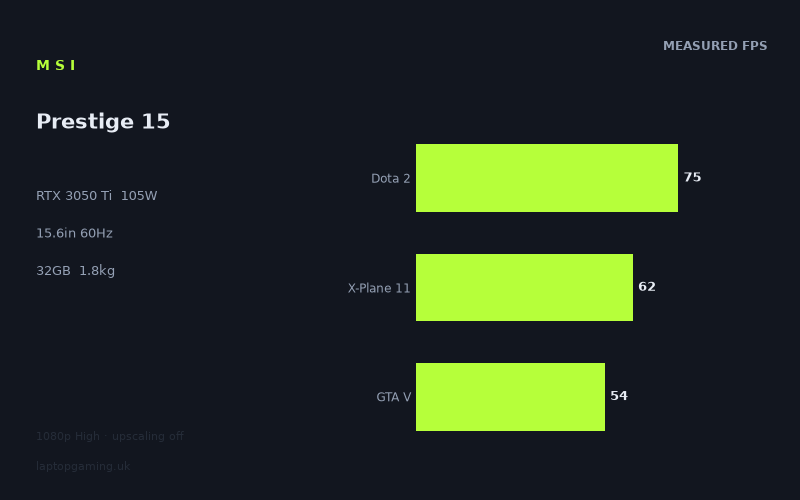
Frame rates
1920×1080, High preset, upscaling off.
Measured on this machine. Source: Notebookcheck, 2022-12-03.
Not scored: incomplete benchmark suite
Every scored laptop on this site is averaged over the same 5 games, and this one is short of Cyberpunk 2077, Baldur's Gate 3. A mean over 4 games is not comparable to a mean over 5, so we publish the figures we have and leave the score blank rather than rank it against machines tested on a different set. The numbers below are real - the suite is just incomplete.
How these numbers were produced
Frame rates here are not measured by us, and we label how each one was arrived at. A figure marked measured comes from a published run on that exact machine. A figure marked representative is derived from the GPU and its power limit (TGP) and cross-referenced against published reviews - a sound estimate of what that configuration delivers, but not a measurement of that specific laptop. Unless stated otherwise, numbers are 1920x1080, High preset, upscaling off. Where a laptop ships in several power configurations we use the wattage of the exact SKU listed, because a 140W RTX 5070 and a 115W one are not the same product.
In use
The short version
The MSI Prestige 15 A12UD-093 is an awkward gaming proposition. Its specification has several elements that look strong for a machine that may also be used for demanding non-gaming work: a Core i7-1280P processor, 32GB of memory, a 1TB SSD, an 80Wh battery and a 15.6in 3840x2160 IPS display. It is also relatively light at 1.76kg. The problem is that the graphics results do not justify treating it as a straightforward gaming laptop, particularly when its RTX 3050 Ti is listed with a 105W GPU power limit.
Notebookcheck’s measured figures at 1920x1080, High settings and with upscaling disabled show a machine that can play some games well enough, but not one that delivers a consistently strong result across the selection. Dota 2 reaches 75fps and X-Plane 11 manages 62fps, so those titles can make effective use of the screen’s 60Hz refresh rate. GTA V at 54fps sits close enough to that limit to be broadly sensible on this display. After that, the results drop away: F1 22 is measured at 48fps, Far Cry 5 at 36fps, The Witcher 3 at 30fps and Final Fantasy XV at 24fps.
That spread matters more than the headline specification. This is not a case of every game landing slightly below the display’s refresh rate. It is a machine that ranges from clearly adequate in Dota 2 to distinctly compromised in Final Fantasy XV. The measured mean across the four available scoring-suite games is 54fps, but that figure should be read as a summary of uneven results rather than a promise of a 54fps experience in every game. There is no Strange Brigade figure, so the usual five-game scoring suite is incomplete and this laptop cannot be ranked directly against fully scored machines.
The most important warning comes from comparison with the listed rivals. The Prestige 15 trails the Lenovo Slim Pro 7 with an RTX 3050 limited to 58W by 30fps on average across four shared games. It also trails the Schenker Vision 14, which has an RTX 3050 Ti limited to 50W, by 31fps on average across four shared games. Those are not small differences that can be dismissed as a quirk of one title. They show that the Prestige 15’s quoted 105W limit does not, by itself, translate into the gaming outcome a buyer might expect.
Buy this MSI only if gaming is a secondary use and the combination of a 15.6in 3840x2160 IPS panel, 32GB of memory, 1TB SSD, Core i7-1280P and 1.76kg weight suits the rest of your work. It can handle selected games at 1920x1080, especially where Notebookcheck’s figures are around or above 60fps. Do not buy it on the assumption that the RTX 3050 Ti and 105W power limit make it a strong all-round gaming machine. The published results do not support that conclusion.
There is no confirmed UK price in the available information. That prevents a useful value judgement. A low enough price could make the Prestige 15 more defensible as a general-purpose laptop with some gaming capability; a high price would be difficult to support when machines with much lower listed GPU power limits produce substantially higher shared-game averages. Until there is a confirmed UK price, the case for this model rests on its specification mix rather than a demonstrated bargain.
Performance
What the benchmark data says
All of the frame rates discussed here are Notebookcheck measurements, recorded on 2022-12-03 at 1920x1080 using the High preset with upscaling switched off. That test method is useful because it gives the Prestige 15 a more realistic gaming target than its own 3840x2160 display resolution. It also means the figures should not be read as native-resolution 3840x2160 results. There are no measured 3840x2160 gaming figures in the supplied data, and it would be wrong to assume that performance at the panel’s native resolution will resemble the 1920x1080 results.
The strongest result is Dota 2 at 75fps. On a 60Hz display, that is comfortably above the screen’s refresh ceiling. It does not mean every moment of play will necessarily remain above that figure, because the fact sheet provides a measured result rather than a full frame-time record, but it does show that this title is not constrained by the panel’s 60Hz limit in the same way as the slower results are. For someone whose gaming is centred on Dota 2, the Prestige 15’s result is practical and the screen refresh rate is not the immediate problem.
X-Plane 11 reaches 62fps. That is only slightly above the display’s 60Hz refresh rate, but it still matters. A result around this level means the laptop is at least operating in the range where the panel can be fully fed by the measured performance. There is little headroom in the published figure, so this is not evidence of excess graphics capacity. It is evidence that, under the stated benchmark conditions, X-Plane 11 is one of the games for which the Prestige 15 reaches the display’s intended refresh limit.
GTA V is measured at 54fps. This is below 60fps, but it is close enough that it remains one of the more convincing gaming results for the laptop. A buyer choosing between this machine and a much slower option would reasonably see 54fps as usable. At the same time, it is still not a 60fps result. The distinction matters because the Prestige 15’s screen offers only a 60Hz refresh rate, not a higher refresh mode that could make stronger results more visibly useful. In GTA V, the machine is near that ceiling without consistently reaching it in the reported figure.
F1 22 comes in at 48fps. This is where the review changes from “near the panel limit” to “below it by a noticeable amount”. The gap between 48fps and 60Hz is not an academic one: the display can refresh at 60Hz, but the measured game performance does not keep up with that rate. The result does not make the game unusable by definition, but it does mean that buyers should not expect the Prestige 15 to deliver a 60fps High-preset experience in this title under the stated conditions.
Far Cry 5 is measured at 36fps. At this point, reducing expectations is necessary. The result is substantially below the panel’s 60Hz refresh rate and considerably below the stronger Dota 2 and X-Plane 11 figures. This is not simply a laptop that misses its target by a small margin in every game. Far Cry 5 is an example of the Prestige 15 landing in a different performance class from its best results, even though all figures were taken at the same 1920x1080 resolution, High preset and with upscaling disabled.
The Witcher 3 records 30fps. That is half of the screen’s refresh rate. Again, there is no need to invent a usability threshold: some buyers will accept 30fps in a particular game while others will not. What can be said firmly is that this is not a result that matches the capability implied by a 60Hz panel. A prospective owner who expects a broadly consistent 60fps experience at 1920x1080 and High settings should treat The Witcher 3 result as a direct warning that the Prestige 15 cannot meet that expectation across the measured titles.
Final Fantasy XV is the weakest reported result at 24fps. It is also one of the four games used for the available scoring-suite mean. This number pulls the 54fps mean down, but it is more useful to consider it individually than to hide it inside an average. A 24fps result at 1920x1080 High with upscaling off shows that the RTX 3050 Ti in this laptop can be pushed well beyond a level that suits the 60Hz screen. It is the clearest indication that the Prestige 15 should be chosen for selective rather than universal gaming use.
The available scoring-suite results are Dota 2 at 75fps, X-Plane 11 at 62fps, GTA V at 54fps and Final Fantasy XV at 24fps. Their mean is 54fps. That mean is useful as a broad description of the performance level, but it conceals the range from 24fps to 75fps. A buyer looking only at 54fps might imagine four games all hovering near the mid-50s. Notebookcheck’s numbers show something else: three results between 54fps and 75fps, then Final Fantasy XV at 24fps. The lesson is not that averages are useless. It is that this laptop’s average cannot substitute for checking the titles that matter to you.
The 105W GPU power limit in context
The Prestige 15’s RTX 3050 Ti is specified with a 105W GPU power limit. On paper, that is a significant part of the machine’s gaming identity. GPU power limits are relevant because they describe the power allowance attached to the graphics configuration. But the published results demonstrate why a power-limit figure should never be treated as a performance guarantee in isolation.
The strongest evidence is supplied by the comparison machines. The Lenovo Slim Pro 7 uses an RTX 3050 with a 58W limit, yet the Prestige 15 is 30fps behind it on average across four shared games. The Schenker Vision 14 uses the same RTX 3050 Ti GPU name as the MSI but has a 50W limit, and the Prestige 15 is 31fps behind it across four shared games. The MSI’s listed 105W limit is higher than both 58W and 50W, but the shared-game results go the other way.
That does not make the power-limit specification meaningless. It means it is not enough information on its own. The available data does not identify why these lower-limit systems outperform the Prestige 15, and this review should not invent an explanation. What it does establish is a practical buying rule: use the 105W figure as one specification to investigate, not as proof that this version of the RTX 3050 Ti will outrun lower-power alternatives.
The distinction is especially important because the Prestige 15’s absolute results are mixed. If Notebookcheck’s figures had shown consistently strong performance across the set, the high listed limit would at least align with the practical outcome. Instead, the laptop produces 75fps in Dota 2 and 62fps in X-Plane 11, while dropping to 30fps in The Witcher 3 and 24fps in Final Fantasy XV. The 105W figure therefore does not remove the need to manage settings and expectations.
A buyer comparing product pages could see “RTX 3050 Ti” and “105W” and reasonably expect the Prestige 15 to sit above lighter configurations carrying the same or lower GPU designation. The rival figures show that this would be a bad purchasing shortcut. The name of the GPU, the stated power limit and the measured performance should all be considered together. Here, the measured performance has to take priority.
Why the results vary so much by game
The data presents a wide spread even though the test conditions remain fixed. Dota 2 reaches 75fps, while Final Fantasy XV reaches 24fps: a difference of 51fps. X-Plane 11 at 62fps and GTA V at 54fps are much closer to the display’s refresh rate than Far Cry 5 at 36fps and The Witcher 3 at 30fps. This is exactly why a single “gaming performance” label is too blunt for the Prestige 15.
Different games place different demands on a laptop, and the fact sheet gives the resulting measurements rather than a universal answer. In the lighter end of this particular measured set, the Prestige 15 can approach or exceed 60fps. In the heavier end, it cannot. The important point for a buyer is not to assume that a good Dota 2 figure transfers to Final Fantasy XV, or that a serviceable GTA V figure proves the laptop will deliver a similar result in Far Cry 5.
The shared-game comparison notes add another useful caution. At 1920x1080, lighter titles in the shared set can be CPU-bound and can compress genuine GPU gaps. In other words, a very small difference between machines in a lighter title might not reveal the full difference between their graphics configurations. That makes the Prestige 15’s large shared-game deficits against the Lenovo Slim Pro 7 and Schenker Vision 14 more meaningful, not less. The supplied comparison averages are not near-zero results obscured by CPU limits; they are 30fps and 31fps deficits across four shared games.
For a prospective owner, the correct approach is title-first. If Dota 2, X-Plane 11 and GTA V are the games you actually play, the reported figures are far more encouraging than the weakest results suggest. If Final Fantasy XV, The Witcher 3, Far Cry 5 or F1 22 are closer to your usual games, the performance case is weaker. The MSI is not adequately described by either “it can game” or “it cannot game”. It can game in a selective way, and that selectivity is central to whether it is the right purchase.
What settings expectations should look like
The reported figures are all at High settings, 1920x1080 and with upscaling disabled. This gives a clean baseline, but it also defines the limits of what can be claimed. There are no supplied figures for other presets, other resolutions, or upscaling modes. It would be reasonable to expect that changing settings can alter performance, but no particular improvement can be promised from the available information. There is no basis here for claiming a specific frame rate at a lower preset, with upscaling enabled, or at the 3840x2160 native panel resolution.
For that reason, the safe conclusion is straightforward. At the published High-preset 1920x1080 settings, Dota 2 and X-Plane 11 are the measured games that meet or exceed the 60Hz display rate. GTA V falls just short at 54fps. F1 22, Far Cry 5, The Witcher 3 and Final Fantasy XV fall progressively further behind. Anyone buying the Prestige 15 specifically to use High settings without upscaling at 1920x1080 should base their decision on the slower titles, not only the best-case 75fps result.
The machine’s 32GB of memory and 1TB SSD are substantial parts of the broader specification, but the fact sheet does not provide measurements connecting them to gaming performance. They should therefore be treated as capacity specifications rather than evidence that the laptop will compensate for the lower figures in the demanding games. Likewise, the Core i7-1280P is an important processor specification, but it does not change the measured result that Final Fantasy XV is 24fps under the stated conditions.
The screen
The Prestige 15 has a 15.6in IPS screen with a 3840x2160 resolution and a 60Hz refresh rate. This is a display specification that points in two directions at once. The 3840x2160 resolution gives the machine a high-resolution panel, while the 60Hz refresh rate sets a clear ceiling for gaming motion. The measured frame rates show that the laptop can reach that ceiling in some games at 1920x1080, but not in all of them.
The first practical issue is resolution. Notebookcheck’s figures are at 1920x1080, not at 3840x2160. That matters because the panel has four times the pixel count of a 1920x1080 display, but there are no native-resolution game results in the supplied information. It would be irresponsible to publish an invented 3840x2160 frame rate or to imply that the laptop can maintain its 1920x1080 numbers at native resolution. Buyers should assume only what the data supports: these are 1920x1080 High-preset figures with upscaling off.
For gaming, that makes 1920x1080 the known performance mode rather than merely an optional fallback. The Prestige 15 reaches 75fps in Dota 2 and 62fps in X-Plane 11 at that resolution. It reaches 54fps in GTA V, then 48fps in F1 22, 36fps in Far Cry 5, 30fps in The Witcher 3 and 24fps in Final Fantasy XV. The higher-resolution panel does not change those results. It simply means that the measured gaming configuration is below native resolution.
The 60Hz refresh rate is also important. A 60Hz panel cannot show more than 60 refreshes per second. Dota 2 at 75fps therefore has more measured performance than the panel can fully display in refresh-rate terms. X-Plane 11 at 62fps is similarly just beyond the screen’s limit. In those games, the display rather than the benchmark result becomes the cap on how much of the measured frame rate can be reflected as refreshes.
GTA V at 54fps is close to the panel rate but below it. That is a relatively balanced match between game performance and display capability, even though it is not a full 60fps result. F1 22 at 48fps is further away. Far Cry 5 at 36fps, The Witcher 3 at 30fps and Final Fantasy XV at 24fps are all clearly below the 60Hz target. In those titles, the screen is not the limiting factor in the simple sense of refresh rate; the measured gaming performance is.
The consequence is that the screen and GPU pairing is uneven. The Prestige 15 has enough measured performance to make a 60Hz display reasonable in Dota 2 and X-Plane 11, and nearly reasonable in GTA V. It does not have enough published performance to make 60fps High-preset play a reliable expectation across the whole set. The 60Hz panel is therefore not the main weakness. A higher-refresh panel would not solve the results of 36fps, 30fps or 24fps. The underlying issue is that the GPU performance varies sharply by game.
The IPS panel type is part of the stated screen specification. Beyond that, the fact sheet provides no measured information on brightness, contrast, colour, response behaviour, backlight behaviour or any other display characteristic. It would be inappropriate to turn “IPS” into a claim about those things. For a buyer, the defensible conclusion is limited but useful: this is a 15.6in 3840x2160 IPS display refreshing at 60Hz, and the available gaming data is for 1920x1080 rather than the panel’s native resolution.
That also affects who should value the panel most. Someone buying the Prestige 15 for work that benefits from a 3840x2160 resolution may see the screen as a major attraction and treat gaming as occasional use at 1920x1080. In that context, the compromise is coherent: the display specification serves the wider role of the laptop, while the measured frame rates show what to expect when gaming. Someone buying primarily for games will see the same compromise differently, because they are paying attention first to the mismatch between a 3840x2160 panel and a GPU that already records 24fps in Final Fantasy XV at 1920x1080 High without upscaling.
Build, size and portability
The MSI Prestige 15 weighs 1.76kg. That is the only supplied physical measurement, so it is the one that should guide the portability discussion. No dimensions are available in the fact sheet. There is therefore no basis for claims about its footprint, thickness, bag fit or desk space. What can be said is that 1.76kg is the stated laptop weight, and this places a meaningful constraint on how it should be considered beside the gaming specification.
A 1.76kg machine is easier to view as something that may move between locations than as a purely fixed gaming system, especially when combined with a 15.6in screen, 80Wh battery, Core i7-1280P, 32GB memory and 1TB SSD. That does not prove a particular travel experience, and there is no measured battery-life figure to support one. It does suggest that the Prestige 15 is built around a broader brief than maximum gaming output alone.
The 80Wh battery is another specification that should be handled carefully. Capacity is not runtime. The fact sheet does not provide a battery-life result, whether for web use, video playback, productivity work or gaming. It would be wrong to turn 80Wh into a promise about hours away from the mains. The only firm statement is that the machine has an 80Wh battery. Buyers who need a known battery-life outcome should seek measured battery data rather than inferring it from capacity.
For gaming use, portability and graphics performance pull in different directions. The Prestige 15 is not a particularly heavy 15.6in option on the available specification, yet its Notebookcheck figures do not make it a compelling replacement for a gaming-focused machine. That may be acceptable for a buyer who needs one laptop for work, storage-heavy tasks, memory-intensive tasks and some games. It is much less acceptable for a buyer whose main requirement is high and consistent frame rates.
The 32GB memory allocation is generous in straightforward capacity terms, and the 1TB SSD provides a substantial stated storage capacity. These details strengthen the case for the Prestige 15 as a laptop intended to do more than one thing. But they must not be used to distract from the GPU results. More memory and storage do not alter the fact that the measured games range from 75fps to 24fps under the same stated graphics settings.
There is no noise data, thermal data or chassis-material information in the supplied facts. There is also no information on ports, keyboard, trackpad, webcam, speakers or upgrade access. Those omissions matter because they prevent a complete assessment of the Prestige 15 as a portable daily machine. This review can analyse the known 1.76kg weight and 80Wh battery capacity, but it cannot claim that the laptop is quiet, cool, durable, easy to carry in a particular bag, comfortable to type on or convenient to connect to external devices.
The most sensible interpretation of the physical specification is therefore modest. The MSI combines a 15.6in 3840x2160 display with a listed 1.76kg weight and an 80Wh battery. It has 32GB of memory and 1TB of SSD storage. Those are potentially attractive ingredients for a general-purpose laptop that also runs selected games. They are not enough to overturn the benchmark evidence showing that the machine is inconsistent as a High-preset 1920x1080 gaming laptop.
How it compares
Against the Lenovo Slim Pro 7
The Lenovo Slim Pro 7 is one of the closest listed comparison points, but the result is not close in performance terms. It has an RTX 3050 with a 58W GPU power limit. The MSI Prestige 15 has an RTX 3050 Ti with a 105W limit. Looking only at those labels, a buyer might expect the MSI to have a clear advantage. The shared-game average says the reverse: the Prestige 15 is 30fps behind across four shared games.
This is the most damaging comparison for the Prestige 15 because the Lenovo is listed with both a lower GPU designation and a much lower power limit. The lesson is not that every RTX 3050 will beat every RTX 3050 Ti. The lesson is that the particular implementation matters, and the Prestige 15’s results do not live up to the easy assumptions generated by its headline GPU and 105W figure.
The comparison notes explain that lighter games at 1920x1080 can become CPU-bound and compress genuine GPU gaps. That is useful context when two machines are nearly tied. It does not rescue a 30fps average deficit. A gap of that size over four shared games is large enough that a buyer should take it as a substantial practical advantage for the Lenovo in the available comparison data.
There is no confirmed UK price for the Lenovo Slim Pro 7 in the supplied facts, so a value verdict between the two cannot be made. If the Lenovo were priced differently, that would obviously affect the decision. What the data does establish is performance: on the shared-game comparison, the lower-power RTX 3050 Lenovo is ahead by a wide margin.
Against the Schenker Vision 14
The Schenker Vision 14 is an equally uncomfortable rival for the Prestige 15. It uses an RTX 3050 Ti, matching the MSI’s GPU name, but has a 50W GPU power limit rather than 105W. Despite that, the Prestige 15 trails by 31fps on average across four shared games.
This comparison removes the possibility of explaining the difference simply through the RTX 3050 versus RTX 3050 Ti naming distinction, because both machines carry the RTX 3050 Ti designation. Again, the available facts do not establish the reason for the Schenker’s lead, and there is no value in pretending otherwise. But they do establish the outcome: the 50W Schenker is substantially faster in the shared measurements than the 105W MSI.
The 31fps deficit is also slightly larger than the 30fps deficit against the Lenovo Slim Pro 7. These are effectively the same practical message: the Prestige 15 sits well behind both of the closest comparison machines. It is not being narrowly edged out by a few frames in a limited selection. It is losing by around thirty frames per second on average in each case.
There is no confirmed UK price for the Schenker Vision 14 either. That means the comparison must remain focused on frame rates rather than value. Still, performance is the area in which a gaming buyer most needs clarity, and the shared-game data clearly favours the Schenker.
Against the MSI Raider GE77 HX
The MSI Raider GE77 HX is the upper-end extreme in the listed comparison group. It has an RTX 3080 Ti with a 175W GPU power limit and beats the Prestige 15 by 99fps on average across four shared games. This is not a close category comparison, and it should not be presented as one. The Raider’s result demonstrates the scale of the gap between the Prestige 15’s selective gaming capability and a substantially more powerful GPU configuration.
A 99fps shared-game deficit is so large that the Prestige 15 cannot sensibly be positioned as a substitute for the Raider for buyers prioritising frame rate. The two laptops may have different broader aims, but the gaming outcome is clear in the available data. If high performance across games is the priority, the Raider is in a different class.
There is no confirmed UK price for the Raider GE77 HX in the supplied information. That means there is no responsible way to declare it better value or worse value. It may be aimed at a different buyer entirely. But price uncertainty does not alter the performance conclusion: the Raider’s RTX 3080 Ti at 175W delivers a far higher shared-game average than the Prestige 15’s RTX 3050 Ti at 105W.
What the rival set means for the Prestige 15
The comparison group is useful because it includes a spread rather than only one adjacent machine. The Prestige 15 trails a lower-power RTX 3050 system by 30fps, a lower-power RTX 3050 Ti system by 31fps, and a much more powerful RTX 3080 Ti system by 99fps. The final result is expected in broad terms, but the first two are the crucial findings for a buyer who might otherwise assume that 105W gives this RTX 3050 Ti a strong position among its generation.
It does not. At least not in the published shared-game averages. The Prestige 15’s strongest argument is not gaming leadership. It is the possibility that a buyer values the Core i7-1280P, 32GB memory, 1TB SSD, 15.6in 3840x2160 IPS screen, 80Wh battery and 1.76kg weight enough to accept the gaming compromise. That can be a reasonable personal priority, but it is a different argument from saying this MSI is fast for its GPU class.
The incomplete scoring suite should also remain in view. The Prestige 15 has no Strange Brigade result, while fully scored laptops are averaged across the same five games. That prevents a direct ranking against machines with complete scoring data. The four-game rival comparisons are still useful, because they compare games both machines hold. But they are not a substitute for a complete five-game ranking, and this laptop should not be presented as though it has one.
Who it’s for
The MSI Prestige 15 is for the buyer who wants a laptop with a 15.6in 3840x2160 IPS screen, 32GB of memory, 1TB SSD, Core i7-1280P, 80Wh battery and 1.76kg weight, while accepting that gaming will be selective rather than consistently high-performing. Its strongest fit is someone who has a clear reason to value those non-gaming specifications and only needs games that resemble the better outcomes in Notebookcheck’s data.
It is a plausible fit for someone focused on Dota 2, where the measured result is 75fps at 1920x1080 High with upscaling off. It is also plausible for X-Plane 11 at 62fps and GTA V at 54fps, provided the buyer understands the distinction between exceeding the 60Hz panel rate, just exceeding it, and falling slightly below it. These are the games that make the Prestige 15 look like a sensible occasional gaming machine rather than a poor one.
It may also suit a buyer who wants one relatively light 15.6in laptop rather than separate work and gaming machines. The stated 1.76kg weight, 80Wh battery, 32GB memory and 1TB SSD give that argument some substance. But it is important to state the limitation precisely: the fact sheet does not provide battery-life measurements, portability dimensions, noise figures or thermal results. Buy it for the known specification balance, not for unverified claims about how it behaves away from the desk.
The Prestige 15 is not for someone who expects its RTX 3050 Ti and 105W limit to guarantee strong results against similarly named or lower-power rivals. The Lenovo Slim Pro 7 and Schenker Vision 14 comparisons are too decisive for that. The MSI is behind by 30fps and 31fps respectively across four shared games, despite those rivals having 58W and 50W limits. A buyer who prioritises gaming performance should regard those figures as a reason to look elsewhere.
It is also not for someone who wants every measured game to run at or near the 60Hz display limit at 1920x1080 High settings with upscaling off. Dota 2 at 75fps and X-Plane 11 at 62fps meet that standard. GTA V at 54fps nearly does. F1 22 at 48fps, Far Cry 5 at 36fps, The Witcher 3 at 30fps and Final Fantasy XV at 24fps do not. The slower titles are not edge cases that can be ignored; they define the limits of this laptop as a gaming purchase.
Buy something else if native 3840x2160 gaming is the goal. There are no measured native-resolution figures here, and the existing 1920x1080 results already range down to 24fps. The high-resolution screen may be valuable for other uses, but there is no evidence in the supplied benchmark data that the RTX 3050 Ti can drive the measured games well at the panel’s full resolution.
Buy something else if you need a complete, directly rankable gaming result. The Prestige 15 lacks a Strange Brigade measurement, so its scoring suite is incomplete. The available four-game mean is 54fps, but it cannot be set into the usual five-game ranking used for scored laptops. That is not a flaw in the disclosed benchmark numbers; it is simply a limit on the certainty with which this machine can be positioned against the wider market.
Finally, do not make a value decision until the UK price is confirmed. There is no confirmed UK price for the MSI Prestige 15, and none is supplied for the listed Lenovo, Schenker or MSI Raider rivals. Without those figures, this cannot responsibly be called a bargain, overpriced, or good value. The performance evidence is clear enough: the Prestige 15 is mixed in its own game results and well behind its closest listed rivals in shared-game averages. Whether its broader specification makes that acceptable depends entirely on a price that is not yet confirmed.
The final judgement is therefore cautious rather than dismissive. The Prestige 15 has a credible general-purpose specification and useful results in Dota 2, X-Plane 11 and GTA V at 1920x1080 High without upscaling. But its 105W RTX 3050 Ti does not produce the consistently strong gaming performance that buyers may infer from the specification sheet. Treat it as a high-resolution, relatively light 15.6in laptop that can play selected games, not as a gaming-first machine.