Review
Alienware 16X Aurora Core Ultra 9 290HX Plus review
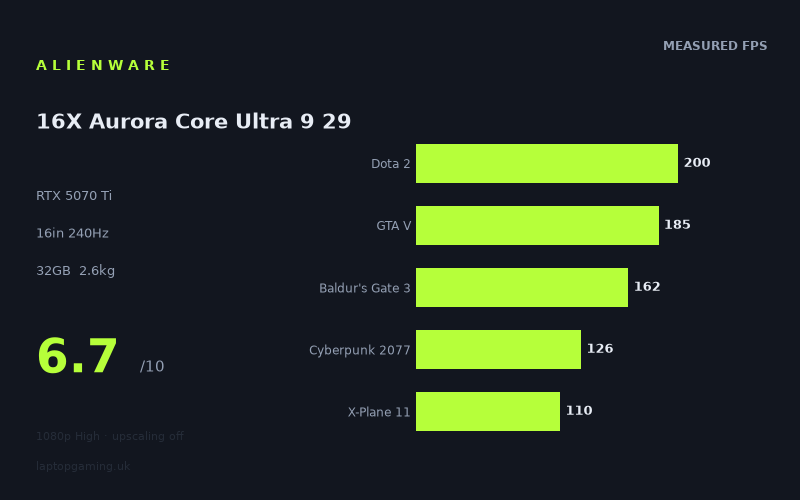
Frame rates
1920×1080, High preset, upscaling off. Averages 156fps across the 5 core benchmark games.
Measured on this machine. Source: Notebookcheck, 2026-05-14.
Not scored: no confirmed UK price
We have the full benchmark suite for this machine, so it ranks on the frame rate leaderboard like any other. What we don't have is a UK listing for this exact configuration - it's sold as a European review unit, or only in specifications that differ from the one tested. Since 30% of our score is value for money, scoring it would mean pretending price is no object, which would flatter it against every laptop you can actually buy. The frame rates below are real and comparable; there is just no buying recommendation to make yet.
How these numbers were produced
Frame rates here are not measured by us, and we label how each one was arrived at. A figure marked measured comes from a published run on that exact machine. A figure marked representative is derived from the GPU and its power limit (TGP) and cross-referenced against published reviews - a sound estimate of what that configuration delivers, but not a measurement of that specific laptop. Unless stated otherwise, numbers are 1920x1080, High preset, upscaling off. Where a laptop ships in several power configurations we use the wattage of the exact SKU listed, because a 140W RTX 5070 and a 115W one are not the same product.
In use
The short version
The Alienware 16X Aurora Core Ultra 9 290HX Plus is a difficult laptop to recommend on price alone, even though its measured gaming performance is strong. At £2,569, it combines an RTX 5070 Ti, 12GB of VRAM, a Core Ultra 9 290HX, 32GB of memory, a 1TB SSD and a 16in 2560x1600 240Hz OLED display. That is an undeniably high-end specification, and the screen in particular is a serious attraction. The problem is that the published frame-rate data does not establish a convincing performance advantage over several alternatives, including a much cheaper MSI Vector 16 HX AI with the same RTX 5070 Ti.
Notebookcheck’s figures show that this Alienware is fast at 1920x1080 on the High preset with upscaling disabled. The five-game scoring-suite average is 157fps, with especially high results in Strange Brigade, F1 24, Dota 2 and GTA V. It is therefore not a weak gaming laptop, nor is the RTX 5070 Ti being obviously wasted here. Yet that average also hides a substantial divide between lighter or older games and newer, more demanding releases. Strange Brigade reaches 281fps and F1 24 reaches 268fps, while Black Myth: Wukong records 73fps and Assassin’s Creed Shadows records 71fps.
That spread matters because the display is not a basic 1080p panel. It is a 2560x1600 OLED with a 240Hz refresh rate. The benchmark figures are useful, attributable results, but they were measured below the panel’s native resolution. There is no published native-resolution frame-rate set in the supplied data, so it would be wrong to promise that the laptop can reproduce these figures at 2560x1600. What can be said is that only Strange Brigade and F1 24 exceed the display’s 240Hz ceiling in the supplied benchmark data. Dota 2 at 200fps comes close, GTA V at 185fps remains very fast, and Baldur’s Gate 3 and Final Fantasy XV are also comfortably above 160fps. The tougher modern games are a different proposition.
This is therefore a laptop for someone who places real value on the OLED panel, the 240Hz refresh rate, the Core Ultra 9 290HX, 32GB of memory and the Alienware configuration as a whole, rather than someone shopping purely for the most frame rate per pound. Buyers seeking an expensive all-round gaming machine with a premium screen may find the specification appealing. Buyers who want the strongest value case should look carefully at the MSI Vector 16 HX AI, because the Alienware’s published advantage over that rival is only 5fps across the shared games despite the very large difference in listed UK price.
The 2.589kg weight and 96Wh battery also frame how this machine should be viewed. It is a substantial 16in laptop rather than a light, easy-to-forget travel companion. The battery capacity is large on paper, but no battery-life measurement is included in the fact sheet, so there is no basis for claiming how long it lasts away from mains power. Likewise, no dimensions are supplied, so there is no evidence for claims about its footprint or thickness. The known weight alone is enough to place it firmly in the transportable desktop-replacement category.
The central verdict is simple. The Alienware 16X Aurora is capable, well specified and equipped with a display that is more compelling than its price-to-performance position. It makes sense for a buyer who specifically wants this screen format and is content to pay heavily for it. It makes much less sense for the buyer whose priority is measurable gaming output for a fixed UK budget.
Performance
What the measured figures say
The benchmark data comes from Notebookcheck, dated 2026-05-14, and all listed games were measured at 1920x1080 using the High preset with upscaling switched off. That last detail is important. These are not figures inflated by an upscaling mode, and they provide a clean indication of the machine’s performance under a conventional high-quality 1080p workload. They are not, however, native-resolution 2560x1600 results, and they should not be treated as such.
Across the five scoring-suite games, the Alienware averages 157fps. That is a strong result in isolation. It indicates that the RTX 5070 Ti and Core Ultra 9 290HX combination can produce very high frame rates in a broad range of games at the tested settings. For players using a high-refresh display, especially in games where response and motion clarity matter, there is enough performance here to make a fast panel worthwhile. But a mean should always be read alongside the individual results. A 157fps average does not mean every game runs near 157fps, and the supplied data shows exactly why that distinction matters.
At the very top end of the results, Strange Brigade runs at 281fps. F1 24 follows at 268fps. These are the only measured games that exceed the panel’s 240Hz refresh rate at the tested 1920x1080 High settings. In those titles, a 240Hz display is not merely decorative: the benchmark data indicates that the laptop can generate more frames than the panel can physically refresh. That does not mean every player will require such a high refresh rate, but it does mean the display specification is supported by the GPU in these particular games at the benchmark setting.
Dota 2 reaches 200fps. That falls short of 240fps but remains a very high frame rate, and it is close enough to the display ceiling that the 240Hz panel still has a practical role. The machine is not delivering a locked 240fps in the supplied Dota 2 result, so buyers should not read the panel specification as a guarantee of maximum-refresh operation in every match or every game setting. Still, 200fps is a notably strong outcome and demonstrates why this laptop is likely to appeal to players of games that benefit from high frame rates.
GTA V records 185fps, while Baldur’s Gate 3 records 162fps. Final Fantasy XV also records 161fps. These are all substantial results, but they sit clearly below the panel’s maximum refresh rate. The important practical conclusion is not that the screen is inappropriate; a 240Hz panel can still display these frame rates without becoming a limitation. Rather, the conclusion is that the panel has more headroom than the laptop can use in many of the supplied games. The display is premium hardware, but the measured GPU performance does not make 240fps a routine expectation beyond the fastest titles.
Cyberpunk 2077 comes in at 126fps, and X-Plane 11 reaches 110fps. Those results remain good, particularly because the benchmark setting is High with upscaling disabled, but they sit in a different performance class from the 200fps-plus results. A buyer comparing only the headline 157fps mean could overlook this. Cyberpunk 2077 and X-Plane 11 show that the machine can still be very quick in more demanding or differently structured workloads, but they also show that there is no universal 240Hz experience here. The performance ceiling is determined by the game, not by the refresh rate printed on the specification sheet.
The hardest results in the supplied set are Black Myth: Wukong at 73fps and Assassin’s Creed Shadows at 71fps. Neither number suggests poor performance in a vacuum. Both are playable-looking results at the stated 1920x1080 High test condition, and neither relies on upscaling in the supplied figures. But they are far removed from the laptop’s 240Hz display capability. For these titles, the Alienware’s screen offers refresh-rate headroom that the measured frame rate does not come close to filling. Anyone buying this machine primarily to play the newest, most graphically demanding games should pay attention to these figures rather than focusing solely on Strange Brigade or F1 24.
The benchmark spread is the important story
The range from 281fps in Strange Brigade to 71fps in Assassin’s Creed Shadows is large, and it is the best reason to avoid simplistic conclusions. This is not a laptop that belongs neatly in one frame-rate category. It can be a genuinely high-refresh gaming machine in some titles, a very fast conventional gaming machine in others, and a machine that lands closer to a typical high-end experience in the newest heavy games.
The spread is not evidence that the hardware is inconsistent or faulty. Games place different demands on a system. Some titles can run at extremely high rates on powerful current hardware; others are more graphically intensive, more processor-sensitive, or simply harder to run at the same visual setting. The measured results demonstrate that distinction clearly. What they do not support is a blanket statement that the Alienware is a 240fps laptop. It is a laptop with a 240Hz display and with measured results that range from well beyond 240fps to well below 100fps.
For competitive or frequently played games that resemble Dota 2 in demand, 200fps is a strong basis for choosing a fast panel. For games that resemble GTA V, Baldur’s Gate 3 or Final Fantasy XV in this benchmark set, the machine provides a high-frame-rate experience without reaching the display maximum. For games that resemble Cyberpunk 2077, X-Plane 11, Black Myth: Wukong or Assassin’s Creed Shadows, the buyer should think in terms of good performance rather than maximum-refresh gaming.
There is also a distinction between the performance a screen can display and the performance a player needs. A 71fps or 73fps result does not become inadequate merely because the display can refresh at 240Hz. Many single-player games do not demand the same frame-rate target as a competitive title. However, it does mean that the 240Hz specification is not, by itself, a useful shorthand for real-world gaming performance. The panel can show a great deal more motion information than the measured result supplies in those games.
The 12GB of VRAM is part of the stated configuration, but the fact sheet does not contain testing that isolates VRAM behaviour, memory use, stuttering, texture settings or performance at native resolution. It would therefore be speculation to say that 12GB is sufficient or insufficient for any particular future game. The responsible conclusion is narrower: the published 1080p High benchmark results are the evidence available, and they show strong but highly title-dependent performance.
GPU power limit: what is known and what is not
The machine is specified with an RTX 5070 Ti, but the supplied fact sheet does not confirm this Alienware’s GPU power limit. That absence matters because laptop GPUs with the same name can be configured differently by different manufacturers. It would be unsafe to assume that this machine runs at the same power level as another RTX 5070 Ti laptop, and it would be equally unsafe to infer its power limit from its frame rates alone.
The rival list does confirm that the Medion Erazer Major 16 X1 uses an RTX 5070 Ti at 140W, while the Asus ROG Zephyrus Duo uses an RTX 5090 at 150W. Those figures tell us something about those specific comparison machines, not about the Alienware. The Alienware’s own GPU power figure is not present in the supplied data. As a result, the review cannot claim that the Alienware is operating at a lower or higher limit than the Medion, cannot describe it as a full-power configuration, and cannot attribute its performance to any particular wattage setting.
What the benchmark comparisons do show is that GPU naming and price do not tell the whole story. The Alienware averages the same frame rate as the Medion Erazer Major 16 X1 across their shared games, despite the Medion’s confirmed 140W RTX 5070 Ti. It also averages 5fps ahead of the MSI Vector 16 HX AI across the shared games, even though both use an RTX 5070 Ti. These outcomes show why buyers should focus on attributable game results rather than assume that a GPU badge alone establishes the final performance order.
There is a limit to that conclusion. The shared-game comparisons are not a complete performance ranking, because each comparison covers a different set of games. The Medion comparison covers six shared games. The MSI Vector comparison covers six shared games. The comparison against the MSI Crosshair A16 HX covers eight shared games, while the comparisons against the Asus ROG Zephyrus Duo and MSI Crosshair 16 HX AI cover nine shared games. Those are useful samples, but not a universal proof that one system is faster in every title or at every setting.
The practical buying lesson is that the Alienware’s unconfirmed power limit should make buyers more careful, not more dismissive. There is no evidence here that the machine is underperforming its class. There is also no evidence allowing it to be presented as a particularly aggressive RTX 5070 Ti implementation. Its measured figures are the correct basis for judgement, and those figures say it is fast, though not decisively faster than the rivals that matter most to its price position.
How to read the figures for actual game choices
If your library consists mainly of titles where frame rate is the priority and the supplied results resemble Dota 2, Strange Brigade or F1 24, the Alienware can make a strong case for its 240Hz panel. Strange Brigade at 281fps and F1 24 at 268fps exceed the panel limit at 1920x1080 High. Dota 2 at 200fps is below that limit but still well suited to high-refresh play. In this part of the benchmark set, the system has enough performance to support the screen’s ambitions.
If your library is built around large, demanding single-player releases, the picture is less straightforward. Cyberpunk 2077 at 126fps is still a strong number, but it is not near 240fps. Black Myth: Wukong at 73fps and Assassin’s Creed Shadows at 71fps make it clear that a demanding modern game can leave much of the display refresh rate unused at the tested settings. That does not invalidate the OLED panel; image quality and display responsiveness can matter independently of maximum frame rate. It does mean buyers should be honest about where their money is going. A meaningful part of the purchase is the screen, not just raw gaming speed.
The 32GB of memory and 1TB SSD are appropriate headline specifications for a high-priced gaming laptop, but there are no measurements here for loading performance, storage speed, application performance or multitasking. The Core Ultra 9 290HX is also a high-end named processor, but no processor-specific benchmark data is supplied. It would be wrong to attach performance claims to those components beyond the overall gaming results. The game figures demonstrate what the complete laptop achieved in the stated benchmark conditions; they do not separate CPU, GPU, memory and storage contributions.
That restraint is especially important in X-Plane 11. The measured result is 110fps, but the fact sheet does not include CPU utilisation, graphics settings beyond High, scene details, or comparative processor results. The number is useful as an attributable benchmark result, but it does not justify a broader claim that this is a specialist simulation laptop or that the processor is the reason for the outcome. It tells prospective buyers that this configuration reached 110fps in Notebookcheck’s test. Nothing more precise should be inferred.
The screen
The screen is the strongest part of the Alienware’s proposition. It is a 16in OLED panel with a 2560x1600 resolution and a 240Hz refresh rate. On a gaming laptop at this price, that is exactly the sort of display specification buyers should expect to be distinctive, and it is more distinctive here than the raw frame-rate advantage over cheaper alternatives.
OLED is a material part of the specification, not an incidental line in a table. The fact sheet does not provide measured brightness, colour coverage, response-time figures, contrast measurements or HDR testing, so those areas cannot be assessed here. There is no basis for claiming that this panel is brighter, more colour accurate, faster or better calibrated than a specific rival. Still, the combination of OLED, 2560x1600 and 240Hz is itself a high-end display package, and it gives the machine a clear reason to exist beyond its RTX 5070 Ti badge.
The resolution is higher than the 1920x1080 benchmark setting. That creates both an opportunity and a warning. A 2560x1600 panel gives the user a higher-resolution desktop and gaming target than 1080p, but the supplied frame-rate figures do not tell us what happens when games are actually rendered at 2560x1600. There is no native-resolution result for Strange Brigade, F1 24, Dota 2, GTA V, Baldur’s Gate 3, Final Fantasy XV, Cyberpunk 2077, X-Plane 11, Black Myth: Wukong or Assassin’s Creed Shadows in the fact sheet.
Buyers should therefore not take the 281fps Strange Brigade result or the 268fps F1 24 result as evidence of equivalent performance at the panel’s native resolution. Nor should they take Black Myth: Wukong at 73fps or Assassin’s Creed Shadows at 71fps as native-resolution figures. The benchmark is explicitly 1920x1080, High preset, upscaling off. That is the condition under which the numbers are attributable.
At the tested setting, the panel’s 240Hz refresh rate is fully exceeded by Strange Brigade and F1 24. Dota 2 at 200fps is close enough to make strong use of a high-refresh display, though it does not hit 240fps in the published result. GTA V at 185fps, Baldur’s Gate 3 at 162fps and Final Fantasy XV at 161fps are all fast enough that a 240Hz panel remains an asset, but they do not exploit the full refresh ceiling. Cyberpunk 2077 at 126fps, X-Plane 11 at 110fps, Black Myth: Wukong at 73fps and Assassin’s Creed Shadows at 71fps underline that a 240Hz panel does not turn every game into a maximum-refresh experience.
That should not be read as an argument against the screen. A high refresh rate is not wasted simply because a game does not run at its maximum. The panel can still accommodate the output of the GPU without becoming the limiting factor. But a buyer deciding between this Alienware and a less expensive machine should recognise the difference between a display that has high specifications and a GPU that reaches those specifications in every game. The Alienware has the former. The Notebookcheck data shows the latter only in selected titles at 1920x1080 High.
The screen’s 16in size also shapes the laptop’s identity. This is not a compact small-screen machine built chiefly around low weight. The display is large enough to make the higher resolution and OLED technology central to the ownership proposition. A buyer who plans to use the laptop mostly at a desk, for games and general computing, may value that more than a buyer whose main concern is travelling light. The fact sheet does not include dimensions, chassis thickness or screen measurements beyond the 16in size, so the assessment should stop there.
The absence of native-resolution testing is the single biggest limitation in evaluating the display-and-GPU pairing. There is no responsible way to turn the 1080p figures into promised 2560x1600 performance. Buyers who consider native resolution essential should seek additional attributable data before treating this as a proven 2560x1600 high-refresh machine. Based on the supplied numbers alone, it is proven as a very fast 1080p High laptop in some games, a strong one in many others, and a more moderate performer in the most demanding titles listed.
Build, size and portability
The Alienware weighs 2.589kg. That is the most useful portability figure supplied, and it places the machine in a category where carrying it is certainly possible but should not be confused with effortless mobility. A 16in gaming laptop with this weight is better suited to regular movement between fixed locations than to being carried all day with minimal thought.
For a buyer commuting occasionally, travelling between home and university, moving between rooms, or taking the laptop to a second location, 2.589kg is manageable if performance and screen quality are the priority. For a buyer who needs a laptop to be genuinely light in a bag every day, the weight is a clear compromise. The machine’s gaming hardware, 16in OLED panel and 96Wh battery suggest that it has been designed as a substantial system, and the weight confirms that it should be considered accordingly.
No dimensions are supplied in the fact sheet. There is therefore no evidence for claims about whether it is thin, deep, compact for its class, easy to fit into a particular bag, or unusually large on a desk. Similarly, there is no information on materials, rigidity, keyboard quality, trackpad quality, ports, webcam, speakers, cooling layout or serviceability. Those are all important purchase factors, particularly at £2,569, but they cannot be honestly reviewed from the available information.
The 96Wh battery is sizeable as a specification, but battery capacity is not battery life. The fact sheet provides no measured runtime for browsing, video, office work or gaming. It also provides no data on charging speed or charging hardware. The right conclusion is that the laptop has a 96Wh battery and that its actual unplugged endurance is unconfirmed in the supplied evidence. Anyone who needs dependable all-day use away from mains power should not assume that battery capacity alone answers that question.
Gaming laptops are generally used near a power socket for sustained performance, but no claim about this Alienware’s performance on battery is supported by the fact sheet. The Notebookcheck frame-rate figures should be understood as benchmark data under the stated test conditions, not as evidence of unplugged gaming performance. Buyers who expect to game without mains power regularly should seek measured battery-mode data before deciding.
The 32GB memory capacity and 1TB SSD capacity make the system feel appropriately provisioned for its price bracket on paper. The memory capacity should reduce the immediate need to think about upgrades for ordinary gaming and multitasking use, but no upgrade details are provided. The SSD capacity is useful for a large game library, although no storage speed, available space or second-drive information is supplied. Again, the machine looks well specified, but not every practical ownership detail is confirmed.
The key point is that the Alienware is portable in the sense that it is a laptop, not portable in the sense that it is a lightweight machine. Its 2.589kg weight, 16in display and performance-oriented internal specification make it most convincing for buyers who want one powerful system that can move when required, rather than buyers who need mobility to be the first priority.
How it compares
The rival data is particularly revealing because it prevents the Alienware from being judged in isolation. On its own, a 157fps scoring-suite average and results such as 281fps in Strange Brigade or 268fps in F1 24 look impressive. Against the listed alternatives, however, the Alienware does not establish a decisive lead. In some comparisons it is effectively tied, and in others its lead is so small that price and screen specification become more important than raw frame rate.
Medion Erazer Major 16 X1
The Medion Erazer Major 16 X1 has an RTX 5070 Ti at 140W and is listed at £2,770. Across six games shared with the Alienware, this Alienware averages 0fps behind it. In plain terms, the shared-game average is level. That is a useful result for the Alienware because it shows that it can match another RTX 5070 Ti machine with a confirmed 140W configuration in the available common tests.
The comparison does not prove that both laptops perform identically in every game. It covers six shared games rather than the entire benchmark list, and the fact sheet does not give the individual shared-game results. It also does not establish the Alienware’s GPU power limit. Still, for a buyer choosing between these two machines, the data provides no frame-rate reason to pay more for the Medion. The Alienware matches it on the shared-game average while also offering the stated 16in 2560x1600 240Hz OLED screen.
The Medion’s £2,770 price is higher than the Alienware’s £2,569 price. That does not make the Alienware cheap; it remains expensive. It does mean the Medion does not improve the Alienware’s value problem merely by being an alternative with a similar GPU. If the Medion has features beyond the supplied data that matter to a buyer, those cannot be assessed here. On the attributable figures supplied, the two are tied for shared-game performance, while the Alienware costs less and has the specified OLED panel.
MSI Crosshair A16 HX
The MSI Crosshair A16 HX uses an RTX 5070, and no confirmed UK price is available in the fact sheet. Across eight shared games, the Alienware averages only 1fps ahead. That is a tiny margin in the context of a £2,569 laptop. The Alienware has an RTX 5070 Ti rather than an RTX 5070, yet the shared-game data does not show a meaningful practical separation between the two machines.
Without a confirmed UK price for the MSI, this comparison cannot settle the value argument. If the Crosshair A16 HX were similarly priced, the Alienware’s 1fps average lead would be difficult to use as a buying justification. If the MSI were substantially cheaper, the Alienware’s value case would become weaker still. If the MSI were more expensive, the Alienware might look more reasonable. The price information is absent, so the correct conclusion is simply that the Alienware’s performance lead is negligible in the eight shared games.
This comparison is another reminder not to over-read GPU labels. The RTX 5070 Ti name does not automatically translate into a major measured lead over every RTX 5070 laptop. Configuration, game selection and the complete system matter. The Alienware remains the better-specified machine in GPU naming terms, but the published shared-game evidence shows almost no average performance advantage here.
Asus ROG Zephyrus Duo
The Asus ROG Zephyrus Duo is listed with an RTX 5090 at 150W, yet the Alienware averages 2fps ahead across nine shared games. That is the most surprising comparison in the supplied data, and it reinforces the need to rely on measured figures rather than assumptions based on the graphics label. The Alienware’s RTX 5070 Ti configuration is not expected, from the name alone, to sit ahead of an RTX 5090 at 150W. But the shared-game benchmark average says that it does, by 2fps, in this particular comparison set.
This result must be handled carefully. It does not mean the Alienware is universally faster than the Asus ROG Zephyrus Duo. It does not mean an RTX 5070 Ti is generally faster than an RTX 5090. It does not explain why the outcome occurred, because the fact sheet does not provide detailed settings beyond the general benchmark condition, individual game comparisons, or configuration details for the Asus beyond GPU and power limit. What it does establish is a narrow shared-game average lead for the Alienware across nine games.
No confirmed UK price is provided for the Asus. That prevents a value comparison. The sensible buyer takeaway is not that the Alienware has defeated every RTX 5090 laptop; it is that published laptop gaming performance can be more complicated than GPU names imply, and that the Alienware is competitive in the listed shared-game set.
MSI Vector 16 HX AI
The MSI Vector 16 HX AI is the comparison that most damages the Alienware’s value case. It has an RTX 5070 Ti, the same GPU family as the Alienware, and a listed UK price of £1,592. Across six shared games, the Alienware averages only 5fps ahead. A 5fps advantage can matter in a close performance contest, but it is not remotely enough on its own to explain the Alienware’s £2,569 price.
There may be reasons to choose the Alienware that are not captured by that shared-game figure. The Alienware has a 16in 2560x1600 240Hz OLED display, 32GB of memory, 1TB SSD storage, a Core Ultra 9 290HX and a 96Wh battery in the supplied specification. The MSI Vector’s corresponding screen, processor, memory, storage, battery, weight and other features are not supplied here, so it cannot be treated as a like-for-like total-system comparison. But that limitation cuts both ways: the Alienware buyer must identify a concrete reason to pay so much more, because the benchmark advantage is modest.
For a buyer who cares chiefly about frame rate per pound, the MSI Vector is the obvious machine to investigate. The Alienware has only a small shared-game lead despite both using an RTX 5070 Ti. The Alienware’s OLED display may be worth a premium to some users, but it would need to be worth a very substantial premium to overcome the price gap in this comparison. The benchmark data does not do that work for it.
MSI Crosshair 16 HX AI
The MSI Crosshair 16 HX AI has an RTX 5070, and no confirmed UK price is supplied. The Alienware averages 7fps ahead across nine shared games. This is a clearer performance lead than the 1fps margin over the MSI Crosshair A16 HX, but it is still not a transformative gap. It supports the view that the Alienware is faster in the available shared-game sample, while also showing that the difference between RTX 5070 and RTX 5070 Ti laptop configurations is not necessarily dramatic in published gaming averages.
Because the Crosshair 16 HX AI has no confirmed UK price, it cannot be used to make a firm value judgement. A 7fps advantage may be worthwhile if prices are close and the buyer also values the Alienware’s OLED display. It may be irrelevant if the MSI is much cheaper. The correct conclusion is conditional: the Alienware is ahead in the shared data, but the missing UK price prevents a meaningful purchasing recommendation between the two.
Across all listed rivals, the pattern is consistent. The Alienware is competitive, sometimes marginally ahead, and level with the Medion. What it is not is a machine that clearly outruns its rivals by enough to make £2,569 self-justifying on performance. Its case rests on its screen and its overall specification, not on a decisive benchmark lead.
Who it’s for
The Alienware 16X Aurora Core Ultra 9 290HX Plus is for the buyer who wants a powerful 16in gaming laptop with a 2560x1600 240Hz OLED display and is willing to pay for that display specification. It is also for someone whose game library includes titles where the measured results are particularly high: Strange Brigade at 281fps, F1 24 at 268fps and Dota 2 at 200fps. In those games, the fast panel is not merely an aspirational feature. The benchmark data shows that the system can make meaningful use of it at 1920x1080 High without upscaling.
It also suits a buyer who wants a substantial desktop-replacement machine rather than a lightweight travel laptop. The 2.589kg weight should not deter someone who mainly uses the laptop on a desk and occasionally moves it between locations. The 96Wh battery is a welcome capacity figure, although no runtime result is available and buyers should not assume a particular level of unplugged endurance.
The 32GB memory capacity, 1TB SSD and Core Ultra 9 290HX make it an appealing high-end specification for a buyer who wants to avoid an immediately compromised configuration. The fact sheet does not establish component-level performance or upgrade options, but the headline configuration is clearly positioned above basic gaming-laptop territory. Buyers who value a generous memory allocation and large SSD alongside an OLED display may see more sense in the Alienware than those comparing GPU names alone.
It is not the right choice for the buyer focused primarily on value. The MSI Vector 16 HX AI is listed at £1,592, has an RTX 5070 Ti, and trails the Alienware by only 5fps across six shared games. The Alienware may offer worthwhile advantages outside that narrow benchmark comparison, particularly its OLED display, but the published performance margin is small. A value-focused buyer should require a very clear personal reason to spend £2,569 rather than investigate that MSI.
It is also not the right choice for someone expecting every demanding game to run near 240fps. The 240Hz OLED panel is excellent on paper, but Black Myth: Wukong at 73fps and Assassin’s Creed Shadows at 71fps demonstrate the gap between display capability and demanding-game performance. Cyberpunk 2077 at 126fps and X-Plane 11 at 110fps reinforce the same point. This laptop can be exceptionally fast, but it is not a universal maximum-refresh machine in the supplied benchmarks.
Buyers who insist on native 2560x1600 frame-rate evidence should also wait for more data. Every supplied gaming result is measured at 1920x1080 on High with upscaling off. There is no responsible basis for converting those results into native-resolution promises. The higher-resolution OLED panel is attractive, but its pairing with the RTX 5070 Ti at native resolution is not proven by the benchmark set provided.
Finally, it is not the obvious choice for someone who needs low weight. At 2.589kg, this Alienware is best described as transportable rather than highly portable. It can move with you, but it is not the machine to choose if your priority is reducing bag weight. No dimensions are available, so there is no basis to claim that it makes up for its weight with an unusually compact chassis.
The best way to buy the Alienware is to treat it as a screen-led premium gaming laptop. If the 16in 2560x1600 240Hz OLED panel is central to what you want, and you accept a 2.589kg machine at £2,569, the measured performance is strong enough to support that choice. If you are buying principally for RTX 5070 Ti frame rates, the evidence points elsewhere: this machine is fast, but its modest shared-game leads do not make it the sensible value leader.