Review
Medion Erazer Major X20 review
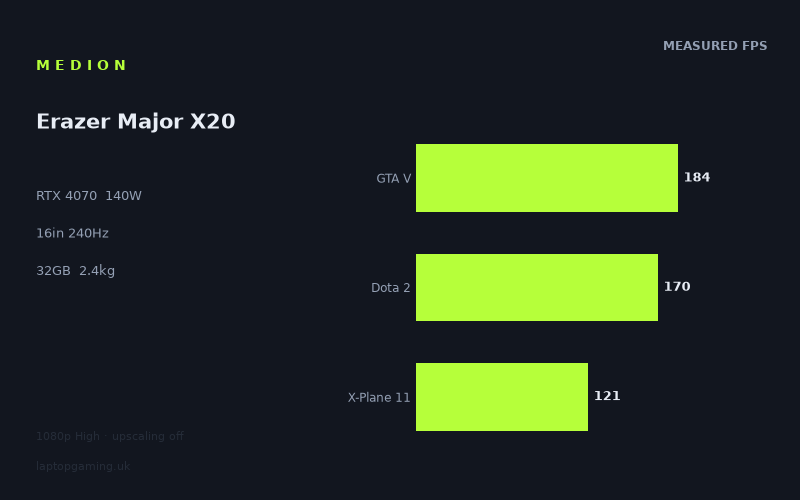
Frame rates
1920×1080, High preset, upscaling off.
Measured on this machine. Source: Notebookcheck, 2023-04-26.
Not scored: incomplete benchmark suite
Every scored laptop on this site is averaged over the same 5 games, and this one is short of Cyberpunk 2077, Baldur's Gate 3. A mean over 3 games is not comparable to a mean over 5, so we publish the figures we have and leave the score blank rather than rank it against machines tested on a different set. The numbers below are real - the suite is just incomplete.
How these numbers were produced
Frame rates here are not measured by us, and we label how each one was arrived at. A figure marked measured comes from a published run on that exact machine. A figure marked representative is derived from the GPU and its power limit (TGP) and cross-referenced against published reviews - a sound estimate of what that configuration delivers, but not a measurement of that specific laptop. Unless stated otherwise, numbers are 1920x1080, High preset, upscaling off. Where a laptop ships in several power configurations we use the wattage of the exact SKU listed, because a 140W RTX 5070 and a 115W one are not the same product.
In use
The short version
The Medion Erazer Major X20 has the core specification of a serious high-refresh gaming laptop: an RTX 4070 running at a stated 140W GPU power limit, a Core i9-13900HX, 32GB of memory, a 1TB SSD and a 16in 2560x1600 IPS display with a 240Hz refresh rate. The published benchmark data backs up the idea that this is a fast machine, particularly in older, lighter or well-optimised games. Notebookcheck’s measured figures at 1920x1080, High preset and with upscaling disabled range from 121fps to 244fps across the listed games.
That range matters more than any simple average. In Strange Brigade and The Witcher 3, the Major X20 is effectively operating in high-refresh territory, with measured results of 244fps and 242fps respectively. F1 22 also gets close enough to the display’s 240Hz ceiling to make that panel feel justified, at 206fps. In GTA V, Dota 2 and Far Cry 5, the measured figures of 184fps, 170fps and 153fps remain very strong, although they no longer fully occupy a 240Hz panel. Final Fantasy XV and X-Plane 11 are the reminder that an RTX 4070 laptop is not a universal 240fps machine: both recorded 121fps.
The important caveat is that these figures are at 1920x1080, while the laptop’s own display is 2560x1600. The Major X20’s native screen has substantially more pixels to render than the benchmark resolution. It is therefore not sensible to read the published 1080p figures as promised native-resolution results. They are useful for showing the machine’s general performance level and the difference between lighter and heavier games, but they do not demonstrate that every listed title will run at the panel’s full resolution and full refresh rate simultaneously.
The 140W GPU power limit is significant because it tells us this is not an RTX 4070 being presented in an especially low-power, thin-and-light configuration. Medion has specified a comparatively high power allowance for the GPU. That does not make the Major X20 automatically faster than every other RTX 4070 laptop, because game performance also depends on the processor, cooling implementation, game engine, memory configuration and the particular graphics settings used. But it does mean the specification is aimed at extracting meaningful performance from the RTX 4070 rather than treating it as a secondary feature in an ultraportable chassis.
There is a strong combination here for a buyer who wants high frame rates in competitive games, older AAA titles and less demanding releases, but who also wants a sharper 16in screen than a conventional 1920x1080 panel. The Core i9-13900HX and 32GB of memory also make the machine look better suited to demanding general work than a stripped-back gaming configuration would. That said, it is not possible to declare it a bargain, expensive or sensibly priced because there is no confirmed UK price. That missing information is important. A laptop with these specifications may be appealing, but value depends heavily on what Medion actually charges in the UK and what competing RTX 4070 systems cost at the same time.
The Major X20 is not the right purchase for someone expecting every game to sit at 240fps at the screen’s native 2560x1600 resolution with no compromises. The benchmark data does not support that expectation. Nor is it a machine for somebody whose priority is a light travel laptop: at 2.366kg, it is portable in the literal sense, but it belongs in the performance-laptop category rather than the easy-to-carry-everywhere category. It is better understood as a powerful desktop replacement that can move between rooms, workplaces, university accommodation or occasional trips, rather than as a machine you will forget is in your bag.
The overall case for the Major X20 is therefore straightforward. It has the hardware to produce very high frame rates in a meaningful number of games, a screen whose refresh rate can be exploited in lighter titles, and enough memory and processor capacity to suit gaming alongside heavier everyday workloads. The compromises are equally clear: the native 2560x1600 display is more demanding than the benchmark resolution, 240Hz is an aspirational ceiling in several of the listed games rather than a universal result, and the lack of a confirmed UK price prevents a final judgement on value.
Performance
What the published figures show
Notebookcheck’s figures were measured at 1920x1080 using the High preset with upscaling disabled. That is a useful baseline because it avoids hiding performance behind an upscaling mode, but it is still a particular scenario rather than a complete description of how every game will behave. The Major X20’s screen is 2560x1600, so the benchmark results should be read as 1080p High figures, not as direct native-panel figures.
Across the three games in the available scoring suite, GTA V, Dota 2 and X-Plane 11, the Major X20 records a mean of 158fps. That is a strong result in isolation, but the individual results are more informative than the mean. GTA V reaches 184fps and Dota 2 reaches 170fps, while X-Plane 11 is lower at 121fps. A mean can make those games appear more similar than they are in practice. Someone mostly playing GTA V or Dota 2 should expect a substantially different high-refresh experience from someone primarily using X-Plane 11.
The full set of measured figures gives the machine a clear performance hierarchy:
- Strange Brigade: 244fps
- The Witcher 3: 242fps
- F1 22: 206fps
- GTA V: 184fps
- Dota 2: 170fps
- Far Cry 5: 153fps
- Final Fantasy XV: 121fps
- X-Plane 11: 121fps
There is no single “RTX 4070 performance” number that can replace this list. The difference between 244fps in Strange Brigade and 121fps in Final Fantasy XV or X-Plane 11 is not minor. It is the difference between a result that can meet the display’s 240Hz refresh rate and one that is around half of that ceiling. Both outcomes can still be good gaming results, but they suit different priorities. A player chasing the lowest possible input latency and the smoothest motion in a competitive or fast-moving title will care deeply about the higher figures. A player prioritising image quality, simulation complexity or a heavier game engine may be satisfied with lower performance, especially when the alternative is reducing graphics settings.
The 140W RTX 4070 matters, but it is not magic
The RTX 4070 is the key gaming component in the Major X20, and the stated 140W GPU power limit places it in a performance-oriented configuration. Laptop GPU names do not, on their own, tell the whole story. The power limit matters because it indicates how much electrical power the laptop is designed to allow the GPU to use. In broad terms, a GPU configured with more available power has more scope to maintain higher performance than the same GPU placed in a more constrained design.
That is why the 140W figure is worth considering alongside the RTX 4070 name rather than treating it as a line of technical trivia. Medion is not pairing the RTX 4070 with a deliberately low stated limit. The Major X20 is intended to give the GPU room to perform. The measured results support the broad conclusion that this is a fast configuration, with several games well above 150fps at the published 1920x1080 High setting and two results above 240fps.
However, power limit is not a guarantee of a fixed performance advantage. The available rival comparison data demonstrates that clearly. Against the Lenovo Legion Slim 7i 16 Gen 8, another RTX 4070 laptop, the Major X20 is only 1fps ahead across three shared games. That near-level result does not mean the 140W specification is meaningless. It means that the shared 1080p tests, particularly the lighter titles available for comparison, can compress differences between laptop graphics configurations. Once a game is limited more by processor performance or its own engine behaviour than by the GPU, a higher GPU power allowance may not translate into a large visible lead.
Buyers should therefore treat the 140W rating as evidence of intent and capability, not as a shortcut to assuming a huge lead over every RTX 4070 competitor. It is encouraging that Medion has specified a high GPU power limit. It is also sensible to judge the laptop using the actual game data available, which shows excellent results in several titles but not a clean sweep at the screen’s refresh ceiling.
High refresh performance, game by game
Strange Brigade at 244fps is the clearest example of the 240Hz panel being used to its full potential in the published data. At the measured 1920x1080 High setting, the figure sits above the screen refresh rate. This does not mean every moment of play will necessarily remain above that figure, because the data supplied is a benchmark result rather than a frame-time analysis. But it does establish that the Major X20 has enough performance in this game to make a 240Hz screen more than a paper specification.
The Witcher 3 at 242fps tells a very similar story. It is almost exactly aligned with the panel’s refresh capability and is another result showing that the laptop can enter genuinely high-refresh territory in the right game. For a buyer who wants a machine that does not merely have a 240Hz screen but can occasionally make compelling use of it, these two results are the strongest evidence in the data.
F1 22 at 206fps falls short of the panel’s maximum refresh rate, but it remains a very high result. The gap between 206fps and 240Hz should not be framed as failure. It shows that the laptop can drive fast-moving racing gameplay at a frame rate far beyond the conventional 60Hz or 120Hz targets, even though the measured result does not fully occupy all 240 refresh opportunities. It also illustrates why a 240Hz panel is not an all-or-nothing proposition. A display can still offer a very fluid experience when the game runs below its maximum refresh rate, provided the game is producing high frame rates.
GTA V at 184fps is another strong result, and it is particularly useful because GTA V is part of the available scoring suite. It is comfortably in high-refresh territory, but it is not a 240fps result. A player using the Major X20’s native 2560x1600 resolution should be especially careful not to assume that the 184fps measured at 1920x1080 will carry over unchanged. The benchmark tells us that the laptop has substantial headroom at the tested resolution; it does not supply a native-resolution number.
Dota 2 at 170fps is also well suited to a fast display, though again not enough to meet 240Hz in the published result. For a game where responsive mouse control and clear motion can matter, 170fps remains a convincing figure. It also shows why it would be misleading to reduce the Major X20 to a single average. Dota 2 is meaningfully faster than X-Plane 11 in the same scoring suite, despite both being tested under the same general benchmark conditions.
Far Cry 5 at 153fps is a very capable result, but it is the point where the distinction between “high refresh” and “full use of a 240Hz panel” becomes more obvious. At 153fps, the Major X20 is still delivering a result that should appeal to anyone upgrading from a 60Hz gaming laptop. It is not, however, a result that justifies claiming the screen will always operate at its maximum refresh rate in demanding games.
Final Fantasy XV at 121fps and X-Plane 11 at 121fps are the lowest measured results. Neither is weak in the ordinary sense; 121fps remains above the refresh rate of many gaming displays. But on a laptop fitted with a 240Hz panel, these figures establish a practical limit to the machine’s high-refresh ambitions. In these games, at the stated test settings, the Major X20 does not get close to fully driving the display at 240Hz.
X-Plane 11 is especially important because it is part of the scoring suite and because it highlights how game type affects conclusions. Simulation titles often do not behave like conventional action games. The benchmark result is 121fps, while GTA V and Dota 2 in the same available suite reach 184fps and 170fps. Anyone buying principally for flight simulation should focus on the X-Plane 11 figure rather than being reassured by the 244fps result in Strange Brigade. The Major X20 is evidently capable, but the benchmark data does not make it a universally max-refresh gaming machine.
Why the performance spread is so wide
The 121fps to 244fps spread is not a contradiction. It is what gaming laptop benchmark data normally looks like when a range of game engines and genres are involved. Games place different demands on the processor and graphics hardware, and their built-in benchmark paths can stress a system in different ways. A title that is comparatively light at 1920x1080 can run into processor or game-engine limits before the RTX 4070 is fully challenged. A heavier title can remain more dependent on graphics performance and show a lower result at the same nominal preset.
The Major X20’s Core i9-13900HX is relevant here. It is a high-end processor choice for a gaming laptop, and it helps make the machine a plausible option for games that lean heavily on processor performance as well as graphics work. However, the figures do not allow us to separate precisely how much of each result is determined by the CPU, GPU, memory or game engine. It would be overconfident to claim that a particular result is exclusively CPU-bound or GPU-bound without more detailed testing. What can be said is that the shared rival data explicitly warns that lighter 1080p games can become CPU-bound and compress real GPU differences. That context should inform how the Major X20’s strong results are interpreted.
At 1920x1080, especially in lighter titles, the RTX 4070 can have enough performance that the system is no longer separated cleanly by graphics hardware alone. That helps explain why the Major X20 is only fractionally different from one RTX 4070 rival and fractionally behind an RTX 4050 rival in the limited shared-game comparison. It does not mean an RTX 4050 and RTX 4070 are generally interchangeable. It means the games and settings shared by those laptops do not expose the full difference in the same way that a heavier graphics workload might.
The lesson for buyers is simple: use the game nearest to what you actually play. If your library resembles Strange Brigade, The Witcher 3 and F1 22, the Major X20’s published figures make a persuasive case for a high-refresh screen. If your focus resembles X-Plane 11 or Final Fantasy XV, the machine still looks capable, but the display’s 240Hz rating should be seen as headroom for lighter games rather than a performance level guaranteed in every title.
What is missing from the benchmark picture
There are no supplied figures for Cyberpunk 2077 or Baldur’s Gate 3. That means the available scoring suite is incomplete. Every laptop that receives a comparable ranking is averaged across the same five games, and the Major X20 has published figures for only three of them. It cannot therefore be ranked honestly against laptops with complete five-game results.
This is not a small administrative detail. Cyberpunk 2077 and Baldur’s Gate 3 would be useful additions because they would broaden the picture beyond GTA V, Dota 2 and X-Plane 11. Without them, the available mean of 158fps is informative only for those three games. It is not a complete all-round gaming verdict and should not be treated as one.
There are also no supplied figures here for the Major X20 at 2560x1600, no figures at alternative graphics presets, and no figures using upscaling. It would be easy to assume that upscaling could change the native-resolution picture, but that would be speculation without measured data for this particular laptop and these particular games. The responsible conclusion is narrower: the available figures demonstrate strong 1920x1080 High performance without upscaling, while the 2560x1600 experience has not been quantified in the supplied benchmark set.
The screen
A 16in 2560x1600 IPS panel with a 240Hz target
The Major X20 has a 16in IPS screen with a 2560x1600 resolution and a 240Hz refresh rate. On paper, that is a more ambitious display than a basic 1920x1080 gaming panel. The extra resolution should provide more desktop space and a sharper image than a 1080p screen of the same general size, while the 240Hz refresh rate gives the laptop scope to present exceptionally smooth motion when the game can supply enough frames.
The key word is “when”. A 240Hz panel is a capability of the display, not a statement that every installed game will run at 240fps. Notebookcheck’s data shows both sides of that distinction. Strange Brigade at 244fps and The Witcher 3 at 242fps can effectively meet the panel’s refresh target at the tested 1920x1080 High setting. F1 22 at 206fps comes close. GTA V at 184fps, Dota 2 at 170fps and Far Cry 5 at 153fps are all fast enough to make a high-refresh panel worthwhile, but they do not reach 240fps. Final Fantasy XV and X-Plane 11, both at 121fps, are further away again.
That is not an argument against the screen. It is an argument for buying it with realistic expectations. The 240Hz specification is most valuable to players who spend time in games where very high frame rates are attainable. It can also be useful simply as a ceiling that prevents the screen from being the limitation in lighter games. But a buyer mostly playing more demanding titles should not choose this laptop solely because 240Hz sounds more impressive than a lower-refresh option. The frame-rate data needs to support the display choice for the games that person actually plays.
The benchmark resolution is not the panel resolution
The bigger issue is resolution. The benchmark data is at 1920x1080, whereas the Major X20’s own screen is 2560x1600. These are not interchangeable settings. The display’s native resolution is not merely 1080p with extra vertical space; it requires the system to render a higher-resolution image. As a result, the published figures should not be used to claim native 2560x1600 performance.
This is particularly relevant to the headline-like results. A measured 244fps in Strange Brigade at 1920x1080 High is excellent evidence that the machine is very fast in that test. It is not evidence that Strange Brigade will deliver 244fps at 2560x1600 High. The same applies to the 242fps result in The Witcher 3 and the 206fps result in F1 22. Buyers comparing this laptop with a 1080p-screen rival should be aware that the Medion’s sharper native display asks more of the GPU when used at native resolution.
There are several sensible ways a buyer might approach that trade-off, but the benchmark sheet does not tell us which one will be best in every game. Some owners may prefer native 2560x1600 for image detail and accept a lower frame rate. Others may prioritise frame rate in selected competitive titles. The important thing is not to assume that one setting suits every game or that the published 1080p result will reproduce itself at the laptop’s own native resolution.
What IPS tells us, and what it does not
The panel is IPS. That identifies the panel type, but it does not tell us everything that matters about display quality. The supplied information does not include brightness, contrast, colour coverage, response-time measurements, adaptive-sync support or any assessment of backlight behaviour. Those omissions matter if the screen is a deciding factor for you.
It would be wrong to claim that this is an exceptional content-creation display, a class-leading esports panel or a particularly bright outdoor screen without those measurements. It would also be wrong to infer display response from the 240Hz rating alone. The refresh specification tells us the maximum refresh rate; it does not provide a measured account of pixel response or motion handling.
What can be said with confidence is that the specification is well matched to the Major X20’s strongest measured results. A 240Hz display would be excessive if the laptop could not exceed 120fps in any of the listed games. That is not the case here. The Major X20 reaches 244fps, 242fps and 206fps in three titles, and it clears 150fps in a further three. The panel’s high refresh rate is therefore not empty marketing, even if it is not fully exploited in every game.
Build, size and portability
The Major X20 weighs 2.366kg. That puts it firmly on the substantial side for a 16in gaming laptop. It is not immovable, and it can clearly be transported when needed, but the specification points towards a machine that will be most comfortable spending much of its life on a desk, table or other stable surface rather than being carried all day.
Weight matters because it changes the sort of ownership experience a laptop provides. A 2.366kg computer can make sense for a buyer who wants one system for gaming, work and home use, especially if it moves occasionally between locations. It is less ideal for someone who expects to carry it through a full day of commuting, lectures or frequent travel. The laptop itself is not the only item in a bag, and a performance-focused machine is normally part of a broader setup that may include a charger, peripherals or other equipment. No charger weight is supplied here, so it would be wrong to quantify the full travel load, but the laptop’s own mass is enough to make the direction of travel clear.
There are no dimensions in the supplied specification, so there is no basis for describing the Major X20 as especially thin, compact or large in terms of footprint. The 16in display tells us its class, and the 2.366kg weight tells us it is not an ultralight design, but the exact practical space it occupies in a bag cannot be established from the available facts.
The weight also fits the machine’s performance priorities. A laptop combining a Core i9-13900HX, RTX 4070 with a 140W power limit, 32GB of memory and a 240Hz display is not aimed primarily at minimising mass. The published gaming figures suggest that Medion has chosen a performance-led configuration. For the right buyer, that is the correct trade-off. Someone purchasing a laptop mainly as a portable writing, browsing or office machine would be paying for substantial gaming hardware and accepting substantial weight without necessarily benefiting from either.
No battery-life data is available in the fact sheet. That means there is no honest basis for predicting how long the Major X20 will last away from mains power, whether during general use or gaming. The same applies to noise and temperatures: no measurements have been supplied. It would be especially unwise to infer cool or quiet operation from the 140W GPU limit, because a higher-performance configuration can place significant demands on cooling, but the actual behaviour of this model has not been provided here.
For practical buying purposes, the safest interpretation is that this is a transportable performance laptop, not a lightweight mobile-first machine. It suits a buyer who values the flexibility of a laptop form factor but expects to use it like a powerful main computer. It is a less convincing fit for a buyer whose first requirement is low carry weight, long unplugged use or a compact chassis, because the supplied facts do not support those claims and the 2.366kg weight points in the other direction.
How it compares
Against the MSI Thin GF63
Across three shared games, the Major X20 averages 71fps ahead of the MSI Thin GF63. The MSI uses an RTX 4050, while the Medion uses an RTX 4070 with a stated 140W GPU power limit. This is the largest positive gap in the supplied rival set and the clearest evidence that the Major X20 is operating in a materially higher performance tier than at least one lower-specification alternative from the same GPU generation.
A 71fps average advantage across three shared games is not the kind of difference that can be dismissed as benchmark variation. It is a meaningful separation. For a buyer deciding between a budget-oriented RTX 4050 laptop and this Medion configuration, the available shared-game data supports paying close attention to the Major X20’s performance advantage rather than assuming that all current-generation gaming laptops are broadly alike.
That does not settle the buying decision by itself, because neither machine has a confirmed UK price in the supplied information. If the MSI were far cheaper, it could still make sense for a buyer with modest frame-rate requirements. But if pricing is close, the Major X20’s 71fps shared-game lead would be difficult to ignore. The Medion’s 32GB memory, Core i9-13900HX, 1TB SSD and 240Hz 2560x1600 display also make it a more ambitious overall configuration on paper.
Against the Lenovo Legion Slim 7i 16 Gen 8
The closest comparison is the Lenovo Legion Slim 7i 16 Gen 8, also fitted with an RTX 4070. Across three shared games, the Major X20 averages only 1fps ahead. This is effectively a level result in the context provided. It does not establish a meaningful gaming lead for either machine based on these shared figures.
That near-zero gap is useful because it prevents overclaiming based on the Major X20’s 140W GPU power limit. A buyer might expect the Medion’s stated power allowance to guarantee a large advantage over every other RTX 4070 laptop. The shared data says otherwise, at least in these three games and at the tested settings. The explanation supplied with the rival context is important: at 1080p, lighter games in the shared set can be CPU-bound and can compress genuine GPU gaps.
In other words, an almost identical result does not prove that the GPU configurations are identical in every workload. It means that these particular common benchmarks do not show a meaningful separation. For a buyer choosing between the Major X20 and the Legion Slim 7i 16 Gen 8, gaming performance in the shared set is not enough to decide the matter. Price would matter, but neither has a confirmed UK price here. Other factors would also matter, but the fact sheet does not provide comparable information on battery life, noise, thermals, dimensions or display measurements.
The honest conclusion is that the Major X20 is competitive with this RTX 4070 Lenovo rather than demonstrably superior. That is still a respectable position. The mistake would be to turn a 1fps average into a claim that Medion has clearly won.
Against the Lenovo Legion Pro 5 16ARX8
The comparison with the Lenovo Legion Pro 5 16ARX8 is the most surprising on paper. The Lenovo is listed with an RTX 4050 and an R5 7645HX processor, yet the Major X20 averages 1fps behind it across three shared games. Again, that is a near-level result rather than evidence of a meaningful Lenovo victory.
It is tempting to see RTX 4070 versus RTX 4050 and assume the Medion must lead in every benchmark. The shared data is a useful corrective. At 1920x1080, and especially in lighter games, the GPU may not be the only or even dominant limiter. CPU performance, game-engine behaviour and the exact benchmark workload can narrow differences that might be more visible elsewhere. The supplied comparison note explicitly warns that CPU-bound behaviour in lighter 1080p tests can compress genuine GPU gaps.
For the Major X20, the practical message is not that its RTX 4070 is wasted. Its own full benchmark list shows very high results in several games. Instead, the message is that buyers should not choose solely by GPU label or assume that one shared-game average answers every performance question. The Medion needs heavier graphics workloads, different resolutions or broader game coverage before anyone could state a general performance hierarchy with confidence.
Neither the Major X20 nor this Lenovo has a confirmed UK price in the supplied facts. There is therefore no defensible value comparison. The 1fps shared-game deficit is too small to be a deciding factor, and it would be misleading to present it as a loss in real buying terms.
Against the Asus ROG Strix Scar 17
The Asus ROG Strix Scar 17 is the strongest rival in the provided group. It uses an RTX 4090 and is listed at £4,866. Across three shared games, the Major X20 averages 41fps behind it. Unlike the 1fps gaps against the two Lenovo machines, this is a substantial difference and reflects the fact that the Asus occupies a higher-end GPU class.
The comparison is useful for setting expectations. The Major X20 is fast, but it is not being presented by the data as a replacement for an RTX 4090 laptop. If your goal is to push the highest possible frame rates across demanding games, the RTX 4090 Scar is the quicker machine in the shared tests. A 41fps average gap is a genuine performance advantage, not a rounding issue.
At the same time, the Asus price provides some context for what top-end mobile gaming performance can cost. The Scar 17 is listed at £4,866, while the Major X20 has no confirmed UK price. That prevents a direct value judgement, but it does show why the Medion should not be criticised simply for being slower than the RTX 4090 system. The relevant question is whether the Medion is priced sensibly below such a flagship machine, and that cannot be answered until a UK price is confirmed.
The Major X20’s strongest case is not that it defeats the Scar 17. It does not, based on the shared data. Its case is that it delivers high frame rates with an RTX 4070, a 140W GPU limit, a Core i9-13900HX, 32GB of memory and a 240Hz 2560x1600 display, without requiring a buyer to assume that flagship-level RTX 4090 performance is necessary for enjoyable high-refresh gaming.
Who it’s for
Buy it if high frame rates are the priority, but not at any cost
The Medion Erazer Major X20 makes most sense for the buyer who wants a powerful gaming laptop with a properly high-refresh display and who plays a mixture of competitive games, racing games, older AAA titles and general PC games that can run well above 120fps. The benchmark data is particularly encouraging for someone whose library includes games similar in demand to Strange Brigade, The Witcher 3, F1 22, GTA V, Dota 2 and Far Cry 5.
For that user, the 240Hz screen has real value. Strange Brigade at 244fps and The Witcher 3 at 242fps show that the Major X20 can reach the panel’s maximum refresh rate in the published 1080p High tests. F1 22 at 206fps is also close enough to make the screen’s high-refresh capability meaningful. GTA V, Dota 2 and Far Cry 5 all remain well above 150fps in the supplied results. This is not a laptop where a 240Hz panel is paired with universally modest performance.
It is also a sensible candidate for somebody who needs a gaming laptop to do more than gaming. The Core i9-13900HX, 32GB of memory and 1TB SSD suggest a configuration intended to avoid the common compromise of pairing a good GPU with minimal memory or limited storage. No workload benchmarks are supplied for productivity applications, so it would be wrong to claim specific performance in editing, coding, rendering or professional software. But the specification itself is more suitable for demanding multitasking than a lower-memory gaming configuration.
The Major X20 also suits a buyer who uses a laptop primarily at home or at a fixed workspace but wants the ability to move it when necessary. At 2.366kg, it is substantial rather than ultra-portable, but that can be entirely reasonable for a main gaming computer that occasionally travels.
Buy something else if native-resolution 240Hz is the requirement
Do not buy the Major X20 on the assumption that its 2560x1600 screen will be driven at 240fps in every game. The supplied data does not support that. Even at the lower 1920x1080 benchmark resolution, Final Fantasy XV and X-Plane 11 record 121fps, Far Cry 5 records 153fps, Dota 2 records 170fps and GTA V records 184fps. These are strong results, but they are not 240fps results.
The resolution difference makes the point stronger. The screen is 2560x1600, but all published frame rates are at 1920x1080. Native-resolution performance is not supplied. If your personal minimum requirement is a measured 240fps at the panel’s native resolution in the games you play, there is not enough evidence here to recommend this laptop. You would need native-resolution benchmark data for those specific games, rather than extrapolation from 1080p figures.
Similarly, simulation-focused buyers should be cautious about assuming that the highest figures define the experience. X-Plane 11 records 121fps, which is respectable but nowhere near the screen’s maximum refresh rate. A buyer whose main use is simulation should place more weight on that result than on the 244fps in Strange Brigade.
Buy something else if low weight and battery life come first
At 2.366kg, the Major X20 is not the natural choice for someone who carries a laptop constantly. It may be manageable for occasional travel, but it is not the machine to choose if the main goal is reducing bag weight. There are no dimensions, battery-life results or charger-weight figures supplied, so no stronger portability claim can be made.
Battery-conscious buyers should also look elsewhere until proper battery measurements are available. There is no basis here for saying whether the Major X20 lasts well away from a socket or whether it needs frequent charging. Gaming laptops with high-performance hardware are often bought for plugged-in use, but that general observation is not a substitute for a measured result for this specific machine.
Wait for pricing before making a value decision
The final group who should not buy immediately are buyers who are sensitive to value. The Major X20 has no confirmed UK price. That means there is no responsible way to call it cheap, expensive, good value or poor value. The hardware and benchmark data establish that it is a serious performance laptop, but they cannot tell you whether it is worth the money without knowing the money.
This matters especially because the rival set includes both lower-specification machines and a flagship RTX 4090 system at £4,866. The Major X20 is 71fps ahead of the MSI Thin GF63 across three shared games, effectively level with the Lenovo Legion Slim 7i 16 Gen 8, effectively level with the Lenovo Legion Pro 5 16ARX8, and 41fps behind the Asus ROG Strix Scar 17. Those results position the Medion in an interesting performance space, but none of them can answer the value question until its UK price is known.
If Medion prices it sensibly against RTX 4070 alternatives, the Major X20 has a convincing specification and benchmark case. If it is priced too close to stronger alternatives, the lack of a clear shared-game lead over the Legion Slim 7i 16 Gen 8 becomes more relevant. If it is priced much above more affordable RTX 4050 machines, the 71fps advantage over the MSI Thin GF63 would need to justify the difference for your own games and priorities. Until a confirmed UK price appears, the sensible verdict is performance-positive but value-unresolved.