Review
Asus ROG Strix Scar 15 G533zm review
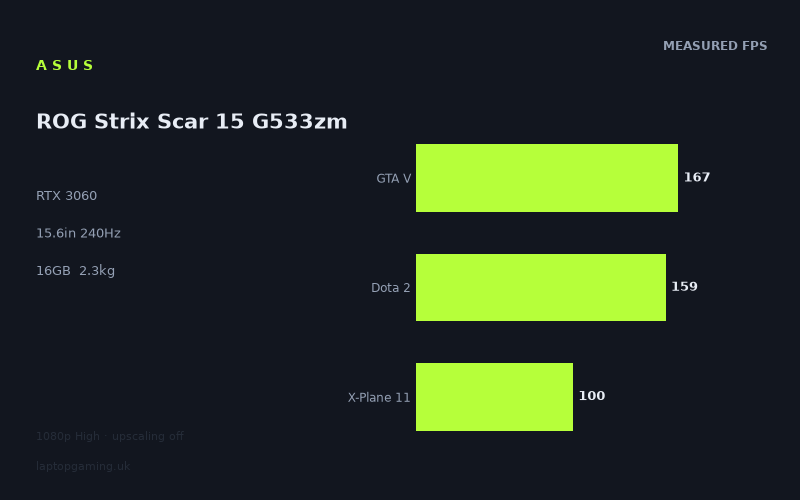
Frame rates
1920×1080, High preset, upscaling off.
Measured on this machine. Source: Notebookcheck, 2024-11-01.
Not scored: incomplete benchmark suite
Every scored laptop on this site is averaged over the same 5 games, and this one is short of Cyberpunk 2077, Baldur's Gate 3. A mean over 5 games is not comparable to a mean over 5, so we publish the figures we have and leave the score blank rather than rank it against machines tested on a different set. The numbers below are real - the suite is just incomplete.
How these numbers were produced
Frame rates here are not measured by us, and we label how each one was arrived at. A figure marked measured comes from a published run on that exact machine. A figure marked representative is derived from the GPU and its power limit (TGP) and cross-referenced against published reviews - a sound estimate of what that configuration delivers, but not a measurement of that specific laptop. Unless stated otherwise, numbers are 1920x1080, High preset, upscaling off. Where a laptop ships in several power configurations we use the wattage of the exact SKU listed, because a 140W RTX 5070 and a 115W one are not the same product.
In use
The short version
The Asus ROG Strix Scar 15 G533zm is a performance-led 15.6in gaming laptop with a Core i9-12900H, an RTX 3060, 16GB of memory, a 1TB SSD and a 2560x1440 IPS display running at 240Hz. The important point is that its published gaming results are considerably more varied than the headline specification might suggest. At 1920x1080 on the High preset with upscaling off, Notebookcheck recorded excellent results in several lighter or older games, but substantially lower figures in the more demanding titles. It is capable of very fast play, but it is not a machine that can be assumed to drive its 240Hz panel at anything close to full refresh in every modern game.
The measured five-game scoring-suite average is 138fps. That is a strong average in isolation, and it shows that this is not an underperforming RTX 3060 laptop in ordinary 1080p gaming. However, the average needs reading alongside the individual figures. Strange Brigade reaches 176fps, GTA V 167fps and Dota 2 159fps, while X-Plane 11 records 100fps and Final Fantasy XV 88fps. Cyberpunk 2077 1.6, although outside that five-game average, is at 63fps. This is a laptop that delivers a very different experience depending on the game engine, the game’s CPU demands, and how heavily the title leans on the GPU.
Buy it if the appeal is a high-refresh QHD screen for competitive games, older games, less graphically punishing games and general desktop use, while accepting that demanding games will need sensible expectations. The combination of a 240Hz IPS panel and the Core i9 is particularly useful where a game can generate high frame rates. In the games Notebookcheck measured, the laptop is clearly capable of fast output. It is not, though, a convincing choice for somebody buying specifically to play every current demanding game at the screen’s native 2560x1440 resolution on High settings without compromises. The published figures are at 1920x1080, not 2560x1440, and the more demanding results at 1080p are already well below the panel’s maximum refresh rate.
The Core i9-12900H is a serious processor for this class of machine, and it helps explain why the Scar 15 can stay close to laptops with nominally more powerful graphics chips in the lighter games shared with its rivals. That should not be misread as proof that every RTX 3060 behaves like an RTX 3070 or RTX 3080. At 1080p, some games become limited more by processor performance than by graphics power, which compresses the gaps between otherwise very different GPUs. The benchmark comparison is useful precisely because it shows both sides of that story: the Scar 15 can be level with some higher-tier machines in the shared set, yet it falls clearly behind the high-power RTX 3080 Ti laptop.
There is no confirmed UK price for this exact configuration. As a result, a value assessment cannot be calculated and this machine has no overall score here; that is solely because price is needed for the value portion of the calculation, not because the benchmark suite is incomplete or because there is anything unusual about its ranking. The performance data is complete enough to judge the laptop’s gaming character, but not whether it is a good deal in pounds.
The 2.328kg weight and 90Wh battery place it in the substantial, performance-first end of the 15.6in market. It is portable in the basic sense that it is a laptop rather than a fixed desktop, but the available specification does not support presenting it as a light travel machine. There are also no published battery-life figures in the fact sheet, so the 90Wh capacity should not be turned into an unsupported claim about how long it lasts away from mains power.
Performance
What the measured numbers actually say
Notebookcheck measured the Asus ROG Strix Scar 15 G533zm at 1920x1080, using the High preset with upscaling disabled. That last condition matters. These are not figures inflated by an upscaling mode, nor are they native-resolution results for the built-in 2560x1440 display. They are a clean, comparable 1080p High snapshot of what the Core i9-12900H and RTX 3060 combination can do across a useful spread of games.
- Strange Brigade: 176fps
- GTA V: 167fps
- The Witcher 3: 165fps
- Dota 2: 159fps
- Far Cry 5: 123fps
- X-Plane 11: 100fps
- Final Fantasy XV: 88fps
- Cyberpunk 2077 1.6: 63fps
The five scoring-suite games produce a mean of 138fps. That is useful as a broad indication of throughput, but it should not become the entire buying decision. A mean smooths away the very thing that matters most to someone selecting settings: this laptop ranges from 176fps in Strange Brigade down to 88fps in Final Fantasy XV within the scoring suite. Add Cyberpunk 2077 1.6 and the measured range stretches further, to 63fps. One number can describe the overall class of performance; it cannot tell an owner whether a particular game will feel like a high-refresh showcase or a title where the panel’s 240Hz capability is largely unused.
The top end is genuinely quick. Strange Brigade at 176fps, GTA V at 167fps, The Witcher 3 at 165fps and Dota 2 at 159fps are all strong results for 1080p High gaming without upscaling. These are not merely acceptable frame rates. They indicate that the Scar 15 can deliver a responsive, fast-moving experience in games that are either less demanding by current standards, respond well to the system’s processor, or both. For a player whose library includes Dota 2, GTA V and comparable titles, there is a great deal of useful headroom above conventional refresh targets even though the figures remain below the screen’s stated 240Hz maximum.
Far Cry 5 at 123fps is the next step down, but it remains a strong outcome. It is well placed for fluid play and shows that the laptop does not only produce fast results in the very lightest games in the list. At the same time, it illustrates the point that a 240Hz label should be treated as the display’s capability rather than a promise of a matching frame rate. At the stated settings, Far Cry 5 is running well below 240fps. That is not a criticism of 123fps; it is a reminder that the panel is provisioned for the games and settings that can use it, rather than being fully saturated by every game.
X-Plane 11 at 100fps and Final Fantasy XV at 88fps show a more restrained side of the machine. Both are still usable, credible results for High settings with no upscaling, but they sit far from the figures posted by Strange Brigade, GTA V and Dota 2. A buyer who mainly plays simulation games should take the X-Plane 11 result seriously rather than assuming the 138fps scoring-suite mean describes their likely experience. Simulation workloads can respond very differently to processor limits, scene complexity and game-engine behaviour than a less simulation-heavy action title. The 100fps figure is respectable, but it does not transform the Scar 15 into a laptop that makes its 240Hz panel meaningful in every flight-simulation scenario.
Final Fantasy XV at 88fps is also important because it provides a useful reality check for the RTX 3060. This is a fast laptop in the right games, but High settings with no upscaling can still leave it short of the very high frame rates suggested by the display specification. That does not mean 88fps is poor. It means that the machine’s sensible role is high-quality, fluid gaming rather than unquestioning maximum-refresh gaming across the board.
Cyberpunk 2077 1.6 is the toughest result listed, at 63fps. It is outside the five-game scoring-suite mean, so it should not be folded into the quoted 138fps average. It is nevertheless arguably one of the most valuable figures for a buyer looking at a modern gaming machine. Cyberpunk 2077 is a much more demanding test of graphics performance than the titles sitting near the top of this list. At 1080p High with upscaling off, the Scar 15 remains capable of playable performance, but it is nowhere near the panel’s 240Hz ceiling. A purchaser focused on visually demanding recent games should start from this end of the results rather than from Strange Brigade’s 176fps.
The performance spread is the story
The wide gap between the 176fps result in Strange Brigade and the 63fps result in Cyberpunk 2077 1.6 is not a contradiction. It is the normal consequence of different games placing different demands on the processor and graphics hardware. The RTX 3060 has a fixed level of graphics capability, but the frame rate it delivers depends heavily on whether a game is principally limited by the GPU, by the CPU, by its simulation load, by its engine behaviour or by a mixture of all of those factors.
At 1920x1080, lighter titles can reach a point where graphics performance is no longer the sole limiting factor. The Core i9-12900H then matters greatly. That is one reason the Scar 15 can post 167fps in GTA V, 165fps in The Witcher 3 and 159fps in Dota 2. These figures should not be interpreted as a guarantee that the same RTX 3060 will maintain equivalent results in a graphically heavier game, or at the screen’s native resolution. They demonstrate that the platform has substantial speed where the workload allows it.
Conversely, Cyberpunk 2077 1.6 at 63fps is much closer to the sort of result that exposes the graphics side of the system. When the GPU has more work to do, the advantage of a strong processor cannot simply remove the graphics bottleneck. That is why it is unhelpful to describe the Scar 15 as either “a 176fps laptop” or “a 63fps laptop”. It is both, depending on the game. A good buying decision depends on recognising which category best resembles the games a person actually plays.
The same point applies to the 138fps mean. It is a strong summary of the scoring suite, but it is not a target that every game should be expected to achieve. The lower-scoring games in the set carry as much practical significance as the highest result. Someone spending most of their time in Dota 2 will see a markedly different return from the 240Hz panel than someone spending most of their time in X-Plane 11 or Final Fantasy XV. Someone primarily interested in Cyberpunk 2077 1.6 should expect a different tuning conversation again.
GPU power limit: what can and cannot be concluded
Graphics power limits are crucial in gaming laptops. Two machines carrying the same RTX 3060 name can perform differently if they are configured to allow different amounts of graphics power, and the cooling and platform design can also affect how consistently that performance is sustained. However, the fact sheet does not provide a specific GPU power limit for this Asus configuration. It would be wrong to attach an unverified wattage to the RTX 3060 or to claim that the published numbers arise from a particular power setting.
What the benchmark data does establish is the outcome, which is more useful than guessing at a missing specification. This Scar 15 produces a 138fps mean across the specified five-game suite, has several results above 150fps, reaches 123fps in Far Cry 5, records 100fps in X-Plane 11 and 88fps in Final Fantasy XV, and delivers 63fps in Cyberpunk 2077 1.6. Those figures describe a competent performance implementation in this set of 1080p High tests. They do not provide licence to infer an exact GPU power limit.
That distinction matters especially when comparing the Scar 15 with laptops using higher-tier RTX graphics. In low-resolution or lighter shared workloads, a fast CPU can narrow the observed gap because the GPU is not always the limiting component. In GPU-heavier workloads, graphics power and GPU tier tend to matter more. The rival data bears this out: the Scar 15 is effectively level with one RTX 3070 system and one RTX 3080 system in the relevant shared game sets, yet trails the RTX 3080 Ti laptop by a far more substantial margin. The near ties are real measurements, but they are not evidence that all graphics chips are interchangeable.
For a buyer, the practical lesson is straightforward. Do not pay for this laptop on the assumption that an RTX 3060 badge alone defines its performance, but do not dismiss it because the badge is below those of some rivals either. Read the actual game data. In this case, the measured figures show plenty of 1080p speed, but they also make clear that demanding games and the laptop’s QHD screen place greater pressure on the graphics hardware.
Settings choices matter more in the demanding games
The stated benchmark conditions are High settings, 1920x1080 and no upscaling. That is a sensible baseline, but it is only one settings point. The figures do not tell us what this Scar 15 would achieve with lower presets, different individual settings, upscaling enabled, ray tracing enabled, or at 2560x1440. Those outcomes must not be invented from the existing numbers.
What can be said is that the benchmark spread gives a sensible indication of where settings decisions will be most useful. In Strange Brigade, GTA V, The Witcher 3 and Dota 2, the measured numbers are already high enough that a player may value image quality, resolution or frame-rate consistency differently from someone working from the Cyberpunk 2077 1.6 result. In Cyberpunk 2077 1.6, the 63fps figure at the published settings gives much less room before visual changes begin to affect smoothness. In Final Fantasy XV and X-Plane 11, the measured 88fps and 100fps likewise argue for a more deliberate balance between graphics settings and frame-rate ambitions.
The important discipline is not to convert a 1080p High result into a promise about QHD. The Scar 15’s internal display has 2560x1440 pixels, while Notebookcheck’s figures are at 1920x1080. Native QHD asks the GPU to render a different workload, and no measured native-QHD results are supplied here. It is reasonable to say that the published results establish strong 1080p capability. It is not reasonable to claim an exact QHD frame rate, or to say that the laptop will hold any particular target at the panel’s native resolution.
The screen
A high-refresh QHD panel, but not a universal 240fps experience
The Scar 15 has a 15.6in IPS display with a 2560x1440 resolution and a 240Hz refresh rate. On paper, this is an ambitious screen specification for an RTX 3060 laptop. The resolution is higher than the 1920x1080 benchmark setting, while the refresh rate is high enough to reward very fast games. It is a display designed to serve more than one use case: high-refresh gaming where the laptop can provide the frames, and a sharper desktop or game image where native QHD is preferred.
The benchmark figures demonstrate that the 240Hz refresh rate is not wasted, but they also show that it is not a target the laptop reaches in the published games at the stated settings. The fastest result is Strange Brigade at 176fps. GTA V follows at 167fps, The Witcher 3 at 165fps and Dota 2 at 159fps. These are all fast outcomes and should make good use of a high-refresh display compared with a conventional panel, but each remains below 240fps.
That is a realistic outcome for this kind of combination. A 240Hz panel is a capability ceiling, not a guaranteed frame-rate floor. Its practical value on the Scar 15 is likely to be greatest in games which are lighter than the demanding end of the benchmark list, in games where settings are adjusted to favour frame rate, and in titles where the system is CPU-limited rather than heavily GPU-limited. The figures at hand support the first part of that argument: this laptop can reach well into the 150fps range in several games at 1080p High with no upscaling. They do not establish 240fps performance in the measured games.
At the other end, X-Plane 11 at 100fps, Final Fantasy XV at 88fps and Cyberpunk 2077 1.6 at 63fps show why the display should not be bought solely for its maximum refresh figure. These games will still benefit from a capable panel, but the measured output is much lower than 240fps. A buyer whose main priority is graphically demanding single-player games should regard the QHD resolution and IPS panel type as at least as relevant as the refresh-rate headline. The high refresh is a welcome reserve for games that can exploit it; it is not the central performance experience in every title.
Native resolution needs a separate judgement
The most important screen caveat is the mismatch between the panel resolution and the benchmark resolution. The display is 2560x1440, but all listed frame rates are measured at 1920x1080. This is not a minor technicality. It means the published data proves the Scar 15’s performance at 1080p High without upscaling, not its native-QHD performance.
There are several sensible ways a buyer might use a QHD high-refresh laptop display, but the fact sheet only supports hard performance conclusions for one of them: 1080p High with upscaling off. Anyone planning to play at 2560x1440 should treat the available figures as a baseline rather than as a direct forecast. The games already producing 63fps, 88fps or 100fps at 1080p are the clearest warning against assuming that native QHD High will automatically meet the same standard of smoothness.
That does not make the screen a poor match for the laptop. It makes it a flexible screen that needs a realistic owner. The high-resolution panel can be valued for sharpness and workspace as well as game frame rate, while the 240Hz capability is there when a title and chosen settings permit very high output. The problem only arises if the specification is read as a promise that the RTX 3060 will deliver native-resolution High gaming at 240fps. Notebookcheck’s 1080p results do not support that claim.
What the IPS specification tells us, and what it does not
The panel is specified as IPS. That identifies the display technology, but the supplied information does not include measured brightness, contrast, colour coverage, response behaviour, HDR capability, adaptive-sync support or any panel-quality assessment. Those areas should therefore remain open rather than being filled with generic claims about IPS displays.
The safe conclusion is that this is a 15.6in IPS panel with a 2560x1440 resolution and a 240Hz refresh rate. Those are meaningful specifications for a gaming laptop, particularly because the frame-rate data confirms that the machine can generate high output in several games. Beyond that, there is not enough information here to declare it especially colour-accurate, especially bright, especially fast in pixel response, or suited to a specific creative workflow. A screen specification is not the same as a complete screen review.
Build, size and portability
The weight points to a performance-oriented portable
The Asus ROG Strix Scar 15 G533zm weighs 2.328kg. That is the key physical figure supplied, and it places the machine firmly on the substantial side of 15.6in gaming laptops. It is not an ultralight system intended to disappear into a bag without thought. At the same time, it remains a single 15.6in laptop rather than a desktop tower, so it can serve users who want a powerful machine that can move between rooms, homes, workspaces or occasional travel locations.
The correct expectation is portability with compromise. The Scar 15’s component selection is built around gaming performance: a Core i9-12900H, RTX 3060, 16GB of memory, 1TB SSD and high-refresh QHD display are not the specification of a minimalist travel laptop. The 2.328kg weight reinforces that. It is better understood as a machine for somebody who needs mobility around a performance setup than as a machine for somebody who carries a computer for long periods every day.
No dimensions are provided in the fact sheet. It would therefore be wrong to make claims about its footprint, thickness, bag compatibility or desk space beyond the fact that it has a 15.6in display. Likewise, there are no published details here about chassis materials, keyboard layout, trackpad quality, ports, webcam, speakers or cooling noise. Those omissions matter because they are often decisive in day-to-day ownership. The available evidence allows a judgement about weight and gaming performance, not a complete physical-design verdict.
The 90Wh battery is capacity, not a battery-life result
The battery is rated at 90Wh. That is a substantial capacity figure, but capacity alone does not tell us how long the laptop runs in any specific use. Battery life varies with workload, screen settings, power mode, background activity and many other factors. There are no measured battery-life results supplied, so no endurance claim should be attached to the 90Wh specification.
For a buyer, the practical implication is simply that this machine has a 90Wh battery and that it is still a 2.328kg gaming laptop. Anyone whose purchase depends on a certain amount of unplugged use should seek measured battery data for this exact configuration before deciding. The gaming benchmark results are all that is available here for performance analysis; they do not tell us whether gaming on battery, office work away from mains power or video playback will meet a particular need.
Memory and storage are sensible, but not the whole ownership picture
The Scar 15 is specified with 16GB of memory and a 1TB SSD. For the games represented in the benchmark data, the machine clearly has enough overall platform capability to produce the listed results. The combination of a fast Core i9 processor and 16GB of memory is particularly relevant in games where CPU performance helps the system reach high frame rates.
However, the specification does not provide memory speed, memory configuration, storage performance measurements, spare storage capacity or upgrade information. It is not possible to say whether the supplied 1TB SSD is especially quick, whether the memory arrangement influences the benchmark results in a particular way, or what future expansion options exist. A buyer with a large game library should note the stated 1TB capacity, but should not assume anything beyond that capacity figure from the information available.
How it compares
Against the MSI Prestige 15 with RTX 3050 Ti
Against the MSI Prestige 15 with an RTX 3050 Ti at 105W, the Scar 15 averages 75fps ahead across four shared games. That is the largest advantage the Asus holds among the listed comparison machines, and it is a meaningful one. It places the Scar 15 in a distinctly faster gaming class than the RTX 3050 Ti Prestige in the shared set.
This is the comparison that most clearly supports choosing the Scar 15 for gaming rather than simply for having a discrete GPU. The Core i9-12900H and RTX 3060 combination is delivering much more frame-rate headroom than the MSI Prestige 15’s RTX 3050 Ti configuration in the games both machines hold. For someone whose priority is the difference between merely running a game and having enough performance for a high-refresh display to matter, the Asus has a clear advantage.
Neither machine has a confirmed UK price in the supplied information, so this cannot become a value comparison. The performance lead is clear, but there is no basis for saying whether it is worth any particular premium. The correct conclusion is limited but useful: if the choice is driven by gaming speed alone, the Scar 15 is substantially ahead of the RTX 3050 Ti Prestige in their four shared games.
Against the MSI Pulse GL76 with RTX 3070
The comparison with the MSI Pulse GL76 is more surprising. The Pulse has an RTX 3070 at 105W and is listed at GBP 1,788, yet the Scar 15 averages 0fps behind across five shared games. In practical terms, the two machines are level in that shared benchmark set.
This should not be reduced to a simplistic statement that the RTX 3060 equals the RTX 3070. It does not establish that. The shared tests are at 1080p, and the fact sheet specifically notes that lighter titles in this sort of shared set can become CPU-bound at that resolution. Once a game is limited more by processor performance than by GPU performance, a genuine graphics gap is compressed. The Scar 15’s Core i9-12900H is therefore a major part of why it can stay level with a higher-tier GPU laptop in these particular games.
The result is still valuable. It tells a buyer not to shop entirely by GPU name. In the five shared games, the Asus does not surrender performance to the RTX 3070 Pulse GL76. That makes the Scar 15 a strong option for a player whose own library resembles those shared games and who values high 1080p frame rates. But it does not tell us that the two laptops will remain level in every GPU-heavy title, at native QHD, with other settings, or in workloads outside the shared benchmarks.
The listed GBP 1,788 price belongs to the MSI Pulse GL76, not to the Asus. Since the Scar 15’s UK price is unconfirmed, there is no legitimate way to say which is better value. The performance tie is real. A cost verdict is not available.
Against the Gigabyte Aero 17 HDR YD with RTX 3080
The Gigabyte Aero 17 HDR YD carries an RTX 3080, yet the Scar 15 averages only 1fps behind across five shared games. This is another near-zero result, and it needs the same careful interpretation as the MSI Pulse comparison. It does not mean an RTX 3060 has become an RTX 3080. It means that, in the specific shared games and benchmark conditions, the Asus and Gigabyte deliver effectively the same average frame rate.
The key context is 1920x1080 testing. At this resolution, lighter games can place enough of the burden on the processor that bigger GPU differences do not translate into proportionately bigger frame-rate differences. The Scar 15’s strong Core i9 platform helps it here. The shared-game average captures the actual observed result, which is the right evidence to use, but it should not be stretched beyond its conditions.
This comparison is especially relevant to buyers tempted to pay for a much higher GPU tier simply because it appears superior on a specification sheet. In the five games both machines hold, the data does not show a material performance advantage for the RTX 3080 Aero 17 HDR YD. A buyer whose games resemble that set should look closely at the rest of the ownership proposition rather than assuming the RTX 3080 label settles the matter.
There is no confirmed UK price for the Gigabyte in the supplied data, just as there is none for this exact Asus configuration. That prevents any value conclusion. It also prevents an argument that the Scar 15 is a bargain relative to the Aero, even though the shared frame-rate result is effectively tied.
Against the MSI Raider GE77 HX with RTX 3080 Ti
The MSI Raider GE77 HX is where the Scar 15’s limits become much more obvious. The Raider uses an RTX 3080 Ti at 175W and averages 31fps ahead across five shared games. Unlike the near-zero differences against the RTX 3070 Pulse and RTX 3080 Aero, this is a clear performance lead for the Raider.
This comparison shows why the earlier ties should not be overinterpreted. When the rival combines a higher-tier GPU with a stated 175W power figure, the performance gap reappears strongly enough to matter across the shared set. The Scar 15 remains a fast laptop, but it is not competing with the Raider as a maximum-performance machine. The 31fps deficit is the evidence that the RTX 3060 platform has a real ceiling even when its Core i9 processor allows it to perform very well in games that compress GPU differences.
The fact sheet does not provide a confirmed UK price for the Raider, so again this is a performance comparison rather than a value judgement. The Raider is faster in the shared games. Whether that speed advantage is worth any difference in cost, weight, battery behaviour or other ownership factors cannot be determined from the available information.
The comparison summary
The four rivals provide a useful spread. The Scar 15 is far ahead of the RTX 3050 Ti MSI Prestige 15, level with the RTX 3070 MSI Pulse GL76, effectively level with the RTX 3080 Gigabyte Aero 17 HDR YD, and clearly behind the RTX 3080 Ti MSI Raider GE77 HX. That pattern is more informative than a simple ranking by GPU model number.
For lighter shared games at 1080p, the Core i9-12900H helps the Scar 15 extract a great deal from its RTX 3060. That is why it can meet higher-tier machines in the shared averages. For a much more powerful high-power RTX 3080 Ti rival, the graphics advantage is large enough to show through. The buying lesson is to match the machine to the intended workload. If the priority is fast performance in games like the lighter shared titles, the Scar 15 is more competitive than its RTX 3060 label might imply. If the priority is the highest possible performance in demanding GPU-led games, the Raider comparison is the more relevant warning.
Who it’s for
Buy it for high-speed 1080p gaming with realistic QHD expectations
The Asus ROG Strix Scar 15 G533zm suits the player who wants a fast 15.6in gaming laptop and whose game library includes titles capable of producing high frame rates on this hardware. Strange Brigade at 176fps, GTA V at 167fps, The Witcher 3 at 165fps and Dota 2 at 159fps demonstrate that the machine has genuine high-refresh potential at 1920x1080 High with upscaling off. If those sorts of games dominate a library, the 240Hz display is not merely decorative. The published figures show enough output for the high-refresh panel to have practical value, even if none of those measured results reaches 240fps.
It also suits a buyer who values a strong processor alongside the graphics card. The Core i9-12900H is part of what makes this configuration competitive with the RTX 3070 and RTX 3080 rivals in their shared 1080p game sets. A player interested in games where high frame rates can become CPU-sensitive should not overlook that advantage. The Scar 15’s benchmark behaviour suggests a platform designed to deliver high output rather than simply relying on the GPU badge.
The QHD IPS screen is best suited to someone who sees resolution and refresh rate as two separate tools. Use the 240Hz capability in games where the laptop can deliver high frame rates. Treat the 2560x1440 resolution as a screen feature whose gaming performance needs settings choices and measured native-resolution evidence before making firm promises. That is a more sensible approach than expecting one configuration to provide maximum settings, native QHD and maximum refresh in every game.
The 2.328kg weight also suits a buyer who will mostly use the laptop as a movable gaming system rather than as an all-day carry machine. It can be a desktop replacement for someone who still needs to transport it occasionally. The 90Wh battery is a useful capacity specification, but the lack of measured battery-life data means this recommendation should not be extended to users who need proven unplugged endurance.
Buy something else if native-QHD demanding games are the priority
Someone buying primarily for the most demanding current games at 2560x1440 should be cautious. The available figures are at 1920x1080, and Cyberpunk 2077 1.6 records 63fps even at that lower benchmark resolution with High settings and no upscaling. Final Fantasy XV at 88fps and X-Plane 11 at 100fps reinforce the point that performance is not uniformly high-refresh once the workload becomes more demanding or behaves differently.
This does not make the Scar 15 unsuitable for those games. It means that a buyer who wants uncompromised native-QHD High performance needs more evidence than this fact sheet provides, and should not assume that the screen specification guarantees the result. The MSI Raider GE77 HX comparison also shows that there are machines with substantially more shared-game performance headroom. Its RTX 3080 Ti at 175W is 31fps ahead on average across five shared games. For a person who prizes maximum graphics performance above all else, that is the more relevant performance class.
Buy something else if lightness or proven battery life matters most
The Scar 15 is not the obvious choice for a buyer seeking the least burdensome laptop to carry. At 2.328kg, it is a substantial machine. There are no dimensions in the available data, so it would be wrong to make stronger claims about its physical bulk, but the weight alone is enough to rule it out for some users.
It is also not the right purchase to make on the basis of assumed battery life. The battery is 90Wh, but there are no measured endurance results. Buyers who spend much of the day away from mains power should require actual battery data rather than relying on capacity alone. A gaming laptop can have a large battery and still behave very differently depending on how it is used; no specific conclusion is supported here.
Do not buy on price until the exact UK configuration is confirmed
The final restriction is simple: there is no confirmed UK price for this exact Asus ROG Strix Scar 15 G533zm configuration. That means it cannot yet be called good value, poor value, expensive or competitively priced. Its performance position is clear enough: it is much faster than the RTX 3050 Ti Prestige 15 in the shared games, level with the RTX 3070 Pulse GL76 and RTX 3080 Aero 17 HDR YD in their shared sets, and behind the RTX 3080 Ti Raider GE77 HX. But performance alone does not settle a purchase without knowing the price.
As a machine, the Scar 15 makes the most sense for someone who wants strong 1080p High performance, appreciates a high-refresh QHD IPS display, and understands that game-by-game results matter more than a single GPU label. Its best numbers are genuinely fast. Its demanding-game results are more restrained. That is not a flaw in the data; it is the useful truth the data reveals.