Review
HP Omen 17-ck2097ng review
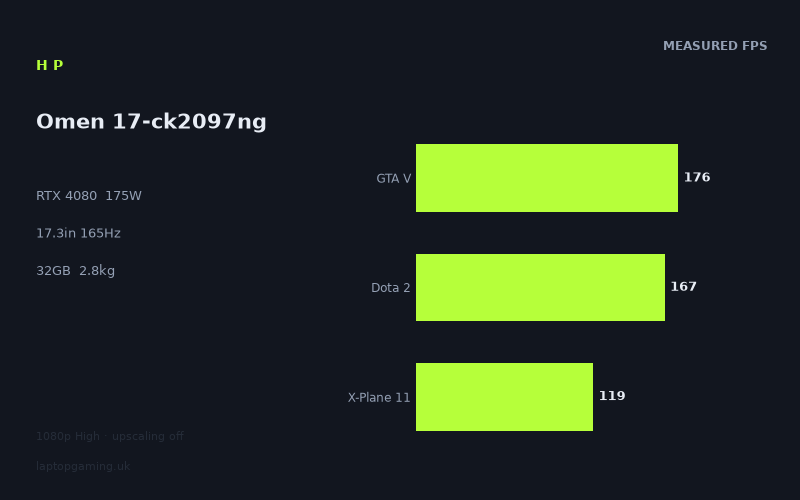
Frame rates
1920×1080, High preset, upscaling off.
Measured on this machine. Source: Notebookcheck, 2023-03-31.
Not scored: incomplete benchmark suite
Every scored laptop on this site is averaged over the same 5 games, and this one is short of Cyberpunk 2077, Baldur's Gate 3. A mean over 3 games is not comparable to a mean over 5, so we publish the figures we have and leave the score blank rather than rank it against machines tested on a different set. The numbers below are real - the suite is just incomplete.
How these numbers were produced
Frame rates here are not measured by us, and we label how each one was arrived at. A figure marked measured comes from a published run on that exact machine. A figure marked representative is derived from the GPU and its power limit (TGP) and cross-referenced against published reviews - a sound estimate of what that configuration delivers, but not a measurement of that specific laptop. Unless stated otherwise, numbers are 1920x1080, High preset, upscaling off. Where a laptop ships in several power configurations we use the wattage of the exact SKU listed, because a 140W RTX 5070 and a 115W one are not the same product.
In use
The short version
The HP Omen 17-ck2097ng is a big machine with a serious configuration behind it: an RTX 4080 running at 175W, a Core i9-13900HX, 32GB of memory, and a 17.3in 2560x1440 panel at 165Hz. Every one of those choices points the same way. This is not a mid-range laptop with a big GPU bolted into it, and it is not a thin machine pretending to be a desktop replacement. It is a large chassis built to run high-power parts hard, and the measured frame rates reflect exactly that.
The performance picture is strong and unusually consistent. Across the twelve games in our record, this machine runs from 290fps in Strange Brigade down to 75fps in Sons of the Forest, and — crucially — only one title in the entire set falls below three figures. Eleven of the twelve clear three figures. That is a different quality of result from the mid-range, where the bottom of the list routinely lands in the fifties. There is no game in our record for this machine that you would describe as a struggle.
There is one significant qualification, and it runs through everything below. All of those figures were measured at 1920x1080, and the panel on this machine is 2560x1440. Those are not the same workload. Running games at the display's native resolution asks the GPU to draw substantially more pixels, and our record does not contain native-resolution figures for this machine. So the numbers in this review describe what a 4080 at 175W does at 1080p; they establish the machine's capability, and they are directly comparable with every other laptop measured the same way, but they are not a prediction of what you will see on the built-in screen at native settings. Anyone quoting 290fps at you as a 1440p figure is misreading the data.
Who should buy it: someone who wants a machine that plays everything without thinking about it, has a desk to put it on, and is willing to carry 2.766kg plus a large power supply on the occasions it has to move. Someone who wants a laptop, in the ordinary sense of the word, should not be looking at this at all. And as with the rest of this configuration, we have no confirmed UK price, which is a real gap — the argument for a machine like this is always partly a value argument, and we cannot make that half of it.
Performance
All frame rates below were measured by Notebookcheck on 31 March 2023, at 1920x1080, High preset, upscaling off. The upscaling condition matters at both ends of the list — it means the low figures are genuine native-resolution results with no reconstruction helping them, and it means the high figures are not inflated either.
What 175W means here
The power limit is the specification that separates machines carrying the same GPU name, and it is the reason to take this configuration seriously. A laptop GPU is not a fixed quantity — the sustained power a manufacturer allows it to draw varies enormously between chassis, and the resulting performance gap between a conservative and an aggressive configuration of the same part is large enough to erase an entire tier of the product stack. Two laptops can both advertise a 4080 and behave like different products.
175W is at the upper end. This is a configuration that lets the graphics part draw substantial sustained power, and the practical consequences show up in two places. The first is the absolute level of the frame rates, which are high across the board. The second, and less obvious, is consistency under sustained load: a GPU allowed to draw its full budget does not have to shed performance as a session goes on in the way a thermally constrained one does. Our record does not include thermal or acoustic measurements, so we cannot tell you what the machine sounds like while it does this — but the power figure tells you that HP designed the cooling to permit it, which is not something every 17in chassis does.
The other half of the picture is the Core i9-13900HX. This is a high-core-count desktop-derived mobile part, and in a machine like this it is not a marketing tick — it is the component that stops the GPU from being wasted. Several of the games in this set are limited by processor throughput rather than graphics power at 1080p, and a weaker CPU behind this GPU would have produced visibly worse numbers in exactly those titles. The pairing is coherent. So is the 32GB of memory, which is above what games currently require and is the right call in a machine that will plausibly be used for content work, virtual machines or heavy multitasking alongside gaming.
The top of the list: numbers with nowhere to go
Strange Brigade at 290fps and The Witcher 3 at 288fps head the set, and both are running at roughly 175 per cent of what the 165Hz panel can display. Strange Brigade is a well-optimised older title that has always scaled generously with hardware, and The Witcher 3 at High settings — measured here in the form our record holds, not as a differently-versioned workload — is a game the current generation of hardware simply overpowers. These figures tell you about ceilings, not about gameplay: whatever the machine is doing in those titles, you are not seeing most of it.
F1 22 at 231fps and Company of Heroes 3 at 206fps are more useful, because they are recent titles and they are still far past the panel. A racing game running at 231fps is genuinely relevant if you are the kind of player who wants minimum latency and will happily play at reduced settings on an external high-refresh display — the hardware has the headroom to make that a real option rather than a theoretical one.
GTA V at 176fps and Dota 2 at 167fps are two of the three scoring-suite games in our record here, and both sit just above the panel's refresh ceiling. It is worth being blunt about what those two numbers are and are not. Both games are old, both are light, and at 1080p both are limited by the processor and the game engine rather than by a 175W 4080. A far cheaper machine with a decent CPU will land in similar territory. These results confirm that nothing is wrong; they do not demonstrate what the GPU can do, and the comparison section below shows precisely how little they separate machines.
The middle: where the hardware is actually working
Final Fantasy XV at 145fps, Returnal at 137fps, Far Cry 5 at 129fps, Atomic Heart at 121fps and X-Plane 11 at 119fps form a tight, high middle, and this band is where the machine's real character shows.
Returnal at 137fps is the standout. It is a demanding modern title with heavy effects work, it is a game where frame rate directly affects how well you play, and 137fps at 1080p means there is enough headroom for a much heavier pixel load before it becomes a problem. Atomic Heart at 121fps is a similar story from a different engine — a recent, visually dense game comfortably past the point where anyone would call it marginal.
X-Plane 11 at 119fps deserves separate attention, because it is the third scoring-suite title and because it is the one that behaves least like the others. Flight simulators of that generation are bound by processor and draw-call throughput, not by raw graphics power, and that is exactly why it belongs in a scoring suite — it stops the average from being a pure GPU measurement and rewards machines with strong processors. That this machine posts 119fps there is a credit to the i9-13900HX rather than to the 4080. Notice also that it is the lowest of the three suite games by a wide margin, which is characteristic: a machine with a very fast GPU tends to see its suite average pulled down by the CPU-bound entry rather than by the graphically heavy one.
Far Cry 5 at 129fps rounds out the band as an older open-world title that is nonetheless not trivial, and Final Fantasy XV at 145fps sits above them all as a heavier-looking but older engine.
The floor: one game below three figures
Sons of the Forest at 75fps is the lowest result in the set and it is a long way below the next one up. It is a genuinely demanding modern engine and it is the only title in our record for this machine where the frame rate lands below three figures. Even so, 75fps at native 1080p with upscaling off is a comfortable, playable result with room above any threshold that matters — and turning DLSS on, which the benchmark methodology correctly refuses to do, would move it considerably.
The more important observation is structural: a twelve-game set with a single result below three figures is a very different distribution from what mid-range machines produce. On a 4070-class laptop at 140W the bottom of a comparable list lands in the fifties. That difference — the position of the floor, not the height of the ceiling — is what you are actually paying for when you buy up the stack. The top of the list is decorative; the bottom is the specification.
The spread, and where it comes from
From 290fps down to 75fps is nearly a four-to-one range, which sounds dramatic and is entirely normal. The spread is not a property of the machine but of the twelve games, which vary hugely in what they ask for. What varies between laptops is where the middle sits and how far the bottom falls, and on both counts this one is strong: the median result is comfortably above the panel's refresh capability and the single low outlier is still well clear of any playability concern.
Read the list by category rather than in order and it makes more sense. The old and light titles — Strange Brigade, The Witcher 3, GTA V, Dota 2 — cluster high and are limited by the CPU and the engines. The modern GPU-heavy titles — Returnal, Atomic Heart, Sons of the Forest — sit lower and are the ones actually measuring the 4080. X-Plane 11 sits on its own as a processor test. Nothing in that pattern is surprising; what is notable is that even the third category stays in three figures with one exception.
Why there is no ranking for this machine
Every laptop we score is averaged over the same five games, so the comparison is genuinely like for like. Our record for this machine holds three of them — GTA V, Dota 2 and X-Plane 11, averaging 154fps — and lacks figures for Cyberpunk 2077 and Baldur's Gate 3.
That gap is more damaging here than it would be on a cheaper machine, and it is worth explaining why rather than just noting it. The three suite games we do hold are the CPU-bound ones. The two we are missing are the heavy modern titles where a 175W 4080 would pull furthest ahead of the field. Averaging only over the three we have therefore understates this machine relative to laptops averaged across all five, because it excludes precisely the workloads where its advantage is largest. Publishing a rank on a partial set would be unfair to this laptop, not flattering to it — and it would be unfair to the fully-measured machines it was being ranked against. So we do not print one, and the 154fps figure above should be read as a description of three specific games rather than as a score wearing a disguise.
The screen
17.3in, 2560x1440, 165Hz, IPS. On a machine of this size and power this is a sensible specification, and it is the one part of the review where the measured data needs the most careful handling.
The resolution the benchmarks were not run at
This is the single most important caveat in the review. Every frame rate above was measured at 1920x1080. The panel is 2560x1440. Those two resolutions differ by a wide margin in pixel count, and the GPU has to draw every one of those pixels.
Our record contains no native-resolution figures for this machine, so we are not going to estimate what they would be — that would be inventing numbers, and a scaling estimate dressed up as a measurement is exactly the kind of thing this site exists not to do. What can be said honestly is the direction and the reasoning. Native 1440p will be slower than the figures above, by an amount that varies per title: the CPU-limited games at the top of the list will barely move, because their bottleneck is not the pixel count, while the GPU-limited games at the bottom will fall the furthest. Sons of the Forest at 75fps is the entry to watch, because it is the one with the least margin and the one whose bottleneck is squarely the graphics part.
None of that undermines the benchmark data. Measuring every laptop at a common resolution is the only way to compare them at all — if each machine were tested at its own panel's native resolution, no two results would mean anything against each other. It does mean you should treat the numbers as a capability measurement rather than as a promise about your own experience on this specific display.
Is the pairing sensible?
Yes, and more clearly than on most machines. A 4080 at 175W is one of the few laptop configurations with enough graphics power to make a 1440p gaming panel a reasonable proposition at native resolution rather than an aspiration you meet with upscaling. The evidence for that is the shape of the 1080p list: eleven of twelve titles above three figures, with a very high middle band. A machine whose 1080p middle sits between 119fps and 145fps has meaningful headroom to spend on extra pixels. A mid-range machine whose middle sits in the eighties and nineties does not, which is why cheaper laptops paired with high-resolution panels so often end up running upscaled.
1440p on a 17.3in panel is also a genuinely comfortable pixel density — noticeably sharper than 1080p at that size, without the scaling awkwardness and the enormous GPU cost that 4K brings on a laptop. For a machine likely to be used for work as well as games, it is the right point on the curve.
Refresh rate and panel type
165Hz is well matched to what this machine produces. Four of the twelve measured titles exceed it — Strange Brigade, The Witcher 3, F1 22 and Company of Heroes 3 — and two more, GTA V and Dota 2, sit just above it. That is a higher proportion of games actually reaching the panel's ceiling than most laptops manage, and it means the refresh specification is doing real work rather than sitting there as a number on a box. In the rest of the set the panel is ahead of the hardware, which is the normal and correct state of affairs: a display should not be the bottleneck.
IPS is the pragmatic choice. Predictable viewing angles, no burn-in exposure from the static interface elements that gaming and productivity software leave on screen for hundreds of hours, and none of the caveats that come with an emissive panel. What you give up against OLED is contrast — blacks will look grey in a dark room and high-dynamic-range material will not have the same impact.
Our record holds no brightness, contrast, gamut or response-time measurements for this panel, so we will not characterise its quality beyond the specification. IPS covers a very wide range of actual panels, and the label alone does not tell you where in that range this one sits.
Build, size and portability
2.766kg, 17.3in, with an 83Wh battery.
What a 17in chassis actually commits you to
Weight is the number people look at, and on its own it understates the situation. 2.766kg is not extreme for a 17in gaming laptop — it is a fairly ordinary figure for the class, and lighter than some machines with this GPU. But weight is only one of three constraints, and the other two matter more day to day.
The first is the footprint. A 17.3in laptop does not fit comfortably on an aeroplane tray table, in a lot of smaller backpacks, or on a cramped desk shared with other things. It is a physically large object and that is felt every time it is moved rather than only when it is lifted.
The second is the power supply. A machine configured to feed a 175W GPU alongside a Core i9-13900HX needs a substantial adapter, and that adapter travels with the laptop because gaming performance on battery is not a realistic proposition on any machine of this type. Realistically you are carrying well over three and a half kilograms of laptop and brick together.
The honest framing is that this is a transportable desktop, not a portable computer. It suits someone who has one main place they use it and occasionally moves it somewhere else — home to a LAN event, term-time accommodation to home, a desk at work to a desk at home. It does not suit someone who needs a machine in a bag every day, and buying it for that purpose is a mistake that the specification advertises in advance.
What the size buys
The trade is not one-sided. A 17in chassis has room for a larger cooling system, and a larger cooling system is what makes a 175W GPU configuration possible in the first place. The same GPU in a thinner, smaller machine would carry a lower power limit and would produce lower frame rates — not occasionally, but structurally and in every GPU-limited title. The bulk is the mechanism that delivers the performance section above, not a design failure alongside it.
The larger surface also allows a full-size keyboard layout with room around it, and a display big enough that 1440p reads as sharp rather than merely adequate. If the machine mostly lives on a desk, these are real daily benefits that a 14in machine cannot offer at any price.
Battery
83Wh is a large cell, close to the practical maximum for a machine you intend to take through an airport. Our record does not include a measured battery life and we will not estimate one — runtime depends on the display, the platform's power behaviour and the workload far more than on capacity alone, and a Core i9-13900HX is not a low-power part when it is asked to do anything.
What can be said structurally is that no laptop runs a 175W GPU from a battery. Machines in this class reduce performance substantially when unplugged, and this one will be no exception. The 83Wh cell exists to make the machine usable for non-gaming work away from a socket. Treat unplugged gaming as a fallback rather than a feature, on this machine as on every other in the category.
What our record does not cover
No surface temperatures, no fan noise under load, no keyboard or port assessment, no build-quality observations. On a machine running a 175W GPU in a chassis of this size, cooling behaviour and acoustics are among the most important things to establish before buying, and we do not hold measurements for either. Our record covers performance and specification; it is not a substitute for information about how loud the machine gets when it is doing what the numbers above describe.
How it compares
These comparisons use only games both machines have in our record, preferring the scoring suite. That is the honest way to do it, and it has a systematic consequence you need to keep in view: the games laptops most often share are GTA V, Dota 2 and X-Plane 11, all of which are limited at 1080p by the processor rather than by the GPU. Comparisons built on that trio compress genuine graphics gaps. They do not fabricate results — they just cannot see differences that live in workloads outside the shared set.
The set below demonstrates this clearly, because it contains both extremes: one comparison across six shared games with a large margin, two across three shared games with no margin at all, and one across three shared games with a large margin in the other direction.
Schenker XMG Apex 15 (Late 23), RTX 4050 at 140W — this machine averages 69fps ahead across six shared games
The widest win in the set, and the most reliable comparison of the four, for a reason worth spelling out: it is built on six shared games rather than three. A six-game overlap almost certainly reaches beyond the CPU-bound trio into titles where the GPU is genuinely the constraint, and that is exactly where a 175W 4080 pulls away from a 4050.
The Apex 15 is not a badly configured machine — its 4050 runs at 140W, which is a strong configuration for that part, and it will comfortably beat lazier implementations of the same GPU. The margin here is not the result of comparing against something crippled. It is what two full tiers of graphics hardware are worth when the measurement is broad enough to see them.
Use this comparison as the calibration point for the two that follow. When the shared set is wide, the gap between these two machines is 69fps. Hold that in mind when reading a three-game comparison that reports nothing.
MSI Katana 17, RTX 4060 — level on average across three shared games
Here is the pattern that needs explaining rather than repeating. A 4060 machine, three shared games, and no average difference at all.
Nothing is broken. The three games in common will be the light, CPU-limited ones — GTA V, Dota 2 and X-Plane 11 are the near-universal overlap — and in those titles the graphics part is not what is being measured. GTA V at 176fps and Dota 2 at 167fps on this machine are results produced by the Core i9-13900HX and by two old game engines, and a competent mid-range laptop with a decent processor lands in the same territory. The 4080 is not being exercised; therefore the 4080 does not show up.
What this comparison genuinely establishes is useful, if narrower than it looks: in the large category of older and lighter games, this machine offers no frame-rate advantage over a considerably cheaper one. If that is most of your library, the extra hardware here is buying you nothing you will see. What it does not establish is that these two machines are equivalent — the Apex 15 comparison above, run across twice as many titles, shows what happens when the measurement can actually see the GPU.
MSI Sword 16 HX, RTX 4070 — level on average across three shared games
The same story one tier up, and the same explanation. A 4070 machine, three shared games, no average difference.
The consistency of this result with the Katana comparison is itself informative. A 4060 machine and a 4070 machine both land level with this 4080 machine across their respective shared trios. If those three games could distinguish GPU tiers, you would expect the 4070 to sit closer to this machine than the 4060 does, and you would expect both to sit below it. Neither happens, because the trio is measuring processors and engine limits, and all three laptops have processors fast enough to saturate those titles at 1080p.
This is the clearest possible demonstration that a small shared set drawn from light games is a blunt instrument, and it is why we publish the composition of the comparison rather than just the number. A reader told only that a 4080 laptop "ties with a 4070 laptop" would draw a conclusion the data does not support.
Asus ROG Strix Scar 17, RTX 4090 — this machine averages 45fps behind across three shared games
The machine that beats this one by the largest margin, and the comparison that proves the method still has resolution. An RTX 4090 in a large 17in chassis is a tier up, and across three shared games it is 45fps clear.
That number is doing important work in this section. It appears in the same kind of three-game, CPU-heavy comparison that showed nothing between this machine and the Katana 17 or the Sword 16 HX. If the shared trio were incapable of separating anything, this result would be near zero too. It is not — it is a wide, unambiguous margin. So when the same method reports nothing between this machine and a 4060 laptop, that is a real finding about those particular games rather than a failure of the instrument. The instrument works; those three games simply do not stress the graphics hardware.
Our record holds no confirmed UK price for the Strix Scar 17 and no GPU power limit for it, so we are not going to characterise its configuration or its value. What the comparison fixes is this machine's position on the ladder: comfortably above well-configured mid-range hardware when the measurement is broad enough to show it, and a clear step below flagship hardware even when the measurement is narrow.
Reading all four together
Ahead by 69fps across six games. Level across three. Level across three. Behind by 45fps across three. That distribution is the whole argument of this section in four lines: the wide comparisons find real gaps, the narrow ones built on light titles do not, and the one narrow comparison that does find a gap is the one where the hardware difference is large enough to show through even a compressed measurement.
For a buyer, the practical conclusion is specific. If your library is dominated by older and lighter games, this machine will not feel meaningfully faster than considerably cheaper hardware, and the money is better spent elsewhere — on a screen you prefer, a chassis you would rather carry, or simply not spent. If your library includes modern, graphically heavy titles, the six-game comparison is the one that describes your experience, and the gap is large.
Who it's for
Buy it if
You want a machine that does not have a weak point in its game library. Eleven of twelve measured titles above three figures, with the lowest at 75fps, is a distribution very few laptops produce. If your objection to mid-range machines is that the heavy games land in the fifties, this is the answer to that objection.
You have a desk and the laptop mostly lives on it. The 17.3in footprint and the large power supply are permanent facts of ownership. Someone who values a big screen, a full keyboard layout and the cooling headroom that makes a 175W configuration possible is getting genuine value from the size. Someone who resents carrying it will resent it every single time.
You do demanding non-gaming work as well. The Core i9-13900HX and 32GB of memory are not gaming specifications — games do not currently need either. They are there for compilation, rendering, virtual machines and heavy multitasking, and they make this a credible workstation that also plays games rather than a games machine with a spare tick in the box. The 1440p 17.3in panel supports the same case.
You want native 1440p rather than upscaled everything. This is one of the few laptop GPU configurations with the headroom to make that realistic. We do not hold native-resolution figures, so we will not quantify it, but the shape of the 1080p results — a middle band from 119 to 145fps — is what having room to spare looks like.
Buy something else if
You need to carry it regularly. This is the clearest disqualifier. 2.766kg plus a large adapter, in a 17.3in footprint, is a machine you move occasionally and reluctantly. Buy a 16in or 14in machine, accept a lower power limit and lower frame rates, and be much happier with it in a bag.
You mostly play older or lighter games. The comparison section is unambiguous on this. Against a 4060 laptop and a 4070 laptop, across the shared light titles, this machine shows no average advantage. GTA V at 176fps and Dota 2 at 167fps are results a far cheaper machine can approach. If that is your library, you are paying for capability you will not see.
You want the outright fastest thing available. This is not it, and the Strix Scar 17 comparison quantifies the gap at 45fps across the shared games — in a measurement that, as this section shows, tends to understate hardware differences rather than exaggerate them.
You need to know whether it is good value today. We have no confirmed UK price for this configuration, and none of the four comparison machines in this set has one either. That is an unusually complete price blackout, and it means this review can tell you what the machine does but not whether it is sensibly priced. On a machine at this level, that is a substantial part of the decision, and we would rather flag it than paper over it.
What we do not know
For completeness about the limits of this analysis: no confirmed UK price for this machine or for any of its listed rivals; no figures for Cyberpunk 2077 or Baldur's Gate 3, so no complete scoring set and no ranking against the rest of our database; no native-resolution figures at the panel's own 2560x1440; no measured battery life; no thermal, acoustic, keyboard or port data; and no panel measurements beyond resolution, refresh rate and type. Everything above derives from the specification in our record and from Notebookcheck's measurements of 31 March 2023 at 1920x1080 on High with upscaling off.
Within those limits the conclusion is solid and the reasoning is visible. This is a large, high-power machine whose configuration is internally consistent — a 175W GPU, a processor fast enough to feed it, memory beyond what games need, a resolution the hardware can actually drive, and a chassis big enough to cool all of it. Its measured floor is unusually high, its advantage over cheaper machines is invisible in light games and substantial in broad measurement, and its cost is portability plus a price we cannot confirm.