Review
MSI GS76 Stealth review
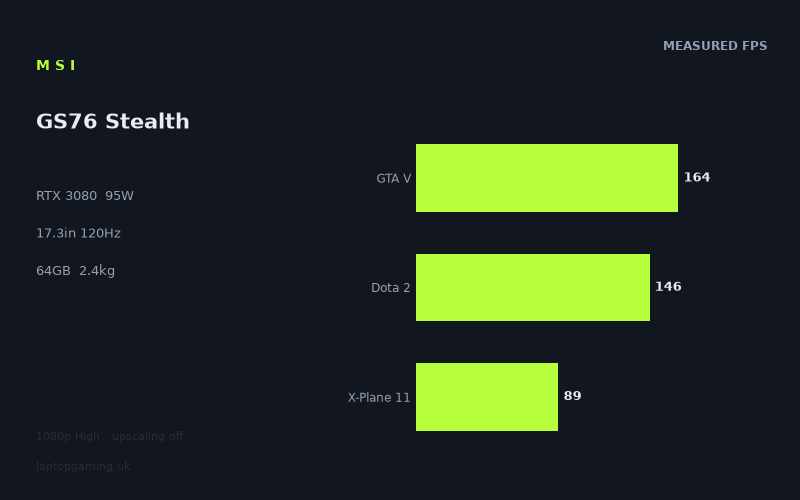
Frame rates
1920×1080, High preset, upscaling off.
Measured on this machine. Source: Notebookcheck, 2021-09-19.
Not scored: incomplete benchmark suite
Every scored laptop on this site is averaged over the same 5 games, and this one is short of Cyberpunk 2077, Baldur's Gate 3. A mean over 5 games is not comparable to a mean over 5, so we publish the figures we have and leave the score blank rather than rank it against machines tested on a different set. The numbers below are real - the suite is just incomplete.
How these numbers were produced
Frame rates here are not measured by us, and we label how each one was arrived at. A figure marked measured comes from a published run on that exact machine. A figure marked representative is derived from the GPU and its power limit (TGP) and cross-referenced against published reviews - a sound estimate of what that configuration delivers, but not a measurement of that specific laptop. Unless stated otherwise, numbers are 1920x1080, High preset, upscaling off. Where a laptop ships in several power configurations we use the wattage of the exact SKU listed, because a 140W RTX 5070 and a 115W one are not the same product.
In use
The short version
The MSI GS76 Stealth is a high-specification 17.3in gaming laptop built around an RTX 3080, a Core i9-11900H, 64GB of memory and a 2TB SSD. On paper, that is an expensive-class component list. The important qualification is that this RTX 3080 runs at a 95W GPU power limit, not at the much higher limits available in thicker performance-led laptops using the same generation of graphics hardware.
That distinction matters more than the RTX 3080 badge alone. Notebookcheck’s measured figures show that the GS76 can be extremely quick in lighter games and in titles that are not placing the whole load on the GPU. Star Wars Squadrons reaches 228fps, FIFA 21 reaches 227fps, Strange Brigade reaches 185fps and The Witcher 3 reaches 174fps at 1920x1080 on the High preset with upscaling disabled. Those results are well suited to the laptop’s 120Hz display refresh rate if you are playing at 1080p rather than the screen’s native 3840x2160 resolution.
But the same data also shows why the GS76 should not be treated as an unrestricted 4K gaming machine simply because it has a 3840x2160 panel and an RTX 3080. The slower end of the measured list includes Crysis Remastered at 79fps, Final Fantasy XV at 88fps and X-Plane 11 at 89fps. These are still playable-looking results at the tested 1920x1080 High setting, but they are below the screen’s 120Hz refresh ceiling. Moving from the tested resolution to the native panel resolution would demand substantially more work from the GPU, and there is no published 3840x2160 frame-rate data in the fact sheet to demonstrate that this configuration can sustain high-refresh native-resolution gaming.
The most useful way to understand this laptop is as a large-screen machine with strong 1080p performance, a high-resolution IPS panel that gives you a choice between sharp desktop use and more practical gaming resolution, and unusually generous memory and storage for the specification. It is not a machine whose graphics card name should be used as shorthand for maximum performance from this GPU generation. The 95W limit is central to the buying decision.
The benchmark data is complete and the GS76 ranks normally on the frame-rate leaderboard, but there is no confirmed UK price for this exact configuration. That means value cannot be calculated. This is not a criticism of the machine or its benchmark results; it is simply not possible to judge whether its performance is good value without a confirmed price. It would be misleading to speculate about what this configuration should cost.
Buy the GS76 only if its particular combination of a 17.3in 3840x2160 IPS display, 64GB of memory, 2TB SSD capacity and credible 1080p gaming results matches your priorities. It makes the most sense for someone who wants a large, high-resolution laptop screen and who is content to set demanding games below native resolution when frame rate matters. It is less compelling for someone buying primarily for the fastest possible RTX 3080-class gaming performance, for someone determined to run every game at 3840x2160, or for anyone expecting the RTX 3080 label to guarantee that the panel’s 120Hz refresh rate will be fully used in every title.
Performance
What Notebookcheck’s measured figures show
The published measurements were taken by Notebookcheck on 2021-09-19 at 1920x1080, using the High preset with upscaling off. That test method is important. These are not native-resolution results for the GS76’s 3840x2160 panel, and they are not results assisted by an upscaling mode. They show the raw performance available when the laptop is asked to deliver conventional 1080p High gaming.
Across the five scoring-suite games, the GS76 records a mean of 134fps. The individual scoring-suite results are 185fps in Strange Brigade, 164fps in GTA V, 146fps in Dota 2, 89fps in X-Plane 11 and 88fps in Final Fantasy XV. That spread is wide, and it is more informative than the mean alone. A 134fps average can sound as though the laptop will regularly sit beyond the screen’s 120Hz refresh rate. The individual figures show that this is true in some games but not in all of them.
Strange Brigade at 185fps is comfortably beyond 120Hz. GTA V at 164fps and Dota 2 at 146fps are also above the panel’s refresh ceiling in this test. In those games, the GS76 has enough measured performance at 1920x1080 High to supply more frames than the display can show each second. That does not mean every part of the experience is automatically identical between titles, but it does mean there is no basic shortage of frame rate relative to the panel refresh in those particular measurements.
X-Plane 11 at 89fps and Final Fantasy XV at 88fps tell a different story. Both remain below 120fps at the same test settings. The gap is not evidence that the laptop has become weak; it shows that game engines, rendering workloads and processor demands vary substantially. A gaming laptop should be judged by where its performance lands in difficult games as well as by the very high numbers it can produce in favourable ones. The GS76 delivers very high 1080p results in several games, but its published data does not support a claim that it can turn every High-preset game into a 120fps experience.
Looking beyond the scoring suite makes that pattern clearer. Star Wars Squadrons reaches 228fps and FIFA 21 reaches 227fps, both far above 120fps. Monster Hunter Stories 2 records 144fps and Gears Tactics records 138fps, again above the display refresh rate. The Witcher 3 reaches 174fps, while F1 2021 reaches 172fps. Far Cry 5 records 125fps, narrowly clearing 120fps. In practical terms, these are the results that make the GS76 look convincing as a 1080p high-refresh machine.
The more demanding or differently limited titles sit lower. Hunt Showdown records 110fps. Death Stranding and Mafia Definitive Edition each record 102fps. X-Plane 11 records 89fps, Final Fantasy XV reaches 88fps and Crysis Remastered reaches 79fps. There is no single result here that makes the laptop unsuitable for gaming, but there is a clear performance hierarchy. A buyer interested in games resembling Star Wars Squadrons, FIFA 21, Strange Brigade, The Witcher 3 or F1 2021 can reasonably expect measured frame rates that make strong use of a 120Hz display at the tested settings. A buyer whose priorities are closer to Crysis Remastered, X-Plane 11 or Final Fantasy XV should expect to be below 120fps at those settings.
The 95W RTX 3080 needs to be read in context
The GS76 uses an RTX 3080, but it is an RTX 3080 configured at 95W. GPU names matter, but their power limits matter too. The same graphics family can appear in laptops designed around markedly different power budgets. A 95W RTX 3080 is not automatically comparable with every other RTX 3080 laptop simply because the GPU name is the same.
The performance comparison in the published rival data makes this especially clear. The MSI Raider GE77 HX uses an RTX 3080 Ti at 175W and averages 35fps ahead of the GS76 across five shared games. The Raider has a different GPU model as well as a much higher GPU power limit, so it is not a simple one-variable comparison. Still, it demonstrates the broader point: the GS76 is not configured as the no-compromise, highest-power expression of this generation’s high-end graphics hardware.
At the other end of the comparison list, the MSI Prestige 15 has an RTX 3050 Ti at 105W, and the GS76 averages 68fps ahead across four shared games. That is a much clearer performance advantage for the GS76. The Prestige’s listed power limit is higher in watts, but it uses a different and lower-tier GPU. Power limit alone does not define performance; the GPU itself remains fundamental. The GS76’s RTX 3080 has the performance headroom to establish a large lead over that RTX 3050 Ti system in the shared results.
The more surprising comparisons are the two machines where the average difference is effectively absent. Against the Schenker XMG Fusion 15, fitted with an RTX 3070 at 145W, the GS76 averages +0fps across five shared games. Against the Acer Predator Triton 300 SE, with an RTX 3060 at 95W, it also averages +0fps across five shared games. Those results should not be rewritten as proof that all three GPUs are equivalent. They are a result from limited shared game sets at 1920x1080, where lighter titles can become CPU-bound and compress real GPU differences.
That compression matters at 1080p. When a game is already producing very high frame rates, the limiting factor may not remain purely the graphics processor. Processor work, game engine behaviour and the individual benchmark workload can have a larger influence. In a shared set containing lighter titles, a faster GPU may not create a proportionately larger headline difference because the system is no longer gaining frames in a simple GPU-limited way. The near-zero averages are therefore real published results, but they should be interpreted as evidence about those shared games at those settings, not as a universal statement about the relative value of an RTX 3080, RTX 3070 and RTX 3060.
The practical consequence for the GS76 is straightforward. Its 95W RTX 3080 delivers high performance, but it should be bought on the strength of the results actually measured rather than on the assumption that it will dominate every laptop carrying a lower GPU name. At 1080p, the data shows a machine that can be extremely fast. It also shows a machine whose GPU advantage can be hidden in lighter shared workloads, and whose lower power limit leaves it behind a much higher-power RTX 3080 Ti system.
Where the game-to-game spread comes from
The GS76’s results range from 228fps in Star Wars Squadrons to 79fps in Crysis Remastered. That is a substantial difference within one laptop at one resolution and one broad preset level. It is a reminder that “High” is not a standardised workload between games. Each game has its own engine, rendering techniques, processor demands and balance between graphics load and other system work.
FIFA 21 at 227fps and Star Wars Squadrons at 228fps are examples of games where the GS76 reaches very high measured frame rates. These are the results that make 120Hz feel like a sensible match for 1080p gaming. The laptop has considerable room above the display refresh ceiling in both cases. Strange Brigade at 185fps, The Witcher 3 at 174fps and F1 2021 at 172fps also sit well into high-refresh territory.
GTA V at 164fps, Dota 2 at 146fps, Monster Hunter Stories 2 at 144fps and Gears Tactics at 138fps remain above 120fps, but with less headroom. Far Cry 5 at 125fps is closer still. These figures are useful because they show a more realistic middle ground than the headline-leading results. The GS76 can exceed the panel refresh rate in a substantial selection of measured games, but some titles leave little room for heavier scenes, altered settings or higher resolution.
Hunt Showdown at 110fps, Death Stranding at 102fps and Mafia Definitive Edition at 102fps occupy a different category. They are close enough to 120fps that the laptop is still delivering a fast gaming result at 1080p High, but the panel’s refresh rate is no longer fully supplied by the benchmark figure. This is where display refresh and frame rate should be separated. A 120Hz screen is capable of showing up to 120 frames each second, but it does not make a game run at 120fps. The laptop has to produce those frames, and the published data says it does not always do so.
Crysis Remastered at 79fps is the clearest warning against treating this as a blanket 120fps machine. The result remains far from poor in isolation, but it is well below the panel refresh maximum. X-Plane 11 at 89fps and Final Fantasy XV at 88fps reinforce the same point. A buyer who values consistent high-refresh performance in the most demanding games will need to accept setting compromises, a lower resolution, or a different laptop configuration. The fact sheet does not contain alternate-setting results, so it would be wrong to promise a particular frame-rate outcome from such changes.
The screen
A 3840x2160 IPS panel with a 120Hz refresh rate
The GS76 has a 17.3in IPS display at 3840x2160 with a 120Hz refresh rate. This is an ambitious screen specification because it combines a large physical panel, a high resolution and a refresh rate above the conventional 60Hz level. It also creates an unavoidable tension between what the screen can display and what the measured gaming data proves at the native resolution.
The Notebookcheck results are all at 1920x1080, while the panel is 3840x2160. The tested gaming resolution is therefore below the screen’s native resolution. There are no native-resolution figures in the fact sheet, so no responsible review can state that this model runs any named game at a particular frame rate at 3840x2160. The correct conclusion is more limited but more useful: the GS76 has demonstrated strong 1080p High performance across much of the tested list, while its native-resolution gaming capability is unconfirmed by the provided benchmark data.
That does not make the screen specification pointless. A 3840x2160 panel can suit buyers who want more desktop space, sharper-looking static work or high-resolution media use, while the 120Hz refresh rate can be valuable in games where the laptop can exceed 120fps at a practical gaming resolution. The issue is not whether the panel is technically impressive. The issue is whether a buyer expects the same resolution and refresh rate to be fully exploited simultaneously in every game. The measured data does not support that expectation.
At 1920x1080 High, the GS76 exceeds 120fps in Star Wars Squadrons, FIFA 21, Strange Brigade, The Witcher 3, F1 2021, GTA V, Dota 2, Monster Hunter Stories 2, Gears Tactics and Far Cry 5. That is a long list, and it means the 120Hz capability is not merely decorative. There are many measured cases where the system can provide frame rates above the screen’s refresh ceiling.
However, Hunt Showdown, Death Stranding, Mafia Definitive Edition, X-Plane 11, Final Fantasy XV and Crysis Remastered are all below 120fps in the same 1920x1080 High test. Because 3840x2160 requires more graphical work than 1920x1080, it would be unsafe to assume that these games will meet the refresh ceiling at the panel’s native resolution. The same warning applies to the faster titles too: the fact that a game reaches 172fps or 228fps at the tested resolution does not establish a native-resolution result.
How to use this screen sensibly for games
The sensible reading of the specification is that the screen offers flexibility rather than a promise of one ideal setting for every game. The display’s 3840x2160 resolution is there when resolution is the priority. The 120Hz refresh rate is there when frame rate is the priority. The published 1920x1080 results show that the GS76 can make meaningful use of the high refresh rate in many games when played at the tested resolution and preset.
For games such as Star Wars Squadrons and FIFA 21, the measured results are far enough beyond 120fps that the display refresh rate becomes the visible limit at 1920x1080 High. For Strange Brigade, The Witcher 3 and F1 2021, the same broad conclusion applies. For Far Cry 5 at 125fps, the laptop is only just beyond 120Hz, so there is much less margin. For the games around 102fps to 110fps, the panel can still present a smooth high-refresh-capable experience, but the measured figures are not high enough to claim that the laptop is fully saturating 120Hz.
The IPS panel type is also relevant to the buying decision, but the fact sheet provides no measured panel quality data beyond panel technology, resolution and refresh rate. There are no supplied figures for brightness, contrast, colour coverage, response behaviour or outdoor visibility. It would therefore be inappropriate to make claims about colour-critical work, black levels or motion performance beyond the stated 120Hz refresh specification.
Buyers should also avoid confusing a 120Hz panel with a guarantee of 120fps at any chosen settings. The GS76’s data is an excellent example of why that distinction matters. It can produce 228fps in one measured game and 79fps in another. The panel is capable of refreshing at 120Hz throughout, but the game and settings determine whether the system feeds it enough frames to do so.
Build, size and portability
The GS76 is a 17.3in laptop weighing 2.384kg. That is the key portability fact supplied for this configuration. It is not a small-screen machine designed around minimum mass; the screen size alone places it in a category for buyers who value a larger built-in display. At 2.384kg, it is best understood as portable in the literal sense rather than as a laptop chosen primarily for effortless daily travel.
The advantage of a 17.3in format is obvious in the context of the 3840x2160 screen. A larger panel gives the high resolution more room to be useful for desktop tasks and for games where a large display area is preferred. The trade-off is that the laptop is still a 2.384kg device. Someone regularly moving between rooms, travelling occasionally, or using the laptop as a mostly fixed machine that can be relocated may find that reasonable. Someone who wants the lightest possible laptop for daily commuting should treat the weight as a serious consideration rather than an afterthought.
No dimensions are provided in the fact sheet, so there is no basis for claims about its footprint, thickness, bag fit or desk space beyond the stated 17.3in screen size and 2.384kg weight. Likewise, there is no battery-life, chassis-temperature or noise data supplied. Those aspects are important to a full ownership decision, but they cannot be filled in with assumptions. The available data supports conclusions about screen size, weight, component specification and gaming performance; it does not support a verdict on acoustic behaviour, battery endurance or thermal comfort.
The component mix suggests a machine intended to cover more than a narrow gaming role. The Core i9-11900H, 64GB of memory and 2TB SSD give it substantial specification headroom alongside the RTX 3080. But the fact sheet does not include productivity benchmark measurements, storage speed tests or application-specific results. It is fair to say that the memory and storage capacities are large within the stated configuration. It is not fair to turn that into unmeasured claims about editing, compiling, rendering or workstation performance.
The 2.384kg weight also changes how the high-resolution display should be judged. A 17.3in 3840x2160 panel is most attractive when the laptop is used for extended sessions rather than as a tiny secondary device. The GS76 appears better suited to a desk, a home setup, a student room, an office or occasional travel than to a buyer who wants the smallest and lightest system possible. That is not a criticism. It is a matter of matching the machine’s physical class to the buyer’s routine.
How it compares
Against the MSI Prestige 15
The MSI Prestige 15 uses an RTX 3050 Ti at 105W. Across four shared games, the GS76 averages 68fps ahead. This is the largest positive gap among the listed comparisons, and it is the clearest evidence that the GS76’s RTX 3080 is capable of delivering a materially higher gaming tier than a lower-end GPU configuration, even where the lower-end GPU has a listed 105W power limit.
The comparison is useful because it prevents an overly simplistic reading of TGP. The Prestige’s RTX 3050 Ti has a higher listed wattage figure than the GS76’s 95W RTX 3080, yet the GS76 is substantially faster in the shared data. The GPU model matters. A 95W limit constrains the RTX 3080 relative to higher-power implementations, but it does not erase the performance advantage of the larger GPU over an RTX 3050 Ti.
For a buyer choosing between these two types of machine primarily for gaming, the GS76’s 68fps average lead across the shared games is decisive evidence in its favour. There is no confirmed UK price for either listed configuration, so value cannot be compared. The conclusion is limited to the available data: the GS76 delivers much higher measured frame rates in the shared games.
Against the Schenker XMG Fusion 15
The Schenker XMG Fusion 15 is listed with an RTX 3070 at 145W. Across five shared games, the GS76 averages +0fps. That is a striking result because the Schenker has a lower GPU model number but a substantially higher listed GPU power limit. It is also exactly the sort of result that needs interpretation rather than repetition.
The shared-game average does not prove that an RTX 3070 at 145W is universally identical to an RTX 3080 at 95W. The result applies to the five shared games in the comparison. At 1920x1080, lighter games can become CPU-bound and reduce the visible impact of GPU differences. Once that happens, a faster or higher-tier GPU cannot necessarily turn its theoretical advantage into a larger frame-rate lead in the benchmark result.
For a buyer, the useful lesson is that the GS76’s RTX 3080 name alone does not establish a lead over every RTX 3070 laptop. The actual power configuration and the games played matter. If your game library resembles the shared set used here, the published result says there is no average frame-rate advantage for the GS76. If your buying decision depends on a broader set of games, higher resolutions or different settings, this comparison alone cannot settle it.
Against the Acer Predator Triton 300 SE
The Acer Predator Triton 300 SE uses an RTX 3060 at 95W, the same listed GPU power limit as the GS76, and the GS76 averages +0fps across five shared games. This is another near-zero result that should be treated as real but narrow. It is not a basis for claiming that an RTX 3060 and an RTX 3080 are interchangeable in all circumstances.
At the shared 1920x1080 workloads, the games can compress genuine GPU differences when the processor or game engine becomes the limit. This is especially plausible in lighter titles producing very high frame rates. The GS76’s own figures demonstrate how high some results can rise: 228fps in Star Wars Squadrons and 227fps in FIFA 21 leave plenty of scope for non-GPU limits to become important.
The practical conclusion is caution. A buyer comparing the GS76 with the Triton 300 SE should not pay for the RTX 3080 label alone on the expectation of an automatic advantage in every 1080p game. The shared data says there is no average difference in the five games compared. There are no confirmed UK prices for either exact configuration, so a value conclusion is not possible.
Against the MSI Raider GE77 HX
The MSI Raider GE77 HX is the clearest performance-led rival in the list. It uses an RTX 3080 Ti at 175W and averages 35fps ahead of the GS76 across five shared games. That is a meaningful gap, and it reflects the fact that the Raider is configured with both a higher GPU model and a far higher listed power limit.
The comparison places the GS76 accurately within its generation. It is not slow, and its own results frequently exceed 120fps at 1920x1080 High. But it is not the configuration to choose if the priority is extracting the most gaming performance from this class of hardware. The Raider’s shared-game lead shows that a higher-power design can move the performance ceiling materially higher.
That does not automatically make the Raider the better purchase for every buyer. The fact sheet supplies no confirmed UK price for either exact configuration, and it provides no comparative data on weight, display, battery, noise or temperatures for the Raider. What can be said is narrower and more useful: on the shared games, the Raider is faster by 35fps on average. A buyer who values maximum gaming frame rate should give that result substantial weight. A buyer who values the GS76’s stated 17.3in 3840x2160 IPS display, 64GB memory and 2TB SSD may still have different priorities, but the performance compromise is clear.
Who it’s for
The GS76 is for the buyer who wants a large 17.3in laptop with a 3840x2160 IPS display, 120Hz refresh capability, 64GB of memory and 2TB of SSD storage, and who understands that gaming settings may need to prioritise frame rate over native resolution. Its strongest measured case is 1920x1080 High gaming without upscaling. At that setting, it posts excellent results in Star Wars Squadrons, FIFA 21, Strange Brigade, The Witcher 3, F1 2021, GTA V, Dota 2, Monster Hunter Stories 2, Gears Tactics and Far Cry 5.
It is also for someone who values a machine that can move between high-refresh gaming and a high-resolution desktop environment. The display specification gives it a broader role than a straightforward 1080p gaming laptop. The important caveat is that the published performance data validates the high-refresh side at 1920x1080, not native 3840x2160 gaming. Buyers comfortable with that distinction can make good use of the specification.
The GS76 is not for the buyer who wants the maximum possible performance from an RTX 3080-class laptop. The 95W GPU power limit matters, and the MSI Raider GE77 HX’s 35fps shared-game lead shows what a higher-power RTX 3080 Ti configuration can achieve. If your main priority is the highest frame rate in demanding games, the GS76 is a compromise rather than the obvious destination.
It is also not for someone who expects every game to reach 120fps. Notebookcheck’s figures show 110fps in Hunt Showdown, 102fps in Death Stranding, 102fps in Mafia Definitive Edition, 89fps in X-Plane 11, 88fps in Final Fantasy XV and 79fps in Crysis Remastered. Those results are still respectable at the tested 1920x1080 High setting, but they are below the screen refresh ceiling. Native 3840x2160 performance is not supplied, so anyone who insists on gaming at the panel’s full resolution should look for directly attributable native-resolution data before buying.
It is not for a buyer choosing purely by GPU badge. The comparisons with the Schenker XMG Fusion 15 and Acer Predator Triton 300 SE both produce a +0fps average across their five shared games. Those averages do not erase the differences between RTX 3080, RTX 3070 and RTX 3060 hardware, but they do show that a laptop’s real gaming position depends on power configuration and the games being played. At 1080p, lighter shared titles can hide genuine GPU gaps.
Finally, it is not the obvious choice for someone whose first requirement is minimal carry weight. At 2.384kg with a 17.3in display, the GS76 is a large-screen laptop that can be moved, not a machine defined by ultra-light portability. There are no supplied dimensions, battery figures, noise figures or temperature figures, so those areas remain unknown rather than assumed.
The sensible conclusion is that the MSI GS76 Stealth is a capable but specific proposition. It offers strong measured 1080p gaming performance, often enough to make real use of its 120Hz display, alongside a high-resolution 17.3in IPS panel, 64GB of memory and 2TB of storage. Its 95W RTX 3080 does not deliver the highest ceiling available from this generation, and the screen’s native 3840x2160 gaming performance is unproven by the available figures. Buy it for the whole package and for the games where its measured results are strong, not for an assumption that the RTX 3080 name alone guarantees maximum-power performance or effortless native-resolution 120Hz gaming.