Review
Lenovo Legion 5 Pro 16ACH6H (82JQ001PGE) review
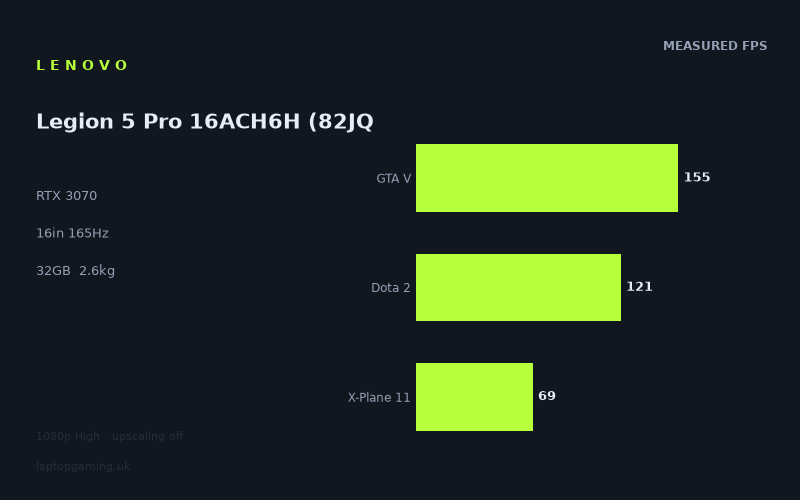
Frame rates
1920×1080, High preset, upscaling off.
Measured on this machine. Source: Notebookcheck, 2021-08-13.
Not scored: incomplete benchmark suite
Every scored laptop on this site is averaged over the same 5 games, and this one is short of Cyberpunk 2077, Baldur's Gate 3. A mean over 5 games is not comparable to a mean over 5, so we publish the figures we have and leave the score blank rather than rank it against machines tested on a different set. The numbers below are real - the suite is just incomplete.
How these numbers were produced
Frame rates here are not measured by us, and we label how each one was arrived at. A figure marked measured comes from a published run on that exact machine. A figure marked representative is derived from the GPU and its power limit (TGP) and cross-referenced against published reviews - a sound estimate of what that configuration delivers, but not a measurement of that specific laptop. Unless stated otherwise, numbers are 1920x1080, High preset, upscaling off. Where a laptop ships in several power configurations we use the wattage of the exact SKU listed, because a 140W RTX 5070 and a 115W one are not the same product.
In use
The short version
The Lenovo Legion 5 Pro 16ACH6H is a serious performance-focused gaming laptop built around an RTX 3070, a Ryzen 7 5800H, 32GB of memory and a 16in 2560x1600 IPS display running at 165Hz. The specification is clearly aimed at someone who wants high frame rates in competitive and older games, while retaining enough graphical headroom for demanding single-player titles.
Notebookcheck’s measured figures at 1920x1080, High settings and with upscaling disabled are strong. The laptop reaches 219fps in Strange Brigade, 218fps in F1 2021 and 207fps in F1 2020. Those are the sort of results that make proper use of a 165Hz panel possible, even if the screen’s native resolution is higher than the benchmark resolution. It is also quick in GTA V at 155fps, while The Witcher 3 reaches 132fps and Dota 2 reaches 121fps.
The important qualification is that this is not a machine that can be assumed to maintain 165fps in every game merely because it has a 165Hz display. Far Cry 5 reaches 112fps, Final Fantasy XV reaches 102fps, Far Cry New Dawn reaches 96fps, Cyberpunk 2077 reaches 81fps and X-Plane 11 reaches 69fps. These are still playable-looking results at the tested settings, but they show that the screen refresh rate is a ceiling rather than a guaranteed target.
The mean across the five scoring-suite games is 133fps. That is a healthy overall result, but the spread matters more than the average. The Legion is extremely fast in Strange Brigade and both F1 games, still strong in GTA V, but increasingly limited in heavier or more demanding workloads. Buyers should therefore see it as a machine for high-refresh gaming in favourable titles and high-settings gaming in tougher ones, rather than as a laptop that turns every game into a 165fps experience.
There is no overall score for this exact configuration because its UK price is not confirmed. That is not a criticism of the laptop or its benchmark position: the frame-rate suite is complete and it ranks normally, but price accounts for 30% of the calculation and cannot be assessed without a confirmed UK figure.
On the available evidence, the Legion 5 Pro makes most sense for the buyer who values performance before portability, wants 32GB of memory and 1TB of SSD storage, and is comfortable using settings adjustments when a game is too demanding for the panel’s full refresh rate. At 2.578kg, it is not the laptop to choose primarily for carrying around every day. It is a larger, heavier gaming system with a high-resolution screen and frame rates that are often excellent at 1920x1080, but which need to be interpreted carefully when considering the native 2560x1600 display.
Performance
What the benchmark data says
Notebookcheck measured the Legion 5 Pro at 1920x1080, using High settings with upscaling disabled. That matters because these are clean, directly attributable figures, but they are not native-resolution 2560x1600 results. The laptop’s display has substantially more pixels than the benchmark resolution, so the numbers should be treated as a useful indication of relative performance and likely settings flexibility, not as a promise of identical frame rates on the built-in panel at its full resolution.
The measured result in Strange Brigade is 219fps. That is comfortably beyond the display’s 165Hz refresh rate. It means the RTX 3070 and Ryzen 7 5800H combination has considerably more performance than the panel can show at once in this particular game and test setting. For a player focused on fast response, high refresh and consistent motion, Strange Brigade is an example of a title where the Legion’s hardware is operating with room to spare at 1920x1080 High.
F1 2021 is similarly quick at 218fps, while F1 2020 reaches 207fps. Again, both results exceed 165fps. These figures are important because they are not marginal wins over the screen refresh rate; they are clearly above it. That gives the owner useful flexibility. The machine can pursue the panel’s refresh ceiling at the tested resolution and preset, or it can trade some of that performance for higher resolution or different graphical choices. There are no measured native-resolution figures here, so the latter should not be treated as a firm prediction, but the benchmark headroom is real.
GTA V records 155fps. That remains a very high result, although it sits below the display’s 165Hz maximum. In practical terms, this is close enough to the panel’s refresh rate to make the screen specification feel well chosen, rather than wildly beyond what the hardware can use. It also illustrates why a simple statement that the Legion is either a “165Hz laptop” or a “not 165fps laptop” would be misleading. Performance moves game by game. A 155fps result is not the same as the 219fps seen in Strange Brigade, but neither is it evidence that the screen is wasted.
The Witcher 3 reaches 132fps. Dota 2 reaches 121fps. Both are clearly strong results, but neither reaches 165fps in the measured configuration. This is the middle of the Legion’s performance range: high enough for fluid play and high-refresh benefits, but below the point where the panel’s maximum refresh can be fully matched according to the measured numbers. That distinction matters especially for buyers whose priority is not merely high average performance, but a consistent ability to saturate a 165Hz display.
Far Cry 5 reaches 112fps, Final Fantasy XV reaches 102fps and Far Cry New Dawn reaches 96fps. These figures show the RTX 3070 working in a more conventional high-settings gaming range. None is poor, and all sit well above the sort of frame rate usually associated with basic playability. But they also underline that the Legion 5 Pro’s display is more ambitious than its measured performance in every game. The screen has room for more frames than the laptop supplies in these titles at the tested settings.
Cyberpunk 2077 reaches 81fps. That is one of the most useful figures in the list because it demonstrates the difference between games that reward a fast system with extremely high frame rates and games that remain demanding even on capable hardware. The Legion does not collapse in Cyberpunk 2077, but it is nowhere near the results recorded in Strange Brigade or the F1 games. A buyer who mainly plays graphically intensive games should base expectations closer to this kind of result than to the headline 219fps figure.
X-Plane 11 is measured at 69fps, the lowest figure supplied. It is a reminder that gaming performance is not solely an RTX badge or a simple consequence of resolution. Different engines, scene complexity and processor demands create very different outcomes. The Ryzen 7 5800H is a capable processor on paper, but the only directly attributable result available here is the game data itself. X-Plane 11 at 69fps demonstrates that there are workloads where this configuration will not approach the panel’s full 165Hz refresh rate, regardless of the much higher figures achieved elsewhere.
The performance spread is more useful than a single average
The mean across the five scoring-suite games is 133fps. That is a useful summary, but it should not replace reading the individual results. A mean can hide the difference between a laptop that is moderately quick in everything and one that is extremely fast in some games while more limited in others. The Legion 5 Pro is clearly the latter.
Its top measured figure, 219fps in Strange Brigade, is far above its 69fps result in X-Plane 11. Between those points are several distinct performance bands. F1 2021 and F1 2020 are above 200fps. GTA V sits at 155fps. The Witcher 3 and Dota 2 fall into the 132fps and 121fps range. Far Cry 5, Final Fantasy XV and Far Cry New Dawn range from 112fps to 96fps. Cyberpunk 2077 reaches 81fps, while X-Plane 11 is at 69fps.
That range is not a flaw in the benchmark data; it is exactly why publishing a list of attributable frame rates is more useful than presenting one simplified gaming claim. A laptop can look exceptional if the discussion stops at Strange Brigade and the F1 titles. It can look merely adequate if the discussion focuses only on Cyberpunk 2077 and X-Plane 11. Neither view is complete. The more accurate conclusion is that the Legion is capable of extremely high frame rates in the right games, but should be treated as a high-settings machine rather than a full-refresh-rate machine in the demanding end of the catalogue.
For the buyer, this changes the question from “is it fast?” to “fast for what?” It is fast for games where 219fps, 218fps and 207fps are relevant. It is fast enough to deliver 155fps in GTA V and over 120fps in The Witcher 3 and Dota 2. It is also capable of running more demanding titles at 112fps, 102fps, 96fps and 81fps at the tested settings. But it is not supported by the evidence as a laptop that holds 165fps across the board.
That is especially important because the Legion’s screen is not a basic 1920x1080 panel. The laptop has a 2560x1600 display. It makes little sense to buy a higher-resolution screen and then assume that benchmark results recorded at 1920x1080 will automatically transfer unchanged. The 1080p High figures establish a strong baseline, but native-resolution gaming will require its own measurements before any exact performance claims can be made.
What the RTX 3070 means here
The Legion uses an RTX 3070. In this configuration, the GPU is paired with a Ryzen 7 5800H and 32GB of memory. That is a balanced-looking specification for a gaming laptop: there is no obvious shortage of system memory, and the processor is not a low-tier part paired with a more ambitious graphics chip. But the useful judgement still comes from the measured frame rates rather than the component names alone.
One important limitation in the supplied specification is that there is no GPU power limit stated for this exact Legion configuration. That means it would be wrong to claim a specific RTX 3070 wattage, to describe it as a particular-power implementation, or to attribute its results to a confirmed power target. Laptop RTX 3070 performance can vary by implementation, and the benchmark figures show where this machine lands in practice without giving us grounds to state why at a power-limit level.
The absence of a stated GPU power limit does not make the benchmark results less useful. On the contrary, the figures are the evidence that matters to a buyer. The Legion delivers 219fps in Strange Brigade, 218fps in F1 2021, 207fps in F1 2020 and 155fps in GTA V. It reaches 132fps in The Witcher 3 and 121fps in Dota 2. It then falls to 81fps in Cyberpunk 2077 and 69fps in X-Plane 11. Those are measurable outcomes. What cannot be responsibly supplied is an invented explanation based on an unconfirmed TGP figure.
In practical terms, the RTX 3070 here appears capable of feeding a fast panel effectively in lighter or more favourable games, while providing substantial but not limitless performance in tougher titles. That is a more useful conclusion than trying to infer too much from the GPU name. The laptop is not defined solely by an RTX 3070 sticker; it is defined by the actual spread of results available for this exact model.
High refresh gaming
The 165Hz display invites a straightforward performance question: which measured games can actually make use of it? At the benchmark settings, Strange Brigade at 219fps, F1 2021 at 218fps and F1 2020 at 207fps all exceed the panel refresh rate. These are the clearest cases where the laptop has enough measured performance to drive the screen at its maximum refresh in the tested 1920x1080 High configuration.
GTA V at 155fps is close. It does not reach 165fps according to the measured number, but it is far closer to the refresh limit than it is to conventional lower frame-rate targets. It should be viewed as a good match for a 165Hz panel, just not a complete saturation of it under the recorded settings.
The Witcher 3 at 132fps and Dota 2 at 121fps remain high-refresh territory in the broad sense, because both deliver well over 100fps. However, they do not match the panel’s stated maximum. Far Cry 5 at 112fps, Final Fantasy XV at 102fps and Far Cry New Dawn at 96fps continue the same pattern: fast enough to benefit from a high-refresh display, but not evidence of a locked 165fps experience.
Cyberpunk 2077 at 81fps and X-Plane 11 at 69fps are different cases. These are results where the panel’s 165Hz ceiling is largely unused at the tested settings. That does not make the display a mistake. A 165Hz panel can still be a good screen when a game does not reach its maximum refresh, and the IPS panel is not only about the headline refresh figure. But buyers should not make a purchase decision on the assumption that every game will turn the Legion into a full-refresh gaming machine.
If your library consists mainly of competitive, older or well-optimised titles, the high results in Strange Brigade and the F1 games are encouraging. If your library is dominated by demanding open-world games, graphically intensive releases or simulation workloads, the lower results deserve more weight. The Legion is capable across both groups, but its appeal changes. In the first group it can be a high-refresh machine; in the second it is better described as a laptop delivering solid high-settings performance without a guarantee of using all 165Hz.
The screen
A 16in 2560x1600 IPS panel with a 165Hz refresh rate
The display specification is one of the Legion 5 Pro’s strongest attractions. It is a 16in IPS panel with a 2560x1600 resolution and a 165Hz refresh rate. That is a more ambitious screen than a basic 1920x1080 gaming display, both in resolution and in refresh capability.
The extra resolution is valuable for a buyer who does more than play fast competitive games. A 2560x1600 panel offers more desktop space than 1920x1080, and the 16in size gives that higher resolution a sensible physical canvas. The IPS panel specification is also preferable for the buyer who does not want the screen choice to be dictated only by gaming speed. However, no brightness, colour coverage, response-time, contrast or outdoor-use measurements are supplied here, so those aspects cannot be assessed from this fact sheet.
The 165Hz refresh rate is well supported by the Legion’s best benchmark results. Strange Brigade at 219fps, F1 2021 at 218fps and F1 2020 at 207fps all exceed 165fps at 1920x1080 High with upscaling off. GTA V at 155fps comes close. This means the display is not an obviously excessive specification attached to inadequate hardware. There are multiple measured examples where the system has enough performance to use a fast screen properly.
Yet the native resolution is the critical caveat. The Notebookcheck figures are recorded at 1920x1080, while the panel is 2560x1600. There are no measured frame rates supplied for games running at the screen’s native resolution. It would therefore be wrong to say that Strange Brigade will run at 219fps at 2560x1600, or that Cyberpunk 2077 will run at 81fps at 2560x1600. The benchmark data does not say that.
This does not undermine the screen; it defines how to think about it. The Legion 5 Pro gives its owner options. The display can be used at its native resolution where image detail and workspace matter. At the same time, the 1920x1080 benchmark data shows that the laptop has very strong performance when prioritising frame rate. What cannot be stated without further measurements is exactly where the balance lands in each game at 2560x1600.
Can the GPU drive the display?
The honest answer is: sometimes fully, often substantially, but not universally in the supplied games and not on the basis of native-resolution measurements. At 1920x1080 High, the RTX 3070 exceeds 165fps in Strange Brigade, F1 2021 and F1 2020. It nearly reaches the refresh rate in GTA V. That is strong evidence that the GPU can drive a 165Hz screen very effectively in favourable titles.
In The Witcher 3, Dota 2, Far Cry 5, Final Fantasy XV and Far Cry New Dawn, the measured figures range from 132fps to 96fps. This is still enough performance for the 165Hz panel to be more than decorative. A higher-refresh display is not only useful when its maximum number is reached. But it is not a full utilisation of the refresh ceiling.
In Cyberpunk 2077 at 81fps and X-Plane 11 at 69fps, the Legion is not close to the display’s maximum at the tested settings. That is where buyers need realistic expectations. The screen gives headroom, but headroom is not the same as guaranteed delivered frame rate. A demanding game may require different settings priorities if the owner wants to chase higher frame rates, and no measured settings-scaling data is provided here.
The panel specification is therefore best suited to someone who appreciates both sides of its design. It is a high-resolution IPS display for general use and detailed gaming, but it also has the refresh rate to reward the laptop’s strongest results. It is less suited to a buyer who wants every game to run at 165fps at the native 2560x1600 resolution without compromises. The supplied evidence simply cannot support that expectation.
Build, size and portability
This is a 2.578kg gaming laptop
The Legion 5 Pro weighs 2.578kg. That immediately places it in a different category from a lightweight travel-first laptop. It can certainly be moved, carried to another room or taken to a desk away from home, but it is not a machine whose appeal rests on being unobtrusive in a bag.
That weight makes sense in context. The Lenovo combines a 16in display, an RTX 3070, a Ryzen 7 5800H, 32GB of memory, a 1TB SSD and an 80Wh battery. This is not a stripped-back configuration built around low weight. It is designed around hardware capability and a substantial screen, and the mass reflects that priority.
For a buyer whose laptop mostly lives on a desk, the 2.578kg figure is unlikely to be a major objection. The larger 16in screen, 2560x1600 resolution and 165Hz refresh rate arguably make more sense in that use case than they would in an ultra-portable chassis. It is a system intended to act as a main gaming machine, or at least as a machine that spends much of its time in one place.
For someone carrying a laptop throughout the day, the situation is less favourable. A 2.578kg device is not impossible to transport, but it is substantial before considering whatever else may be carried alongside it. Buyers who prioritise daily mobility should not dismiss that figure simply because the performance numbers are attractive. A gaming laptop is not only the hardware inside it; the physical burden matters every time it leaves the desk.
Dimensions, battery life and other missing measurements
No dimensions are supplied for this configuration, so there is no basis for claiming that the Legion is thin, compact, deep or especially large on a desk. The 16in screen and 2.578kg weight establish that it is not a small lightweight design, but exact footprint and thickness should not be invented.
The battery capacity is 80Wh. That is all that can be stated with confidence from the supplied facts. There is no measured battery-life figure, so it would be wrong to estimate how long it lasts for gaming, video playback, web use or general work. Battery capacity alone does not establish runtime.
Likewise, no thermal or fan-noise data is provided. It would be inappropriate to describe the Legion as cool, hot, quiet or loud. Gaming laptops with RTX 3070 graphics and Ryzen 7 processors need careful thermal assessment, but that assessment must come from attributable measurements rather than assumption. None is supplied here.
The same restraint applies to keyboard quality, port selection, upgrade access, webcam quality and chassis materials. They may matter to a buyer, but they are not included in the fact sheet. The available evidence supports a performance and specification analysis, not a claim to have physically handled the machine.
How it compares
Against the MSI Prestige 15 with RTX 3050 Ti
The MSI Prestige 15 is listed with an RTX 3050 Ti at 105W. Across four shared games, the Legion 5 Pro averages 58fps more. That is the largest positive gap among the named comparisons and it is substantial.
The important point is not simply that the Legion has a higher-numbered GPU. The shared-game comparison shows a meaningful real-world frame-rate advantage in the games both machines hold. An average lead of 58fps across four games is large enough to alter the kind of gaming experience the buyer can expect, particularly when aiming for a high-refresh display.
That difference aligns with the Legion’s identity. It has a 165Hz 2560x1600 screen, 32GB of memory and an RTX 3070. The Prestige comparison reinforces that the Lenovo is the more performance-oriented option. The Legion’s strongest results, such as 219fps in Strange Brigade and 218fps in F1 2021, are a better fit for high-refresh gaming than a machine sitting materially behind in the shared-game data.
Neither machine has a confirmed UK price in the supplied comparison information, so this is a performance comparison rather than a value judgement. The Legion is faster by a considerable measured margin against the Prestige 15, but no price-based conclusion should be drawn from that alone.
Against the Razer Blade 14 Ryzen 9 with RTX 3070 Ti
The Razer Blade 14 Ryzen 9 uses an RTX 3070 Ti at 100W and is listed at £860. Across five shared games, the Legion averages +0fps against it. That is a genuinely interesting result because the Razer’s GPU name suggests a straightforward hierarchy that the shared-game figures do not support.
A near-zero difference is not a reason to ignore the comparison. It is the result. At 1920x1080, lighter titles in the shared set can become CPU-bound, compressing genuine GPU gaps. In those circumstances, a faster-labelled GPU does not automatically produce a meaningful advantage in the measured average. The Legion’s RTX 3070 and the Blade’s RTX 3070 Ti are therefore effectively level across the five shared games used here.
This does not prove that the two laptops are identical in every game, every resolution or every setting. It proves only what the shared data supports: across five shared games, the average difference is +0fps in the Legion’s favour. That is a very different claim from saying the Legion is universally faster, and it is also different from saying the RTX 3070 Ti offers no potential benefit under other conditions.
The comparison should make buyers cautious about shopping by GPU suffix alone. The Legion’s measured results are competitive with this RTX 3070 Ti machine in the shared games. If the choice is being made on 1920x1080 High performance in these titles, there is no measured average advantage for the Razer. Other factors could still matter, but they are not included in the supplied data.
Price cannot settle the comparison from the Legion’s side because there is no confirmed UK price for this exact Lenovo configuration. The Blade’s listed £860 price is known, but it would be irresponsible to label either machine the better value without a confirmed Lenovo price.
Against the Alienware m15 R4 with RTX 3070
The Alienware m15 R4 also uses an RTX 3070. Across three shared games, the Legion averages +0fps. As with the Razer comparison, the near-zero result is meaningful. It says that, in the shared benchmark set, there is no measured average separation between the two laptops.
Three shared games are fewer than the five shared with the Razer Blade 14, so the conclusion should be narrower. The data does not establish that the Lenovo and Alienware are performance equals in every title. It establishes that the available common-game results produce a +0fps average.
At 1920x1080, lighter shared games can be CPU-bound and can compress genuine GPU differences. That helps explain why laptops with the same GPU class, or even adjacent GPU classes, can produce very similar averages in certain shared test sets. The correct response is not to dismiss the data, but to understand its limits. The shared figures are useful for this comparison, but not a substitute for a complete identical-suite comparison.
No confirmed UK price is supplied for the Alienware m15 R4, so this is again strictly a performance comparison. The Legion does not establish a measurable shared-game average advantage, but it also does not concede one in the available data.
Against the MSI Raider GE77 HX with RTX 3080 Ti
The MSI Raider GE77 HX is the machine that beats the Legion by the widest named margin. It uses an RTX 3080 Ti at 175W and averages 36fps ahead of the Lenovo across five shared games. This is the clearest reminder that the Legion’s RTX 3070 performance, while strong, is not the top end of this comparison group.
A 36fps deficit across five shared games is significant. It is not the kind of tiny difference that can be dismissed as a compressed result in lighter titles. The Raider is the faster gaming laptop in the available shared-game comparison, and buyers who want the greatest possible frame-rate margin should recognise that clearly.
The gap also helps put the Legion’s 133fps scoring-suite mean in context. The Lenovo is capable and often very fast, but there remains a class of more powerful hardware above it. That matters particularly for someone whose priority is the demanding end of the game list, where Cyberpunk 2077 reaches 81fps and X-Plane 11 reaches 69fps on the Legion. Additional GPU performance can be more valuable in those kinds of titles than in games already running beyond a 165Hz display limit.
However, no confirmed UK price is supplied for the Raider, so there is no evidence-based value conclusion to make. It is faster by 36fps on average across five shared games. Whether that advantage is worth its cost to a particular buyer cannot be answered here.
Who it’s for
Buy it if performance and a high-quality screen matter more than low weight
The Legion 5 Pro is best suited to the buyer who wants a proper gaming laptop rather than a travel-first machine. The RTX 3070, Ryzen 7 5800H, 32GB of memory and 1TB SSD make it a substantial configuration, while the 16in 2560x1600 IPS display gives it a screen specification that is useful beyond pure esports gaming.
It is especially appealing for someone playing titles where the measured figures approach or exceed the display’s refresh rate. Strange Brigade at 219fps, F1 2021 at 218fps and F1 2020 at 207fps show that the Legion can exploit a 165Hz panel in the right circumstances. GTA V at 155fps is also close enough to make the fast screen worthwhile.
It also suits someone who values high settings performance in games that do not necessarily run at 165fps. The Witcher 3 at 132fps, Dota 2 at 121fps, Far Cry 5 at 112fps, Final Fantasy XV at 102fps and Far Cry New Dawn at 96fps are all evidence of a machine with considerable gaming ability. The Legion does not need to hit 165fps in every title to be effective.
The 32GB memory allocation is another reason this configuration is aimed at the more demanding buyer. There is no need to claim a specific productivity benefit without workload measurements, but it is plainly more generous than a minimal gaming specification. Alongside the 1TB SSD, it gives the system a less compromised overall specification than a graphics-led laptop with limited memory or storage.
The laptop is also a sensible candidate for someone who expects to use it mostly in one location. At 2.578kg, it is better understood as a portable desktop replacement than as a machine to carry casually all day. If it spends most of its time on a desk, the larger screen and hardware specification make more sense than they would for a buyer obsessed with bag weight.
Buy something else if your priority is native-resolution 165fps in demanding games
The Legion should not be the automatic choice for someone who expects native 2560x1600 gaming at 165fps in every demanding title. The supplied benchmarks are at 1920x1080, not 2560x1600, and even at the tested resolution several games remain below 165fps. Cyberpunk 2077 reaches 81fps and X-Plane 11 reaches 69fps. There is no honest route from those figures to a blanket promise of full-refresh native-resolution gaming.
Buyers who want the widest possible performance margin should look towards faster hardware where the data supports it. The MSI Raider GE77 HX with RTX 3080 Ti at 175W is 36fps ahead on average across five shared games. That does not establish value, because no confirmed UK price is supplied for the Raider, but it does establish that the Legion is not the fastest option in this comparison set.
Someone whose main requirement is low weight should also look elsewhere. The Legion’s 2.578kg mass is not extreme for a performance gaming laptop, but it is substantial. A buyer who spends long days travelling with a laptop may prefer a lighter class of machine, even if that involves accepting lower gaming performance or a different screen compromise.
Those who need proven battery longevity should wait for battery measurements rather than assuming that the 80Wh battery delivers a particular runtime. Capacity is not runtime. The fact sheet contains no attributable battery-life result, so no recommendation should be based on expected hours away from mains power.
Similarly, buyers who are especially sensitive to heat or fan noise should seek measured thermal and acoustic data before committing. No such figures are supplied here. It would be irresponsible to infer cooling quality from the RTX 3070 and Ryzen 7 5800H specification alone.
The practical conclusion
The Lenovo Legion 5 Pro 16ACH6H is a strong gaming configuration on the evidence that matters most: attributable frame rates. Notebookcheck’s data shows exceptional results in Strange Brigade and the F1 games, high results in GTA V, The Witcher 3 and Dota 2, and still capable performance in more demanding titles such as Cyberpunk 2077 and X-Plane 11.
Its 16in 2560x1600 165Hz IPS display is a compelling match for the laptop’s better results, but buyers should respect the difference between the tested 1920x1080 benchmark resolution and the panel’s native resolution. The display gives the machine room to excel, but it does not make 165fps automatic in every title.
The comparison results are equally revealing. The Legion holds a large 58fps average lead over the MSI Prestige 15 with RTX 3050 Ti across four shared games. It is level on average with both the Razer Blade 14 Ryzen 9 with RTX 3070 Ti across five shared games and the Alienware m15 R4 with RTX 3070 across three shared games. It trails the RTX 3080 Ti-equipped MSI Raider GE77 HX by 36fps across five shared games.
That places the Legion in a sensible position: clearly more capable than a lower-tier RTX 3050 Ti machine, competitive with certain RTX 3070 Ti and RTX 3070 rivals in the shared data, but behind a more powerful RTX 3080 Ti laptop. For the buyer who wants strong 1920x1080 High performance, a high-resolution 165Hz IPS screen, 32GB of memory and 1TB of storage, and who accepts a 2.578kg chassis, it is a convincing performance-led option. For the buyer demanding guaranteed native-resolution 165fps in demanding games, all-day portability, or confirmed battery and noise behaviour, the available evidence points towards looking more carefully at alternatives and additional measurements.