Review
Acer Aspire 5 review
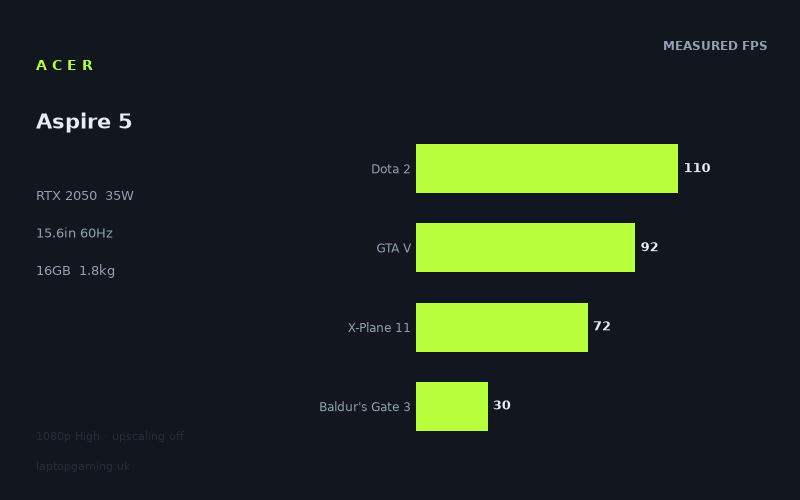
Frame rates
1920×1080, High preset, upscaling off.
Measured on this machine. Source: Notebookcheck, 2023-09-23.
Not scored: incomplete benchmark suite
Every scored laptop on this site is averaged over the same 5 games, and this one is short of Cyberpunk 2077, Baldur's Gate 3. A mean over 5 games is not comparable to a mean over 5, so we publish the figures we have and leave the score blank rather than rank it against machines tested on a different set. The numbers below are real - the suite is just incomplete.
How these numbers were produced
Frame rates here are not measured by us, and we label how each one was arrived at. A figure marked measured comes from a published run on that exact machine. A figure marked representative is derived from the GPU and its power limit (TGP) and cross-referenced against published reviews - a sound estimate of what that configuration delivers, but not a measurement of that specific laptop. Unless stated otherwise, numbers are 1920x1080, High preset, upscaling off. Where a laptop ships in several power configurations we use the wattage of the exact SKU listed, because a 140W RTX 5070 and a 115W one are not the same product.
In use
The short version
The Acer Aspire 5 A515-58GM-76S8 is a general-purpose 15.6in laptop with an Nvidia RTX 2050 running at a 35W GPU power limit, a Core i7-1355U, 16GB of memory and a 512GB SSD. Its gaming case rests on a clear split in the benchmark data: it is capable of good results in lighter and older games at its native 1920x1080 resolution and High preset, but it is not a laptop that can treat every demanding game as a 60fps experience.
Notebookcheck’s measured figures show Dota 2 at 110fps, GTA V at 92fps, X-Plane 11 at 72fps and F1 22 at 68fps. Those are useful numbers for a laptop with a 60Hz screen. In these games, the Aspire 5 can meet or exceed the display’s refresh ceiling without needing upscaling, since the published figures use High settings with upscaling switched off. Strange Brigade is also close at 63fps, while The Witcher 3 is just below the same target at 59fps.
The other half of the results matters just as much. God of War reaches 45fps, Atlas Fallen reaches 43fps and Final Fantasy XV reaches 35fps. Hogwarts Legacy and Sons of the Forest are both measured at 34fps. Armored Core 6 is at 32fps, Returnal at 31fps, and Atomic Heart and Baldur’s Gate 3 are both at 30fps. Star Wars Jedi Survivor, Ratchet & Clank Rift Apart and Immortals of Aveum are considerably more demanding for this configuration, at 20fps, 18fps and 17fps respectively.
That is a broad performance range rather than a single verdict. The Aspire 5 is sensible for someone whose gaming revolves around Dota 2, GTA V, X-Plane 11, F1 22 and similarly manageable titles, and who also wants a relatively light 1.794kg laptop for non-gaming work. It is much less convincing for a buyer who expects new, technically demanding games to run smoothly at 1920x1080 on High settings without compromises. The benchmark data does not support that expectation.
The machine’s five-game scoring-suite mean is 74fps. That is useful as a summary of its stronger results in Dota 2, GTA V, X-Plane 11, Strange Brigade and Final Fantasy XV, but it should not be mistaken for a promise of 74fps in every game. Final Fantasy XV is included in that group and reaches 35fps, while Dota 2 reaches 110fps. The mean describes a varied set of titles, not a consistent gaming experience.
There is no confirmed UK price for this exact configuration, so no value judgement can be calculated for it. That is a pricing limitation, not a missing benchmark result: the benchmark suite is complete and the Aspire 5 ranks normally on the frame-rate leaderboard. Until a confirmed UK price is available, however, it is not possible to say whether this performance represents strong, average or poor value against other laptops.
The strongest reason to consider it is not that it turns the Aspire range into a high-end gaming proposition. It is that it combines a 15.6in 1080p IPS screen, 16GB of memory, a 512GB SSD, a Core i7-1355U and entry-level RTX gaming capability in a 1.794kg machine. For mixed use, that can be a coherent package. The important caveat is that the RTX 2050 is limited to 35W here, and the measured results show exactly where that configuration is comfortable and where it is under pressure.
Performance
What the published benchmark data says
All of the frame rates below are Notebookcheck measurements from 2023-09-23, taken at 1920x1080 using the High preset with upscaling off. That test method is especially relevant to the Aspire 5 because its built-in display is also 1920x1080. These are not results obtained by reducing the resolution to make the numbers look better, and they are not results assisted by upscaling. They are a useful indication of what the hardware can do at the panel’s native resolution when asked to run demanding settings.
At the top of the list, Dota 2 reaches 110fps. This is the clearest example of the Aspire 5 having more performance than its 60Hz display can show at once. The screen can refresh at 60Hz, so a measured result of 110fps is well beyond that refresh rate. That does not make the result irrelevant: it indicates that Dota 2 is not an especially difficult workload for this RTX 2050 configuration at the stated settings. It does, however, mean the screen rather than the GPU becomes the obvious visible limit when playing at those settings.
GTA V follows at 92fps. Again, that exceeds the screen’s 60Hz refresh rate. For a buyer whose regular games include GTA V, the Aspire 5 has a meaningful margin at 1080p High in this particular benchmark. It is not merely reaching 60fps; the published number is comfortably above it. That provides more reassurance than a result sitting only just on the refresh ceiling, although the figure should remain tied to the specific test conditions rather than treated as a universal result for every scene or every game setting.
X-Plane 11 is measured at 72fps and F1 22 at 68fps. Both are above 60fps, so both fit well with the Aspire 5’s 60Hz panel in the tested configuration. These results are important because they prevent the review from reducing the laptop to an “esports only” machine. The benchmark spread shows it can do more than the lightest competitive titles. At the same time, it would be a mistake to leap from these figures to a broad claim that all simulation, racing or graphically complex games will behave the same way. The lower results elsewhere in the list demonstrate why title-by-title evidence matters.
Strange Brigade comes in at 63fps. That is another result above the panel’s refresh rate, although only by a small amount. It is therefore in the group of games where the Aspire 5 can broadly use the full capability of its 60Hz display at 1080p High with upscaling off. The Witcher 3 is measured at 59fps, one frame per second below that same refresh target. In practical buying terms, these two figures sit on opposite sides of 60fps, but they tell a similar story: this hardware can get close to the screen’s maximum refresh rate in some substantial games, but it does not retain a large margin once the workload becomes more demanding.
God of War at 45fps marks the start of a different class of experience. The result is not as low as the weakest figures in the list, but it is well below the 60Hz panel’s full refresh rate. Anyone buying the Aspire 5 mainly to play God of War at 1920x1080 High with upscaling off should understand that the published data points to a sub-60fps result. Atlas Fallen, at 43fps, is in much the same position. These are not numbers that support an expectation of a locked 60fps experience at the tested settings.
Final Fantasy XV reaches 35fps. Its presence in the five-game scoring suite is an important reminder that the suite mean of 74fps is not a minimum result. It is a blended average containing both very high and much lower outcomes. Final Fantasy XV is not close to the 60Hz display’s maximum refresh rate in the published test. It is instead a clear sign that the Aspire 5’s 35W RTX 2050 has limited headroom in some games even before moving to the most difficult titles in the wider results list.
Hogwarts Legacy and Sons of the Forest are both measured at 34fps. Armored Core 6 reaches 32fps, Returnal reaches 31fps, and Atomic Heart and Baldur’s Gate 3 each reach 30fps. This cluster is valuable because it shows the Aspire 5’s limitations are not restricted to one anomalous game. Across several different titles, the benchmark data settles around the low-thirties under the stated 1080p High, no-upscaling conditions. A buyer who is comfortable adjusting settings, reducing resolution, or using available game-specific image-scaling options may approach these games differently, but those outcomes are not in the supplied benchmark data. The measured figures themselves should be read as a warning against expecting High settings at native resolution to deliver 60fps here.
Star Wars Jedi Survivor at 20fps, Ratchet & Clank Rift Apart at 18fps and Immortals of Aveum at 17fps are the results that set the practical floor. These are not marginal misses of the 60Hz target. They are far beneath it. The Aspire 5 can launch into these games as benchmarked, but the published figures do not make a persuasive case for playing them at 1920x1080 High with upscaling off. For these titles, compromises would be essential if the aim were a materially smoother result, but the fact sheet does not provide alternative-preset or upscaled figures and it would be wrong to invent them.
The significance of the 35W RTX 2050
The RTX 2050 name on its own does not explain this laptop’s gaming position. The GPU power limit is equally important: Acer’s configuration runs the RTX 2050 at 35W. The measured frame rates are therefore results for a 35W RTX 2050 paired with the Core i7-1355U, rather than a generic statement about every laptop carrying the same GPU label.
A 35W limit is central to understanding why the Aspire 5 can look strong in Dota 2 and GTA V yet struggle in games such as Ratchet & Clank Rift Apart and Immortals of Aveum. The graphics workload changes dramatically between titles. The fact that the same laptop records 110fps in Dota 2 and 17fps in Immortals of Aveum is not contradictory; it is the benchmark spread made visible. A GPU configuration that is sufficient for one game at High settings can be substantially short of what another game demands at the same resolution and preset.
The data also argues against judging the Aspire 5 from the suite mean alone. The 74fps mean across the five scoring-suite games looks healthy if it is read without context. Yet those five results span from 110fps in Dota 2 to 35fps in Final Fantasy XV. The mean is useful for comparing machines under the same scoring method, but a prospective buyer should begin with the games they actually intend to play. Someone focused on Dota 2, GTA V, X-Plane 11 and Strange Brigade will see a substantially different machine from someone focused on Hogwarts Legacy, Returnal, Jedi Survivor or Immortals of Aveum.
The Core i7-1355U and 16GB of memory are part of the listed configuration, but the supplied data does not separate CPU, GPU and memory effects within each game. It would therefore be overconfident to attribute every low or high result to one component. What can be said is that the whole configuration, as measured, has enough performance for several games to meet or exceed 60fps at 1080p High, and not enough for others. That is the only conclusion that remains properly tied to the evidence.
Comfortable games, borderline games and games needing compromise
For the Aspire 5’s 60Hz screen, the most comfortable results are Dota 2 at 110fps, GTA V at 92fps, X-Plane 11 at 72fps, F1 22 at 68fps and Strange Brigade at 63fps. Each meets or exceeds 60fps in Notebookcheck’s measurements. They are the titles that best match the panel’s refresh rate under the stated test settings.
The Witcher 3 at 59fps is borderline only in the literal numerical sense: it sits just below 60fps. It is much closer to the panel target than God of War at 45fps or Atlas Fallen at 43fps. Still, it is below the refresh rate, and the distinction matters when the question is whether the laptop can fully drive its screen at the High preset without upscaling. The measured figure says it falls just short.
God of War and Atlas Fallen form the next group. At 45fps and 43fps, they are neither close to the weakest outcomes nor able to make full use of a 60Hz panel. They are useful examples of games where the Aspire 5 is viable only if the buyer accepts that the benchmarked settings do not produce a 60fps result. Whether that is acceptable is personal, but the frame-rate evidence is clear.
Final Fantasy XV, Hogwarts Legacy, Sons of the Forest, Armored Core 6, Returnal, Atomic Heart and Baldur’s Gate 3 occupy the low-thirties range, from 35fps down to 30fps. That group is particularly important for a buyer considering this machine as a long-term gaming purchase. It is not just one visually ambitious title falling short; several games do. If native 1080p High without upscaling is the baseline, this laptop has limited room for the more difficult workloads in the list.
The last group is unambiguous. Jedi Survivor at 20fps, Ratchet & Clank Rift Apart at 18fps and Immortals of Aveum at 17fps show that some games are simply not suited to this exact benchmark configuration. A buyer who considers any of those titles essential should not buy the Aspire 5 on the assumption that its RTX branding guarantees satisfactory High-preset performance. The published results directly contradict that assumption.
The screen
The Aspire 5 has a 15.6in IPS display with a 1920x1080 resolution and a 60Hz refresh rate. This is a conventional 1080p laptop screen rather than a higher-resolution panel or a high-refresh gaming display. For this hardware, that is not necessarily a disadvantage. The benchmark figures show that even at 1920x1080, the RTX 2050 at 35W is already heavily challenged by several games at the High preset with upscaling off. A higher-resolution screen would demand still more from the graphics hardware, but no such alternative-resolution measurements are supplied here.
The 60Hz refresh rate is a practical match for the Aspire 5’s best gaming results. Dota 2, GTA V, X-Plane 11, F1 22 and Strange Brigade all reach at least 60fps in the measured data. In those games, the panel’s refresh rate is not an obstacle to a conventional 60fps target. Dota 2 and GTA V exceed it by a substantial margin, while X-Plane 11, F1 22 and Strange Brigade clear it more narrowly.
For The Witcher 3, the result of 59fps is almost exactly aligned with the display’s 60Hz limit but remains below it. The numbers for God of War and Atlas Fallen, at 45fps and 43fps, make the screen’s 60Hz capability less relevant because the GPU configuration does not reach that level in the benchmarked conditions. The same is even more true for the low-thirties group and the three lowest results. A 60Hz screen cannot compensate for a game running at 35fps, 30fps, 20fps, 18fps or 17fps.
The panel type is IPS. That tells us the display technology, but the fact sheet does not provide brightness, colour coverage, contrast, response-time or outdoor-visibility measurements. Those are important display characteristics, especially for a laptop likely to be used for work as well as games, but they are not available here. It would be wrong to infer panel quality simply because it is IPS. The defensible conclusion is narrower: this is a 15.6in 1080p 60Hz IPS panel, and its resolution and refresh rate are broadly appropriate for the Aspire 5’s stronger game results.
There is also a sensible relationship between the 60Hz screen and the laptop’s position in the benchmark list. A faster-refresh panel would be more useful where games consistently run well beyond 60fps. On this machine, only part of the tested library does that. Dota 2 at 110fps and GTA V at 92fps would have room for a higher-refresh display, but X-Plane 11 at 72fps, F1 22 at 68fps and Strange Brigade at 63fps would offer far less headroom. Much of the list is below 60fps altogether. The supplied screen therefore does not look obviously mismatched to the machine’s measured gaming capability.
Buyers should nevertheless be clear about the distinction between a 60Hz panel and a 60fps gaming result. The Aspire 5 has the former in every game; it only has the latter in selected games at the tested settings. The screen is capable of displaying a 60Hz output, but the GPU must produce sufficient frames in a given title. Notebookcheck’s figures show when that happens and when it does not.
Build, size and portability
The Aspire 5 weighs 1.794kg. For a 15.6in laptop with a dedicated RTX 2050 GPU, 16GB of memory and a 512GB SSD, that figure suggests a machine intended to remain usable away from a desk rather than an oversized system designed only to stay in one place. It is not a claim that the laptop is weightless or effortless to carry; 1.794kg remains a meaningful load in a bag. But it is also not in the territory of the much larger, heavier gaming-laptop class represented by machines such as the MSI GT76 Titan DT.
The supplied specification does not include the Aspire 5’s dimensions, chassis materials, port selection, keyboard characteristics, touchpad, hinge design, cooling noise, surface temperatures or charger weight. Those details should not be filled in with assumptions. There is therefore no basis here to claim that it is slim, thick, quiet, cool-running, rugged, easy to upgrade or particularly travel-friendly beyond what its stated mass supports.
What the 1.794kg figure does support is a practical distinction between the Aspire 5 and a desktop-replacement approach. The Acer’s Core i7-1355U, 16GB of memory, 512GB SSD and 15.6in screen make it a specification that can serve ordinary laptop duties alongside gaming. The 48Wh battery gives the machine a defined battery capacity, but the fact sheet includes no battery-life measurement. Battery capacity is not battery runtime. It would be misleading to convert 48Wh into claimed hours of video playback, office work or gaming without published measurements.
For someone moving between home, study, office and occasional travel, the stated weight makes the Aspire 5 more plausible than a very large gaming machine. For someone who expects long unplugged gaming sessions, there is no evidence here to make a battery-life promise. Gaming battery life is especially not something that can be inferred from the 48Wh figure alone. The RTX 2050’s 35W power limit, the CPU, display behaviour and the workload all matter, and none of the required runtime data is provided.
The storage allocation deserves a similarly measured interpretation. A 512GB SSD is specified, but no usable capacity, expansion arrangement or additional-drive support is provided. It is enough to identify the machine as having solid-state storage and to distinguish it from a configuration with a smaller listed drive, but it does not tell us how many games a particular buyer can install or whether the laptop can be expanded later. Game sizes vary, and the fact sheet does not provide a storage-upgrade assessment.
The same restraint applies to the 16GB memory figure. It is a concrete part of the configuration and should be welcomed over an unspecified amount, but the fact sheet does not state memory speed, channel arrangement or upgradeability. The benchmark results already reflect this installed configuration. What they do not establish is whether different memory would materially alter results in any named game.
How it compares
The rival data is deliberately a spread rather than a list of only the nearest alternatives. It includes two close comparisons, one machine against which the Aspire 5 records its largest lead, and one against which it records its largest deficit. The comparisons use only games held in common, with preference given to the scoring suite. That limitation matters. A shared-game average is useful evidence, but it is not identical to comparing every game in the full benchmark list.
Acer Aspire 17: effectively the same result
Against the Acer Aspire 17 with an RTX 2050 at 35W, the Aspire 5 averages 2fps more across five shared games. Both machines use an RTX 2050 at the same stated 35W GPU power limit. The Aspire 5’s lead is real in the shared-game comparison, but it is small. It should not be presented as evidence of a dramatically faster gaming machine.
This is the kind of result where the exact context is more useful than a simplistic ranking. The two laptops are close because the shared titles do not create a large separation in the recorded average. For a buyer choosing between these Acer models, the benchmark evidence does not support paying attention only to a tiny frame-rate difference. Screen size, weight, storage, memory, price and other configuration details would normally matter greatly, but only the Aspire 5’s specifications are provided here and neither exact configuration has a confirmed UK price in the supplied data.
The Aspire 5’s 2fps shared-game advantage is enough to say it is ahead in that specific comparison. It is not enough to claim that the Aspire 17 is a poor gaming alternative or that the Aspire 5 offers a categorically higher class of performance. The measured gap is narrow, and buyers should treat it as such.
Schenker XMG Core 15: a near-zero comparison with an RTX 2060
The most surprising close comparison is the Schenker XMG Core 15 with an RTX 2060. The Aspire 5 averages 1fps more across three shared games. That does not mean the RTX 2050 is universally faster than the RTX 2060, nor does it overturn the importance of individual laptop configurations. It means that in this restricted shared-game comparison, the recorded average is essentially level, with the Aspire 5 just ahead.
The fact sheet gives an important explanation for such near-zero results: at 1080p, lighter titles in the shared set can be CPU-bound and compress genuine GPU gaps. That is why the result should be interpreted rather than merely repeated. When a game is limited by factors other than GPU throughput, changing the graphics hardware does not necessarily produce a proportionate difference in the frame rate. A small shared-game average can therefore coexist with meaningful underlying differences between the GPUs in other workloads.
For the Aspire 5, this comparison is encouraging but should not be oversold. It shows that this 35W RTX 2050 configuration can keep pace with the XMG Core 15’s RTX 2060 in the three games both hold under the comparison method. It does not prove equivalent performance across the wider library, and it certainly does not erase the Aspire 5’s low results in Jedi Survivor, Ratchet & Clank Rift Apart and Immortals of Aveum. The full title-by-title data remains the more useful guide.
HP Envy 17-cr0079ng: a genuine dead heat
Against the HP Envy 17-cr0079ng with an RTX 2050, the Aspire 5 averages -0fps across five shared games. In plain terms, the shared-game result is level. The minus sign should not be treated as a meaningful performance deficit; the fact sheet explicitly identifies a near-zero difference as a real result requiring explanation rather than repetition.
As with the Schenker comparison, lighter titles at 1080p can be CPU-bound and compress genuine GPU differences. The Aspire 5 and HP Envy are therefore inseparable on this shared-game average, not necessarily identical in every game or every condition. A prospective buyer should not expect the benchmark evidence supplied here to choose between them on gaming speed alone.
That comparison also reinforces a useful warning for spec-sheet shopping. Two laptops with the same named GPU can look straightforward to compare, but results depend on the whole machine and the games selected. Conversely, two different GPU names can sometimes produce tightly clustered averages in limited shared sets. The Aspire 5’s own results are best understood through the actual game figures rather than by assuming a component name settles the question.
MSI GT76 Titan DT: a different performance class in the shared games
The MSI GT76 Titan DT, equipped with an RTX 2080, is the machine that beats the Aspire 5 by the largest margin in the supplied comparison set. The Aspire 5 averages 77fps fewer across five shared games. Unlike the narrow differences against the Aspire 17, XMG Core 15 and HP Envy, this is not a result that needs careful language to avoid exaggeration. The shared-game gap is large.
The comparison demonstrates the limits of treating all dedicated-GPU laptops as broadly interchangeable. The Aspire 5 can achieve strong figures in selected games, including 110fps in Dota 2 and 92fps in GTA V, but it is not competing with the GT76 Titan DT’s level of shared-game performance. Buyers seeking the highest frame rates should not interpret the Aspire’s good results in lighter games as evidence that it belongs in the same category.
That does not make the MSI automatically the better purchase for every person. The fact sheet provides no confirmed UK price for either machine, and it does not provide the MSI’s weight, battery capacity, screen specification or other practical information in this comparison. What can be concluded is limited but significant: in the five shared games, the Aspire 5 is substantially behind the RTX 2080-equipped MSI. The difference is far larger than the tiny movements recorded against the nearer alternatives.
Who it’s for
A good fit for mixed-use buyers with realistic gaming expectations
The Aspire 5 is best suited to a buyer who needs a normal 15.6in laptop for work, study or general use and wants credible gaming performance as part of the package rather than as the machine’s sole purpose. The Core i7-1355U, 16GB of memory and 512GB SSD provide a clearly specified base configuration, while the 1.794kg weight is more manageable than a large desktop-replacement design. The 15.6in 1080p IPS screen is a conventional size and resolution for that role.
It is particularly suitable for someone whose regular gaming includes Dota 2, GTA V, X-Plane 11, F1 22 and Strange Brigade. Notebookcheck’s figures of 110fps, 92fps, 72fps, 68fps and 63fps show that these games can meet or exceed the built-in 60Hz screen’s refresh rate at 1920x1080 High with upscaling off. That is the Aspire 5 at its most convincing.
The laptop can also make sense for a buyer who is happy to judge each game on its own results rather than demanding one performance rule for everything. The Witcher 3 at 59fps is close to the panel’s limit, while God of War at 45fps and Atlas Fallen at 43fps are lower but still far ahead of the weakest entries. A buyer willing to accept variation between games, and willing to make settings decisions where necessary, has a more realistic basis for choosing this machine than someone who insists on native 1080p High at 60fps in all titles.
The Aspire 5 is also appropriate for someone who values portability more than chasing the very highest benchmark numbers. The 1.794kg weight is the key fact here. It does not establish that every aspect of travel use is ideal, because battery runtime and charger weight are not supplied, but it does distinguish the Acer from a machine chosen primarily for maximum frame rates regardless of mobility.
Who should buy something else
Buyers focused on the newest and most demanding games at High settings should look elsewhere. The reason is not vague caution about entry-level graphics hardware; it is the actual benchmark list. Hogwarts Legacy and Sons of the Forest both reach 34fps. Armored Core 6 reaches 32fps, Returnal reaches 31fps, Atomic Heart and Baldur’s Gate 3 reach 30fps, Jedi Survivor reaches 20fps, Ratchet & Clank Rift Apart reaches 18fps and Immortals of Aveum reaches 17fps. Those results do not support a confident recommendation for native-resolution High-preset gaming without upscaling in these titles.
Anyone who specifically wants a 60fps experience in God of War or Atlas Fallen should also choose a different machine, at least if High settings and upscaling off are fixed requirements. The Aspire 5’s measured 45fps and 43fps are not close enough to treat 60fps as a reasonable expectation. Likewise, Final Fantasy XV at 35fps shows that even a title included in the scoring suite can be a demanding workload for this configuration.
Competitive players who want to take advantage of frame rates substantially above 60fps should consider that the Aspire 5’s own screen is limited to 60Hz. Dota 2 at 110fps and GTA V at 92fps show that the GPU can exceed the panel’s refresh rate in some games, but the display cannot refresh beyond 60Hz. The fact sheet does not provide response-time data or external-display details, so no stronger recommendation can be made around competitive use. What is clear is that a buyer prioritising a high-refresh built-in panel should not regard this 60Hz screen as equivalent.
Buyers who need evidence of long battery life should not purchase on the basis of the 48Wh capacity alone. The battery size is known; the runtime is not. There are no supplied figures for light work, video playback, web use or gaming away from mains power. If unplugged endurance is decisive, more data is needed before making this purchase.
Finally, buyers looking for the largest possible gaming-performance step should not compare the Aspire 5 only with the closely matched Aspire 17, Schenker XMG Core 15 or HP Envy 17-cr0079ng. Those shared-game comparisons are narrow, and in the HP’s case level. The MSI GT76 Titan DT comparison shows what a genuinely different performance tier looks like: the Aspire 5 trails by 77fps on average across five shared games. That does not tell us whether the MSI is practical, affordable or suitable for the same buyer, but it does establish that the Aspire is not a substitute for a high-performance gaming laptop.
The Acer Aspire 5 is therefore a laptop to buy with a focused brief. Choose it for 1080p gaming in lighter or more manageable titles, for a conventional 60Hz IPS display, for a 15.6in form factor, and for a listed weight of 1.794kg alongside a Core i7-1355U, 16GB of memory and 512GB SSD. Do not choose it on the assumption that RTX branding alone will carry every demanding game at High settings. Notebookcheck’s frame-rate data is detailed enough to show both its strengths and its limits, and the limits are too clear to ignore.