Review
HP Omen Transcend 14-fb0014 review
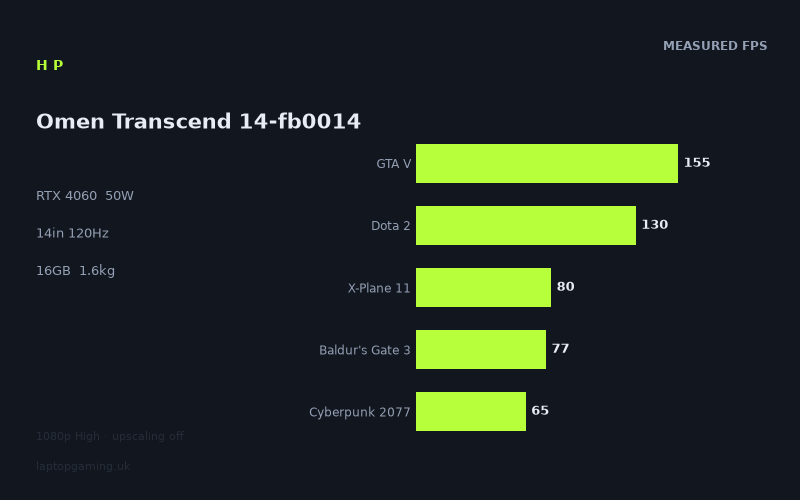
Frame rates
1920×1080, High preset, upscaling off. Averages 101fps across the 5 core benchmark games.
Measured on this machine. Source: Notebookcheck, 2024-03-06.
Not scored: no confirmed UK price
We have the full benchmark suite for this machine, so it ranks on the frame rate leaderboard like any other. What we don't have is a UK listing for this exact configuration - it's sold as a European review unit, or only in specifications that differ from the one tested. Since 30% of our score is value for money, scoring it would mean pretending price is no object, which would flatter it against every laptop you can actually buy. The frame rates below are real and comparable; there is just no buying recommendation to make yet.
How these numbers were produced
Frame rates here are not measured by us, and we label how each one was arrived at. A figure marked measured comes from a published run on that exact machine. A figure marked representative is derived from the GPU and its power limit (TGP) and cross-referenced against published reviews - a sound estimate of what that configuration delivers, but not a measurement of that specific laptop. Unless stated otherwise, numbers are 1920x1080, High preset, upscaling off. Where a laptop ships in several power configurations we use the wattage of the exact SKU listed, because a 140W RTX 5070 and a 115W one are not the same product.
In use
The short version
The HP Omen Transcend 14-fb0014 is a 14in machine weighing 1.649kg, built around an RTX 4060 configured at 50W, a Core Ultra 7 155H, 16GB of memory, a 71Wh battery and a 2880x1800 OLED panel running at 120Hz. Notebookcheck's measured figures, dated 6 March 2024, cover eleven titles at 1920x1080 on the High preset with upscaling switched off. They run from 173fps in Strange Brigade down to 65fps in Cyberpunk 2077.
The 50W power limit is the most important number on this page and it explains almost everything below it. Nvidia allows this generation's RTX 4060 to be configured across a wide band, and 50W sits at the very bottom of it — roughly half what the same chip is given in a conventional gaming chassis. HP has done that deliberately, because 50W is what makes a 1.649kg 14in machine with a 71Wh battery and an OLED panel physically possible. Everything good about this laptop and everything disappointing about it comes from that single decision.
The measured set shows the consequence with unusual clarity. In lighter and older titles the machine is quick: Strange Brigade at 173fps, GTA V at 155fps, The Witcher 3 at 150fps, F1 22 at 146fps, Dota 2 at 130fps. Then, as the workload shifts from the processor to the graphics card, the numbers fall away steeply — Tiny Tina's Wonderlands at 87fps, Final Fantasy XV at 83fps, X-Plane 11 at 80fps, Baldur's Gate 3 at 77fps and Cyberpunk 2077 at 65fps. That is the profile of a strong platform attached to a deliberately restrained graphics card, and it is exactly what 50W buys.
The comparison that best captures the machine's position is against the Schenker Key 14 (M24), which carries the same RTX 4060 at 100W — precisely double the power budget. Across five shared games the Transcend 14 averages just one frame per second behind it. Doubling the power budget of an identical graphics chip buys, in this comparison, essentially nothing. That result is genuinely surprising, it is not a fluke of a shallow overlap, and the comparison section works through the several reasons why it comes out that way.
There is no score on this page, and for once it is not because the data is incomplete. The benchmark suite is complete — we hold all five scoring games, averaging 101fps across GTA V at 155fps, Dota 2 at 130fps, X-Plane 11 at 80fps, Baldur's Gate 3 at 77fps and Cyberpunk 2077 at 65fps — and the machine ranks normally on the frame rate leaderboard. What we lack is a confirmed UK price for this exact configuration, and value accounts for 30 per cent of the score, so it cannot be computed. We are not going to speculate about what it might cost.
Buy it if you want a genuinely portable 14in machine with an excellent display that plays a wide range of games well, and you understand that the newest and heaviest titles will run at 60 to 80fps rather than filling the 120Hz panel. Look elsewhere if Cyberpunk 2077 at 65fps — at 1080p, on a screen with two and a half times that many pixels — is not a number you can live with.
Performance
50W, and what it actually means
The single most predictive figure for any laptop graphics card in this generation is the power limit its manufacturer chose. Nvidia sells identical silicon to every laptop maker with a configurable ceiling, and each maker picks a point in that band according to how much heat the chassis can move, how much fan noise they will accept and what the machine is meant to be. The consequence is a product stack where the difference between a well-fed GPU and a starved one of the same model routinely exceeds the difference between adjacent model numbers.
Here we hold the number, which is a considerable advantage over most of the machines we cover. The RTX 4060 in the Omen Transcend 14 is configured at 50W. That is at the bottom of the band this chip is sold across, and it is roughly half the ceiling the same silicon is given in a conventional 15in or 16in gaming chassis — the Schenker Key 14 in the comparison section runs the identical GPU at 100W.
It is important to be precise about what this does and does not mean, because the intuitive reading is wrong in both directions.
It does not mean the machine performs at half the level of a 100W RTX 4060. Graphics performance scales strongly sub-linearly with power. Silicon runs most efficiently at moderate clock speeds, and pushing frequency higher costs disproportionately more power for progressively smaller returns — the top of the voltage-frequency curve is where most of the power budget goes and the least performance is gained. Cutting a GPU's ceiling in half moves it down that curve into its efficient region, and the performance lost is very much smaller than the power removed. The five-game comparison against the 100W Key 14 is direct measured evidence of exactly this, and it is the most useful thing on this page.
What it does mean is that in workloads where the graphics card is genuinely the constraint, this machine has a hard ceiling that a more generously configured version of the same chip does not. Cyberpunk 2077 at 65fps and Baldur's Gate 3 at 77fps are the visible edge of that ceiling. They are not bad results for a 1.649kg machine — they are, in fact, rather good ones — but they are the numbers a buyer should plan around, because they will not improve.
The other thing 50W means is the rest of the laptop. A 14in chassis at 1.649kg with a 71Wh battery and a 2880x1800 OLED panel is a coherent, desirable product, and it is only buildable because the graphics card is not asking for more heat than a body that size can move. HP has not compromised the GPU by accident. The GPU configuration is the enabling decision for everything else, and judging the machine as though it were a failed attempt at a gaming laptop misses what it is.
The top of the set: 173fps down to 130fps
Five titles sit above the panel's 120Hz refresh rate: Strange Brigade at 173fps, GTA V at 155fps, The Witcher 3 at 150fps, F1 22 at 146fps and Dota 2 at 130fps.
At these frame rates the results are substantially limited by the processor rather than the graphics card. When a game runs at 155fps at 1080p, the GPU is finishing frames faster than the Core Ultra 7 155H can prepare work for it, and what the number mostly describes is the processor with the graphics card waiting. This is why the 50W ceiling is invisible here: a power limit only binds when the graphics card is the thing doing the deciding, and in these titles it is not.
The Witcher 3 at 150fps is the most encouraging result in this group. It is a substantially heavier workload than GTA V or Dota 2 and it still clears the panel by 30fps, which places a large and popular category of games — mid-weight open-world titles of that era — comfortably within the machine's comfortable zone. F1 22 at 146fps makes the same point for racing, a genre where frame rate translates into control feel rather than just smoothness.
The practical conclusion from this group is that the Transcend 14 is not a slow machine in any general sense. For anyone whose library sits at this level of graphical ambition or below — and that is an enormous amount of what people actually play — it delivers frame rates that fill a 120Hz display with room to spare.
The middle: Far Cry 5 at 114fps
Far Cry 5 at 114fps sits alone between the two clusters, six frames below the panel's refresh rate, and it is the point at which the balance starts shifting from processor to graphics card. In practical terms 114fps against a 120Hz display is indistinguishable from filling it — the shortfall is well inside the range where nobody would perceive a difference.
What makes this result worth noting is where it sits in the sequence. Above it, every title clears the panel. Below it, nothing comes close. Far Cry 5 marks the boundary of what this configuration handles without compromise, and it is a useful mental benchmark: games of roughly that graphical weight and older will fill the display; anything meaningfully heavier will not.
The floor: 87fps down to 65fps
Five titles sit between 87fps and 65fps: Tiny Tina's Wonderlands at 87fps, Final Fantasy XV at 83fps, X-Plane 11 at 80fps, Baldur's Gate 3 at 77fps and Cyberpunk 2077 at 65fps. This is where the 50W ceiling becomes visible, and this is the part of the record a prospective buyer should study hardest.
Note first how tightly clustered these results are. From 87fps to 65fps is a span of 22fps across five titles of quite different character — an open-world shooter, a Japanese role-playing game, a flight simulator, a large-scale CRPG and the most demanding mainstream title of its generation. When results compress like that across dissimilar workloads, it is a strong indication that they share a common constraint rather than each hitting a different one. That common constraint is the power budget. The graphics card reaches its ceiling and stays there, and what the individual titles ask for beyond that point stops mattering very much.
Cyberpunk 2077 at 65fps is the most important number in the set and deserves care. It is the untagged title — the current build, not a version-locked benchmark from an older release, which we would treat as a separate workload entirely and never merge with this figure. 65fps at native 1080p on High with upscaling off is a genuinely respectable result for a 50W graphics card in a 1.65kg body, and it is above the 60fps threshold that matters most. It is also barely half the panel's refresh rate, and it is measured at a resolution well below the panel's native one. Both things are true at once.
Baldur's Gate 3 at 77fps completes our scoring suite and is a similarly reassuring result in isolation — a demanding, densely populated title running comfortably above 60fps at native resolution.
X-Plane 11 at 80fps belongs in this group by number but not by cause. Flight simulation is heavily processor-limited by design, leaning on the CPU for world streaming and physics, so 80fps here is more likely a statement about the Core Ultra 7 155H than about the 50W ceiling. That distinction matters for anyone whose main interest is simulation, because it means a more powerful graphics card would not necessarily improve it.
The honest summary of the floor: nothing in the measured set falls below 65fps, which is a genuinely creditable outcome for a machine of this weight and power budget. But the five heaviest titles all sit well below the display's refresh rate, and the gap between what the panel can show and what the graphics card can produce in modern games is the defining compromise of the product.
The shape of the curve
Stepping back, the eleven results describe a very particular profile: 173, 155, 150, 146, 130, 114, 87, 83, 80, 77, 65.
There is a cluster in the 130 to 173fps range, a single result at 114fps, and a cluster in the 65 to 87fps range. There is nothing between 114fps and 87fps. That gap — a 27fps hole in the middle of the distribution — is the fingerprint of a machine transitioning between two different bottlenecks. Above the gap the processor is deciding; below it the graphics card is. A machine with a balanced configuration produces a smoother distribution because the two constraints hand over gradually. This one hands over abruptly, which is what a strong CPU paired with a hard GPU power ceiling looks like in data.
That is not a criticism, but it is a useful diagnostic for a buyer. It means the question to ask about any specific game is not "how fast is this machine" but "which side of the gap does this game fall on". Older and lighter titles land in the high cluster and are excellent. Current and demanding titles land in the low one, and no setting adjustment moves them up into the high cluster — you can only move them within it.
The screen
The display is a 14in OLED panel at 2880x1800, refreshing at 120Hz, and it is the component most likely to make someone want the machine.
2880x1800 against a 1080p benchmark
The arithmetic first, because it changes how every number above should be read. 2880x1800 is 5.18 million pixels. 1920x1080, the resolution at which every measured figure was taken, is 2.07 million. The panel therefore carries two and a half times the pixel count of the benchmark resolution.
Games do not scale linearly with pixel count and the relationship varies enormously by title, so we are not going to build native-resolution estimates out of 1080p measurements — that would mean publishing figures we do not hold. But the direction is not in question, and it applies most severely to exactly the titles that already sit lowest. Cyberpunk 2077 measures 65fps at 1080p. It does not measure 65fps at 2880x1800.
The proportions are also worth noting. 2880x1800 is 16:10; 1920x1080 is 16:9, and the two do not divide evenly. Running a game at 1080p on this display therefore means non-integer scaling across the full panel, with the softness that implies, or letterboxing. Neither is a disaster and modern GPU scaling handles it competently, but at this pixel density on a 14in screen the difference between a natively rendered image and an upscaled one is visible if you look for it.
The sensible strategy given the measured spread is asymmetric, and it follows the shape of the curve described above. For the five titles above 130fps there is genuine surplus, and pushing render resolution towards native is the obvious use for it — the panel is good enough to reward the pixels and the frames would otherwise be discarded. For the five titles at the bottom, the sensible approach is the reverse: keep the render resolution modest and use DLSS to reconstruct towards the panel. The graphics card supports it, and a 50W GPU driving a very high-resolution display is close to the ideal case for upscaling. It would be dishonest to quote 65fps and then quietly assume a buyer recovers the difference in software, but it is equally dishonest to ignore that the option exists and works well here.
120Hz
120Hz is a well-judged refresh rate for this machine, and the measured set shows why.
Five of the eleven titles clear it outright and a sixth, Far Cry 5 at 114fps, is close enough to be treated as level with it. That is a display whose ceiling the hardware can actually reach in a meaningful share of the games measured, which is more than can be said for many high-refresh panels fitted to machines that cannot feed them. A 240Hz panel here would be filled by nothing at all and would be pure specification-sheet decoration.
The gap is at the other end. The five heaviest titles run between 65fps and 87fps, which is roughly half to three-quarters of what the panel can show. In those games the display is idling and the graphics card is the constraint — the exact inverse of the position in the lighter titles. That is the visible cost of the 50W ceiling, expressed in the one place a buyer will actually notice it.
Worth stating plainly for anyone weighing this against a conventional gaming laptop: 120Hz is a good refresh rate but not a competitive one. If your main use is competitive first-person play, where the difference between 120Hz and 240Hz is felt in aim rather than admired in motion, this is not the machine. Our measured set contains no titles from that genre and we would not extrapolate into it, but the panel and the graphics configuration together point elsewhere.
OLED
The panel technology is OLED, and on a 14in screen at this pixel density it is the specification most likely to make a side-by-side comparison against a conventional machine look one-sided. Per-pixel illumination gives true black, effectively infinite static contrast and no backlight bleed, and the difference against an IPS panel is obvious to anyone without needing a trained eye or a test pattern.
Our record holds the panel type, its resolution and its refresh rate. It does not hold brightness, contrast measurements, colour gamut coverage, colour accuracy or response times, so we are not going to characterise those. What the specification establishes is intent: 2880x1800 OLED at 120Hz on a 14in chassis is aimed at someone who cares what the screen looks like when they are not gaming, and who wants gaming capability as a secondary rather than a primary function.
It is also the component that most justifies the machine's existence. Fit a 1920x1200 IPS panel instead and the Transcend 14 becomes an unremarkable 50W RTX 4060 laptop. With this display it is a specific product for a specific person, and that is worth more than a handful of frames.
Build, size and portability
1.649kg is the number that decides who this machine is for, and it needs to be read in context rather than admired in isolation.
Conventional gaming laptops with a discrete graphics card start around 2kg for a 15in machine and climb steeply — the Acer Nitro 17 in the comparison section is a 17in-class machine, and machines of that class routinely sit well above 2.5kg, though our record does not hold its weight. At 1.649kg the Transcend 14 is in the weight class of mainstream productivity notebooks. It is not merely a light gaming laptop; it is a light laptop with gaming capability inside, and the distinction determines how it will be used.
A 2.5kg machine is something you take somewhere and set up. A 1.65kg machine is something you carry by default, because the cost of bringing it stops being a decision you weigh. That is the entire value proposition here, and it is worth being honest that it is worthless to a buyer whose laptop lives on a desk. If the machine rarely moves, you are paying for portability you will never use and accepting a 50W graphics ceiling in exchange for nothing.
The relationship between the weight and the power limit is not incidental — it is causal, and it runs in a specific direction. A 14in chassis at this mass has strictly limited internal volume for heatsink and fan assembly, strictly limited surface area to shed heat, and a Core Ultra 7 155H sharing whatever headroom exists. 50W is not a number HP picked arbitrarily; it is approximately what a body of this size can cool alongside a full mobile processor. Anyone who wants a 100W or 140W graphics card in a 14in shell is asking for something this generation's thermals do not permit at this weight.
It is also worth noting that 1.649kg is not the lightest this category goes, and the machines that go lighter generally make the same trade harder — less chassis means less cooling means a lower ceiling still. The Transcend 14 sits at a sensible point on that curve: light enough that the portability is genuinely useful, heavy enough that the cooling can support a GPU with real capability behind it.
The battery is 71Wh, which is a reasonable capacity for a 14in chassis. Our record holds no measured runtime for this configuration and we are not going to estimate one — an OLED panel's draw varies enormously with screen content, and a Core Ultra processor's varies enormously with workload, so capacity alone predicts very little. What is structurally safe to say is that no laptop of this class games meaningfully away from mains power, and that the relevant unplugged figure for a buyer is a productivity one. The 50W GPU ceiling is, incidentally, the sort of decision that tends to help here — a machine that never asks for 140W is a machine with a smaller charger and less thermal drama.
The memory configuration is 16GB. That is the sensible baseline for this class today and adequate for every title in the measured set, but it is not generous, particularly on a machine likely to be asked to do creative work alongside games. Buyers planning to keep the laptop for several years should establish whether the memory is upgradeable before committing — our record does not say whether it is socketed or soldered, and on 14in machines at this weight it is frequently soldered.
How it compares
The four machines below all carry graphics cards from this same generation and are a deliberate spread rather than a list of nearest neighbours: the two closest results, the machine this one beats by the widest margin, and the machine that beats it by the widest. Each comparison uses only games both machines hold, drawing preferentially on our scoring-suite titles. The overlaps here are unusually deep — two of them run to five shared games — which makes this set more informative than most.
Schenker Key 14 (M24) — the same GPU at double the power, and one frame
The Schenker Key 14 (M24) carries an RTX 4060 at 100W — the identical graphics chip to this machine's, configured at exactly twice the power budget. We hold no confirmed UK price for it. Across five shared games, the Transcend 14 averages one frame per second behind it.
This is the most important comparison on the page and it deserves proper attention, because on the face of it the result should not be possible. Double the power, one frame of difference, across a five-game overlap that is the deepest this machine has.
Several things are happening at once and they compound.
The first is the sub-linear power scaling described earlier. Doubling a GPU's power budget does not double its performance; it does not come close. Most of the additional power goes into pushing clock frequency up the steep part of the voltage-frequency curve, where each additional megahertz costs disproportionately more watts. A 50W part is operating near the efficient portion of that curve and a 100W part is operating well up it, which means the second 50W buys far less than the first. This is the fundamental reason the result is smaller than intuition suggests, and it is a property of the silicon rather than of either laptop.
The second is the composition of the shared set. Five shared games drawn preferentially from our scoring suite means the comparison includes GTA V, Dota 2 and X-Plane 11 alongside the heavier titles — and in the lighter of those, both machines are limited by their processors rather than their graphics cards. Where neither GPU is the constraint, neither power limit matters, and the two machines produce the same numbers. A genuine graphics advantage in the demanding titles is then divided by five before it reaches the average. The mean says one frame; that does not mean every game says one frame, and it would be wrong to read it that way.
The third is that a rated power limit is a ceiling, not a guarantee of sustained behaviour. Our record holds rated figures, and how close any given chassis comes to holding its rated ceiling under prolonged load depends on cooling we have not measured. We are not going to claim the Key 14 fails to sustain 100W — we have no evidence either way — but it is a legitimate part of why rated wattage and measured performance do not track proportionally across machines.
The fourth is platform. Our record for the Key 14 holds its graphics card and its power limit; it does not hold its processor. In a comparison where several of the shared titles are processor-limited, the CPUs on both sides are doing a substantial share of the work, and we cannot attribute the outcome purely to graphics.
What should a buyer take from it? Something quite encouraging, but stated carefully. The Transcend 14's 50W configuration is not costing it anything like proportionally to the power removed, and across a broad five-game set it is functionally level with the same chip run twice as hard. That is a strong argument for the machine and a strong argument against buying on power-limit figures alone. It is not an argument that 50W and 100W are equivalent in a demanding game at high resolution, and the Cyberpunk 2077 result at 65fps is where the limit still shows.
Acer Nitro 17 — an RTX 4070 at 140W, £1,946, and a gap of nothing
The Acer Nitro 17 carries an RTX 4070 at 140W and costs £1,946. Across four shared games, the Transcend 14 averages level with it: the difference rounds to zero.
Taken at face value this is remarkable and taken at face value it is wrong. A 140W RTX 4070 is a far more capable graphics configuration than a 50W RTX 4060 — nearly three times the power budget and a tier further up the product stack. Any reading of this comparison that concludes otherwise has misunderstood what is being measured.
The explanation is the one set out above, and this is its clearest demonstration. The four shared titles are drawn preferentially from our scoring suite, and the lighter members of that set are substantially processor-limited at 1080p on hardware of this class. When a game runs at 155fps because the CPU cannot feed frames faster, a more powerful graphics card contributes nothing — it finishes early and waits. Both machines have capable modern processors. Both therefore produce similar numbers, and the Nitro's very real advantage stays invisible because the measurement is not asking the question that would reveal it.
You can see the hidden advantage by looking at this machine's own record. The Transcend 14 does not fall to 65fps in Cyberpunk 2077 because its processor ran out of headroom — 155fps in GTA V rules that out. It falls there because the 50W graphics card does. That is precisely the workload class where a 140W RTX 4070 would pull decisively ahead, and precisely the class this four-game average does not reach.
There is a second axis the comparison ignores entirely, and it is the one that matters most. The Nitro 17 is a 17in-class machine; this is a 14in one at 1.649kg. Getting level frame rates in four shared games at that weight difference is the achievement here, not parity in general. And the Nitro carries a price — £1,946 — which is the only firm price anywhere in this comparison set. We hold none for the Transcend 14, so we cannot complete the sum, but a buyer who has both prices in front of them now knows what the trade looks like on the performance side.
MSI Thin GF63 — an RTX 4050, and 25 frames per second
The MSI Thin GF63 carries an RTX 4050. We hold no confirmed UK price for it. Across five shared games, the Transcend 14 averages 25 frames per second more.
This is the widest winning margin in the set, and the depth of the overlap makes it the most trustworthy of the four positive comparisons. Five shared games drawn preferentially from the scoring suite reaches into the heavier titles as well as the light ones, so unlike the near-zero results above, this one is not confined to workloads where the graphics cards are irrelevant.
25fps is a solid rather than a spectacular margin, and that is worth reading honestly. A 50W RTX 4060 is clearly ahead of the GF63's RTX 4050, but it is not in a different league — the power ceiling that keeps this machine within a frame of a 100W part also keeps it within 25fps of a tier below. The Transcend 14 is not a machine that dominates weaker hardware; it is one that occupies a narrow and efficient band.
Set against the Key 14 comparison, this pair is the most useful thing on the page for understanding this generation. One tier down costs 25fps across five games. Double the power at the same tier costs one frame across five games. The model number matters more than the power limit here, and both matter less than a buyer's intuition would suggest. That is a genuinely counter-intuitive conclusion and it is drawn from the deepest overlaps we have.
Asus ROG Strix Scar 17 — an RTX 4090, and 77 frames per second
The Asus ROG Strix Scar 17 carries an RTX 4090. We hold no confirmed UK price for it. Across three shared games, the Transcend 14 averages 77 frames per second behind it.
This is the result that proves the benchmark can separate machines, and its value comes from the contrast with everything above it. In four shared games a 140W RTX 4070 could not distinguish itself from this laptop at all. In three shared games — a shallower overlap, more heavily weighted towards the processor-limited end — the Strix Scar is 77fps clear.
That combination rules out the lazy conclusion that the measurement simply cannot tell laptops apart. It plainly can, and on a narrower overlap than the ones that produced zeroes. What separates the Strix Scar is not just its graphics card but its platform as a whole: a 77fps advantage in titles where this machine's own GPU is frequently not the constraint indicates an advantage that runs beyond graphics into the processor and system behind it. Our record for this comparison holds its graphics card and no confirmed UK price; we do not hold its processor, so we will not attribute the margin to a specific component.
It is also a fair calibration of where the Transcend 14 sits. An RTX 4090 in a full-size gaming chassis is several tiers and a great deal of power above a 50W RTX 4060 in a 1.649kg 14in one. The 77fps gap is not a criticism; it is a measurement of how wide this generation's range is, and this machine sits deliberately near the efficient end of it.
What the four say together
Against an RTX 4050 across five shared games: 25fps ahead. Against the same RTX 4060 at double the power across five: one frame behind. Against a 140W RTX 4070 across four: level. Against an RTX 4090 across three: 77fps behind.
Three conclusions follow, and all three are useful to a buyer.
First, power limits scale far worse than intuition suggests. Doubling the wattage of an identical chip produced a one-frame difference across the deepest overlap available. Anyone dismissing a machine because its GPU is configured conservatively is applying a rule of thumb that this data does not support.
Second, a near-zero margin describes the games in the overlap, not the hardware. The 140W RTX 4070 comparison is the clearest case: real, substantial capability that four shared titles at 1080p have no way of exposing. The Strix Scar result on a shallower overlap demonstrates that separation appears immediately when the platforms genuinely differ.
Third, this machine's own record is the better guide than any of the comparisons. Eleven measured titles running from 173fps to 65fps, with a complete scoring suite among them, tell you more about what the Transcend 14 will do than four averaged deltas against machines of different sizes. The comparisons are context; the record is the evidence.
Who it's for
Buy it if portability is the requirement you are actually solving. 1.649kg with a discrete graphics card, a 2880x1800 OLED panel and a complete set of measured results that never falls below 65fps is a genuinely uncommon combination. If your machine moves every day, the weight is felt every day and the frame-rate compromise is felt only in the heaviest games. That is the correct trade for a lot of people and most of this page's caveats do not apply to them.
Buy it if the display is a large part of the appeal. An OLED panel at this pixel density on a 14in machine is a serious display, and if you spend most of your time in creative applications, documents or video and want something that games properly in the evening, it justifies a great deal. The measured figures show the GPU driving it comfortably in a wide band of titles, and DLSS covers a useful part of the rest.
Buy it if your library sits in the upper cluster. The Witcher 3 at 150fps, F1 22 at 146fps, GTA V at 155fps, Dota 2 at 130fps and Strange Brigade at 173fps describe a machine that handles the enormous long tail of established games without any difficulty at all, filling its 120Hz panel while doing it.
Do not buy it if the newest and heaviest games are the point. Cyberpunk 2077 at 65fps and Baldur's Gate 3 at 77fps are the measured facts, at 1080p, with upscaling off, on a panel with two and a half times that many pixels. Those numbers are creditable for the weight and they are not going to improve — the 50W ceiling is fixed. If the games you are buying a machine for are the ones at the bottom of that list, a heavier chassis with a better-fed graphics card is the honest recommendation.
Do not buy it for competitive play. A 120Hz panel and a 50W graphics configuration both point away from that use. Our measured set contains no competitive shooters and we will not extrapolate into the genre, but nothing about this machine's design suggests it was built for it.
Do not buy it if it lives on a desk. This is the most common way to get this purchase wrong. If the laptop rarely moves, the 1.649kg is worth nothing to you and the 50W ceiling costs you real performance for no return. The Acer Nitro 17 comparison at £1,946 is the shape of the alternative — a much larger machine with a 140W RTX 4070 that will pull decisively ahead in exactly the demanding titles where this one is weakest.
Be careful about the missing price. The reason this page carries no score is that we have no confirmed UK price for this exact configuration, and value is 30 per cent of how we rank machines. Everything else about the record is complete — all five scoring games, eleven measured titles, a stated power limit — which is more than most machines we cover can say. The performance picture here is unusually well evidenced. It is only the question of what it costs, and therefore whether it is worth buying, that we cannot answer for you.