Review
Lenovo Legion 9 18IAX10 RTX review
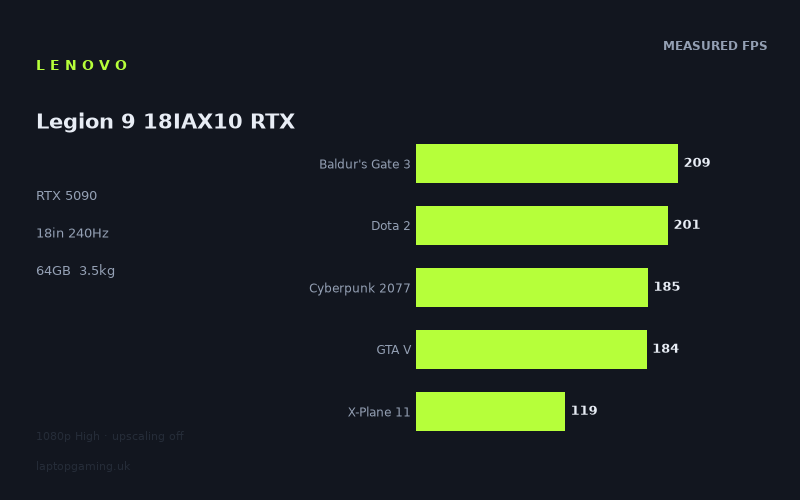
Frame rates
1920×1080, High preset, upscaling off. Averages 179fps across the 5 core benchmark games.
Measured on this machine. Source: Notebookcheck, 2025-10-24.
Not scored: no confirmed UK price
We have the full benchmark suite for this machine, so it ranks on the frame rate leaderboard like any other. What we don't have is a UK listing for this exact configuration - it's sold as a European review unit, or only in specifications that differ from the one tested. Since 30% of our score is value for money, scoring it would mean pretending price is no object, which would flatter it against every laptop you can actually buy. The frame rates below are real and comparable; there is just no buying recommendation to make yet.
How these numbers were produced
Frame rates here are not measured by us, and we label how each one was arrived at. A figure marked measured comes from a published run on that exact machine. A figure marked representative is derived from the GPU and its power limit (TGP) and cross-referenced against published reviews - a sound estimate of what that configuration delivers, but not a measurement of that specific laptop. Unless stated otherwise, numbers are 1920x1080, High preset, upscaling off. Where a laptop ships in several power configurations we use the wattage of the exact SKU listed, because a 140W RTX 5070 and a 115W one are not the same product.
In use
The short version
The Lenovo Legion 9 18IAX10 RTX is an 18in desktop-replacement gaming laptop built around an RTX 5090, a Core Ultra 9 275HX, 64GB of memory and a 2048GB SSD. The available benchmark data is strong across a wide range of games: Notebookcheck measured 479fps in Strange Brigade, 209fps in both Baldur’s Gate 3 and Final Fantasy XV, 201fps in Dota 2, 185fps in Cyberpunk 2077 and 184fps in GTA V. Even the more demanding results remain substantial, including 168fps in Stalker 2, 160fps in Battlefield 6, 141fps in Horizon Forbidden West and 133fps in Doom: The Dark Ages.
That is the important headline. This is not merely a laptop that can claim an RTX 5090 on its specification sheet; its measured figures place it among the fastest machines in the database. More importantly, it does not appear narrowly tuned for a handful of older or lighter games. There is a substantial result in CPU-sensitive titles such as Baldur’s Gate 3, Dota 2, GTA V and X-Plane 11, while demanding modern games including Cyberpunk 2077, Stalker 2, Horizon Forbidden West, Space Marine 2 and Doom: The Dark Ages also run at convincing rates under the stated 1920x1080 High-preset test conditions with upscaling disabled.
The caveat is that the Legion 9’s display is not a 1920x1080 panel. It is an 18in IPS display with a 3840x2400 resolution and a 240Hz refresh rate. Notebookcheck’s figures tell us what this hardware can do at 1920x1080 on High settings, not what it will deliver at the screen’s native resolution. That distinction matters enormously. The machine has the hardware credentials for very serious gaming, but the measured results cannot be used to promise a particular frame rate at 3840x2400, and they cannot tell us how particular settings choices, resolution scaling or upscaling modes would behave at native resolution.
It is also important not to overstate the meaning of the 240Hz panel. Strange Brigade reaches 479fps and can plainly run beyond the panel refresh rate in this test. The other games do not. Baldur’s Gate 3 and Final Fantasy XV reach 209fps, Dota 2 reaches 201fps, Cyberpunk 2077 reaches 185fps and GTA V reaches 184fps. These are all fast results, but they remain below 240Hz. In the more demanding modern games, the gap is wider still. The display offers a high refresh ceiling, but the benchmark data shows that only some games will approach or exceed that ceiling under the tested settings, and that is before moving from 1920x1080 to the panel’s far higher native resolution.
The Lenovo is therefore best understood as a machine for buyers who want a very large screen, an RTX 5090, large memory and storage allocations, and the strongest possible 1920x1080 High-preset performance from a laptop-class system. It is particularly compelling for someone who plays a mixture of competitive games, large open-world games, demanding cinematic releases and simulation titles rather than focusing on one genre. Its measured results are broad enough to support that use case.
It is not, however, a laptop for someone looking for something compact or light. At 3.52kg, the Legion 9 is a substantial machine before any charger or other accessories are considered. Nor is it a machine that can currently be judged as a value purchase, because there is no confirmed UK price for this exact configuration. No overall score is available for that reason: the benchmark suite is complete, but a price is required to assess value. That is not a criticism of the hardware; it is simply an unavoidable buying decision gap until a confirmed UK price exists.
Performance
The measured frame rates are excellent, but the game-to-game spread matters
Notebookcheck’s benchmark data shows a system with very high performance headroom at 1920x1080 and the High preset, with upscaling switched off. The mean across the five scoring-suite games is 180fps. That is an exceptionally strong average for a suite covering Baldur’s Gate 3, Dota 2, Cyberpunk 2077, GTA V and X-Plane 11, because those games do not stress the same parts of a system in the same way.
Baldur’s Gate 3 reaches 209fps and Dota 2 reaches 201fps. Both are results that suggest the Legion 9 has the processor, memory capacity and graphics performance to keep frame rates high in games where raw GPU capability is only part of the story. The Core Ultra 9 275HX is paired with 64GB of memory, and while the supplied data does not break down component-level behaviour, the finished system’s results in these games are clearly not being held to ordinary gaming-laptop levels at the tested settings.
GTA V reaches 184fps, which is another useful result because it is a long-running game that can expose CPU-side limitations at high frame rates. X-Plane 11 reaches 119fps. That is lower than the other scoring-suite results, but it remains a strong showing for a simulation title and illustrates why a simple average does not tell the whole performance story. A laptop can produce extremely high frame rates in one type of game while delivering a more restrained result in another, even at the same resolution and general quality level. The Legion 9 does not escape that reality, but it remains quick across both categories.
Cyberpunk 2077 reaches 185fps in the supplied test. That is one of the most useful numbers in the set because it is a demanding modern game and because 1920x1080 High settings without upscaling are a direct test of the underlying system rather than a result inflated by image reconstruction. It does not establish how the machine will perform with every visual feature enabled, and it does not establish native 3840x2400 performance, but it does show that the Legion has substantial performance at the tested setting.
There is a broad range of results outside the scoring suite as well. Strange Brigade is the outlier at 479fps. It is the only listed game to exceed the 240Hz screen refresh rate in the available data, and it demonstrates that the Legion 9 can produce extreme frame rates where the game engine and workload allow it. That should not be mistaken for a general promise of 240fps gaming. The remaining data makes clear that the same machine encounters very different demands in different games.
Final Fantasy XV joins Baldur’s Gate 3 at 209fps, while Dota 2 remains close behind at 201fps. Cyberpunk 2077 at 185fps and GTA V at 184fps are still very high results. Stalker 2 at 168fps and Battlefield 6 at 160fps remain well above ordinary console-style frame-rate targets, while Horizon Forbidden West at 141fps and Doom: The Dark Ages at 133fps indicate that this system has meaningful room for smooth high-refresh play in demanding games at the stated settings.
The lower end of the list is more revealing for buyers who want to know where the RTX 5090 starts to meet genuinely heavy workloads. Until Dawn reaches 117fps, Ghost of Tsushima reaches 115fps, The Elder Scrolls IV Oblivion Remastered reaches 112fps and Space Marine 2 reaches 108fps. These are not weak results. They are evidence that even expensive top-end laptop hardware can be well below the headline 240Hz refresh rate in modern, graphically intensive games, despite being very fast in absolute terms.
Senua’s Saga Hellblade 2 reaches 86fps and Borderlands 4 reaches 77fps. These are the most demanding results in the supplied set. They matter because they prevent an unrealistic reading of the RTX 5090 badge. A buyer choosing this machine should expect enormous performance at 1920x1080 High settings, but should not expect every demanding new release to run at 240fps without compromise. The benchmark data says the opposite: some games are dramatically heavier than others, and the heaviest listed titles remain below the rates achieved by the lighter games.
What the benchmark spread says about real buying priorities
The spread from 479fps in Strange Brigade to 77fps in Borderlands 4 is not a flaw in the data. It is exactly why a broad game list is more useful than a single synthetic figure or a manufacturer performance claim. Games differ in their graphics workloads, CPU demands, engine behaviour and the visual features that make their High settings demanding. The Legion 9 is quick in every supplied result, but the degree of that advantage changes substantially by title.
For a buyer mainly interested in competitive games, older games or titles with comparatively lighter graphics loads, the Legion 9 has enormous excess performance at 1920x1080 High settings. Strange Brigade at 479fps is the clearest example, but Baldur’s Gate 3, Final Fantasy XV and Dota 2 are also close enough to the display’s 240Hz ceiling to make the high-refresh screen feel relevant at the tested resolution. In those cases, the question is not whether the machine is capable enough. It plainly is. The practical question becomes whether the buyer wants an 18in 3840x2400 screen for that style of gaming, given that the published measurements are at 1920x1080 rather than native resolution.
For someone playing recent large-budget action games, the Legion 9’s performance profile remains impressive but is more nuanced. Cyberpunk 2077 at 185fps, Stalker 2 at 168fps, Battlefield 6 at 160fps, Horizon Forbidden West at 141fps and Doom: The Dark Ages at 133fps give the machine a lot of room at the tested settings. These figures support high-refresh gaming without needing upscaling in the benchmark setup. At the same time, they do not reach the screen’s full 240Hz refresh rate, which is a reminder that a 240Hz display is a capability rather than a guarantee.
The cluster around 108fps to 117fps is especially relevant for buyers who care more about demanding single-player games than about chasing a refresh-rate number. Until Dawn, Ghost of Tsushima, The Elder Scrolls IV Oblivion Remastered and Space Marine 2 all sit in that range. That means the Legion 9 remains comfortably capable in the supplied 1920x1080 High test, but it also means that the screen’s refresh specification should not dominate the purchase decision. For these games, image quality choices and resolution will likely matter more than attempting to match 240Hz.
Hellblade 2 at 86fps and Borderlands 4 at 77fps should shape expectations most strongly. Neither result undermines the machine’s status as a high-performance laptop; both are still considerably playable-looking figures on paper. But they show where buyers should be realistic. If the priority is maximising visual settings in the newest demanding releases, the path to very high frame rates may involve using settings options not covered by this benchmark data. The supplied figures do not include native-resolution testing, alternative presets or upscaling modes, so it would be wrong to claim precisely what settings will be required. What can be said is that the benchmark data does not support an assumption that RTX 5090 hardware makes compromises unnecessary in every game.
GPU power limit: what is known and what is not
The fact sheet identifies the Legion 9 as an RTX 5090 machine, but it does not provide a GPU power limit for this exact Lenovo configuration. That means there is no sourced basis for stating a wattage figure for the Legion 9, and there is no basis for claiming that it runs at the same power limit as the rival RTX 5090 systems listed below. The comparison machines are identified as 175W models where stated, but the Lenovo’s own GPU power limit is not supplied.
This is worth being precise about because GPU power limits can matter in laptop comparisons. Two machines with the same GPU name can still perform differently depending on how the complete laptop is configured. However, the correct conclusion here is not to fill the missing specification with an assumption. The correct conclusion is to look at the measured results. On that evidence, the Legion 9 is extremely competitive with the specific 175W RTX 5090 rivals in the database, and it is also effectively level with the listed RTX 5080 Legion Pro 7i 16 Gen 10 across their shared games.
The benchmark figures are therefore more useful than an unsupported wattage claim. They show that this particular configuration produces 209fps in Baldur’s Gate 3, 201fps in Dota 2, 185fps in Cyberpunk 2077, 184fps in GTA V and 119fps in X-Plane 11. They show 168fps in Stalker 2, 160fps in Battlefield 6 and 141fps in Horizon Forbidden West. Whatever the underlying power configuration may be, the measured output is plainly at the top end of the current laptop field represented by the supplied rivals.
Buyers should still avoid assuming that every RTX 5090 laptop will behave identically. The shared-game rival figures show small but meaningful variation between systems carrying the same GPU label. In some comparisons the Legion 9 is marginally behind; in others it is ahead. That is exactly the reason to compare attributable benchmark data rather than treating GPU branding as a complete answer.
What 1920x1080 High without upscaling does and does not establish
The benchmark methodology is specific: 1920x1080, High preset, upscaling off. This makes the results useful because every listed frame rate is measured under the same stated conditions. It also creates a clear limit on what can be inferred. The Legion 9 has a 3840x2400 panel, and 1920x1080 is not the panel’s native resolution. The figures are therefore not direct evidence of what a buyer will see when selecting the native resolution in a game.
That does not make the results less valuable. It makes them more honest. At 1920x1080 High with no upscaling, the Legion 9 is fast enough to make a strong case for high-refresh gaming across many titles. The data is especially compelling in Strange Brigade, Baldur’s Gate 3, Final Fantasy XV, Dota 2, Cyberpunk 2077, GTA V, Stalker 2 and Battlefield 6. It remains strong in Horizon Forbidden West and Doom: The Dark Ages. Even the lower figures from Hellblade 2 and Borderlands 4 are useful because they show the limits of raw hardware in demanding games instead of hiding them behind an averaged headline.
What the data cannot answer is whether a buyer should run a given game at 3840x2400, at 1920x1080, or at another resolution. It cannot say what image quality trade-off any particular player will prefer. It cannot state the frame rate at native resolution, and it cannot tell us how alternative graphics presets or upscaling technologies change the picture. A buyer who wants a machine specifically for native-resolution gaming should treat the 1920x1080 numbers as evidence of underlying performance rather than as a native-screen promise.
The screen
A large, high-resolution, high-refresh display with a demanding target
The Legion 9 uses an 18in IPS display with a 3840x2400 resolution and a 240Hz refresh rate. On paper, that is a serious screen specification: large enough to suit an 18in desktop-replacement chassis, high enough in resolution to make the laptop’s panel a much more demanding target than the 1920x1080 benchmark resolution, and fast enough to show very high frame rates in games that can deliver them.
The panel’s 240Hz refresh rate is a real advantage for games where the laptop can approach or exceed it. Notebookcheck measured 479fps in Strange Brigade, making it the clear case where the Legion 9 has more than enough performance to saturate the panel under the stated test conditions. The more interesting question is what happens in the rest of the game list, because that is where the machine’s screen specification meets the practical limits of current games.
Baldur’s Gate 3 at 209fps, Final Fantasy XV at 209fps and Dota 2 at 201fps all come relatively close to 240Hz at 1920x1080 High settings. These are the games where the screen’s refresh rate is likely to be most relevant, although the available data still does not show native-resolution performance. Cyberpunk 2077 at 185fps and GTA V at 184fps are also fast results, but they remain below the screen’s maximum refresh rate. Stalker 2 at 168fps and Battlefield 6 at 160fps reinforce the point: this is powerful hardware, but the panel’s maximum refresh remains an upper ceiling rather than an everyday measured outcome across the entire test set.
At 141fps in Horizon Forbidden West and 133fps in Doom: The Dark Ages, the Legion 9 is still operating at high frame rates by any sensible reading of the benchmark data. Yet those results also show that the 240Hz panel should not be read as a reason to expect 240fps in every demanding release. The machine’s display is capable of it; the games are not equally easy to drive.
The lower results make that even clearer. Until Dawn reaches 117fps, Ghost of Tsushima reaches 115fps, The Elder Scrolls IV Oblivion Remastered reaches 112fps and Space Marine 2 reaches 108fps. Hellblade 2 reaches 86fps and Borderlands 4 reaches 77fps. These figures remain respectable at the test settings, but they are far from 240Hz. Buyers whose main games resemble the latter end of this list should value the panel for its size and resolution as much as for its refresh rate, because the benchmark data does not suggest that the refresh ceiling will be the limiting factor in those titles.
The resolution mismatch is the central screen consideration
The screen’s 3840x2400 resolution is substantially more ambitious than the 1920x1080 benchmark setting. That is not a criticism of the panel; a high-resolution screen is part of what differentiates an 18in flagship laptop from a more ordinary gaming notebook. But it does mean that prospective buyers need to separate two questions. The first is whether the Legion 9 is fast at the tested resolution. The answer is clearly yes. The second is whether it can drive every game at the native panel resolution at the same frame rates. The provided data does not answer that question.
This distinction is especially important because the 240Hz headline is easy to misread. A 240Hz panel and an RTX 5090 do not automatically combine into 240fps at the panel’s native 3840x2400 resolution. The supplied data shows 240fps only in Strange Brigade, and that result is measured at 1920x1080 High with upscaling disabled. Every other listed result is below 240fps under those same conditions. Native resolution would need separate attributable measurements before any stronger claim could be made.
For buyers who mostly play games such as Baldur’s Gate 3, Dota 2, Final Fantasy XV, GTA V or Strange Brigade, the high-refresh panel makes immediate sense because the published 1920x1080 data is already extremely high. For those who mainly play games such as Hellblade 2, Borderlands 4, Space Marine 2 or Horizon Forbidden West, the value of the display may lie more in having a large 18in 3840x2400 workspace and a high maximum refresh capability than in expecting every title to run near 240fps.
The IPS panel type is confirmed, but the fact sheet does not provide brightness, colour coverage, response-time measurements, contrast measurements or HDR information. Those omissions matter to buyers who care about photo work, video work, dark-room gaming or display calibration. It would be wrong to infer those properties from the IPS label alone. What is known is the panel size, resolution, refresh rate and type; what is not known should remain unknown rather than being filled with assumptions.
Build, size and portability
This is a desktop-replacement machine, not a casual carry-everywhere laptop
At 3.52kg, the Legion 9 is a large gaming laptop in the most literal sense. The 18in screen, RTX 5090, Core Ultra 9 275HX, 64GB memory configuration and 2048GB SSD all point in the same direction: this is a machine intended to prioritise capability over easy portability.
That does not mean it cannot be moved. It means buyers should be honest about how they plan to use it. A 3.52kg laptop makes more sense for someone who wants one powerful machine that normally lives on a desk, moves between rooms, travels occasionally, or replaces a separate desktop system. It makes less sense for someone who expects to carry it daily alongside books, work equipment or other travel essentials. The weight alone is enough to make portability a central purchasing consideration.
The fact sheet does not provide chassis dimensions, so there is no sourced basis for describing the Legion 9’s footprint, thickness or bag compatibility. The 18in display and 3.52kg weight establish that it is a substantial device, but they do not establish exactly how much desk space it needs or what type of bag it will fit. Buyers who need to travel frequently should verify those details before committing.
There are also no supplied figures for battery life, charging behaviour, fan noise or temperatures. Those are particularly important omissions for an RTX 5090 laptop because they affect how comfortable the machine is outside a desk-based gaming setup. The benchmark data is enough to judge gaming performance at the stated conditions; it is not enough to make claims about unplugged endurance, acoustics or thermal behaviour. Anyone for whom quiet operation, cool surfaces or long battery life is a priority should wait for attributable data on those areas rather than assuming flagship performance answers them.
The internal specification suits heavy workloads, but the evidence here is gaming-focused
The Legion 9’s 64GB of memory and 2048GB SSD are generous specifications for a gaming laptop. The memory capacity should appeal to buyers who want substantial headroom for demanding software, large projects or heavily multitasked use, while the 2048GB SSD gives the machine a more practical starting point for a large game library than a smaller drive would.
However, the supplied measurements are gaming frame rates rather than application benchmarks. It is reasonable to note that the machine is configured with a Core Ultra 9 275HX, 64GB of memory and a 2048GB SSD, but it would not be reasonable to claim particular performance in editing, rendering, compilation, engineering or content-creation tasks without relevant attributable measurements. The machine looks well specified for those roles, but the published evidence provided here is about games.
The same restraint applies to storage speed and memory performance. Capacity is confirmed. Speed is not. Buyers deciding between this Lenovo and another workstation-style gaming laptop should not assume one has faster storage or a more advantageous memory configuration unless those details are separately documented.
How it compares
Against the Lenovo Legion Pro 7i 16 Gen 10 RTX 5080
The closest comparison may be Lenovo’s own Legion Pro 7i 16 Gen 10 with an RTX 5080 at 175W. It has a confirmed UK price of £3,662. Across the six games both machines have been measured in, the Legion 9 averages 1fps lower. That is effectively a dead heat in the available shared-game comparison, and it is a result that should make buyers pause before assuming that an RTX 5090 label alone creates a large practical lead.
The Legion 9 does bring a different overall specification: an RTX 5090, 24GB of VRAM, an 18in 3840x2400 240Hz IPS panel, 64GB of memory and a 2048GB SSD. But without a confirmed UK price for the Legion 9, it is not possible to say whether those differences are worth paying for relative to the Legion Pro 7i 16 Gen 10. The benchmark comparison says that the two machines are essentially tied across their shared games. That makes the screen size, display resolution, memory allocation, storage allocation and portability difference more important than a simplistic GPU-tier comparison.
For someone who wants an 18in screen and the Legion 9’s 24GB VRAM configuration, the Legion 9 remains the more distinctive machine. For someone who mainly wants maximum shared-game frame rates and can work with a smaller system, the Legion Pro 7i’s near-identical measured comparison result is difficult to ignore. Its confirmed £3,662 UK price gives it a clarity that the Legion 9 currently lacks.
Against the Asus ROG Strix Scar 18 RTX 5090
The Asus ROG Strix Scar 18 is a more directly comparable rival because it also uses an RTX 5090 and is identified as a 175W model. Across seven shared games, the Legion 9 averages 3fps lower. That is a small gap, not a decisive defeat. The key reading is that the Legion 9 is operating extremely close to another high-end RTX 5090 18in-class competitor in the games both systems have been measured in.
Neither machine has a confirmed UK price in the supplied data, so this comparison has to remain focused on performance rather than value. The Legion 9’s result is close enough that a buyer should not choose between the two on an assumption of a dramatic frame-rate difference. The available evidence does not show one system running away from the other. Instead, it shows that both belong to the same top-end performance bracket, with the Asus holding a narrow shared-game advantage.
The Legion 9’s measured results remain persuasive in their own right. An average deficit of 3fps across shared games does not change the fact that it reaches 209fps in Baldur’s Gate 3, 201fps in Dota 2, 185fps in Cyberpunk 2077, 168fps in Stalker 2 and 160fps in Battlefield 6. Buyers should therefore treat this as a close matchup where confirmed price, display preferences, physical design details and connectivity information would matter, but those latter details are not supplied here.
Against the MSI Raider 16 Max HX RTX 5090
The MSI Raider 16 Max HX is another RTX 5090 laptop identified as a 175W system. Here, the Legion 9 averages 4fps ahead across seven shared games. Again, this is not a gulf, but it is a meaningful direction of travel: the Lenovo is slightly faster in the available comparison.
The difference is especially useful because it reinforces the idea that an RTX 5090 laptop should be judged by its published game results rather than by the GPU name alone. The Legion 9 is not merely matching the MSI; it is ahead in the shared set. At the same time, the margin is not large enough to justify overconfident claims that one machine is categorically in another class. These are closely matched flagship systems, and the Lenovo’s advantage is a modest one.
There is no confirmed UK price for the MSI Raider 16 Max HX in the supplied data, so value cannot be settled between them. Buyers who are choosing solely on shared-game performance can reasonably prefer the Legion 9 on the available figures. Buyers who care about chassis size, display characteristics beyond resolution and refresh rate, storage arrangement, acoustics or battery operation need more attributable information before making a complete comparison.
Against the Schenker XMG Neo 16 E25 RTX 5090 Laptop
The Legion 9 averages 10fps ahead of the Schenker XMG Neo 16 E25 RTX 5090 Laptop across seven shared games. The Schenker is also identified as a 175W RTX 5090 machine. This is the most substantial shared-game advantage the Legion 9 holds over the unpriced RTX 5090 rivals listed here.
A 10fps advantage across the shared set does not mean the Lenovo will be ahead by the same amount in every game, because the supplied figure is an average across games both machines have been tested in. It does, however, make the Legion 9’s performance position clear. It is not simply keeping pace with the XMG Neo 16 E25; it has a notable lead in the available direct comparison.
That result also matters in the context of the Legion 9’s 18in 3840x2400 240Hz IPS display. The Lenovo combines its performance lead with a large high-resolution panel, 64GB of memory and a 2048GB SSD. Whether that package is preferable will still depend on price and on physical preferences, neither of which can be fully resolved here. But in pure shared-game terms, the Legion 9 has the stronger case.
Against the Medion Erazer Beast 16 X1 Ultimate RTX 5090
The Medion Erazer Beast 16 X1 Ultimate is the rival with the broadest shared-game comparison in the supplied list. Across eleven shared games, the Legion 9 averages 14fps ahead. The Medion has a confirmed UK price of £4,884, while the Legion 9 does not have a confirmed UK price.
The Legion 9’s 14fps shared-game advantage is the clearest evidence here that the Lenovo is not merely competitive with other RTX 5090 laptops; it can be materially faster depending on the rival and game set. Because the comparison covers eleven shared games, it also rests on a broader overlap than the comparisons against the Asus, MSI and Schenker machines.
It would still be wrong to turn that into a direct value verdict without a confirmed Legion 9 price. The Medion’s £4,884 figure is known, but the Lenovo’s is not. What can be said is that the Legion 9 offers higher shared-game performance than the Medion in the supplied comparison, while also providing an 18in 3840x2400 240Hz IPS panel, 64GB of memory and a 2048GB SSD. Whether those advantages make it the better purchase depends on a UK price that is not yet confirmed.
Who it’s for
Buy the Legion 9 if performance and screen scale come before portability
The Legion 9 is for the buyer who wants a genuine flagship gaming laptop and is prepared to accept a 3.52kg machine to get there. The strongest case is for someone replacing or supplementing a desktop setup, especially someone who wants a large built-in screen rather than using a smaller laptop display as a compromise.
It is also a strong fit for players with varied libraries. The benchmark data is not limited to one type of game. It includes extremely high figures in Strange Brigade, Baldur’s Gate 3, Final Fantasy XV and Dota 2; strong figures in Cyberpunk 2077, GTA V, Stalker 2, Battlefield 6, Horizon Forbidden West and Doom: The Dark Ages; and still substantial results in Until Dawn, Ghost of Tsushima, The Elder Scrolls IV Oblivion Remastered, Space Marine 2, Hellblade 2 and Borderlands 4. A machine that remains convincing across that spread is more useful than one that shines only in lightweight esports titles.
Buyers who value large memory and storage allocations should also take note. The supplied configuration includes 64GB of memory and a 2048GB SSD, alongside the RTX 5090 with 24GB of VRAM. For someone who dislikes buying an expensive laptop only to immediately worry about memory capacity or game-library space, that is an appealing starting specification.
The laptop also makes sense for buyers who understand the difference between a high-refresh display and a guaranteed high-refresh gaming experience. The 240Hz panel is useful. Strange Brigade exceeds it, and several other games approach it at the benchmark settings. But the best buyer for this machine will not expect every demanding release to run at 240fps, particularly when the supplied results are measured below the screen’s native resolution. They will see the panel as a high-quality capability ceiling rather than a promise attached to every game.
Buy something else if you need daily portability, known value or native-resolution proof
Anyone who carries their laptop frequently should look carefully at alternatives. At 3.52kg, the Legion 9 is not the sensible choice for a buyer whose priority is commuting, regular travel or working from different locations every day. The 18in screen is attractive for desk use, but the same feature contributes to the machine’s desktop-replacement character.
Buyers who need a confirmed total cost should also wait. There is no confirmed UK price for this exact configuration, so there is no honest way to say whether it is good value, poor value or fairly priced. The Legion Pro 7i 16 Gen 10 at £3,662 and the Medion Erazer Beast 16 X1 Ultimate at £4,884 provide reference points in the database, but they do not establish what the Legion 9 costs. Until that price exists, performance can be judged but value cannot.
Someone whose priority is the highest possible native-resolution gaming performance should also be cautious. The Legion 9’s panel is 3840x2400, but the supplied measurements are 1920x1080 High-preset figures with upscaling disabled. The data is excellent at that resolution, yet it does not prove how the machine performs at 3840x2400. A buyer determined to game at native resolution should seek attributable native-resolution figures rather than assuming that the RTX 5090 name settles the matter.
The same applies to buyers who need detailed information about fan noise, temperatures, battery life, dimensions, brightness, colour performance or response times. None of those measurements are included in the fact sheet. There is no reason to invent an answer simply because this is a premium laptop. If those factors are central to your purchase, wait for measured evidence.
Finally, buyers who are considering the Legion Pro 7i 16 Gen 10 purely for frame rates should take its shared-game result seriously. The Legion 9 averages only 1fps lower across the six games both machines have been measured in, despite the Legion Pro using an RTX 5080 at 175W. That does not make the Legion 9 redundant; its 18in 3840x2400 240Hz IPS panel, 24GB RTX 5090, 64GB of memory and 2048GB SSD are a different proposition. But it does mean that the more expensive-looking specification should not be treated as an automatic performance win without considering the actual games you play.
The Lenovo Legion 9 18IAX10 RTX is, on the evidence available, one of the strongest gaming laptops in the current database. It is exceptionally fast at 1920x1080 High settings without upscaling, competitive with or ahead of the listed RTX 5090 rivals in shared-game comparisons, and equipped with a large 18in 3840x2400 240Hz IPS display. Its limitations are not weak performance. They are the absence of a confirmed UK price, the lack of a supplied GPU power-limit figure, the lack of native-resolution benchmark data, and the simple physical reality of a 3.52kg laptop. If those compromises fit your use, the measured frame rates make a very strong case for it.