Review
Medion Erazer Beast X25 review
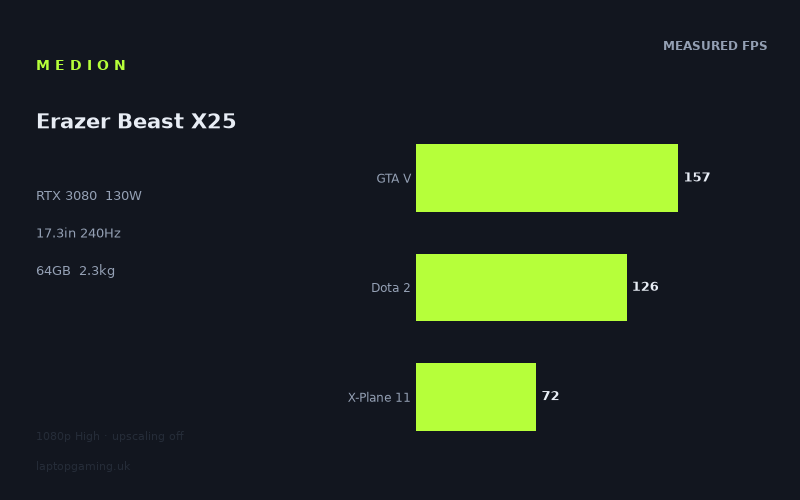
Frame rates
1920×1080, High preset, upscaling off.
Measured on this machine. Source: Notebookcheck, 2021-07-29.
Not scored: incomplete benchmark suite
Every scored laptop on this site is averaged over the same 5 games, and this one is short of Cyberpunk 2077, Baldur's Gate 3. A mean over 5 games is not comparable to a mean over 5, so we publish the figures we have and leave the score blank rather than rank it against machines tested on a different set. The numbers below are real - the suite is just incomplete.
How these numbers were produced
Frame rates here are not measured by us, and we label how each one was arrived at. A figure marked measured comes from a published run on that exact machine. A figure marked representative is derived from the GPU and its power limit (TGP) and cross-referenced against published reviews - a sound estimate of what that configuration delivers, but not a measurement of that specific laptop. Unless stated otherwise, numbers are 1920x1080, High preset, upscaling off. Where a laptop ships in several power configurations we use the wattage of the exact SKU listed, because a 140W RTX 5070 and a 115W one are not the same product.
In use
The short version
The Medion Erazer Beast X25 is a high-frame-rate gaming laptop built around an RTX 3080 running at a stated 130W GPU power limit, a Ryzen 9 5900HX processor, 64GB of memory and a 17.3in 1920x1080 IPS display with a 240Hz refresh rate. On the published Notebookcheck benchmark data, it is plainly a strong 1080p gaming machine. Its best results are exceptionally well suited to the panel: Strange Brigade reaches 180fps, The Witcher 3 reaches 175fps, F1 2021 reaches 165fps and GTA V reaches 157fps. Those are the games in which the Beast X25 makes a fast 240Hz screen feel purposeful rather than merely aspirational.
It is not, however, a laptop that reaches 240fps across the board. The measured results range from 180fps in Strange Brigade down to 72fps in X-Plane 11. That is not a contradiction. It is what a useful gaming result looks like: different games place very different demands on the system, and a machine that flies through one title can be constrained by another title’s graphics workload, engine behaviour or processor demand. The key point is that the Beast X25 remains comfortably capable at its native resolution throughout the measured set, even where it cannot approach the display’s maximum refresh rate.
The benchmark data gives it a mean of 126fps across the five scoring-suite games: Strange Brigade, GTA V, Dota 2, Final Fantasy XV and X-Plane 11. That average is healthy, but it should not be read as a promise that every game will behave like a 126fps game. The individual figures matter much more. A buyer primarily interested in F1 2021, GTA V, The Witcher 3 or Strange Brigade is looking at a markedly different experience from a buyer whose main game is X-Plane 11. The former group can expect frame rates that make serious use of the panel’s high refresh rate. The latter is buying a system that runs the game well, but not one whose 240Hz specification will be fully exploited in that workload.
This is also a laptop whose value cannot be judged yet. There is no confirmed UK price for this exact configuration, so a price-sensitive recommendation would be false precision. That does not mean there is anything missing from the performance evidence: the benchmark suite is complete and the machine ranks normally on the frame-rate leaderboard. It simply means that the value part of the judgement cannot be calculated without a confirmed UK price, and it would be irresponsible to speculate about one.
Buy the Beast X25 if the priority is a large, fast 1080p display and very strong published performance in a broad selection of games, while accepting that it is a 2.27kg laptop rather than a lightweight travel machine. It is particularly compelling for someone who values high frame rates in established competitive, racing and action games, and who wants 64GB of memory in the supplied specification.
Look elsewhere if the main goal is to have a laptop that can sustain the panel’s 240Hz limit in every demanding game, because the measured figures do not support that expectation. Also look elsewhere if a confirmed purchase price is essential to the decision right now. The absence of that price does not make the Beast X25 poor value; it means there is no evidence-based way to say whether it is good value, poor value or somewhere between the two.
Performance
What the benchmark data says
Notebookcheck measured the Medion Erazer Beast X25 at 1920x1080 using the High preset with upscaling off. That setup matters. It is the machine’s native screen resolution, so these are directly useful figures for the supplied display rather than results produced at a lower resolution selected solely to inflate a frame-rate result. Upscaling was also disabled, meaning the published numbers are not relying on an image reconstruction mode to reach their results.
The strongest measured result is Strange Brigade at 180fps. That is a very high outcome for a 1920x1080 High preset result without upscaling, and it is close enough to the 240Hz panel’s ceiling to make the screen’s speed relevant. It is not 240fps, so the display is not being saturated by the measured figure, but 180fps is far beyond the pace at which a conventional laptop screen would be the natural match. For this game, the Beast X25 is very clearly designed around responsiveness and smooth motion rather than simply attaining an acceptable result.
The Witcher 3 follows at 175fps. That result reinforces the point made by Strange Brigade: the Beast X25 has substantial frame-rate capability in games that do not impose the same kind of limits as the slower titles in the list. At 175fps, the display’s 240Hz refresh rate has practical value. The panel can show more updates than a lower-refresh alternative, even though the measured result does not reach its maximum stated refresh rate.
F1 2021 records 165fps. Racing games are a natural fit for high-refresh displays because the combination of rapid scene movement and continuous camera motion can make a strong frame-rate result especially worthwhile. The published figure places F1 2021 among the Beast X25’s most successful showings. A buyer for whom F1 2021 is a major reason to buy a gaming laptop should view this as one of the system’s clearest strengths.
GTA V reaches 157fps. This is another result that puts the Beast X25 firmly in high-refresh territory, although it remains below the 240Hz panel limit. It is also one of the scoring-suite games, so it contributes to the stated 126fps mean across that suite. GTA V is useful in this context because it demonstrates that the system is not dependent on a single unusually favourable title for its best results. Alongside Strange Brigade, The Witcher 3 and F1 2021, it forms part of a group of games in which the laptop delivers a conspicuously high level of performance.
Death Stranding measures 134fps and Days Gone measures 130fps. These results sit below the top group, but they should not be described as weak. Both remain above the scoring-suite mean of 126fps, and both still represent frame rates that make a 240Hz panel more meaningful than it would be on a system operating far below that level. They do not fully use the display’s stated maximum refresh rate, yet they offer enough performance that the panel is not an obvious mismatch for the GPU.
Dota 2 records 126fps, exactly matching the mean across the five scoring-suite games. That coincidence should not be overinterpreted: the mean is an aggregate across games with very different demands, while Dota 2 is one specific title. But the result does make Dota 2 a useful central reference point. It is neither among the Beast X25’s headline results nor among its slowest showings. A buyer who mainly plays Dota 2 should expect the display to have headroom beyond the published frame rate, rather than the game consistently reaching the full stated 240Hz refresh rate in this benchmark configuration.
Hunt Showdown measures 122fps and Far Cry 5 measures 119fps. Both sit close to the scoring-suite mean, despite neither being part of that five-game average. That broad middle range is important because it describes the Beast X25 more realistically than its peak result in Strange Brigade does. The laptop is not merely a machine that achieves huge figures in a few lighter or more favourable games. It also maintains strong results across games that land around the 119fps to 134fps region in the published data.
Mafia Definitive Edition reaches 104fps. That is below the stated 126fps scoring-suite mean, but it remains a solid native-resolution High preset result. The more important implication is for expectations around the display. In Mafia Definitive Edition, the 240Hz screen is a premium capability with substantial unused headroom. It can still present the game at its measured rate, but the benchmark data does not suggest that this particular title will turn the Beast X25 into a 240fps machine at the tested settings.
Final Fantasy XV measures 97fps. It is part of the scoring suite and therefore has a direct effect on the 126fps mean, but it also illustrates why averages must be handled carefully. A system averaging 126fps across five chosen games does not mean that each game hovers near that figure. Final Fantasy XV is materially lower than Strange Brigade, GTA V and Dota 2. For a buyer mainly interested in Final Fantasy XV, 97fps is more useful than the average, because it is the figure that describes the expected performance in that title under the published conditions.
X-Plane 11 is the slowest result at 72fps. It is also part of the scoring suite. This is the benchmark result that most strongly prevents the Beast X25 from being described as a universal 240Hz gaming laptop. The panel is capable of refreshing at 240Hz; X-Plane 11, in the published High preset test, runs at 72fps. That gap is not evidence that the display is bad or that the game is unplayable. It is evidence that the game’s demand profile is very different from Strange Brigade, F1 2021 or GTA V.
For buyers with a strong interest in simulation titles, that distinction deserves particular attention. X-Plane 11 is not merely a little below the average. It is the bottom of a wide spread that runs from 72fps to 180fps. The Beast X25’s specification includes a Ryzen 9 5900HX and 64GB of memory, but the supplied evidence does not separate processor, memory and GPU effects within the X-Plane 11 result. It would be wrong to claim that any one component is solely responsible for the figure. What can be said is simpler and more useful: the published result for this specific laptop, at this specific resolution and preset, is 72fps.
The meaning of the 130W GPU power limit
The Beast X25’s RTX 3080 is listed with a 130W GPU power limit. That figure is important because the RTX 3080 name alone does not describe the whole laptop implementation. The benchmark result belongs to an RTX 3080 operating in this machine, alongside the Ryzen 9 5900HX, 64GB of memory and the stated screen resolution. It should not be assumed that every laptop carrying the same GPU label will perform identically.
In practice, the 130W figure gives context to the frame rates rather than replacing them. A power limit is a specification; the Notebookcheck figures show the outcome. Strange Brigade at 180fps, The Witcher 3 at 175fps, F1 2021 at 165fps and GTA V at 157fps demonstrate that this particular 130W RTX 3080 implementation can produce very high frame rates in the right workloads. The lower figures in Final Fantasy XV and X-Plane 11 demonstrate equally clearly that GPU designation and power limit do not guarantee one uniform result across every game engine.
It is tempting to treat a higher listed GPU power limit as an automatic shortcut to a faster laptop. The rival data supplied here shows why that would be too simplistic. The Medion Erazer Beast X20 uses an RTX 3070 at 140W, while the Beast X25 uses an RTX 3080 at 130W, yet the Beast X25 averages a near-zero advantage across the five shared games. The MSI GP76 Leopard uses an RTX 3070 at 95W and the Beast X25 averages only 1fps ahead across three shared games. Those are real benchmark outcomes, not a reason to disregard power limits, but they show that a wattage number cannot be used as a substitute for game-by-game data.
At the other end of the comparison spread, the MSI Raider GE77 HX is listed with an RTX 3080 Ti at 175W and averages 43fps ahead of the Beast X25 across five shared games. That is a meaningful separation in the shared results. It does not prove that the power-limit difference alone produces the gap, because the rival also uses a different GPU designation and the supplied information does not isolate each factor. It does show that the Beast X25’s 130W RTX 3080 is not the ceiling of performance within this generation of gaming laptops.
The right interpretation is therefore measured rather than theoretical. The 130W RTX 3080 in the Beast X25 is capable of excellent 1080p High preset performance, but it is not a guarantee of 240fps everywhere and it does not place the laptop above every other machine in the generation. It lands in a performance band where game choice matters greatly. That is not a weakness hidden by a specification sheet; it is made visible by the unusually broad set of published frame rates.
Why the results vary so much
The difference between 180fps in Strange Brigade and 72fps in X-Plane 11 is the central story of the Beast X25’s performance. A single average cannot explain that gap. The benchmark data shows that the laptop has enough performance for very high frame rates in several games, while other workloads are constrained well before the screen’s refresh limit. The cause cannot be assigned precisely from the supplied figures alone, but it is reasonable to recognise that games differ in their graphics demands and in how they use the wider system.
The comparison notes provide an additional clue about this behaviour. In the shared-game comparisons, near-zero differences between the Beast X25 and some RTX 3070 rivals are described as genuine results rather than errors. At 1080p, lighter titles in the shared set can be CPU-bound and can compress genuine GPU gaps. That matters when looking at results such as the Beast X25’s 1fps advantage over the MSI GP76 Leopard and its near-zero advantage over the Medion Erazer Beast X20. A close result does not necessarily mean that the GPUs are interchangeable in every game. It can mean that the game is preventing the larger graphics difference from appearing at the tested resolution and settings.
This is also why the 240Hz display should be treated as a capability rather than a promise. In games where the Beast X25 is producing 157fps, 165fps, 175fps or 180fps, there is room for the panel to show a high cadence of frames. In games producing 97fps, 104fps or 119fps, the screen remains fast but is less fully utilised. In X-Plane 11 at 72fps, the display’s maximum refresh rate is largely unused under the measured conditions. The panel does not create performance; it gives the laptop room to display performance where the system and game can provide it.
The absence of upscaling in the published testing is valuable here. There is no need to untangle whether a high result was achieved by rendering at a different internal resolution. The figures are straightforward: 1920x1080, High preset, upscaling off. That makes the wide range more informative, because it shows how the laptop behaves without a further performance variable introduced by an upscaling mode.
The screen
A large, fast native-resolution panel
The Erazer Beast X25 has a 17.3in IPS screen with a 1920x1080 resolution and a 240Hz refresh rate. The specification is aimed at speed rather than at increasing pixel count. For gaming, that makes sense in the context of the measured results. A 1920x1080 panel asks less of the graphics hardware than a higher-resolution screen would, and the published figures show that the RTX 3080 at its stated 130W limit can turn that choice into genuinely high frame rates in a number of games.
The IPS panel type is part of the supplied specification, but no measured brightness, colour coverage, contrast figure or response-time measurement is provided. It would therefore be wrong to make claims about image quality beyond the panel technology, resolution and refresh rate. The useful conclusion is not that the display is definitively excellent in every visual respect; it is that it combines IPS technology with a large 17.3in format and a notably high 240Hz refresh rate.
The resolution is well matched to the benchmark data. There is no evidence here that the Beast X25 needs upscaling simply to deliver strong gaming performance at its own native pixel count. Every measured figure was recorded at 1920x1080 with upscaling off. The lowest result, X-Plane 11 at 72fps, is still a native-resolution result under those conditions. The highest, Strange Brigade at 180fps, demonstrates why a high-refresh 1080p panel remains relevant for performance-led gaming laptops.
Can the GPU drive 240Hz?
The honest answer is: in the measured games, not completely. No published result reaches 240fps. The closest is Strange Brigade at 180fps, followed by The Witcher 3 at 175fps and F1 2021 at 165fps. Those are strong enough to make the 240Hz panel a sensible pairing, but they do not establish that the machine can fill every refresh opportunity offered by the screen.
That distinction matters most to buyers who see 240Hz as a requirement rather than a desirable ceiling. If the goal is to buy a laptop whose benchmarked High preset performance reaches 240fps in the games listed, the Beast X25 does not meet that condition. The measured data is clear on that point. If the goal is to have a display that does not become the obvious limit when games run at 157fps, 165fps, 175fps or 180fps, then the panel is a good fit.
There are effectively several classes of result in the data. Strange Brigade, The Witcher 3, F1 2021 and GTA V are the closest to the display’s potential. Death Stranding, Days Gone, Dota 2, Hunt Showdown and Far Cry 5 make strong use of a high-refresh screen without reaching its stated maximum. Mafia Definitive Edition and Final Fantasy XV show that demanding games can still run at high frame rates while leaving considerable refresh headroom. X-Plane 11 shows the opposite extreme: a title where the panel’s speed is not the limiting factor at all.
For someone moving from a lower-refresh laptop screen, the strongest results are likely to be the most persuasive part of the specification. For someone who already owns a fast external display or who is specifically buying around a 240Hz target, the lack of any measured result at 240fps should temper expectations. The display is faster than the benchmark results, which is generally preferable to the reverse, but the difference is large enough in several games that it should be acknowledged rather than glossed over.
The practical benefit of 1080p
The Beast X25’s screen choice is conservative in pixel count and ambitious in refresh rate. The benchmark data supports that balance. The system reaches 180fps in Strange Brigade, 175fps in The Witcher 3 and 165fps in F1 2021 at the screen’s native resolution, with the High preset and no upscaling. Those figures would be less useful if the display itself could not refresh quickly enough to present them. Here, the 240Hz panel gives the hardware space to deliver its best work.
At the same time, 1080p does not eliminate demanding workloads. The 72fps result in X-Plane 11 is the obvious example, while Final Fantasy XV at 97fps and Mafia Definitive Edition at 104fps also sit well below the fastest results. Buyers should not assume that choosing 1920x1080 turns every modern or complex game into a near-240fps experience. What it does, according to these figures, is give the Beast X25 a strong chance of producing high frame rates across a varied list of games.
Build, size and portability
The Beast X25 weighs 2.27kg. That places it firmly in the category of laptop that can be moved, packed and used away from a desk, but whose 17.3in screen means portability is not its defining purpose. The larger display is one of the reasons to choose this machine: it offers a broad gaming workspace and a 240Hz refresh rate in a size that suits long sessions at a desk or a semi-permanent setup. The trade-off is that this is not presented as a compact travel-first system.
The supplied information does not include the chassis dimensions, so there is no basis for claiming that it will fit a particular bag, occupy a particular amount of desk space or compare precisely with smaller gaming laptops. The 2.27kg weight is the reliable figure. It tells a buyer that the Beast X25 is substantially more substantial than a thin everyday notebook, while still remaining a laptop rather than a desktop-only system.
The 17.3in display also changes the kind of buyer this model suits. Someone who spends most gaming time in one place can benefit from the larger panel and high refresh rate without needing to attach an external monitor. Someone who regularly carries a machine between lectures, offices, trains or flights may reasonably decide that a 2.27kg laptop is more than they want to move repeatedly. That is not a criticism of the Beast X25; it is the predictable consequence of choosing a large-screen performance laptop.
The battery is listed at 91Wh. No battery-life measurement is supplied, so no claim can be made about how long it lasts in games, office work, streaming or any other activity. The capacity is useful as a specification point, but it is not a substitute for a runtime figure. Buyers who require a known level of battery endurance should seek measured battery data before treating the Beast X25 as a travel machine.
The supplied configuration lists 64GB of memory. That is a substantial amount of memory in the specification and gives the Beast X25 a more expansive baseline than a gaming laptop configured purely around the minimum needed for the benchmark suite. However, the provided evidence does not show memory upgrade options, memory speed, storage expansion options or any application-specific memory testing. The sensible conclusion is limited: 64GB is included in this stated configuration, but wider conclusions about expandability or workstation behaviour are not supported by the available information.
Storage is listed as a 0TB SSD. No usable capacity beyond that listing is supplied, and no storage performance measurements are provided. Buyers should verify the exact retail configuration before purchase rather than assuming a particular capacity from the name of the laptop or from another Beast X25 listing. That is especially important because the UK price for this exact configuration is also unconfirmed.
How it compares
Against the MSI Prestige 15
The widest positive comparison in the supplied rival group is against the MSI Prestige 15, which is listed with an RTX 3050 Ti at 105W. Across four shared games, the Beast X25 averages 59fps ahead. That is a large practical advantage. It supports the view that the Beast X25 belongs in a materially higher gaming-performance class when both machines are judged through the shared-game data.
The comparison is useful not because every buyer will cross-shop these exact models, but because it demonstrates what the Beast X25’s RTX 3080 and 130W implementation can achieve relative to a much lower result in the same generation. An average 59fps lead across four shared games is not the kind of gap that disappears into normal benchmark variation or becomes meaningful only to enthusiasts. It is a direct indication that the Beast X25 has far more frame-rate headroom in the games held in common.
Neither machine has a confirmed UK price in the supplied information. That prevents a value conclusion. The Beast X25 may be the faster machine by a wide margin in this comparison, but performance leadership alone does not establish which is the better purchase for a given budget. What it does establish is that anyone choosing the Prestige 15 instead should not expect equivalent gaming performance in the shared titles.
Against the MSI GP76 Leopard
The MSI GP76 Leopard is listed with an RTX 3070 at 95W. Across three shared games, the Beast X25 averages only 1fps ahead. This is one of the most instructive comparisons in the data because it runs against simplistic expectations based only on GPU names or listed power limits. The Beast X25 has an RTX 3080 at 130W, yet the shared-game average produces only a 1fps advantage.
That near-zero result is described as real, not as a missing distinction. At 1080p, lighter titles in the shared set can be CPU-bound and compress genuine GPU gaps. In other words, the GP76 Leopard’s close result does not establish that it will match the Beast X25 in every possible game or at every possible setting. It establishes that in the three shared games used for this comparison, the two systems are effectively level on average.
A buyer deciding strictly between these machines should not use the RTX 3080 label as an automatic reason to dismiss the GP76 Leopard. The shared benchmark evidence says the difference is negligible in that limited overlap. Equally, a buyer should not treat the GP76 Leopard’s result as proof that the Beast X25’s stronger GPU designation and higher stated power limit are meaningless. The supplied explanation is that lighter 1080p titles can reduce the visible GPU separation by becoming CPU-bound.
There is no confirmed UK price for either machine. So the comparison should remain focused on the evidence available: the Beast X25 is effectively tied in the selected shared games, while its own full benchmark list still includes results as high as 180fps and as low as 72fps depending on the title.
Against the Medion Erazer Beast X20
The closest comparison is with the Medion Erazer Beast X20, listed with an RTX 3070 at 140W. Across five shared games, the Beast X25 averages a near-zero advantage. This is particularly notable because it is a same-brand comparison and because the shared-game count is broader than the GP76 Leopard comparison. On the data available, the Beast X25 does not establish a meaningful average lead over the Beast X20 in those five games.
This does not make the Beast X25 redundant. It means the decision cannot be settled by assuming that the RTX 3080 name will translate into a visible lead at 1920x1080 in every shared game. The comparison notes explain that lighter shared games can become CPU-bound at 1080p, compressing genuine GPU gaps. The Beast X20 result is therefore a reminder to compare the actual games a buyer plays rather than buying based on GPU hierarchy alone.
For an owner of a Beast X20 considering the Beast X25 as a performance upgrade, the published shared-game evidence is not persuasive on its own. A near-zero average across five games is not the basis for calling this a clear gaming upgrade. There may be reasons to prefer one configuration over another, but no such additional evidence is supplied here. On frame rates in the shared set, the difference is effectively absent.
For a first-time buyer choosing between the two, the lack of confirmed UK prices again matters. If one machine were available at a meaningfully different price, that would change the buying decision, but no price can be used here. Without it, the fair conclusion is that the Beast X25’s own benchmark results are strong, while its advantage over the Beast X20 in the selected shared games is not.
Against the MSI Raider GE77 HX
The MSI Raider GE77 HX represents the other end of the rival spread. It is listed with an RTX 3080 Ti at 175W, and the Beast X25 averages 43fps behind across five shared games. This is the largest deficit in the supplied comparison group and it is substantial enough to shape a performance-led buying decision.
The contrast with the Beast X20 and GP76 Leopard comparisons is important. Against those machines, the Beast X25 is effectively tied in the available shared data. Against the Raider GE77 HX, it is clearly behind. The result confirms that the Beast X25’s RTX 3080 at 130W is powerful, but not the highest-performing option represented by this generation’s comparison set.
The Raider’s higher stated 175W limit and RTX 3080 Ti designation are both relevant pieces of context, but the supplied data cannot isolate the effect of either one. The defensible claim is the measured one: in five shared games, the Raider GE77 HX is ahead by an average of 43fps. Buyers who simply want the strongest frame rates among these named rivals should favour the Raider on performance grounds.
That does not settle the whole buying decision because no confirmed UK price is supplied for either model. It would be wrong to claim that the Raider is worth its potential cost premium, or that the Beast X25 is better value, without prices. But there is no ambiguity about the performance comparison: the Raider is the faster machine in the shared benchmark set.
Who it’s for
Buy it for high-refresh 1080p gaming
The strongest case for the Medion Erazer Beast X25 is a buyer who wants high frame rates at 1920x1080 on a large 17.3in display. The screen is not merely a specification-sheet flourish. Notebookcheck’s figures show 180fps in Strange Brigade, 175fps in The Witcher 3, 165fps in F1 2021 and 157fps in GTA V. Those are results that justify choosing a 240Hz panel over a slower display.
It also suits someone whose game library spans more than the handful of titles that produce the largest figures. Death Stranding at 134fps, Days Gone at 130fps, Dota 2 at 126fps, Hunt Showdown at 122fps and Far Cry 5 at 119fps show a broad middle of strong performance. The Beast X25 is not reliant on one spectacular benchmark result. It delivers convincing results across action, racing, driving, strategy and shooter titles in the supplied list.
The 64GB memory specification may also appeal to buyers who want a gaming laptop configured with considerable memory from the outset. The supplied material does not establish what that means for particular applications, but it is a concrete part of this exact configuration. Buyers who prefer not to start with a minimal memory allocation have a reason to take notice.
The 2.27kg weight and 17.3in screen make most sense for someone who will use the laptop primarily at a desk, around the home, or between a limited number of locations. It can still be transported, but the specification points toward a portable performance machine rather than an ultraportable companion.
Do not buy it solely for the RTX 3080 badge
The Beast X25 should not be bought on the assumption that RTX 3080 automatically means a decisive lead over every RTX 3070 laptop. The comparison data rejects that simplistic view. It averages only 1fps ahead of the MSI GP76 Leopard across three shared games and has a near-zero advantage over the Medion Erazer Beast X20 across five shared games.
Those comparisons do not undermine the Beast X25’s own strong results. They simply show that laptop gaming performance depends on the game and the implementation, especially at 1080p where lighter titles in the shared set can be CPU-bound and compress genuine GPU gaps. Buyers should use the Beast X25’s published game figures as the primary evidence, then compare against the specific alternative they are considering where shared-game data exists.
Buy something else if your priorities are different
Choose a different machine if the non-negotiable requirement is benchmarked performance that reaches the 240Hz screen limit. The Beast X25 does not reach 240fps in any of the listed games. Its fastest result is 180fps, and several titles are well below that. The panel is fast enough for the laptop; the benchmark data simply does not show universal 240fps performance.
Choose something else if X-Plane 11 is the main workload and the expectation is extremely high frame rates. The published result is 72fps at 1920x1080, High preset and upscaling off. That may be entirely acceptable for some players, but it is dramatically different from the machine’s results in Strange Brigade or F1 2021. A simulation-focused buyer should base the decision on that 72fps figure rather than on the 180fps headline number from a different game.
Choose the MSI Raider GE77 HX instead if outright shared-game performance is the priority and the purchase decision is not constrained by information absent from this comparison. It averages 43fps ahead of the Beast X25 across five shared games. The missing UK prices mean no value verdict can be made, but the Raider has the clear performance advantage in the available data.
Choose a smaller machine if frequent carrying is central to the purchase. At 2.27kg with a 17.3in screen, the Beast X25 is better understood as a sizeable gaming laptop that can travel when needed than as a machine selected for minimal bag weight. The supplied specification does not include dimensions, so precise portability comparisons are not possible, but the weight and display size are enough to define its general role.
Finally, wait for a confirmed UK price if value is the deciding factor. The Beast X25 has enough benchmark evidence to support a strong performance assessment, but no confirmed UK price for this exact configuration. Until that changes, the right conclusion is not that it is expensive or cheap. It is that the performance is known, the specification is known, and the value judgement must remain open.