Review
HP Omen 16-wf000 review
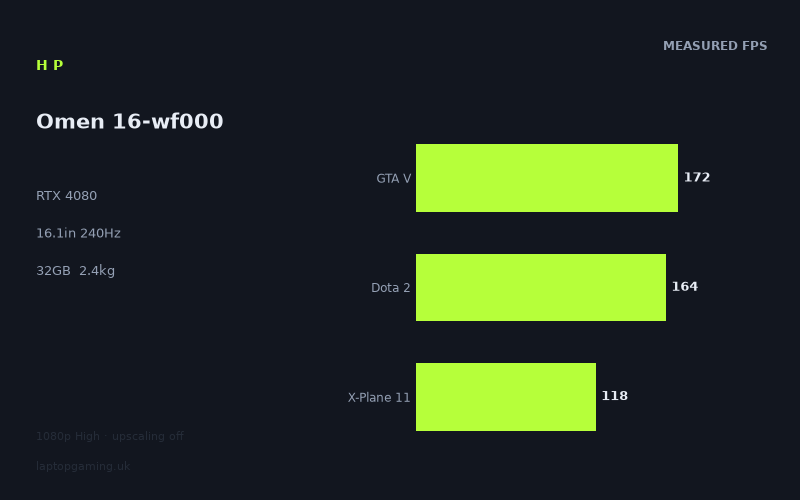
Frame rates
1920×1080, High preset, upscaling off.
Measured on this machine. Source: Notebookcheck, 2023-06-30.
Not scored: incomplete benchmark suite
Every scored laptop on this site is averaged over the same 5 games, and this one is short of Cyberpunk 2077, Baldur's Gate 3. A mean over 3 games is not comparable to a mean over 5, so we publish the figures we have and leave the score blank rather than rank it against machines tested on a different set. The numbers below are real - the suite is just incomplete.
How these numbers were produced
Frame rates here are not measured by us, and we label how each one was arrived at. A figure marked measured comes from a published run on that exact machine. A figure marked representative is derived from the GPU and its power limit (TGP) and cross-referenced against published reviews - a sound estimate of what that configuration delivers, but not a measurement of that specific laptop. Unless stated otherwise, numbers are 1920x1080, High preset, upscaling off. Where a laptop ships in several power configurations we use the wattage of the exact SKU listed, because a 140W RTX 5070 and a 115W one are not the same product.
In use
The short version
The HP Omen 16-wf000 is a 16.1in gaming laptop built around an RTX 4080, a Core i7-13700HX, 32GB of memory, a 2560x1440 IPS panel at 240Hz, an 83Wh battery and a 2.393kg chassis. Notebookcheck's measured figures, dated 30 June 2023, cover ten titles at 1920x1080 on the High preset with upscaling off, and they run from 320fps in Strange Brigade down to 118fps in X-Plane 11. Nothing in the set falls below 118fps. That is an unusually strong floor and it is the single most useful thing a prospective buyer can take away from this page.
The most persuasive individual result is Returnal at 136fps. Returnal is the heaviest genuine graphics workload in the measured set — a demanding, effects-dense title that punished a lot of hardware — and 136fps at native 1080p with no upscaling is a serious number. Tiny Tina's Wonderlands at 177fps and Final Fantasy XV at 154fps tell the same story from the mid-weight end. Whatever power limit HP has given this RTX 4080, and our record does not hold one, the measurements do not describe a starved graphics card.
The comparison data contains one result that dwarfs everything else. Against a Lenovo Yoga Pro 9 16IMH9 carrying an RTX 4050 at 100W, this machine averages 79 frames per second more across seven shared games. Seven games is by far the deepest overlap in this laptop's record, and 79fps is by far the widest margin. That combination is not a coincidence and this review explains at length why it is not.
There is no score on this page. Our scoring suite is five games, identical for every laptop we rank, and we hold three of them here: GTA V at 172fps, Dota 2 at 164fps and X-Plane 11 at 118fps, averaging 151fps. We have no figure for Cyberpunk 2077 and none for Baldur's Gate 3. There is a figure for Cyberpunk 2077 1.6 at 124fps in the record, and it is important to be clear that this does not fill the gap — a version-tagged benchmark is a different workload from the untagged title and cannot be substituted for it. The section below explains why in detail. We also hold no confirmed UK price for this configuration, which independently prevents any value judgement.
Buy it if you want a fast 16.1in machine with an exceptionally high performance floor and a display specification that suits it. Look elsewhere if you need certainty about what you are getting, because our record is missing the GPU power limit, the storage capacity, the price and two of the five games we rank on.
Performance
The power limit we do not hold
Every performance discussion on this site starts in the same place, because in this GPU generation it is the most predictive single number available: the power limit the manufacturer chose. Nvidia sells the same silicon to every laptop maker with a configurable ceiling, and each maker picks a point in that band based on how much heat the chassis can move, how much fan noise they will accept and what price bracket they are chasing. The consequence is worth restating because it underpins everything below: the performance difference between a generously configured GPU and a conservatively configured one of the same model routinely exceeds the difference between adjacent model numbers. A well-fed RTX 4070 beating a starved RTX 4080 is not an anomaly. It is how this product stack behaves.
Our record does not hold a power limit for the Omen 16-wf000's RTX 4080. That is a real gap and it removes the most useful predictor available. We are not going to guess at a figure, and nothing below should be read as implying one.
What we can do is reason from the rest of the record. The chassis is 16.1in and weighs 2.393kg. That is a substantial machine — not a thin-and-light, and with enough internal volume for a proper thermal solution — though not in the three-kilogram desktop-replacement class either. The processor is a Core i7-13700HX, one of the HX-series desktop-derived parts fitted to machines expected to sustain heavy multi-core load rather than a lower-power H-class chip. The battery is 83Wh, which is generous. This is a design built around sustained performance.
The measurements support that reading strongly. Strange Brigade at 320fps and The Witcher 3 at 296fps are figures a badly configured graphics card does not produce. More tellingly, Returnal at 136fps and Tiny Tina's Wonderlands at 177fps are results from genuine GPU workloads where a throttled card would show itself immediately. The reasonable conclusion is a healthily configured RTX 4080 in a chassis with real cooling capacity — but that is a conclusion drawn from outputs, not a specification we hold, and we would rather say so plainly than invent a wattage to fill the hole.
The measured spread, from top to bottom
The ten measured titles run from 320fps to 118fps — a spread of under three to one, which is narrower than many machines produce and is itself informative. The floor is high. Even the slowest result in the set is a frame rate most people would describe as fast.
At the top, Strange Brigade at 320fps. Strange Brigade has been a benchmark fixture for years because it is a clean, well-optimised Vulkan title that scales predictably and asks little of the processor. A result north of 300fps is what a healthy, well-powered card of this tier produces, and its main value here is as a sanity check on the power delivery and cooling.
The Witcher 3 at 296fps is the current build of the game rather than any version-tagged variant, and at 1080p High it is well past the point of stressing hardware of this class. F1 22 at 245fps is the same category of result — Codemasters' racing engines are well optimised and lean on the GPU in a straightforward way, and 245fps is far beyond anything a display can use.
Tiny Tina's Wonderlands at 177fps is where the data starts becoming useful. It is a proper modern renderer with real GPU demand, and 177fps is a strong number that tells you something the top three do not.
Then two scoring-suite titles that need reading carefully. GTA V at 172fps and Dota 2 at 164fps look like GPU results and are not. GTA V is an old game whose renderer leans heavily on single-thread processor performance; at 1080p on High it stopped being graphics-limited on hardware of this class years ago. Dota 2 is not a demanding game for any RTX 40-series card, and 164fps is well below what an RTX 4080 could theoretically produce in it. Both figures are substantially statements about the Core i7-13700HX and the platform around it, not about the graphics card. That observation is the key to the comparison section later.
Final Fantasy XV at 154fps is a mid-weight GPU test with well-documented engine quirks, and a good result. Returnal at 136fps is the heaviest untagged graphics workload we hold for this machine and the one that most deserves weight in a buying decision. Returnal's renderer is demanding in a way that separates well-configured cards from compromised ones, and 136fps at native 1080p with no upscaling is a properly strong showing.
Cyberpunk 2077 1.6 at 124fps is discussed on its own below, because the version tag changes what the number means.
At the bottom, X-Plane 11 at 118fps. X-Plane 11's simulation loop is famously processor-heavy and famously indifferent to graphics hardware. One hundred and eighteen frames per second is a strong result for the platform as a whole and a figure in which the RTX 4080 is largely a bystander. It is in our scoring suite because flight simulation is a real category of software people buy powerful machines to run, not because it tests graphics performance.
The Cyberpunk 2077 1.6 figure, and why it does not count
Our record holds a measurement labelled Cyberpunk 2077 1.6 at 124fps. Our scoring suite includes a title called Cyberpunk 2077 with no version tag. Those are not the same entry and we do not merge them, and it is worth setting out the reasoning because it looks like pedantry from the outside and is not.
A benchmark is a workload, not a name. When a game receives a substantial engine update, the work it asks of a processor and a graphics card changes, sometimes dramatically. Cyberpunk 2077 in particular went through a major overhaul after the 1.6 era that altered how the game loads the hardware. A figure taken on the earlier build and a figure taken on the current one are measurements of different software that happens to share a title. Averaging them together, or using one to fill a gap left by the other, would mean comparing laptops on workloads that are not the same — which is precisely the error our scoring suite exists to prevent.
So the 124fps figure is context, not a suite entry. It is useful context: it tells you that on the build measured, at 1080p High with upscaling off, this machine produced a comfortably high frame rate in a demanding open-world game. It does not tell you how this machine would rank against laptops whose Cyberpunk figures were taken on the current build, and it cannot be used to complete the scoring suite.
The same logic applies to any version-tagged entry anywhere on this site. Where you see a version number attached to a game name, treat it as a related but separate measurement. It never substitutes for the untagged title and it never gets merged into an average with it.
Three of five, and what the three have in common
For this laptop we hold three of the five scoring-suite games: GTA V at 172fps, Dota 2 at 164fps and X-Plane 11 at 118fps, averaging 151fps. We are missing Cyberpunk 2077 and Baldur's Gate 3.
Look at what the three we hold have in common. As set out above, all three are substantially processor-bound at 1080p on hardware of this class. Not one of them is a serious test of an RTX 4080. And the two we are missing are the two in the suite that would have been — Cyberpunk 2077 is the closest thing our five games have to a pure graphics test, and Baldur's Gate 3, while carrying a processor dependence of its own, asks far more of a graphics card than Dota 2 does.
The three-game average of 151fps is therefore not merely incomplete, it is systematically unrepresentative of this specific machine. It averages the three titles least capable of demonstrating what a well-configured RTX 4080 does and omits the two most capable. Ranking that against other laptops' five-game averages would introduce bias in a predictable direction: it would understate this machine.
That is why there is no score here. We would rather show the working and leave the number blank than publish an average that we know to be skewed. It is also why the Returnal figure matters so much in this review — with the suite's two GPU tests absent, Returnal is doing the job of showing what the graphics hardware can do, and it does it well.
What the frame rates mean in practice
Every one of the ten measured games clears 118fps at 1080p on High with no upscaling. Seven of the ten clear 150fps. Three clear 240fps. That is a very high floor by any standard, and it means there is no title in the measured set where this machine has to compromise at 1080p.
If your library is competitive shooters, strategy games, older single-player titles or anything short of the very heaviest modern releases, this laptop produces frame rates well beyond what most players can use and holds a great deal of settings headroom in reserve.
If your library is the demanding end, Returnal at 136fps is the best guide we hold. That is a comfortable, high frame rate in a genuinely heavy title, and it suggests the machine has meaningful headroom for games that came after these measurements were taken — though we hold no figures for anything newer and will not extrapolate to specific titles.
Thirty-two gigabytes of memory is generous and is one of the specifications most likely to keep the machine feeling adequate in several years' time. Sixteen gigabytes is enough for gaming today; 32GB removes the question and leaves real room for everything else you run alongside a game.
The resolution caveat
One thing needs saying clearly, because it applies here more than to a 1080p machine. Every frame rate above was measured at 1920x1080. The panel is 2560x1440.
That is 3,686,400 pixels against 2,073,600 — roughly 1.8 times as many. Rendering cost does not scale perfectly with pixel count and modern engines carry overheads that do not grow with resolution, but the direction is not in doubt. We hold no measurements at the panel's native resolution and we are not going to estimate them.
Directionally, the picture here is more comfortable than on most machines, because the floor is so high. A title measured at 136fps at 1080p has a great deal further to fall before it becomes a problem than one measured at 60fps. The lightest titles in the set have such enormous headroom that a native-resolution penalty barely matters. The realistic expectation is that this machine plays the measured set at 1440p at frame rates that remain high, with upscaling available for anything that has come along since. That is an inference from the shape of the data rather than a measurement, and we flag it as one.
The screen
16.1in at 2560x1440, IPS, 240Hz
Our record lists a 16.1in IPS panel at 2560x1440 and 240Hz. As a specification for a machine with this class of graphics hardware, it is well matched — better matched than the high-resolution creator panels and the very-high-refresh budget panels that appear elsewhere in our records.
The resolution is the right choice. At 16.1in, 2560x1440 gives a visibly sharper image than 1080p without the enormous rendering cost of a 4K or 3200x2000 panel, and it is a resolution an RTX 4080 can genuinely drive in most games. The 16.1in diagonal is worth a note of its own: a 16in-class panel gives meaningfully more usable area than a 15.6in one for a modest increase in footprint, and that area is useful for strategy games, for simulators with dense instrumentation, and for everything you do on the machine that is not a game.
IPS is a sensible choice rather than a compromise. It gives good viewing angles and consistent colour, and it carries none of the burn-in consideration that OLED does — which matters on a machine that will display static interface elements for hours at a time. We hold no brightness, contrast, colour-gamut or response-time measurements for this panel, so nothing here should be read as a claim about this specific example. It is a statement about the technology.
Can the GPU drive 240Hz?
At 1080p, in three of the ten measured titles, yes outright: Strange Brigade at 320fps, The Witcher 3 at 296fps and F1 22 at 245fps all exceed the panel's refresh rate, which means the display is the limiting factor rather than the machine. Tiny Tina's Wonderlands at 177fps, GTA V at 172fps, Dota 2 at 164fps and Final Fantasy XV at 154fps sit in the band where a 240Hz panel is doing real work without being saturated. Returnal at 136fps and X-Plane 11 at 118fps are below that, though both remain far above any threshold where smoothness is in question.
At the panel's native 1440p the answer is less generous and we hold no measurements to quantify it. The important structural point is that this is a display the hardware can meaningfully approach, which is not true of every high-refresh panel we see. A 240Hz ceiling on a machine that produces 320fps in its fastest measured game and 136fps in its heaviest is a defensible specification, not a number on a box.
For a competitive player the practical value is real. For a single-player buyer working through heavy narrative games, 240Hz is more headroom than the hardware will routinely use at native resolution — but headroom costs nothing, high-refresh panels tend to have better response characteristics generally, and variable refresh rate technologies work across a wider range on a faster display.
The specification, judged as a whole
Resolution, refresh rate and graphics configuration are the three specifications that have to agree with each other on a gaming laptop, and they do agree here. An RTX 4080 is roughly the right amount of graphics hardware for 1440p at high frame rates. A 240Hz ceiling gives light and competitive titles somewhere to go without demanding rendering performance the machine cannot supply in heavy ones. Nothing in the display specification asks the GPU for something it cannot deliver, and nothing in the GPU specification is wasted on a panel that cannot show it. That internal coherence is one of this machine's genuine strengths.
Build, size and portability
2.393kg and 83Wh
Our record gives the weight as 2.393kg and the battery as 83Wh. For a 16.1in machine carrying an RTX 4080 and an HX-series processor, just under 2.4kg is reasonable rather than remarkable — comparable machines frequently sit between 2.4kg and 3kg — and it places this laptop firmly in the "portable if you need it to be, but it lives on a desk" category.
The mass is not wasted. Cooling capacity is broadly a function of internal volume: fan diameter, heat-pipe cross-section, exhaust area, and the thermal mass available to absorb a transient load. A machine of this size and weight has considerably more of all of it than a 2kg 15.6in chassis, and that is the physical reason it can run a large graphics card and an HX processor without the frame rates collapsing. The measured results — 320fps at the top, 118fps at the bottom, nothing sagging — are consistent with a thermal solution that is doing its job.
We hold no measured temperatures, no fan noise figures and no sustained-load data for this machine, so we cannot tell you how the cooling sounds while it works. That is a genuine gap and it is one of the more common complaints about machines in this class, so a buyer who cares about acoustics should get the question answered elsewhere before committing.
Eighty-three watt-hours is a generous battery for a gaming laptop of this size. We hold no battery-life measurement and will not estimate one. What can be said, as with every discrete-GPU laptop, is that none of the frame rates above apply on battery — graphics cards are power-limited severely when unplugged, and this is a machine to game on with the charger attached regardless of cell size.
What our record does not contain
Several things a prospective buyer would reasonably want are absent, and listing them is more useful than writing around them. We hold no storage capacity for this configuration, no GPU power limit, no chassis dimensions beyond the 16.1in screen size, no port complement, no keyboard or trackpad detail, no measured noise, no measured temperatures, no battery runtime and no confirmed UK price.
The storage omission is unusual and worth flagging: it means we cannot tell you whether this configuration ships with 512GB, 1TB or something else, and on a gaming machine that is a material difference given how large modern installations have become. The price omission has the larger consequence, because value is a substantial part of how we rank machines and there is nothing to weigh the performance against without a number.
How it compares
The four machines below are all from the same GPU generation, compared only on games both machines hold, with our scoring-suite titles preferred where available. They are a deliberate spread: the two closest results, the machine this one beats by the widest margin, and the machine that beats it by the widest.
Lenovo Yoga Pro 9 16IMH9 — RTX 4050 at 100W — Omen 16-wf000 +79fps across 7 shared games
This is the most valuable comparison in the entire record and it is valuable for two separate reasons.
The margin first: across seven shared games the Omen averages 79 frames per second more than a Lenovo Yoga Pro 9 16IMH9 carrying an RTX 4050 at 100W. Seventy-nine frames per second is an enormous gap and it is exactly what should happen when the largest card in the generation meets the smallest. The Yoga's RTX 4050 at 100W is a reasonably generous configuration for that card — this is not a starved GPU losing to a healthy one, it is a well-fed small card losing to a big one. There is a great deal of silicon between an RTX 4050 and an RTX 4080, and when the test set is capable of showing it, it shows.
The depth second, and this is the part that matters analytically. Seven shared games is the deepest overlap in this laptop's comparison record by a factor of more than two, and it produces by far the widest margin. That is not a coincidence. A wide overlap necessarily includes titles that genuinely load the graphics card — Tiny Tina's Wonderlands, Returnal, Final Fantasy XV are all candidates from this machine's set — rather than being confined to the handful of processor-bound scoring games that any two machines are most likely to share. When the graphics card is actually being asked a question, the answer separates hardware. When it is not, it does not.
Keep this result in mind while reading the next two, because it is the control that makes them interpretable.
Dell G16 (i7-13650HX, RTX 4060) — Omen 16-wf000 +1fps across 3 shared games
Across three shared games the Omen averages one frame per second more than a Dell G16 with a Core i7-13650HX and an RTX 4060.
An RTX 4080 one frame ahead of an RTX 4060 is not a credible statement about graphics hardware, and the correct response to an incredible result is to work out what produced it rather than report it neutrally. The three games in this overlap are not measuring the graphics card.
We know a good deal about which games those are likely to be. This machine's scoring-suite entries — GTA V, Dota 2 and X-Plane 11 — are the titles most likely to appear in a narrow overlap with any other laptop, because the suite exists precisely to be common ground. All three are substantially processor-bound at 1080p on hardware of this class. In those games the frame rate is set by how quickly a single processor thread can prepare work for the renderer, not by how fast the GPU executes it. A Core i7-13650HX and a Core i7-13700HX are both capable HX-series parts and will feed the renderer at broadly similar rates; the graphics cards behind them spend the test waiting.
Set that one-frame margin against the 79-frame margin above and the point becomes unmissable. Same machine, same benchmark method, one comparison against a smaller card than the Dell's and one against a larger — and the results differ by 78 frames per second. The variable that changed is which games were in the overlap.
Our record does not hold a power limit for the Dell G16's RTX 4060, so we cannot say whether that card is generously or conservatively configured. It would not change the analysis: no configuration of an RTX 4060 is one frame per second short of an RTX 4080 in a workload that loads the GPU.
Asus ROG Strix G18 — RTX 4070 at 165W — level across 3 shared games
Across three shared games the two machines are level, with the Omen fractionally behind — a difference that rounds to zero and means, in practice, that the benchmark cannot tell them apart.
This result is more defensible on its own terms than the Dell comparison, and both halves of the explanation matter. The Strix G18's RTX 4070 at 165W is a very generously configured card indeed, at the top of the band that GPU is sold in. As set out at the start of this review, a well-fed card of one tier and a card of the tier above are much closer than their model numbers suggest — the power limit frequently matters more than the badge. So a genuinely close result between these two machines would not be shocking even in a GPU-limited test.
But that is not what produced this particular tie. Three shared games, on a machine whose scoring-suite entries are three processor-bound titles, is the same shallow, CPU-dominated overlap that produced the Dell result. Both machines carry capable HX-class platforms; in GTA V, Dota 2 and X-Plane 11 that is the component doing the work.
The honest conclusion is layered. It is not that an RTX 4080 is no faster than a 165W RTX 4070 — the comparison cannot support that claim in either direction. It is that these three games cannot distinguish them, that a 165W RTX 4070 is a serious piece of hardware regardless, and that anyone paying a large premium for the RTX 4080 badge over a well-configured RTX 4070 should want better evidence than this comparison can supply.
Asus ROG Strix Scar 17 — RTX 4090 — Omen 16-wf000 -48fps across 3 shared games
And here is the result that stops the previous two from being read as "shallow overlaps are meaningless". Across three shared games — the same depth that produced a one-frame win and a dead heat — the Omen averages 48 frames per second behind an Asus ROG Strix Scar 17 with an RTX 4090.
Forty-eight frames per second across three games is a very large gap, and its existence proves the point conclusively: a three-game overlap has ample dynamic range to expose a major difference when a major difference exists. The ties above are not an artefact of comparing too few games. They are a statement about which games, and about where each machine's actual ceiling sits.
What separates the Scar 17 from the Dell and the Strix G18, then, is not the number of shared titles. In processor-bound games the frame rate is set by the platform — the processor, its sustained clock behaviour, the memory subsystem — and the Scar 17 is clearing a ceiling that the Omen, the Dell and the Strix G18 all appear to sit at. Our record does not hold a power limit for the Strix Scar 17's RTX 4090, so we will not attribute the gap to a specific configuration, and on the analysis above we would not attribute a 48fps swing purely to the graphics card in any event.
For a buyer, the practical reading is more measured than the raw figure suggests. Forty-eight frames per second is a large average deficit, but it is an average across three titles this review has established are mostly not GPU tests. In heavy modern software the gap between an RTX 4080 and an RTX 4090 is real but is a different and generally smaller proportional difference than this number implies. We hold no shared heavy-title comparison between these two machines, so that remains an inference and we flag it as one.
What the four results say together
Taken as a set, the comparisons support three conclusions and refuse a fourth.
They support the conclusion that the method can separate machines decisively: +79fps at one end and -48fps at the other are enormous margins, and the +79 came from the deepest overlap in the record while the -48 came from the shallowest. Both extremes are real.
They support the conclusion that the narrow overlaps are dominated by processor-bound titles: a one-frame margin over an RTX 4060 and a dead heat with an RTX 4070, from a machine that is 79 frames clear of an RTX 4050 across seven games, is not explicable any other way.
They support the conclusion that this machine's graphics hardware is properly configured, on the strength of the 79fps margin across a deep overlap and its own Returnal result at 136fps.
What they do not support is a claim about how the RTX 4080 here compares with a well-configured RTX 4070. On the evidence we hold, the two are indistinguishable, and that is a genuine finding about the limits of the data rather than a finding about the hardware.
Who it's for
Buy it if
You want a very high performance floor. This is the machine's clearest strength. Ten measured games and the slowest of them runs at 118fps at native 1080p on High with no upscaling. There is no title in the set where this laptop is working hard, and Returnal at 136fps shows it holds up in genuinely demanding software. If you want a machine where you stop thinking about settings, this qualifies.
You want a 1440p panel the hardware can actually drive. A 16.1in 2560x1440 display at 240Hz is well matched to this class of graphics card. The resolution is sharp without being punishing, the refresh ceiling is high enough to be worth having, and the measured frame rates show the machine reaching into the range where both matter.
You want the machine to stay adequate. Thirty-two gigabytes of memory and a large graphics card are the two specifications that most reliably determine whether a laptop still feels current in several years. Both are right here.
You value screen area. A 16.1in panel is meaningfully more usable than a 15.6in one for simulators, strategy games and non-gaming work, at a modest cost in footprint.
Buy something else if
You need to know exactly what you are getting. This is the strongest reason for caution and it is about our record rather than the machine. We hold no GPU power limit, no storage capacity, no measured temperatures, no noise figures, no battery runtime, no confirmed UK price, and only three of the five games we rank on — with the two missing being the two that test graphics hardware. That is a lot of blank space. If you are the kind of buyer who wants every specification confirmed before spending, this page cannot give you that, and we would rather say so than fill the gaps with plausible-sounding numbers.
You are paying a large premium for the RTX 4080 badge. Against a 165W RTX 4070 across three shared games, this machine is indistinguishable. That comparison cannot prove the RTX 4080 is no faster — it plainly is, in workloads that load the GPU — but neither can it show you the advantage you would be paying for. Given that a well-configured RTX 4070 machine is likely to cost less, the burden of proof sits with the premium, and our data does not discharge it.
You want the fastest thing available. Forty-eight frames per second behind a Strix Scar 17 across three shared games is a large deficit. The section above explains why the number overstates the real-world gap in heavy titles, but it does not overturn the direction of travel. If outright speed is the objective, look higher up the stack.
Quiet operation is a priority. A large graphics card and an HX-series processor in a 2.393kg chassis is a substantial amount of heat in a moderate amount of volume. We hold no acoustic measurements at all, so we can neither reassure you nor warn you. If fan noise would ruin the machine for you, get that question answered elsewhere first.
You want a value judgement. No confirmed UK price means no score, and no honest comment on whether the machine is worth what it costs. Value is a substantial part of how we rank laptops and it cannot be computed from a blank.
The honest summary
The HP Omen 16-wf000 is a strong machine on the evidence available. The floor across ten measured games is 118fps, the heaviest untagged graphics workload in the set runs at 136fps, and the display specification is genuinely well matched to the hardware behind it. The 79-frame margin over a 100W RTX 4050 across seven shared games is the clearest demonstration in the record that the graphics card is doing what a big graphics card should.
The caveats are about what we do not know rather than what the measurements show. No power limit, no storage figure, no price, no acoustics, and a scoring suite three-fifths complete with the two GPU tests missing. The Cyberpunk 2077 1.6 figure in the record looks like it fills one of those holes and does not — it is a different build of the game and therefore a different workload, and we count it as context only.
Within those limits: a fast, coherent, well-specified 16.1in gaming laptop, whose comparison data proves it can pull far ahead of smaller cards when the games allow it, and cannot demonstrate an advantage over a well-configured RTX 4070 when they do not.