Review
Lenovo Legion 7 review
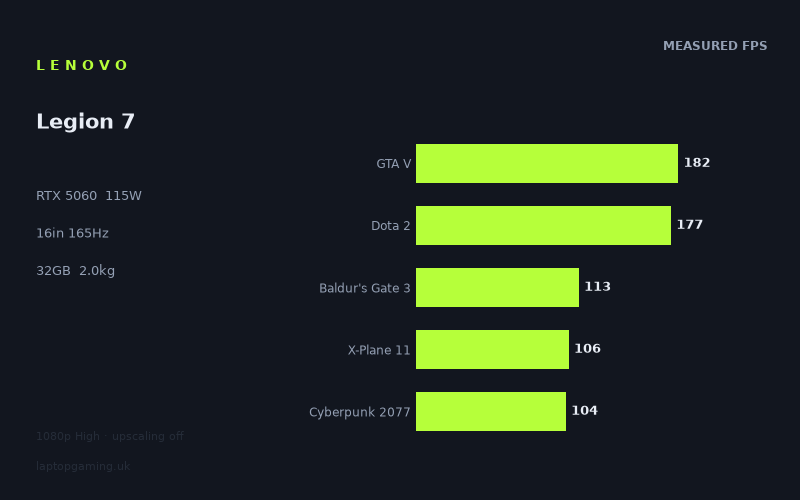
Frame rates
1920×1080, High preset, upscaling off. Averages 136fps across the 5 core benchmark games.
Measured on this machine. Source: Notebookcheck, 2025-10-03.
Not scored: no confirmed UK price
We have the full benchmark suite for this machine, so it ranks on the frame rate leaderboard like any other. What we don't have is a UK listing for this exact configuration - it's sold as a European review unit, or only in specifications that differ from the one tested. Since 30% of our score is value for money, scoring it would mean pretending price is no object, which would flatter it against every laptop you can actually buy. The frame rates below are real and comparable; there is just no buying recommendation to make yet.
How these numbers were produced
Frame rates here are not measured by us, and we label how each one was arrived at. A figure marked measured comes from a published run on that exact machine. A figure marked representative is derived from the GPU and its power limit (TGP) and cross-referenced against published reviews - a sound estimate of what that configuration delivers, but not a measurement of that specific laptop. Unless stated otherwise, numbers are 1920x1080, High preset, upscaling off. Where a laptop ships in several power configurations we use the wattage of the exact SKU listed, because a 140W RTX 5070 and a 115W one are not the same product.
In use
The short version
The Lenovo Legion 7 is a well-specified gaming laptop built around an RTX 5060 running at a 115W GPU power limit, a Core Ultra 7 255HX, 32GB of memory, a 1024GB SSD and a 16in 2560x1600 OLED display with a 165Hz refresh rate. Notebookcheck’s benchmark data shows that it is not merely a competent RTX 5060 machine: across the measured games, it performs close to several RTX 5070 laptops in our database.
That does not mean every game runs anywhere near the display’s 165Hz ceiling. The measured results split clearly into two groups. Less demanding or older games such as Strange Brigade, F1 24, GTA V and Dota 2 run very quickly at 1920x1080 on the High preset with upscaling disabled. More demanding modern games, especially Alan Wake 2, Black Myth: Wukong, Assassin’s Creed Shadows and Indiana Jones and the Great Circle, are much more limited by GPU workload. Those results are still usable in the context of the stated settings, but they are nowhere near a full 165fps experience.
The important point is that this is a 2560x1600 laptop, while the supplied frame-rate data is measured at 1920x1080. That makes the benchmark figures useful for comparing the Legion 7 against other laptops tested under the same conditions, but they do not demonstrate native-resolution performance on its own screen. Higher resolution generally imposes more GPU load, and there is no supplied 2560x1600 benchmark data from which to state the exact performance cost here. Anyone buying this machine principally for native-resolution gaming should treat the 1080p figures as comparative evidence, not as a promise of the frame rate they will see at 2560x1600.
There is also no confirmed UK price for this exact configuration, so we do not publish a score: value cannot be calculated without a price, although the benchmark suite is complete and the machine ranks normally on the frame-rate leaderboard.
On performance alone, the Legion 7 makes sense for the buyer who wants a 16in OLED gaming laptop with 32GB of memory, a 1024GB SSD and strong 1080p High-preset results, but does not expect every demanding release to run at the screen’s maximum refresh rate without compromise. It is particularly persuasive if your game library includes esports titles, older AAA games, driving games, strategy games or broadly scalable games rather than only the most punishing modern releases.
It is less suitable for the buyer whose definition of a gaming laptop is native 2560x1600 gaming at 165Hz in every major new game. Nothing in the supplied data supports that expectation. The display has the refresh rate, but the measured results show that the GPU has very different outcomes depending on the game. This is not a laptop with one universal performance story. It is quick in the right workloads and much more ordinary in the hardest ones.
Performance
A strong result for an RTX 5060, but not a uniform one
Notebookcheck measured the Lenovo Legion 7 at 1920x1080, using the High preset with upscaling disabled. This matters. The figures are not boosted by upscaling, and they are not results from a lower-quality preset. They show the machine’s performance under a clear, comparable gaming workload, but they should not be confused with the result at the laptop’s native 2560x1600 display resolution.
Across the five scoring-suite games, the Legion 7 averages 136fps. That is a good broad result for the hardware, especially because the individual scores include both comparatively light games and demanding releases. The average is useful as a summary, but the spread matters more than the single headline figure. A buyer choosing this laptop should pay attention to the games closest to the ones they actually play.
At the fast end, Strange Brigade reaches 275fps. F1 24 follows at 219fps, GTA V reaches 182fps and Dota 2 reaches 177fps. These are the results that show the Legion 7 can make real use of a 165Hz display in some games. Strange Brigade, F1 24, GTA V and Dota 2 all exceed the panel’s stated refresh rate under the measured settings. In those titles, the question is not whether the machine can generate enough frames for the display. It can. The more relevant question becomes whether the player wants to cap frame rate, alter settings for visual preference, or simply take advantage of the available responsiveness.
There is an important distinction between a laptop that can hit 165fps in selected games and one that can do so consistently across all genres. The Legion 7 is plainly the former. Its strongest results are extremely fast, but they do not establish a 165fps baseline for the system as a whole. The benchmark range extends from 275fps in Strange Brigade to 53fps in Assassin’s Creed Shadows and Indiana Jones and the Great Circle. That is a very large gap, and it is a more honest description of the laptop’s gaming behaviour than calling it simply “high refresh rate capable”.
Final Fantasy XV records 134fps. That is comfortably fast, but it is below the screen’s 165Hz maximum. Baldur’s Gate 3 records 113fps, X-Plane 11 reaches 106fps and Cyberpunk 2077 reaches 104fps. These are all results where the Legion 7 delivers more than a basic 60fps experience at the stated 1080p High settings, but they do not fully fill the display’s refresh envelope. For players who value smooth movement and low perceived input delay, these figures still suggest a strong experience. For buyers who want a fixed 165fps target, they are a reminder that high refresh rate and high frame rate are separate things.
Cyberpunk 2077 at 104fps is especially useful as a practical reference point because it sits between the very easy-to-drive games and the toughest titles in the list. It shows that the RTX 5060 at 115W can produce a genuinely high frame rate in a demanding modern game under the supplied settings, but it also shows why it would be wrong to assume that every new release will behave like F1 24 or GTA V. The same machine that reaches 219fps in F1 24 reaches 104fps in Cyberpunk 2077. Both results are valid; they simply represent different levels of GPU demand.
The difficult games are where expectations need adjusting
The Legion 7 records 67fps in Alan Wake 2, 58fps in Black Myth: Wukong, 53fps in Assassin’s Creed Shadows and 53fps in Indiana Jones and the Great Circle. These are the results that should shape buying advice for anyone focused on the newest graphically intensive games.
Alan Wake 2 at 67fps is above 60fps at the stated settings, which is a respectable outcome for a demanding game. But it is not close to the 165Hz panel limit, and it is not evidence that the laptop is an uncompromised high-refresh machine in this class of title. The gap between 67fps and 165Hz is substantial. The display can present more frames than the benchmark result supplies, but the game’s rendering workload is the limiting factor.
Black Myth: Wukong at 58fps falls below 60fps in the supplied result. That does not make the game unplayable; frame rate alone cannot describe every aspect of game feel. It does, however, establish that the Legion 7 is already near the point where a buyer may need to make decisions about image quality settings, resolution, or the use of supported upscaling options if they want a higher frame rate. The measured result was produced with upscaling disabled, so it is not a statement about every possible configuration. It is a statement about this specific High-preset, 1920x1080 test condition.
Assassin’s Creed Shadows and Indiana Jones and the Great Circle both return 53fps. The matching figures do not mean the games are identical in behaviour or engine demands; they simply show that under Notebookcheck’s stated conditions, both are similarly challenging for this configuration. In either case, the Legion 7 is well below the screen’s maximum refresh rate. A buyer who mainly plays titles of this class should not choose the machine on the assumption that the 165Hz OLED panel will be fully exploited without adjustment.
This is where the difference between buying a display and buying GPU headroom becomes most obvious. A 165Hz panel is excellent hardware to have when the game can deliver the frames. But a laptop’s display refresh specification does not increase GPU output. The Legion 7 has enough performance to run several games far beyond 165fps at the measured settings, yet it also has measured results in the 50fps range in other games. That is not a contradiction. It is what a mixed gaming workload looks like on a modern laptop GPU.
What the 115W GPU power limit means in practice
The RTX 5060 in this Legion 7 is specified with a 115W GPU power limit. That number is important because laptop GPU names alone do not tell the whole performance story. The practical implementation of the GPU matters, and power limits are one of the specifications that affect how a laptop can perform under load. However, the supplied evidence does not include alternative power modes, clock-speed data, thermal data, noise measurements or a direct same-chassis comparison at a different power limit. It would therefore be wrong to claim a precise performance gain from 115W alone.
What can be said is that the benchmark data shows this 115W RTX 5060 implementation is competitive with the named RTX 5070 rivals when compared across their shared games. That is the most useful real-world interpretation available from the fact sheet. Rather than treating the 115W specification as an abstract number, buyers can look at the published results: this Legion 7 is not automatically outperformed simply because a rival carries an RTX 5070 label.
The GPU power limit also needs to be understood alongside the game spread. In Strange Brigade, F1 24, GTA V and Dota 2, the laptop produces frame rates above the panel’s 165Hz refresh rate. In those games, more GPU capability may not transform the visible experience in the same way that it would in a game running at 53fps. Once performance is already above the screen’s refresh ceiling, additional frames are less central to the basic question of whether the panel is being fully fed.
In Alan Wake 2, Black Myth: Wukong, Assassin’s Creed Shadows and Indiana Jones and the Great Circle, the situation is different. Here, every additional frame would be meaningful because the measured results are far below 165fps. The 115W RTX 5060 can clearly handle these games at the stated settings, but the figures show limited margin for anyone demanding high refresh gaming without changing the settings or using features not included in the benchmark condition.
The reasonable conclusion is not that 115W makes the Legion 7 an RTX 5070 replacement in every circumstance. The data does not support that broad claim. The defensible conclusion is narrower and more useful: this is an RTX 5060 laptop whose measured game performance is close to several RTX 5070 laptops in a defined set of shared-game comparisons. That is a strong outcome, but it remains dependent on the game, the benchmark settings and the rival concerned.
CPU-sensitive and GPU-heavy games tell different stories
The Legion 7 combines its RTX 5060 with a Core Ultra 7 255HX and 32GB of memory. The supplied benchmark results do not isolate CPU performance, memory performance or GPU performance, so it would be inaccurate to assign a particular frame rate to one component. But the variation across the games makes clear that a gaming laptop cannot be judged only by the graphics card name.
X-Plane 11 reaches 106fps, while Baldur’s Gate 3 reaches 113fps. Both results are strong enough to support a fluid experience at the stated 1080p High settings, but neither reaches the 165fps display limit. These results sit in the middle of the Legion 7’s performance range. They are useful for buyers whose library includes simulation, role-playing or strategy games, because they show that the machine’s performance is not limited to the highest-scoring arcade or older titles.
Dota 2 at 177fps is a particularly positive result for competitive multiplayer players. It exceeds the 165Hz refresh rate under the measured conditions, meaning the laptop has enough performance to supply more frames than the panel can display in that game. GTA V at 182fps tells a similar story. These are the titles in which the Legion 7’s screen specification and measured performance align most cleanly.
By contrast, Black Myth: Wukong at 58fps and Assassin’s Creed Shadows at 53fps are reminders that the workload can change dramatically between games. A buyer should not use Dota 2 performance to predict Assassin’s Creed Shadows performance, even though both games run on the same laptop. Nor should they use the 53fps results to conclude that the Legion 7 is unsuitable for all gaming. The value of a benchmark suite is precisely that it exposes the range rather than hiding it behind one average.
Upscaling was off, which makes the results easier to interpret
Notebookcheck’s figures were recorded with upscaling disabled. That gives the results a useful clarity. The numbers represent conventional rendered performance at 1920x1080 on the High preset rather than a mixture of game-specific upscaling settings. Buyers can compare the Legion 7 with the listed rivals on the same basis where shared-game figures are available.
It also means the difficult-game results should be read carefully. A result of 53fps in Assassin’s Creed Shadows or Indiana Jones and the Great Circle does not state what performance might be possible with upscaling enabled, with different graphics settings, or at a different resolution. None of those figures are supplied. The benchmark data does show, however, that without those changes, the Legion 7 does not turn these games into 165fps experiences.
This distinction is especially important because the laptop has a 2560x1600 screen. Upscaling, resolution choices and quality settings can be central to how owners choose to run demanding games on a high-resolution laptop display. But this review cannot invent a native-resolution result or estimate a frame rate at another setting. The reliable conclusion is simply that the supplied 1080p High results provide a good comparative baseline, while the native screen resolution remains unmeasured in this fact sheet.
The screen
A high-spec panel with a performance ceiling the GPU cannot always reach
The Legion 7 has a 16in OLED display with a 2560x1600 resolution and a 165Hz refresh rate. On paper, that is an attractive display specification for both games and general use. The OLED panel type is a meaningful part of the machine’s appeal, while the 16in size and 2560x1600 resolution give it a more spacious format than a conventional 1920x1080 gaming display.
There are no supplied measurements for brightness, colour coverage, response time, contrast, HDR performance, PWM behaviour, panel coating or outdoor visibility. OLED itself should not be treated as proof of any of those specific qualities. The panel type tells us what it is, but not how this particular panel performs in those areas. Buyers for whom professional colour work, bright-room use or specific display behaviour is crucial would need independent panel measurements beyond the provided fact sheet.
For gaming, the central question is whether the RTX 5060 at 115W can drive the display properly. The answer depends on what “properly” means. If it means producing frame rates above the 165Hz refresh rate in every measured game, then no. The data clearly does not support that. If it means producing high frame rates in several games while still delivering usable performance in much more demanding titles, then yes, with the important caveat that the supplied figures are at 1920x1080 rather than native 2560x1600.
Strange Brigade at 275fps, F1 24 at 219fps, GTA V at 182fps and Dota 2 at 177fps all exceed 165fps. In those games, the 165Hz panel has enough refresh rate to show the benefit of the laptop’s performance. Final Fantasy XV at 134fps comes close enough to make the screen’s refresh rate relevant, even though it does not reach the maximum. Baldur’s Gate 3 at 113fps, X-Plane 11 at 106fps and Cyberpunk 2077 at 104fps remain high-frame-rate results, but they sit below the panel limit.
The lower results tell a different story. Alan Wake 2 at 67fps, Black Myth: Wukong at 58fps, Assassin’s Creed Shadows at 53fps and Indiana Jones and the Great Circle at 53fps leave much of the 165Hz capability unused under the tested conditions. That is not a failure of the panel. It is simply the reality that the display specification is ahead of the performance available in these GPU-heavy games.
Resolution matters more than the refresh-rate headline
The supplied testing resolution is 1920x1080. The Legion 7’s panel resolution is 2560x1600. These are not the same output target, and it would be misleading to write as if the measured frame rates were native-screen figures. The higher-resolution display is part of what makes the laptop appealing, but it also raises the question of how owners will configure games when they want both image detail and high frame rate.
No native 2560x1600 frame rates are provided. No 1600p quality-setting recommendations are provided either. As a result, the responsible position is not to guess. The measured figures show exactly what the machine can do at 1920x1080, High, with upscaling off. They do not prove that Cyberpunk 2077 will run at 104fps at 2560x1600, nor that Assassin’s Creed Shadows will run at 53fps there. The actual result could only be stated with benchmark data at that resolution.
This does not reduce the value of the 1080p figures for comparison shopping. Every shared-game rival comparison is based on games both machines have measured, and that is useful evidence of relative performance. It simply changes the advice for a prospective owner. Buy the Legion 7’s 2560x1600 OLED screen because you want that display specification, not because the available data proves native-resolution 165fps gaming across the benchmark list.
Competitive players focused on Dota 2, F1 24 or similarly scalable games are the most likely to extract the full refresh-rate benefit from the supplied results. Players focused on newer demanding single-player games should see the 165Hz panel as welcome headroom for lighter titles and future settings choices, rather than a guarantee of maximum-refresh gaming at high image quality.
Build, size and portability
The available portability fact is weight
The Lenovo Legion 7 weighs 1.978kg. For a laptop with a 16in display, 32GB of memory, a 1024GB SSD, an RTX 5060 running at a 115W limit and an 84Wh battery, that weight makes it more plausible as a machine that can travel than a large desktop-replacement design. It is not a claim that the laptop will disappear into a bag or feel weightless. At 1.978kg, it remains a substantial computer, especially when considered as part of a complete working or gaming setup.
No chassis dimensions are included in the fact sheet. That means there is no reliable basis to state its thickness, footprint, bag compatibility or desk space requirement. Weight is only one part of portability. A thin 1.978kg laptop and a larger 1.978kg laptop can be very different to carry, and we do not have the dimensions needed to draw that distinction here.
The 16in screen size also gives a sensible clue to intended use. This is not a compact small-screen gaming laptop. The Legion 7 is aimed at someone who wants a reasonably large integrated display and enough internal hardware for serious gaming, but who may still want to move the machine between rooms, workplaces, university, accommodation or occasional travel. The weight supports that interpretation more than it supports an ultra-light portability argument.
Battery capacity is known; battery life is not
The Legion 7 has an 84Wh battery. That is the only battery fact supplied. There is no measured battery-life figure for web use, video playback, office work, idle time or gaming. There is also no charging information, no power-adapter weight and no detail on how battery operation affects gaming performance. It would be irresponsible to convert an 84Wh capacity into a claimed number of hours.
For a buyer, the practical implication is straightforward: treat the 84Wh battery as a capacity specification, not a battery-life promise. Gaming laptops can behave very differently away from mains power, and the fact sheet does not provide the evidence needed to say where this Legion 7 sits. Anyone whose purchase depends on a specific amount of unplugged use should seek a source with measured battery testing for this exact configuration.
What cannot be concluded about build quality
There is no supplied information on chassis materials, keyboard feel, trackpad quality, hinge behaviour, port selection, webcam quality, speakers, cooling noise, surface temperatures, fan behaviour or upgrade access. This review is based on published specifications and Notebookcheck’s frame-rate figures, not physical use of the machine. As a result, it cannot honestly claim that the Legion 7 feels premium, is quiet, runs cool, has a good keyboard or is easy to service.
That absence does not mean those areas are poor. It means they are unverified here. Buyers should separate the parts of the buying decision supported by this data from the parts that are not. Performance, display resolution, panel type, refresh rate, weight, battery capacity, memory, storage, processor and GPU specification are known. Physical ergonomics, acoustics, thermals and connectivity are not established by the supplied facts.
The practical buying case therefore rests on a combination of measured gaming speed and a relatively manageable listed weight, rather than on claims about luxury construction or travel convenience. If you need a machine to replace a desktop, the 16in display, 32GB memory and 1024GB SSD are more relevant than the 1.978kg figure alone. If you need a machine to carry frequently, the weight is encouraging, but dimensions, charger size and measured battery life remain important unknowns.
How it compares
Against RTX 5070 laptops, this RTX 5060 is unusually close
The most interesting aspect of the Legion 7’s position in our database is its proximity to several laptops equipped with RTX 5070 graphics. GPU names matter, but shared-game results matter more when deciding whether one model is actually ahead in the games you play. In the provided rival comparisons, the Legion 7 is never dramatically separated from the RTX 5070 machines. Its margins range from a small lead to a small deficit.
This does not establish that the RTX 5060 is universally equivalent to an RTX 5070. It does establish that this particular Legion 7 configuration, with its 115W GPU power limit, is competitive in the supplied shared-game comparisons. That is a valuable distinction for a buyer comparing actual laptops rather than comparing component badges in isolation.
MSI Katana 17 HX
Against the MSI Katana 17 HX with an RTX 5070, the Legion 7 averages the same frame rate across six shared games: +0fps. That is as close as a comparison can be. On the shared-game evidence, there is no meaningful performance advantage for either laptop.
The Katana 17 HX has a confirmed UK price of £2,312. The Legion 7 has no confirmed UK price for this exact configuration, so a value verdict between the two cannot be made from the supplied information. Performance alone, however, does not give the Katana 17 HX an advantage despite its RTX 5070 label.
The comparison has a limitation worth keeping in view: it covers six shared games, not the Legion 7’s entire measured list. Still, a dead-even shared-game average is strong evidence that the Legion 7’s RTX 5060 implementation is not a weak one. A buyer choosing between these two machines should not assume the Katana is faster simply because it has the higher-numbered GPU.
HP Omen 17z-db100
Against the HP Omen 17z-db100 with an RTX 5070, the Legion 7 averages +2fps across 12 shared games. That is a small lead, but it is based on the largest shared-game sample among the named rivals. Twelve games give the comparison more breadth than the six-game Katana comparison.
A lead of +2fps should not be exaggerated. It does not mean the Legion 7 is decisively faster in every game. It means that across the games measured on both laptops, it edges the Omen by a very small amount. In practical terms, this is another result that puts the Legion 7 in the same general performance bracket as an RTX 5070 laptop rather than clearly below it.
The HP Omen 17z-db100 also has no confirmed UK price in the supplied data. That prevents a meaningful price-led recommendation between it and the Legion 7. If the decision is based purely on the available shared-game performance, the Legion 7 has the slight advantage. If the decision depends on display behaviour, weight, battery life, noise, ports or build quality, the supplied facts do not provide enough evidence to settle it.
Lenovo Legion 5 15IRX10
Against the Lenovo Legion 5 15IRX10 with an RTX 5070, the Legion 7 averages +3fps across nine shared games. Again, the margin is modest, but it is a lead for the RTX 5060 Legion 7 against an RTX 5070 rival. The comparison covers nine games, enough to be more useful than a single-title result.
The Legion 5 15IRX10 has a confirmed UK price of £2,359. With no confirmed UK price for the Legion 7 configuration, there is no honest way to say which offers better value. What can be said is that the Legion 7 does not concede measured shared-game performance to the Legion 5 15IRX10. It has the small lead while also offering the supplied 16in 2560x1600 OLED and 165Hz display specification.
This is likely to be the comparison that makes buyers look beyond the GPU label. An RTX 5070 badge suggests an easy hierarchy, but the shared-game average does not follow that simple expectation. The Legion 7’s performance result is better by +3fps across the games both systems have been measured in. That does not erase differences outside the benchmark data, but it is important evidence for anyone comparing these specific configurations.
MSI Crosshair 18 HX AI
The MSI Crosshair 18 HX AI with an RTX 5070 averages 5fps ahead of the Legion 7 across nine shared games. This is the first listed rival with a clearer, though still not enormous, performance lead over the Lenovo. The Crosshair’s advantage is small enough that it should be considered alongside other priorities rather than treated as a decisive class difference.
The MSI Crosshair 18 HX AI has a confirmed UK price of £2,095. That price is lower than the listed prices for the MSI Katana 17 HX, Lenovo Legion 5 15IRX10 and Alienware 16X Aurora, RTX, but the Legion 7’s unconfirmed UK price prevents a direct value judgement. If the Legion 7 were being considered only as a route to maximum shared-game frame rate among these two machines, the Crosshair has the evidence-led advantage. If the OLED panel, 16in format, 1.978kg weight or other supplied Lenovo specifications matter more, the performance gap is not large enough to make the decision automatic.
It is important not to turn a 5fps average deficit into a claim that the Legion 7 is slow. The Legion’s own results include 275fps in Strange Brigade, 219fps in F1 24 and 182fps in GTA V. The Crosshair comparison simply says that, over the nine games both laptops share, the MSI is modestly ahead.
Alienware 16X Aurora, RTX
Against the Alienware 16X Aurora, RTX with an RTX 5070, the Legion 7 averages 6fps behind across nine shared games. This is the largest deficit among the listed rivals, but it remains a single-digit average difference. It places the Alienware ahead in the shared-game data, while still keeping the Legion 7 in close range rather than in a clearly lower performance tier.
The Alienware 16X Aurora, RTX has a confirmed UK price of £2,569. That is the highest listed confirmed price among the named rivals. The supplied information does not allow a direct value comparison because the Legion 7 price is not confirmed. The performance evidence alone says that the Alienware is faster on average across the nine shared games, but by 6fps rather than by a dramatic margin.
For buyers looking only at frame rates, the Alienware has the edge in this pairing. For buyers looking at the whole supplied specification, the Legion 7 brings a 16in 2560x1600 OLED display, 165Hz refresh rate, 32GB memory, 1024GB SSD and 1.978kg weight. Whether those characteristics outweigh the shared-game performance deficit is a personal decision, and the missing Lenovo price means no definitive value conclusion should be forced.
The rival picture in plain language
The Legion 7 is effectively level with the MSI Katana 17 HX, slightly ahead of the HP Omen 17z-db100 and Lenovo Legion 5 15IRX10, slightly behind the MSI Crosshair 18 HX AI and a little further behind the Alienware 16X Aurora, RTX. All of those rivals use RTX 5070 graphics. That is the central comparative finding.
The RTX 5060 label should therefore not be used as a shortcut to dismiss this Legion 7. Its measured shared-game position is competitive. At the same time, the comparison does not prove a universal victory over RTX 5070 laptops, because the results differ by rival and are based only on games tested on both systems. The sensible interpretation is that this Lenovo belongs in the conversation with these RTX 5070 machines, not beneath it by default.
Who it’s for
Buy the Legion 7 if your priorities match the evidence
The Legion 7 is a good fit for the buyer who wants strong measured 1080p High-preset gaming performance without relying on upscaling. Its 136fps mean across the five scoring-suite games is a strong headline, but the more important detail is the collection of fast results behind it: 275fps in Strange Brigade, 219fps in F1 24, 182fps in GTA V, 177fps in Dota 2, 134fps in Final Fantasy XV, 113fps in Baldur’s Gate 3, 106fps in X-Plane 11 and 104fps in Cyberpunk 2077.
It particularly suits players whose regular games resemble Dota 2, F1 24, GTA V or Strange Brigade in performance demand. In those measured titles, it can exceed the 165Hz refresh rate of its own OLED screen. That is where the machine’s panel and performance specifications work together most convincingly.
It also suits a buyer who wants a 16in OLED display rather than treating display quality as secondary to GPU naming. The 2560x1600 resolution and 165Hz refresh rate are substantial parts of this configuration’s appeal. The benchmark data does not prove native 2560x1600 performance, but it does show that the laptop has strong comparative 1080p performance and can drive high refresh rates in several games.
The 32GB memory and 1024GB SSD make the configuration more appealing to someone who does not want to begin with a minimal memory or storage allocation. This review cannot state how memory capacity affects any individual benchmark result, but 32GB and 1024GB are clearly part of the specification rather than an afterthought.
The 1.978kg weight also makes sense for the buyer who wants serious gaming capability in a machine that is not defined solely by being large and stationary. It remains a 16in gaming laptop rather than an ultra-light device, but the listed weight gives it a more flexible role than an especially heavy desktop replacement. The lack of dimensions and battery-life testing means that frequent travellers should investigate further, but the basic portability proposition is reasonable.
Finally, it is a sensible choice for the buyer who evaluates laptops by measured shared-game results rather than GPU labels alone. Against several RTX 5070 rivals, the Legion 7 is either level, slightly ahead or only slightly behind. That is meaningful evidence that this 115W RTX 5060 configuration is competitive.
Buy something else if you need assured native-resolution high-refresh gaming
Do not buy the Legion 7 on the assumption that its 2560x1600, 165Hz OLED screen means every game will run at native resolution and 165fps. The available frame rates are measured at 1920x1080, not 2560x1600, and even at that lower test resolution several demanding games are well below 165fps. Alan Wake 2 reaches 67fps, Black Myth: Wukong reaches 58fps, and Assassin’s Creed Shadows and Indiana Jones and the Great Circle each reach 53fps.
If your main priority is the highest possible frame rate in the most demanding games under the supplied benchmark conditions, the MSI Crosshair 18 HX AI and Alienware 16X Aurora, RTX have the advantage in their respective shared-game comparisons. The Crosshair leads by 5fps across nine shared games, while the Alienware leads by 6fps across nine shared games. Those are not huge gaps, but they point in the right direction for a buyer focused purely on the available performance evidence.
Buy something else if your decision depends heavily on verified battery life, fan noise, chassis temperatures, keyboard feel, port selection, webcam quality, speakers, physical dimensions or upgrade access. None of those areas are covered by the supplied facts. It would be a mistake to assume that a strong benchmark result answers all of them.
Also consider another machine if you want a display whose brightness, colour performance, HDR capability or response characteristics have been independently measured and documented. The Legion 7 has an OLED panel, but the fact sheet does not provide those more detailed display measurements. OLED is a significant specification, not a complete panel review.
The final buying judgement
The Lenovo Legion 7’s strongest argument is not that it turns every demanding game into a 165fps showcase. The measured figures show plainly that it does not. Its stronger argument is that it combines a 16in 2560x1600 OLED 165Hz screen, 32GB memory, a 1024GB SSD, a Core Ultra 7 255HX, an 84Wh battery and a 1.978kg listed weight with an RTX 5060 implementation that performs close to multiple RTX 5070 laptops in shared-game data.
That is a more interesting proposition than the GPU label alone suggests. The Legion 7 is fast where many buyers want it to be fast, particularly in F1 24, GTA V, Dota 2 and Strange Brigade. It remains capable in Cyberpunk 2077, Baldur’s Gate 3 and X-Plane 11. It is more constrained in Alan Wake 2, Black Myth: Wukong, Assassin’s Creed Shadows and Indiana Jones and the Great Circle, where the screen’s 165Hz potential is clearly beyond the measured output.
For a buyer with a mixed library, the Legion 7 looks like a balanced, performance-competitive 16in gaming laptop with a notably attractive display specification. For a buyer who only plays the hardest modern games and expects maximum-refresh native-resolution performance without compromise, the benchmark data gives a clear warning to look elsewhere or adjust expectations. The right conclusion is not that the Legion 7 is universally fast or universally limited. It is a machine with very strong results in some games, respectable results in others, and a performance profile that needs to be matched to the games you actually play.