Review
Samsung Galaxy Book6 Ultra review
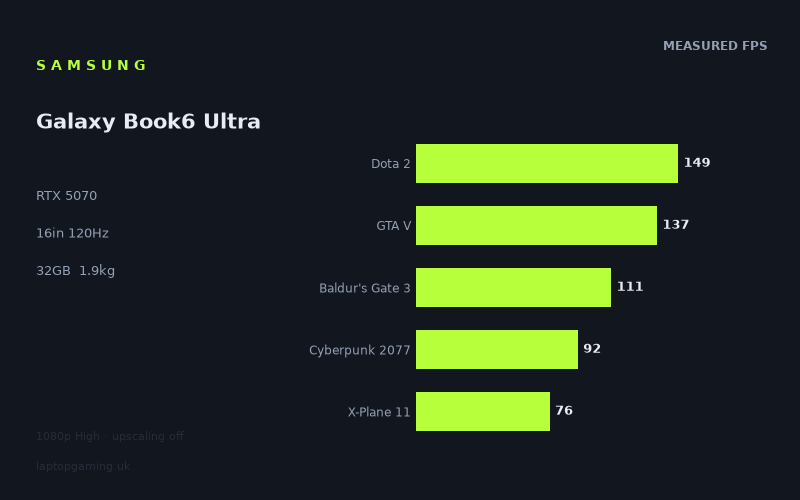
Frame rates
1920×1080, High preset, upscaling off. Averages 113fps across the 5 core benchmark games.
Measured on this machine. Source: Notebookcheck, 2026-03-06.
Not scored: no confirmed UK price
We have the full benchmark suite for this machine, so it ranks on the frame rate leaderboard like any other. What we don't have is a UK listing for this exact configuration - it's sold as a European review unit, or only in specifications that differ from the one tested. Since 30% of our score is value for money, scoring it would mean pretending price is no object, which would flatter it against every laptop you can actually buy. The frame rates below are real and comparable; there is just no buying recommendation to make yet.
How these numbers were produced
Frame rates here are not measured by us, and we label how each one was arrived at. A figure marked measured comes from a published run on that exact machine. A figure marked representative is derived from the GPU and its power limit (TGP) and cross-referenced against published reviews - a sound estimate of what that configuration delivers, but not a measurement of that specific laptop. Unless stated otherwise, numbers are 1920x1080, High preset, upscaling off. Where a laptop ships in several power configurations we use the wattage of the exact SKU listed, because a 140W RTX 5070 and a 115W one are not the same product.
In use
The short version
The Samsung Galaxy Book6 Ultra is not a gaming laptop, and reviewing it as one would be a category error that produces the wrong advice. It is a 1.9kg, 16-inch premium thin-and-light with a 2880x1800 OLED panel, 32GB of memory and a Core Ultra 7 356H, into which Samsung has fitted an RTX 5070 with 8GB of video memory. The question worth answering is not whether it beats a desktop replacement — it does not and never could — but whether the graphics card in it is doing enough to justify choosing this over a machine without one.
The measured figures say it is, with one significant reservation. Notebookcheck's numbers from 6 March 2026, all at 1920x1080 on the High preset with upscaling off, run from 257fps in Strange Brigade and 217fps in F1 24 down through 149fps in Dota 2, 137fps in GTA V, 117fps in Final Fantasy XV, 111fps in Baldur's Gate 3 and 92fps in Cyberpunk 2077, to 76fps in X-Plane 11. Across our five-game scoring suite the average is 113fps.
That is a complete benchmark suite, which means this machine ranks normally on our frame rate leaderboard. What it does not have is an overall score, and the reason is narrow: we have no confirmed UK price for this exact configuration, value is 30% of the score, and we are not going to compute a value figure without a price or speculate about what one might be. Nothing is wrong with the machine. We simply cannot price it.
The reservation is the 8GB of video memory, and it is not a small one. On a machine with a 2880x1800 panel, in 2026, 8GB is the specification most likely to be the thing that eventually stops you — not the shader throughput, not the processor, not the thermal budget. We will make that argument properly below because it is the single most important thing on this page.
Buy it if you want an excellent, genuinely portable 16-inch laptop with a superb display that will also run modern games at sensible settings. Do not buy it if games are the primary purpose, because the comparison data puts it level with RTX 5060 laptops and 88fps behind an RTX 5090 one, and the memory allocation limits how far you can push it.
Performance
Reading the eight measured games
The spread runs from 257fps at the top to 76fps at the bottom — a factor of about 3.4, which is a moderately wide range and tells you the graphics card has genuine headroom in the light titles while being properly worked in the heavy ones.
- Strange Brigade — 257fps. The ceiling. A Vulkan title that is exceptionally efficient relative to how it looks, and the closest thing in any benchmark suite to a best-case result.
- F1 24 — 217fps. A modern racing engine designed to run fast.
- Dota 2 — 149fps. Scoring suite, and the most diagnostic number in the set. Discussed below.
- GTA V — 137fps. Scoring suite. An old engine with a persistent processor dependency.
- Final Fantasy XV — 117fps. A conventional older rendering workload.
- Baldur's Gate 3 — 111fps. Scoring suite. Large and complex, but not a graphics showcase.
- Cyberpunk 2077 — 92fps. Scoring suite. The reference modern rasterisation load, and the most useful single figure here for predicting how the machine handles current single-player games.
- X-Plane 11 — 76fps. Scoring suite, and the floor. Flight simulation, heavily dependent on per-thread processor throughput.
The processor sets the ceiling, and Dota 2 shows it
Dota 2 at 149fps is the number that defines this machine's character. On laptops built around desktop-derived HX processors, Dota 2 typically produces the highest figure in any benchmark set by a very wide margin — it is a light game to draw and a demanding one to simulate, so it scales with the processor and almost ignores the graphics card. Here it comes third, 108fps behind Strange Brigade.
The Core Ultra 7 356H explains that. The H suffix marks it as a mobile-class part designed for thin, efficient machines, not a desktop-derived HX chip built to consume as much power as a large chassis can dissipate. In a 1.9kg laptop that is the only sensible choice — an HX processor in this thermal envelope would be throttled into pointlessness and would destroy the battery behaviour that is half the point of the product. But it has consequences, and they are visible in every processor-limited title in the list.
X-Plane 11 at 76fps is the same effect at its harshest. Flight simulators punish weak per-thread throughput more than any other genre, and 76fps is the lowest figure in this set by some margin. GTA V at 137fps is a milder version of the same thing: an engine from a much older era that never learned to spread its work across many cores.
The practical consequence is specific and worth stating clearly. If your library is competitive shooters, MOBAs, strategy games, flight or driving simulation, this machine's frame rates in those genres are set by a component you cannot configure around. Lowering the graphics settings will not raise Dota 2 much above 149fps or X-Plane 11 much above 76fps, because graphics settings are not what is holding them down. A thicker, cheaper laptop with an HX processor would beat this one in exactly those titles.
The genuinely graphics-limited results
Cyberpunk 2077 at 92fps and Baldur's Gate 3 at 111fps are the two figures that most directly reflect what the RTX 5070 is doing at this power budget, and 92fps at 1080p on High with upscaling off is a solid, unglamorous, entirely usable result for a modern heavy renderer.
It is worth being clear about what that number means in isolation. 92fps is well above the 60fps threshold that most people treat as the floor for comfortable play. It leaves headroom to raise settings or resolution. It is not, however, a number with years of slack in it — the newest and heaviest games will land below it, and there is no measurement in our data of a title newer than those listed to show how far below.
Final Fantasy XV at 117fps sits between the processor-limited and graphics-limited groups, which is where an older but real rendering workload belongs.
What the GPU's power budget means, and what our data lacks
Our fact sheet does not record a graphics power limit for this configuration, and we are not going to invent one. On a modern gaming laptop that is the specification that matters most after the card's model name, because the permitted power range for a single GPU model is wide enough that two machines with identical badges can perform very differently.
What the physical format tells us is more reliable than a guess anyway. A 1.9kg, 16-inch chassis can only move so much heat, and that budget must be shared between the processor and the graphics card. There is no arrangement of physics under which such a machine gives an RTX 5070 the power envelope a 2.5kg gaming laptop would. So the card is running well below what the same silicon could do in a thicker machine, and the frame rates are consistent with that — Cyberpunk 2077 at 92fps is a respectable figure, not a spectacular one.
This is the fundamental bargain of the thin machine with a discrete graphics card, and it is not a criticism. You are not buying the card's maximum performance. You are buying the ability to play modern games at all on a laptop you can carry every day, which the vast majority of 1.9kg laptops cannot do. Judged against that, the numbers here are good. Judged against a gaming laptop, they are not, and no amount of specification-sheet reading changes it.
Our data also contains no sustained-load behaviour, no temperature figures and no noise figures for this machine. On a thin chassis those are the measurements that most distinguish a well-engineered design from a compromised one — small fans have to spin faster, and there is less material between hot components and the palm rest. Their absence is a genuine gap in what this review can claim.
8GB of video memory is the real constraint
This is the part of the specification that should determine whether you buy the machine, and it is invisible in every frame rate above.
At 1920x1080 on High, 8GB is sufficient. Every figure in the measured set was captured under those conditions and none of them was memory-constrained. The problem is that the panel is 2880x1800 — roughly 2.5 times the pixel count of 1080p — and that games have been steadily raising their texture budgets for years.
Video memory demand does not scale linearly with resolution. Texture data, usually the single largest consumer, is broadly resolution-independent; framebuffers, depth buffers and the intermediate buffers used by modern screen-space effects do scale, and at 2880x1800 they scale considerably. So raising the resolution raises the requirement without doubling it — but it raises it from a starting point that is already close to the limit in recent releases at high texture settings.
The reason this matters more than a slow graphics card is the failure mode. A card that lacks shader throughput degrades gracefully: frame rates fall, you lower a setting, you carry on. A card that runs out of video memory does not degrade gracefully. It stutters, textures pop in late or fail to load at their intended quality, and frame times become inconsistent in a way that is far more unpleasant than a lower average frame rate. And it happens suddenly — the game is fine until it is not.
Practically, this means the Galaxy Book6 Ultra's realistic gaming configuration is 1080p or a modest upscaled resolution, with textures at High rather than Ultra, which is exactly what the measured figures describe. That is a perfectly reasonable way to play. But it is a ceiling rather than a starting point, and it is a ceiling that will get lower as games get heavier, in a way that the 113fps average does not warn you about.
If you are comparing this machine against one with 12GB or 16GB and you intend to keep it for four or five years, that is the axis on which the decision genuinely turns — not the frame rates, which will not show you the difference until it is too late to act on.
What 113fps across the scoring suite means
The five-game average is built from Dota 2 at 149, GTA V at 137, Baldur's Gate 3 at 111, Cyberpunk 2077 at 92 and X-Plane 11 at 76. The average of 113fps sits between Baldur's Gate 3 and Cyberpunk, which is a fair representation: this is a machine that does modern games comfortably at 1080p and never spectacularly.
Because the suite is complete, this figure is directly comparable to every other scored laptop on the site. That is worth more than it sounds — a large fraction of the machines we cover have partial suites and cannot be ranked at all. The frame rate half of the picture here is solid and comparable; only the price half is missing.
Set against a 120Hz display, 113fps is a well-judged number, and that is not a coincidence. It is the clearest sign that Samsung specified the panel and the graphics card to match each other rather than to win a specification argument.
The screen
2880x1800 OLED, and why the 120Hz figure is the right one
A 16-inch 2880x1800 OLED is a genuinely excellent display and, along with the weight, it is the main reason to buy this machine. OLED pixels emit their own light and switch off entirely for black, producing contrast an IPS backlight cannot approach. Per-pixel response times are far faster than IPS, which reduces smearing in motion independently of refresh rate. For video, photography, design work and cinematic games, the difference over a typical IPS laptop panel is immediate and large.
The 120Hz refresh rate deserves particular credit because it is the specification most manufacturers would have inflated. A 240Hz panel would have looked better on a comparison table and would have been almost entirely wasted here — at 1080p only four of the eight measured games exceed 120fps, and at the panel's native resolution far fewer would. Specifying 120Hz means the panel and the hardware behind it are matched, and it means whatever power and cost a faster panel would have consumed went somewhere more useful.
That is an unusually honest piece of product design in a market that routinely does the opposite, and it is worth saying so.
Can the graphics card drive the native resolution?
In the lighter titles, yes. In the heavier ones, not without upscaling.
2880x1800 is roughly 2.5 times the pixel count of 1920x1080. In the genuinely graphics-limited titles, frame rate scales substantially with pixel count, so Cyberpunk 2077 at 92fps at 1080p is not going to be a native-resolution proposition with upscaling off. Baldur's Gate 3 at 111fps is in a similar position. We have no native-resolution measurements in our data and we are not going to produce estimates by dividing, so we will describe the shape of the effect rather than its size.
In the processor-limited titles the arithmetic is entirely different. Dota 2 at 149fps, GTA V at 137fps and X-Plane 11 at 76fps are held back by something that does not care about pixel count, so raising the resolution costs far less in those. This is the standard, counter-intuitive shape of high-resolution gaming: the games that look least demanding often scale best, because they were never GPU-bound.
The practical answer for the heavy titles is upscaling — render internally near 1080p, output at native. That configuration is close to what the measured figures describe, which makes them more directly applicable to real use than they first appear. It also keeps video memory pressure lower than native rendering would, which on an 8GB card is not a minor consideration.
The OLED trade-offs
OLED carries a burn-in risk with static content displayed for very long periods. On a machine that will be used for work — the same taskbar, the same application chrome, the same toolbars, day after day — that is a live consideration rather than a theoretical one. Modern panels include mitigations and the risk is much lower than it once was, but it is not zero and it is worth knowing about on a machine you plan to keep for years.
Full-screen brightness on OLED is typically lower than peak highlight brightness, which affects use in bright rooms and outdoors. Our data contains no measured brightness, contrast or colour coverage figures for this specific panel, so everything in this section describes the technology rather than this example. That distinction matters, because OLED panels vary considerably and "OLED" on a specification sheet tells you less than buyers assume.
Build, size and portability
1.9kg is the entire product thesis
Everything about this machine follows from the weight. 1.9kg for a 16-inch laptop with a discrete RTX 5070 in it is a genuinely impressive piece of engineering, and it puts the Galaxy Book6 Ultra in a category almost nothing else occupies.
Understand what that buys. This is a laptop you carry every day without thinking about it. It goes in a rucksack alongside everything else. It fits on a train tray table. It can be taken to lectures, meetings, clients and coffee shops, opened, used and closed again, in a way that a 2.5kg gaming laptop cannot and a 3.5kg desktop replacement absolutely cannot. The 16-inch screen means you are not paying for that portability with a cramped display, which is the usual bargain.
This matters more than most specification comparisons because of a common and expensive failure mode: people buy a powerful laptop, discover it is too heavy to move, and end up with a cramped, thermally compromised desktop they paid a portability premium for. If the machine actually has to travel, the Galaxy Book6 Ultra is solving a real problem and the gaming laptops are not competing with it at all.
Our data does not record the weight of the mains adapter, so we will not put a figure on the travelling total. It is worth noting structurally that an H-class processor and a modestly powered graphics card need a smaller adapter than an HX-and-flagship-GPU combination does, so the gap between this machine and a gaming laptop is wider in the bag than the laptop weights alone suggest.
What the thinness costs
The entire performance section above is, in effect, an account of what 1.9kg costs. A thin chassis has less internal volume for heatsinks, less exhaust area, and room only for smaller fans that must spin faster to move the same air. The total heat the machine can dissipate is lower and must be shared between two components.
The consequences are visible throughout. The processor is an H-class part, which sets the ceiling in Dota 2 at 149fps and X-Plane 11 at 76fps. The graphics card is running well below what the same silicon could do elsewhere, which is why Cyberpunk 2077 lands at 92fps rather than higher. Neither is a failure. Both are the direct and unavoidable price of the weight, and the weight is what you are buying.
We have no measured temperature or noise data for this machine, and we would want it. Thin laptops with discrete graphics cards vary enormously in how pleasant they are under load, and the specification sheet gives no indication either way.
Memory, storage and battery
32GB of memory is the right specification and needs no defence. It is comfortably beyond what games require and gives real room for the professional work this machine is clearly aimed at — large project files, many applications, virtual machines, video timelines.
1TB of storage is adequate rather than generous. Modern games routinely occupy 100GB or more, so a large library will need managing rather than ignoring. For a machine whose primary role is work with gaming as a capable secondary function, that is a defensible balance, and it is a less serious issue here than it would be on a dedicated gaming machine.
Our data does not record a battery capacity for this configuration and contains no measured runtime figure, so we will not comment on how long it lasts. What is structurally safe to say is that the combination of an efficient H-class processor, a large OLED panel and a graphics card that can be idled when not gaming is a far better basis for real away-from-mains use than any gaming laptop configuration, and that this is likely to be one of the machine's genuine strengths. We would rather flag the gap in our data than imply we have measured it.
How it compares
Our database matches machines only on games both have been measured in. All four rivals here are from the same graphics generation and every comparison rests on five shared games, which makes this an unusually clean set — the differences are between contemporaries rather than between eras.
The pattern first: it performs like an RTX 5060 laptop
The two closest machines in our database both carry an RTX 5060 at 115W. The Lenovo LOQ comes out about a frame behind the Galaxy Book6 Ultra across five shared games; the Lenovo Legion 5 15AHP G10 about a frame ahead. Neither has a confirmed UK price in our data.
That is the placement, and it is worth stating without decoration: an RTX 5070 in a 1.9kg chassis delivers what an RTX 5060 at 115W delivers in a conventional gaming laptop. One tier of card, given away to the thermal envelope.
Part of that is the benchmark. Two of the five scoring-suite games — Dota 2 and X-Plane 11 — are limited by the processor rather than the graphics card, and GTA V leans that way too. In those, a bigger card produces very little because it is already waiting on the processor, and the Core Ultra 7 356H is a mobile-class part that reaches its ceiling earlier than the desktop-derived chips in thicker rivals. So some of the compression is the test rather than the hardware.
But that only explains part of it, and the last comparison in this set shows how much.
Against the Schenker XMG Neo 16 A25 — 88fps behind
Five shared games, and the Galaxy Book6 Ultra averages 88fps behind it. The Neo 16 A25 carries an RTX 5090, with no confirmed UK price in our data.
This is the comparison that stops anyone from arguing the ties above are purely a testing artifact. If these five games genuinely could not distinguish between graphics cards, the 5090 machine would be compressed into the same narrow band as the two 5060s. It is not. It is eighty-eight frames clear across the identical five-game set.
The benchmark can separate machines in this generation, and it separates them enormously when there is a real difference to find. The Galaxy Book6 Ultra sits where it sits because of what it is — a mobile-class processor and a graphics card operating in a 1.9kg thermal envelope — not because the measurement is blind.
Eighty-eight frames across a five-game average, in a set where two or three of the games are processor-bound, implies a substantially larger gap still in the genuinely graphics-limited titles. Cyberpunk 2077 at 92fps and Baldur's Gate 3 at 111fps are where that difference would live.
None of this is a failure of the machine. It is the price of the format, and the format is what you are buying. But it settles the question of whether a thin laptop with a discrete card can substitute for a gaming laptop when the games get demanding. On this evidence, it cannot, and no amount of specification-sheet reading changes it.
Against the MSI Cyborg 15 — 25fps ahead
Five shared games, and the Galaxy Book6 Ultra averages 25fps ahead. The Cyborg carries an RTX 5050 and sells for £984.
Twenty-five frames is a real margin and not a rounding error, but it is the smallest gap you will find between a machine of this specification and the cheapest current-generation laptop in our comparison set — and the Cyborg is the only rival here with a confirmed UK price.
That matters for how you frame the decision. The Galaxy Book6 Ultra is not a value proposition in frames per pound and could not be: it is a premium thin-and-light with an OLED panel, 32GB of memory and a chassis that weighs 1.9kg. The £984 machine is 25fps behind it and offers essentially none of that. If frames are what you want, the gap between these two is not where the money goes. If a light, well-made 16-inch laptop with a superb screen is what you want, the Cyborg is not competing at all.
We have no confirmed UK price for the Galaxy Book6 Ultra, so we cannot tell you what those 25 frames and that chassis cost relative to £984. That is the only reason this page carries no score.
Reading the set as a whole
Four current-generation rivals: 25fps ahead of the entry-level machine, level with two RTX 5060 laptops, and 88fps behind an RTX 5090 laptop. The Galaxy Book6 Ultra sits in the lower-middle of its own generation.
The useful conclusion is about category rather than ranking. This machine performs like a competent mid-range gaming laptop while weighing 1.9kg and carrying a display better than almost anything in that category ships with. Judged as a portable computer that plays games, that is an excellent result. Judged as a gaming laptop, it is a mid-range one at what is almost certainly not a mid-range price — and the 88fps gap to a proper flagship is the measure of what you are giving up.
Who it's for
Buy it if
You need a genuinely portable 16-inch laptop and want it to game as well. This is the machine's purpose and it fulfils it. 1.9kg with a discrete graphics card that turns in 92fps in Cyberpunk 2077 and 111fps in Baldur's Gate 3 at 1080p is a combination almost nothing else offers. If you carry a laptop daily and also play games, the alternative is either a heavy machine you resent or a light one that cannot play anything.
The display is a priority. A 16-inch 2880x1800 OLED is an excellent panel for video, photography, design and reading, and it is dramatically better than the IPS displays that dominate the market at any price. If your work involves looking at images critically, this alone can justify the machine.
Work is the primary job and gaming the secondary one. 32GB of memory, an efficient processor, a high-resolution display and a light chassis make an excellent working laptop. The gaming capability is a genuine bonus rather than a compromise, and the frame rates are more than adequate for playing at sensible settings.
You value a machine whose specifications are honest. The 120Hz panel matched to a 113fps average is the clearest example. Nothing here is inflated to win a comparison table, which is rarer than it should be.
Buy something else if
Gaming is the primary purpose. The comparison data places this level with RTX 5060 laptops and a long way behind a current flagship. A thicker machine at similar money will be substantially faster, particularly in the processor-limited genres, and will have more video memory. If the laptop is going to sit on a desk anyway, buy the desk machine.
You intend to keep it for five years and push it. 8GB of video memory on a 2880x1800 panel is the constraint that will bite first, and it will bite as stutter and texture problems rather than as a gently declining frame rate. If longevity under heavy settings matters, this is the specification to walk away from.
Your library is competitive or simulation-heavy. Dota 2 at 149fps and X-Plane 11 at 76fps are processor-limited results, and no graphics settings will improve them meaningfully. MOBAs, competitive shooters, strategy games, flight and driving simulation all want an HX-class processor, and this machine cannot have one without ceasing to be what it is.
You want a large game library on internal storage. 1TB is workable but tight, and it will need managing.
You want a score from us. We cannot compute one without a confirmed UK price, because value is 30% of the total. The frame rate half is complete and ranks normally against every other machine on the site; the price half does not exist in our data yet.
What we do not know
Stated plainly, because the site's proposition is that we do not fill gaps with guesses. We have no confirmed UK price for this configuration. We have no recorded graphics power limit, which on a thin machine largely determines what the card actually delivers and is the specification we would most want. We have no measured battery runtime and no recorded battery capacity in our data, which on a machine whose whole purpose is portability is a serious omission. We have no temperature figures and no noise figures — relevant on any 1.9kg chassis with a discrete graphics card. We have no measured brightness, contrast or colour coverage for the OLED panel, so our comments describe the technology rather than this example. And we have no frame rates at anything other than 1920x1080, when the panel is 2880x1800.
What we do have is a complete eight-game benchmark record and five substantial comparisons, and they describe the machine consistently. This is a very good thin-and-light laptop that plays modern games at the level of a gaming laptop from a couple of generations ago, held back in the processor-limited genres by a processor that is the right choice for the format, and limited in its long-term ceiling by a video memory allocation that is not. Judge it as a portable computer that games, and it is impressive. Judge it as a gaming laptop, and it is not the machine you want.