Review
Medion Erazer Beast 18 X1 review
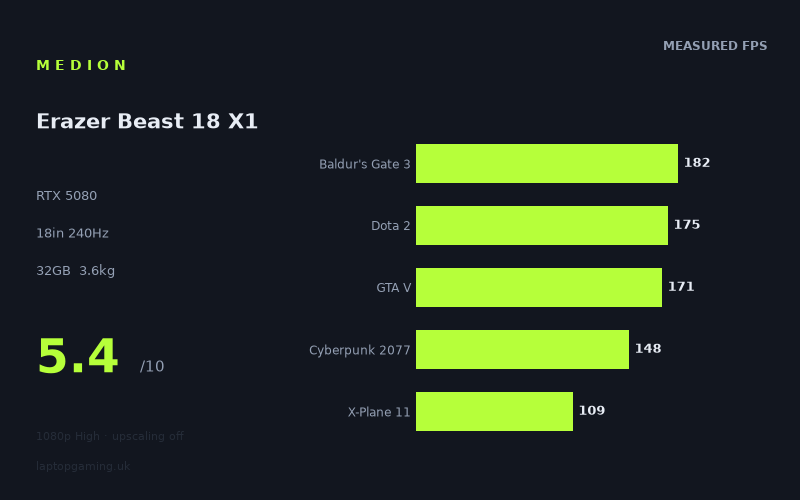
Frame rates
1920×1080, High preset, upscaling off. Averages 157fps across the 5 core benchmark games.
Measured on this machine. Source: Notebookcheck, 2025-05-22.
Not scored: no confirmed UK price
We have the full benchmark suite for this machine, so it ranks on the frame rate leaderboard like any other. What we don't have is a UK listing for this exact configuration - it's sold as a European review unit, or only in specifications that differ from the one tested. Since 30% of our score is value for money, scoring it would mean pretending price is no object, which would flatter it against every laptop you can actually buy. The frame rates below are real and comparable; there is just no buying recommendation to make yet.
How these numbers were produced
Frame rates here are not measured by us, and we label how each one was arrived at. A figure marked measured comes from a published run on that exact machine. A figure marked representative is derived from the GPU and its power limit (TGP) and cross-referenced against published reviews - a sound estimate of what that configuration delivers, but not a measurement of that specific laptop. Unless stated otherwise, numbers are 1920x1080, High preset, upscaling off. Where a laptop ships in several power configurations we use the wattage of the exact SKU listed, because a 140W RTX 5070 and a 115W one are not the same product.
In use
The short version
The Medion Erazer Beast 18 X1 is a large, expensive desktop-replacement gaming laptop built around an RTX 5080, a Core Ultra 9 275HX, 32GB of memory, a 2048GB SSD and an 18in 2560x1600 IPS display with a 240Hz refresh rate. At GBP 2,499, it is not cheap in absolute terms, but the benchmark data makes a strong case that it is considerably more sensible than several similarly fast alternatives.
The central point is that the Beast 18 X1 delivers RTX 5080-class performance without demanding RTX 5090 money. Notebookcheck’s measured figures show it averaging 157fps across the five-game scoring suite, with especially strong results in older, competitive and less graphically punishing games. Strange Brigade reaches 403fps, Prince of Persia The Lost Crown reaches 356fps and Counter-Strike 2 reaches 290fps. Those are the results that make the 240Hz panel meaningful: in selected games, the hardware can provide frame rates high enough to take real advantage of a very fast display.
The picture becomes more restrained in demanding modern releases. Cyberpunk 2077 measures 148fps, Kingdom Come Deliverance 2 reaches 146fps and Helldivers 2 reaches 134fps under the stated 1920x1080 High preset without upscaling. That is still excellent gaming performance, but it is not the same thing as a machine that will hold the panel’s 240Hz maximum in every title. More difficult games show the limit clearly: Horizon Forbidden West records 118fps, Ghost of Tsushima 106fps, Doom: The Dark Ages 104fps, The Elder Scrolls IV Oblivion Remastered 94fps, Dragon’s Dogma 2 85fps, Stalker 2 78fps, Senua’s Saga Hellblade 2 76fps and Star Wars Outlaws 73fps.
That spread is important. The Beast 18 X1 is not simply “a 240fps laptop” because the screen happens to refresh at 240Hz. It is a very quick laptop whose results range from far beyond 240fps in some games to well below 100fps in several of the heaviest releases in the measured list. Anyone buying it for competitive games, older blockbuster titles or games with lighter rendering demands can make much better use of the screen’s refresh rate than someone buying it mainly for the newest demanding cinematic games.
The value argument is stronger than the specification sheet alone suggests. Against the Acer Predator Helios 18 AI, another RTX 5080 laptop priced at GBP 3,103, the Medion is ahead by 1fps on average across seven shared games. Against the Medion Erazer Major 16 X1, which has an RTX 5070 Ti at 140W and costs GBP 2,770, the Beast 18 X1 is ahead by 4fps across eleven shared games. The Beast is not a bargain machine, but those comparisons make its GBP 2,499 price look much more defensible than the price tags of some close competitors.
It is not remotely portable in the ordinary sense. At 3.6kg, before considering anything else that may be needed to run a high-performance 18in gaming laptop, this is a machine for a desk, a home gaming setup, a university room where it largely stays put, or occasional transport between fixed locations. The 99Wh battery is substantial on paper, but no battery-life measurement is provided here, so it would be wrong to treat battery endurance as a buying reason.
Buy the Beast 18 X1 if you want an 18in RTX 5080 gaming laptop, value a 2560x1600 240Hz IPS screen, and accept that the machine is effectively a transportable desktop rather than a laptop to carry every day. It is particularly persuasive for buyers who want very high frame rates in Counter-Strike 2, Prince of Persia The Lost Crown, Strange Brigade, Dota 2, GTA V and Baldur’s Gate 3, while retaining strong results in heavier games.
Do not buy it merely because the panel is 240Hz and assume every game will run anywhere near that figure. The measured data does not support that conclusion. It also is not the right choice for anyone whose first priority is low weight, small physical size, verified battery longevity, or a laptop that can be recommended on the basis of portability. The Beast 18 X1 is a powerful large-screen gaming system with a good price relative to the rivals listed, not an all-purpose machine that happens to play games.
Performance
What the benchmark data actually says
Notebookcheck measured the Medion Erazer Beast 18 X1 at 1920x1080 using the High preset with upscaling off. Those conditions matter. They provide a consistent way to compare the machine with other laptops measured under the same approach, but they are not the Beast 18 X1’s native 2560x1600 screen resolution. The published figures therefore show the machine’s performance under a defined benchmark setting, rather than promising the same results at the display’s native resolution or in every visual mode a game may offer.
Across the five games used for the scoring suite, the Beast 18 X1 averages 157fps. That result is based on Baldur’s Gate 3 at 182fps, Dota 2 at 175fps, GTA V at 171fps, Cyberpunk 2077 at 148fps and X-Plane 11 at 109fps. It is a useful summary because it includes a mix of games rather than relying on one unusually favourable result. It is also a reminder that an average can conceal a large spread. The difference between Baldur’s Gate 3 at 182fps and X-Plane 11 at 109fps is substantial, despite both belonging to the same five-game group.
The highest results are emphatic. Strange Brigade runs at 403fps, Prince of Persia The Lost Crown at 356fps and Counter-Strike 2 at 290fps. These are the games in which the Beast 18 X1 has enough measured performance to exceed the 240Hz refresh rate of its panel. That does not mean the screen will somehow display more than its stated refresh rate, nor does it mean every game will behave like Counter-Strike 2. It does mean the GPU and CPU combination is not wasting the panel in those lighter or more competitive titles. The laptop has the performance headroom to support very high frame-rate play where the game itself permits it under the benchmark conditions.
Final Fantasy XV at 190fps, Baldur’s Gate 3 at 182fps, Dota 2 at 175fps, GTA V at 171fps and Civilization 7 at 166fps make up the next group. These are all clearly high frame-rate results, but they sit below the 240Hz maximum. That distinction matters for buyers who care about the panel’s full refresh capability. A result around this level can still make excellent use of a 240Hz display compared with a lower-refresh panel, particularly where frame delivery is variable rather than fixed, but the published number is not a claim of a locked 240fps experience.
Cyberpunk 2077 at 148fps, Kingdom Come Deliverance 2 at 146fps and Helldivers 2 at 134fps represent a very strong middle tier. These are demanding games, and the Beast 18 X1 remains comfortably above 100fps in all three under Notebookcheck’s stated 1920x1080 High test with upscaling off. That is the level of result that gives the Medion genuine performance credibility beyond esports and older games. It has enough measured speed for demanding modern games without relying on an upscaling mode in this particular benchmark configuration.
Horizon Forbidden West at 118fps, X-Plane 11 at 109fps, Ghost of Tsushima at 106fps and Doom: The Dark Ages at 104fps are still strong outcomes, but they also show where the 240Hz display stops being a performance target and becomes a screen with headroom. These games are above 100fps in the published results, yet their measured figures are less than half of the panel’s stated refresh rate. This is not a criticism of the screen. It is an argument for buying the machine with realistic expectations: the display is capable of more than the GPU will deliver in many demanding games at the benchmark settings.
The lower portion of the results is especially useful because it prevents an overly simple reading of the RTX 5080 label. The Elder Scrolls IV Oblivion Remastered measures 94fps, Until Dawn measures 91fps and Space Marine 2 measures 90fps. Dragon’s Dogma 2 reaches 85fps, Stalker 2 reaches 78fps, Senua’s Saga Hellblade 2 reaches 76fps and Star Wars Outlaws reaches 73fps. These are not weak results in isolation. They are, however, a clear indication that some current games remain heavy enough that even this machine does not approach the display’s 240Hz capability under the stated benchmark conditions.
The gap between Strange Brigade at 403fps and Star Wars Outlaws at 73fps is the most useful single lesson from the benchmark list. It demonstrates that performance depends heavily on the game. A buyer who spends most of their time in Counter-Strike 2, Dota 2, Civilization 7, GTA V or Prince of Persia The Lost Crown will see a very different kind of performance from a buyer focused on Stalker 2, Senua’s Saga Hellblade 2, Star Wars Outlaws, Dragon’s Dogma 2 or Space Marine 2. It would be misleading to reduce the Beast 18 X1 to one number, whether that number were the 157fps scoring-suite average or the 403fps peak result.
Comfortable high-frame-rate games
The clearest fit for the Beast 18 X1 is high-refresh gaming in titles that return high measured frame rates. Counter-Strike 2 at 290fps is the standout competitive result. It exceeds the 240Hz refresh rate of the IPS panel in Notebookcheck’s 1920x1080 High test with upscaling off. Prince of Persia The Lost Crown at 356fps and Strange Brigade at 403fps also exceed that screen refresh figure by a considerable margin.
Those results matter because they show the system is not simply configured with a high-refresh panel for marketing value. In selected titles, the panel has a genuine reason to exist. Buyers who play Counter-Strike 2 regularly should view this as one of the Beast 18 X1’s strongest arguments. The published figure is far closer to the screen’s maximum refresh rate than the results from the more demanding games lower in the list.
Final Fantasy XV at 190fps, Baldur’s Gate 3 at 182fps, Dota 2 at 175fps, GTA V at 171fps and Civilization 7 at 166fps do not reach 240fps, but they still establish the Medion as a high-frame-rate machine. This is the range where the laptop should appeal to players who do not need every game to meet the maximum refresh figure, but want a fast panel and performance well beyond the level associated with basic gaming laptops.
There is a practical difference between buying a 240Hz screen because a single game can exceed 240fps and buying one because a broad range of games can do so. The data supports the first claim for Strange Brigade, Prince of Persia The Lost Crown and Counter-Strike 2. It does not support the second claim across the whole list. That is why the Beast 18 X1 makes most sense for players with a mixed library: fast multiplayer or lighter games can exploit the panel more fully, while demanding single-player games can still run at strong measured frame rates even when they do not come close to 240fps.
Demanding games and the limits of the configuration
Cyberpunk 2077 at 148fps is a major positive for the Beast 18 X1. It sits below the 240Hz ceiling, but it is well into high-frame-rate territory in the stated benchmark. Kingdom Come Deliverance 2 at 146fps and Helldivers 2 at 134fps reinforce that point. These are not isolated results from games with very low demands; they show that the machine can remain fast in demanding releases.
The next tier is where buyers need to set expectations more carefully. Horizon Forbidden West at 118fps, Ghost of Tsushima at 106fps and Doom: The Dark Ages at 104fps are all above 100fps, but none is close to 240fps. A buyer choosing the Beast 18 X1 for these games is paying for a large, quick and high-quality screen with performance headroom, not for a consistently maxed-out refresh rate.
The results below 100fps deserve the same direct reading. The Elder Scrolls IV Oblivion Remastered at 94fps, Until Dawn at 91fps and Space Marine 2 at 90fps all show the system moving into a more conventional high-end gaming range. Dragon’s Dogma 2 at 85fps, Stalker 2 at 78fps, Senua’s Saga Hellblade 2 at 76fps and Star Wars Outlaws at 73fps show that there are demanding titles where the Beast 18 X1 is fast but not extravagant.
This does not undermine the machine’s performance credentials. It does undermine any simplistic assumption that an RTX 5080 laptop automatically turns every current game into a 240fps experience. The benchmark spread shows that the limiting factor is not the badge on the GPU but the interaction between the game and the laptop under the measured settings. Some games are dramatically easier for this hardware to run than others. The difference is visible in every part of the table, from 403fps at the top to 73fps at the bottom.
For buyers deciding whether the Beast 18 X1 has enough performance for a particular game, the sensible approach is to use the closest available result rather than the average alone. A player focused on Cyberpunk 2077 should pay attention to 148fps. A player focused on Star Wars Outlaws should pay attention to 73fps. A player who mainly plays Counter-Strike 2 should care more about 290fps than about the scoring-suite average. The 157fps average is useful context, but it is not a substitute for the individual game results.
GPU power limit: what is known and what is not
The fact sheet identifies the Beast 18 X1 as an RTX 5080 laptop, but it does not provide a confirmed GPU power limit for this Medion configuration. That means there is no basis here for claiming that it runs at a particular wattage, for describing it as a full-power implementation, or for attributing its performance to a specific GPU power setting. Any such claim would go beyond the available information.
The closest-rival data does include one explicit GPU power figure: the Medion Erazer Major 16 X1 uses an RTX 5070 Ti at 140W. It also lists the Asus ROG Strix G16 as an RTX 5080 at 175W. Those figures are useful for understanding those machines, but they do not establish the power limit of the Beast 18 X1. The Beast must be judged on its measured results rather than by assuming it matches either rival’s power configuration.
That measured approach works particularly well here because the Beast 18 X1 is extremely close to other high-end laptops in the shared-game comparisons. It matches the Asus ROG Strix G16 on average across eight shared games, sits 1fps ahead of the Acer Predator Helios 18 AI across seven shared games, is 4fps ahead of the Erazer Major 16 X1 across eleven shared games, sits 5fps behind the Asus ROG Strix Scar 16 across seven shared games, and trails the Aorus MASTER 16 by 8fps across eight shared games.
Those figures are more valuable than speculation about an unconfirmed power limit. They show where the Medion lands in actual published game comparisons. The Beast 18 X1 is not meaningfully separated from the RTX 5080 ROG Strix G16 in the shared list, and it is effectively level with the more expensive Acer Predator Helios 18 AI. It is also close enough to RTX 5090 systems in the listed comparisons to make their likely higher cost difficult to justify purely on the basis of the average frame-rate gaps given here.
The right conclusion is not that power limits do not matter. The right conclusion is that this fact sheet does not supply the Beast 18 X1’s own figure, so the review should not pretend to know it. The Notebookcheck numbers are the evidence available, and they show a laptop that performs at a very high level against the named rivals.
The screen
The Beast 18 X1 has an 18in IPS display with a 2560x1600 resolution and a 240Hz refresh rate. This is one of the machine’s strongest specification advantages. An 18in panel gives the laptop a large physical canvas, while 2560x1600 offers more resolution than the 1920x1080 benchmark setting used for the frame-rate figures. The 240Hz refresh rate is also ambitious for a machine aimed at high-end gaming rather than basic everyday use.
The important question is not whether 240Hz is impressive on a specification sheet. It is whether the measured gaming data gives the panel a practical purpose. In some games, the answer is plainly yes. Strange Brigade at 403fps, Prince of Persia The Lost Crown at 356fps and Counter-Strike 2 at 290fps all exceed 240fps under Notebookcheck’s stated test conditions. The panel has enough refresh capacity for those results.
In other games, the answer is more nuanced. Final Fantasy XV at 190fps, Baldur’s Gate 3 at 182fps, Dota 2 at 175fps, GTA V at 171fps and Civilization 7 at 166fps are all fast, but remain below the screen’s maximum refresh rate. That does not make the 240Hz panel irrelevant. It simply means the screen has more headroom than these measured figures require. Buyers should see it as a premium display feature that is fully exploited in selected games and partially exploited in many others.
The lower half of the benchmark list reinforces the same point. Cyberpunk 2077 at 148fps, Kingdom Come Deliverance 2 at 146fps and Helldivers 2 at 134fps are well below 240fps, while Horizon Forbidden West at 118fps, X-Plane 11 at 109fps, Ghost of Tsushima at 106fps and Doom: The Dark Ages at 104fps sit further away again. The heaviest group, led by The Elder Scrolls IV Oblivion Remastered at 94fps and ending with Star Wars Outlaws at 73fps, is nowhere near the panel’s maximum refresh rate in the measured configuration.
This is not an unusual contradiction. A high-refresh screen is a capability, not a promise that every game will meet its ceiling. The Beast 18 X1 has the hardware to make very good use of 240Hz in Counter-Strike 2 and other exceptionally fast-running titles. It also has the performance to run difficult games at much lower measured frame rates that are still substantial in their own right. The display is therefore best understood as a versatile high-end panel rather than as an indication that every game will run at 240fps.
The resolution needs equally careful treatment. The measured figures are at 1920x1080, while the screen’s native resolution is 2560x1600. The benchmark data cannot be used to state native-resolution performance because no such figures are included here. Buyers who intend to play at 2560x1600 should not treat the 1920x1080 High results as a direct native-resolution forecast. The review has verified benchmark numbers for one resolution and preset, not every possible display setting.
That limitation is especially important for the games near the lower end of the list. A result of 73fps in Star Wars Outlaws, 76fps in Senua’s Saga Hellblade 2, 78fps in Stalker 2 or 85fps in Dragon’s Dogma 2 under the published 1920x1080 High test should make buyers cautious about assuming a similar result at the higher native display resolution. There is no native-resolution measurement in the fact sheet, so no precise claim should be made.
The IPS panel type is also a meaningful part of the package, but the available information does not include measured brightness, contrast, colour coverage, response-time figures or display calibration results. It would therefore be wrong to make claims about image quality beyond the stated panel type, size, resolution and refresh rate. The screen looks strong on paper because it is 18in, 2560x1600 and 240Hz, but the fact sheet does not provide the additional panel measurements needed to make broader quality claims.
For gaming specifically, the strongest screen argument is straightforward. The 240Hz panel is justified for buyers who play games such as Counter-Strike 2, Strange Brigade and Prince of Persia The Lost Crown, where the published figures exceed 240fps. It remains a desirable display for games in the 166fps to 190fps range, even if those figures do not reach the maximum refresh rate. It is less central for the most demanding titles, where the laptop’s measured output is between 73fps and 118fps. In those games, the value of the 18in 2560x1600 screen is more about having a large high-end display than about reaching its full refresh ceiling.
Build, size and portability
The Beast 18 X1 weighs 3.6kg. That is the figure that defines how this laptop should be bought and used. This is not a lightweight machine for regular commuting, frequent travel or casual carrying between classes, meetings and cafés. At 3.6kg, it belongs in the desktop-replacement category: a laptop in the sense that it is self-contained and can be moved, but not a laptop that should be chosen for mobility first.
The 18in screen reinforces that conclusion. A large display is valuable for gaming, but it comes with a clear trade-off in the kind of use the machine suits. The Beast 18 X1 is better viewed as a system that can be relocated when necessary than as a machine designed to disappear into a bag every day. The fact sheet does not provide dimensions, so no claim can be made about thickness, footprint or how much space it occupies beyond the stated 18in screen size and 3.6kg weight.
There is a 99Wh battery, which is a large battery specification, but there is no measured battery-life result in the supplied information. That means battery endurance is unknown. It would be unsafe to assume all-day use, a particular number of hours, or any gaming runtime from the battery capacity alone. Buyers who need a machine for long periods away from mains power should seek verified battery testing before treating the Beast 18 X1 as suitable for that role.
The best use case is a fixed gaming setup where the laptop stays on a desk most of the time. The large 18in 2560x1600 screen, high refresh rate, RTX 5080 and 3.6kg weight all point in that direction. It could also suit someone who moves between a home setup and another fixed location, provided they regard the weight as an acceptable compromise for the performance and screen size.
It is a poor fit for someone replacing a thin everyday laptop. The performance is far beyond that class of machine, but so is the weight. Buyers should not minimise this simply because the Beast has a battery and a folding display. Its capabilities are those of a large gaming system; its portability limitations are equally real.
No build-material, chassis-rigidity, keyboard, trackpad, port-selection, speaker, webcam, fan-noise or temperature data is included in the fact sheet. Those are all important aspects of ownership, particularly in a 3.6kg high-performance laptop, but they cannot be assessed from the information available here. The practical judgement must therefore rest on the confirmed size class, the weight, the battery capacity and the gaming specification rather than unsupported assumptions about the chassis.
How it compares
Against the Asus ROG Strix G16
The Asus ROG Strix G16 is listed with an RTX 5080 at 175W, but no confirmed UK price. Across eight shared games, the Medion Erazer Beast 18 X1 averages 0fps behind it. In practical terms, the benchmark comparison places the two machines level across the shared set.
That is a particularly notable result because the ROG Strix G16 has a stated 175W RTX 5080 configuration while the Beast 18 X1’s GPU power limit is not confirmed in the supplied information. The correct conclusion is not that the Medion has the same power limit. It is that the two machines produce the same average result in the eight shared games listed.
Without a confirmed UK price for the Asus, it is impossible to make a direct value judgement between the two. The Medion costs GBP 2,499, but there is no equivalent price figure here for the ROG Strix G16. Buyers should therefore treat the performance comparison as useful and the value comparison as unresolved.
The physical positioning is also different in an obvious way: the Medion is an 18in, 3.6kg machine, while the fact sheet does not provide a screen size or weight for the Asus. There is no evidence here to claim one is more portable, has a better screen, or offers better battery life. On published shared-game performance alone, they are tied.
Against the Acer Predator Helios 18 AI
The Acer Predator Helios 18 AI is another RTX 5080 laptop and costs GBP 3,103. Across seven shared games, the Beast 18 X1 is ahead by 1fps on average. That is a negligible performance gap in the Medion’s favour, but the pricing difference is not negligible in purchasing terms. The Medion asks GBP 2,499 while the Acer is listed at GBP 3,103.
The useful interpretation is not that the Beast is dramatically faster. It is not; the shared-game average lead is 1fps. The useful interpretation is that the Medion is effectively level on the available benchmark comparison while carrying a substantially lower listed UK price. That makes the Acer difficult to recommend on performance-per-pound grounds using the information here.
There may be reasons outside this fact sheet why a buyer could prefer the Acer, but they cannot be assumed. No build, port, battery-life, noise, temperature or display-quality measurements for the Acer are included here. Based on the data supplied, the Medion is the more rational performance-value choice: nearly identical shared-game speed at GBP 2,499 rather than GBP 3,103.
Against the Medion Erazer Major 16 X1
The Medion Erazer Major 16 X1 uses an RTX 5070 Ti at 140W and is priced at GBP 2,770. The Beast 18 X1 averages 4fps ahead across eleven shared games. That is not an overwhelming frame-rate lead, but it is a lead, and it comes from a machine that is also listed at a lower price.
This comparison is valuable because it is not merely an RTX 5080-versus-RTX 5080 discussion. The Major 16 X1 has a lower-tier RTX 5070 Ti according to the listed specification, yet costs GBP 2,770. The Beast has the RTX 5080, an 18in 2560x1600 240Hz IPS screen, 32GB of memory, a 2048GB SSD and a GBP 2,499 price. The available shared-game results favour the Beast, and the listed price favours it too.
The 4fps average advantage should not be overstated. It does not mean every game is separated by a large margin, and the fact sheet does not provide the individual shared-game values for this comparison. But where a buyer is choosing between these two Medion models on the evidence available, the Beast 18 X1 is the stronger proposition. It offers the higher listed GPU tier, a large 18in display, a measured shared-game lead and a lower UK price.
The main reason to consider the Major 16 X1 would have to come from requirements not covered by the data here. The Beast weighs 3.6kg, and its 18in format is plainly intended for a different kind of buyer than someone looking for a smaller machine. But no weight or screen specification is provided for the Major in this fact sheet, so a portability comparison cannot be made directly.
Against the Asus ROG Strix Scar 16
The Asus ROG Strix Scar 16 is listed with an RTX 5090 and no confirmed UK price. Across seven shared games, the Beast 18 X1 averages 5fps behind it. That is a performance advantage for the Asus, but it is a modest one in the context of the shared results provided.
The key limitation is pricing. Without a confirmed UK price for the Scar 16, there is no way to determine whether its 5fps average lead is worth paying for. If the price gap were small, the Asus might be attractive for buyers chasing the highest available performance. If the gap were large, the Beast could be the much more sensible purchase. The fact sheet does not permit a conclusion either way.
What can be said is that the Medion remains very close to a listed RTX 5090 rival across the seven shared games. That makes the Beast 18 X1’s measured performance look strong, particularly at GBP 2,499. Buyers should not automatically assume the RTX 5090 label produces a dramatic practical advantage. In this specific shared-game comparison, the difference is 5fps on average.
Against the Aorus MASTER 16
The Aorus MASTER 16 is listed with an RTX 5090 and a UK price of GBP 6,007. Across eight shared games, the Beast 18 X1 averages 8fps behind it. The Aorus is faster in the available comparison, but the lead is small beside the difference in listed price.
This is the comparison that most clearly highlights the Beast 18 X1’s value position. The Medion is not presented as the absolute fastest machine in the list; the Aorus MASTER 16 has the higher shared-game average by 8fps. But the Medion delivers performance close enough to an RTX 5090 laptop that the Aorus price of GBP 6,007 becomes very difficult to defend for a buyer primarily interested in measured frame rates.
That is not an accusation that the Aorus has no advantages. It may have other characteristics that matter to specific buyers, but those are not contained in this fact sheet and should not be invented. On the available numbers, however, the Beast 18 X1 is the far more rational frame-rate purchase. An 8fps shared-game deficit does not make the Medion slow; it makes it close to a much more expensive machine.
The overall competitive position
The Beast 18 X1’s rival results establish a clear pattern. It is level with the RTX 5080 Asus ROG Strix G16 across eight shared games. It is 1fps ahead of the RTX 5080 Acer Predator Helios 18 AI across seven shared games, despite the Acer’s GBP 3,103 price. It is 4fps ahead of the GBP 2,770 RTX 5070 Ti Medion Erazer Major 16 X1 across eleven shared games. It is only 5fps behind the RTX 5090 Asus ROG Strix Scar 16 across seven shared games and 8fps behind the GBP 6,007 RTX 5090 Aorus MASTER 16 across eight shared games.
That does not prove the Beast 18 X1 is universally the best gaming laptop. There are too many missing categories for that: no verified battery life, no noise figures, no thermal data, no dimensions, no port information and no detailed panel measurements. But it does establish something important: at GBP 2,499, the Beast is unusually competitive on the published gaming figures against the named alternatives.
Who it’s for
Buy the Beast 18 X1 if you want a large-screen gaming replacement for a desktop
The strongest buyer for the Beast 18 X1 is someone who wants a gaming system that will spend most of its life in one place. The 18in 2560x1600 IPS screen, 240Hz refresh rate, RTX 5080, Core Ultra 9 275HX, 32GB memory, 2048GB SSD and 3.6kg weight describe a machine built for that role. It is best suited to a desk, a dedicated gaming space, or a setup where moving the laptop is occasional rather than routine.
It is also a good fit for someone who plays a mixture of competitive and demanding games. Counter-Strike 2 at 290fps, Prince of Persia The Lost Crown at 356fps and Strange Brigade at 403fps show the kind of games where the 240Hz screen is especially worthwhile. Baldur’s Gate 3 at 182fps, Dota 2 at 175fps, GTA V at 171fps and Civilization 7 at 166fps show that the machine remains very fast in a broader range of titles.
Players of Cyberpunk 2077, Kingdom Come Deliverance 2 and Helldivers 2 should also find the published results encouraging. Notebookcheck’s figures of 148fps, 146fps and 134fps respectively show that the Beast is not limited to lighter games. It has substantial performance in demanding releases under the stated 1920x1080 High test with upscaling off.
The Beast is particularly compelling for buyers comparing it against the Acer Predator Helios 18 AI or the Medion Erazer Major 16 X1. The Medion is ahead by 1fps on average against the Acer across seven shared games while costing GBP 2,499 rather than GBP 3,103. It is ahead by 4fps on average against the Major across eleven shared games while costing GBP 2,499 rather than GBP 2,770. Those are unusually favourable positions for the Beast.
Buy something else if portability is the priority
At 3.6kg, the Beast 18 X1 is not the right machine for someone who carries their laptop every day. Even buyers who are comfortable with a larger laptop should be honest about how often they will move it. The 18in format and weight point to a system that can travel when required, not one designed around convenience in transit.
It is also not the right choice for anyone who needs proven battery endurance. The machine has a 99Wh battery, but there is no measured battery-life figure in the supplied data. Capacity alone is not enough to establish how long it lasts in everyday use or gaming. If battery time away from mains power is central to the purchase, verified battery testing should take priority over assumptions.
Buyers looking for detailed information about chassis quality, keyboard feel, trackpad quality, ports, sound, camera performance, temperatures or fan noise should also wait for verified information in those categories. None is provided here. The Beast 18 X1 can be judged confidently on its published frame rates, screen specification, weight, memory, storage, CPU, GPU and price, but not on the ownership details that are absent from the fact sheet.
Buy something else if your only target is 240fps in every game
The 240Hz screen is one of the Beast 18 X1’s best features, but it should not be mistaken for a 240fps guarantee. The data supports more than 240fps in Strange Brigade, Prince of Persia The Lost Crown and Counter-Strike 2. It does not support that level in Final Fantasy XV, Baldur’s Gate 3, Dota 2, GTA V, Civilization 7, Cyberpunk 2077, Kingdom Come Deliverance 2, Helldivers 2 or the rest of the measured list.
The most demanding games are well below that ceiling in the stated benchmark. Star Wars Outlaws reaches 73fps, Senua’s Saga Hellblade 2 reaches 76fps, Stalker 2 reaches 78fps and Dragon’s Dogma 2 reaches 85fps. Space Marine 2 reaches 90fps, Until Dawn reaches 91fps and The Elder Scrolls IV Oblivion Remastered reaches 94fps. Anyone buying specifically to maximise frame rate in those games should focus on the individual results rather than the 240Hz panel specification.
Likewise, anyone expecting the published 1920x1080 figures to apply automatically at the native 2560x1600 resolution should be cautious. The benchmark data does not include native-resolution figures. The Beast may still be the right purchase, but the supplied measurements do not establish exact performance at 2560x1600.
The final buying advice
The Medion Erazer Beast 18 X1 is a strong choice for the buyer who wants performance first, screen size second, and portability a distant third. Its 3.6kg weight makes its role clear, but its GBP 2,499 price and measured gaming results make that compromise easier to accept. It is effectively tied with the RTX 5080 Asus ROG Strix G16 in the available shared-game data, marginally ahead of the more expensive Acer Predator Helios 18 AI, ahead of the more expensive Erazer Major 16 X1, and surprisingly close to the RTX 5090 rivals listed.
The best reason to buy it is not that it tops every chart. It does not. The best reason is that it gets close enough to much more expensive high-end laptops while offering a large 18in 2560x1600 240Hz IPS display and a benchmark record that ranges from excellent to exceptional depending on the game. For a desk-based buyer who wants a large-screen RTX 5080 laptop without stepping into the pricing of the Aorus MASTER 16, the Beast 18 X1 is a convincing option.
The reasons not to buy it are just as concrete. It is heavy, battery life is unverified, its dimensions are not supplied, and the frame-rate data does not show 240fps across demanding games. If those caveats match your priorities, look elsewhere. If they do not, the Medion Erazer Beast 18 X1 offers a notably strong balance of published performance, screen specification and UK price.