Review
Alienware x17 R2 review
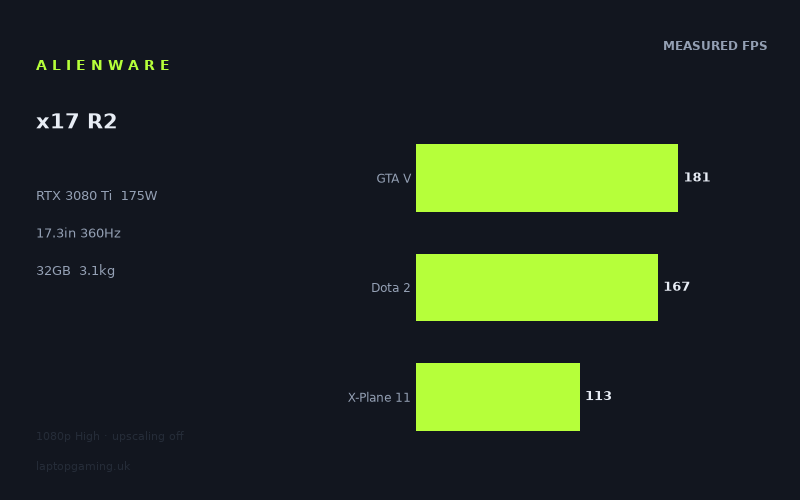
Frame rates
1920×1080, High preset, upscaling off.
Measured on this machine. Source: Notebookcheck, 2022-05-11.
Not scored: incomplete benchmark suite
Every scored laptop on this site is averaged over the same 5 games, and this one is short of Cyberpunk 2077, Baldur's Gate 3. A mean over 5 games is not comparable to a mean over 5, so we publish the figures we have and leave the score blank rather than rank it against machines tested on a different set. The numbers below are real - the suite is just incomplete.
How these numbers were produced
Frame rates here are not measured by us, and we label how each one was arrived at. A figure marked measured comes from a published run on that exact machine. A figure marked representative is derived from the GPU and its power limit (TGP) and cross-referenced against published reviews - a sound estimate of what that configuration delivers, but not a measurement of that specific laptop. Unless stated otherwise, numbers are 1920x1080, High preset, upscaling off. Where a laptop ships in several power configurations we use the wattage of the exact SKU listed, because a 140W RTX 5070 and a 115W one are not the same product.
In use
The short version
The Alienware x17 R2 is a large, heavy 17.3in gaming laptop built around a Core i9-12900HK and an RTX 3080 Ti running at a 175W GPU power limit. The benchmark data gives it exactly the sort of performance that configuration should be bought for: very high frame rates at its native 1920x1080 resolution, with strong results in demanding games as well as exceptional numbers in lighter titles.
Notebookcheck’s figures show a mean of 166fps across the five-game scoring suite. That is an excellent result for a 1920x1080 laptop, but the more useful point is the spread beneath that mean. The x17 R2 reaches 243fps in Strange Brigade, 181fps in GTA V and 167fps in Dota 2, while still managing 128fps in Final Fantasy XV and 113fps in X-Plane 11. In Cyberpunk 2077 1.6, one of the more demanding games here, it records 116fps. These are not merely esports-class frame rates in a single easy title; they show a machine that remains quick across very different workloads.
It is not, however, a laptop that can make a 360Hz screen a literal reality in every game. None of the measured titles reaches 360fps. The Witcher 3 comes closest at 268fps, while Strange Brigade reaches 243fps. Those are extremely high figures, but they are still short of the panel’s maximum refresh rate. In the heavier games, especially Final Fantasy XV, Cyberpunk 2077 1.6 and X-Plane 11, the panel has considerably more refresh capacity than the measured frame rate can use.
That does not make the screen a mistake. A 360Hz display is still useful when frame rates fluctuate, when settings are adjusted, or when playing titles less demanding than the games in this set. But this should be understood as a machine whose display is designed for headroom rather than one that will routinely deliver 360fps in graphically intensive games at High settings with upscaling off.
The 175W RTX 3080 Ti is central to the appeal. It places this Alienware among the high-power implementations of that GPU, and the comparison results show that it performs at the same level as other fast RTX 3080 Ti gaming laptops. Against the MSI GE76 Raider, also using a 175W RTX 3080 Ti, the shared-game average is effectively identical. It is also level with the Asus ROG Strix Scar 17 SE despite that machine listing a 150W RTX 3080 Ti, while the MSI Raider GE77 HX is only 3fps ahead across the shared games. That is the important practical conclusion: this is not a compromised RTX 3080 Ti laptop. Its measured results put it in the same narrow performance group as the fastest comparable machines listed.
The machine is best suited to someone who wants a desktop-replacement-style laptop for high-refresh 1080p gaming, values a 17.3in screen, and accepts that a 3.101kg system is primarily something to transport occasionally rather than carry every day. The 32GB memory allocation is substantial, and the Core i9-12900HK/RTX 3080 Ti combination is supported by benchmark data that is consistently strong rather than dependent on one unusually favourable game.
There is no overall score for this exact configuration because no confirmed UK price is available, so the value element cannot be calculated. That is a limitation of the buying case rather than of the benchmark record: the frame-rate suite is complete and the x17 R2 ranks normally on the performance leaderboard.
The more cautious recommendation is therefore straightforward. Buy the x17 R2 for its measured gaming performance, large high-refresh screen and desktop-replacement intent, not because it is easy to justify as a portable machine. Do not buy it expecting every game to run at 360fps simply because the panel refreshes at 360Hz. And do not treat the RTX 3080 Ti name alone as the reason to choose it: the 175W power limit and the measured results are what establish that this particular implementation is performing where it should.
Performance
A high-power RTX 3080 Ti implementation
The Alienware x17 R2 combines an RTX 3080 Ti with a 175W GPU power limit. That is the specification that matters most when interpreting the benchmark data. A laptop GPU name does not, by itself, tell a buyer how an individual machine will perform. The power limit is part of the implementation, and Notebookcheck’s measured frame rates show how this one behaves in real game workloads at 1920x1080 using the High preset with upscaling off.
At that setting, the x17 R2 produces 268fps in The Witcher 3, 243fps in Strange Brigade, 181fps in GTA V, 167fps in Dota 2, 128fps in Final Fantasy XV, 116fps in Cyberpunk 2077 1.6 and 113fps in X-Plane 11. The five scoring-suite games average 166fps. Read as a whole rather than as a single headline number, that is a strong and useful performance profile. The laptop is very fast in games able to generate very high frame rates, and it remains above 100fps in every measured title, including the more demanding games in the set.
The mean matters because it gives a broad summary of the scoring suite, but it should not be mistaken for a prediction that every game will run at around 166fps. The actual results range from 113fps in X-Plane 11 to 243fps in Strange Brigade within the scoring suite. That is a large spread, and it is normal. Game engines differ in how heavily they load the GPU, how much they rely on the CPU, and how their rendering workloads respond to a powerful graphics processor at 1920x1080.
The Core i9-12900HK is part of that picture. At 1920x1080, particularly in lighter titles capable of very high frame rates, processor limits can become more important. The supplied rival data specifically warns that lighter games in the shared set can be CPU-bound at 1080p and compress genuine GPU gaps. That is important when looking at the near-identical results against other RTX 3080 Ti laptops. A tie does not mean that GPU power limits are irrelevant; it can mean that the game and resolution have shifted the limiting factor away from the GPU.
The measured figures, game by game
The Witcher 3: 268fps. This is the highest measured result in the data provided for the x17 R2. It demonstrates that the Alienware can produce extremely high frame rates at 1920x1080 High without relying on upscaling. A figure of 268fps sits well above the refresh rate of many gaming displays, although it remains below this machine’s own 360Hz ceiling. For someone playing games that perform in this range, the benefit of the 360Hz panel is not that every refresh cycle is filled, but that the screen has ample refresh capacity for high and variable frame rates.
Strange Brigade: 243fps. Strange Brigade is one of the five scoring-suite games and is the second-highest result here. It reinforces the same point as The Witcher 3: the Alienware has the ability to drive a fast panel convincingly in games that are not imposing the same graphics load as the toughest titles in the list. At 243fps, it is below 360fps, but it is close enough that the panel’s unusually high refresh rate is clearly relevant to the experience of games in this performance class.
GTA V: 181fps. GTA V remains comfortably above 144fps in the measured figures, but it is not close to 360fps. This is a useful middle result. It shows why it would be wrong to describe the x17 R2 simply as a “360fps laptop”. The hardware can generate exceptional numbers, but a 360Hz display does not turn every high-end game into a 360fps experience. In GTA V, the measured result is still very high by ordinary gaming-laptop standards, yet the screen has substantial unused refresh headroom.
Dota 2: 167fps. Dota 2 is another scoring-suite title where the x17 R2 is decisively fast but not at the panel maximum. A measured 167fps is enough to make good use of a high-refresh display, particularly compared with conventional 60Hz or lower-refresh gaming panels, but it is less than half of 360fps. That distinction is worth making because buyers considering this laptop specifically for its display should base expectations on measured game behaviour rather than on the maximum refresh specification alone.
Final Fantasy XV: 128fps. This is still a strong 1920x1080 High result with upscaling off, but it is also a clear example of a game where the x17 R2’s 360Hz panel is far beyond what the measured frame rate can fully exploit. That is not a criticism of the GPU. It is a reminder that higher refresh capability and higher graphics demand are not interchangeable. The RTX 3080 Ti is producing a high frame rate in a demanding game, but the system is not operating in the extreme-frame-rate territory seen in Strange Brigade or The Witcher 3.
Cyberpunk 2077 1.6: 116fps. Cyberpunk 2077 1.6 is one of the most useful results in the list because it places the hardware under a more difficult graphics workload. At 116fps, the x17 R2 stays above 100fps at 1920x1080 High with upscaling off. That is a persuasive result for this class of laptop. It is also an important corrective to any assumption that a 175W RTX 3080 Ti makes demanding games trivial at 360Hz. It does not. The measured result is high, but it is much closer to the 100fps range than to 360fps.
X-Plane 11: 113fps. X-Plane 11 is the lowest result in the supplied figures, though only narrowly below Cyberpunk 2077 1.6. It remains above 100fps, which is a good outcome, but it is far from the panel’s maximum. This result underlines the value of looking beyond averages. A buyer interested in simulation games should not infer performance from the 243fps Strange Brigade result or the 268fps Witcher 3 result. The measured X-Plane 11 number is the relevant evidence for that type of workload, and it says that the x17 R2 is fast rather than limitless.
What the 166fps scoring-suite mean actually says
The 166fps mean across Strange Brigade, GTA V, Dota 2, Final Fantasy XV and X-Plane 11 is a useful summary because it spans a mix of game types and performance demands. It confirms that the x17 R2 is not dependent on one unusually easy benchmark. It records 243fps at the top end of that group and 113fps at the bottom end, with the other three results sitting between 128fps and 181fps.
Still, an average should never become a substitute for the individual game results. A player whose main game resembles Strange Brigade in demand may find the 360Hz display more meaningful than the average suggests. A player whose priorities are closer to X-Plane 11, Final Fantasy XV or Cyberpunk 2077 1.6 will see high frame rates, but not anything close to a sustained 360fps outcome based on these figures.
This is especially relevant because the benchmark conditions are clear: 1920x1080, High preset and upscaling off. The x17 R2 has been measured at the same resolution as its built-in screen, so there is no need to mentally translate a higher-resolution result down to native panel resolution. The data directly answers the most practical performance question: what this machine delivers on its own 1920x1080 display at High settings without upscaling.
There is also a useful restraint in those conditions. Upscaling is off, so the quoted performance is not being boosted by an image-reconstruction mode. That does not tell us what will happen with other settings or other technologies enabled, because there are no figures supplied for those situations. But it does mean the reported frame rates are straightforward to interpret: these are native-resolution High-preset numbers from Notebookcheck’s benchmark data.
Why the spread is more informative than a single flagship label
The RTX 3080 Ti badge is associated with high-end gaming, and the x17 R2’s numbers support that positioning. But the range from 113fps to 268fps is a better guide than the GPU name alone. It explains both what the laptop does very well and where expectations should stop.
At the top end, the laptop can drive games well beyond 200fps. That is where a 360Hz 1920x1080 screen becomes a sensible pairing. At the middle of the range, 167fps in Dota 2 and 181fps in GTA V still make the high-refresh display worthwhile, though they do not use its full maximum. At the lower end, 113fps in X-Plane 11 and 116fps in Cyberpunk 2077 1.6 remain excellent figures, but they represent a different kind of gaming experience: smooth, high-frame-rate play rather than display-saturating competitive performance.
The practical lesson is that the Alienware should be bought as a powerful 1080p machine with a very fast display, not as a promise of a fixed frame rate across all game types. The measured evidence is already strong enough without stretching it. It delivers above 100fps in every game listed, reaches well above 200fps in two titles, and has a five-game scoring-suite mean of 166fps. That is a serious performance record.
The 175W GPU power limit also matters most when comparing this laptop with machines that use the same RTX 3080 Ti. The comparison section shows that the x17 R2 is effectively level with the MSI GE76 Raider using the same 175W limit and the Asus ROG Strix Scar 17 SE using a 150W limit, while sitting only 3fps behind the MSI Raider GE77 HX with its own 175W RTX 3080 Ti. These results make it clear that the Alienware’s GPU configuration is not leaving conspicuous performance on the table in the games shared with those rivals.
At 1080p, however, the lighter shared titles can become CPU-bound. That reduces the visible gap between powerful GPUs and helps explain why machines with different GPU power limits can return near-zero differences across a shared set. The correct reading is not that a 175W limit guarantees a lead in every game, nor that a 150W configuration is automatically equivalent. It is that the measured game mix, resolution and CPU behaviour can compress differences that might be more visible in other conditions. For this review, the benchmark results are the evidence, and the evidence puts the x17 R2 in the leading group of comparable RTX 3080 Ti systems.
The screen
A 17.3in 1920x1080 IPS display with a 360Hz refresh rate
The x17 R2 uses a 17.3in IPS display at 1920x1080 with a 360Hz refresh rate. This is an unambiguous gaming-first specification. The 1920x1080 resolution keeps the pixel workload lower than a higher-resolution panel would, which aligns with the aim of generating very high frame rates. The 360Hz refresh rate then provides unusually large headroom for games that can take advantage of it.
The panel size also matters. A 17.3in screen gives the machine a desktop-replacement character before any benchmark figure is considered. It is a large display for games, and pairing that size with 1920x1080 and 360Hz indicates a clear priority: speed and responsiveness rather than pursuing a higher native resolution. The benchmark conditions match the panel’s native resolution, so the measured frame rates are directly relevant to this display rather than being theoretical figures taken at another target.
IPS identifies the panel type, but the supplied information does not include measurements for brightness, contrast, colour coverage, response time or any other display quality metric. There is no basis here to make claims about those areas. The evidence supports a judgement about size, resolution, refresh rate and measured gaming utilisation; it does not support a judgement about image quality beyond those specifications.
Can the RTX 3080 Ti drive 360Hz?
The accurate answer is: sometimes it gets relatively close, but none of the supplied results reaches 360fps. The highest figure is 268fps in The Witcher 3. Strange Brigade follows at 243fps. Those numbers show that the x17 R2 can produce extremely high frame rates, but the display’s 360Hz maximum remains above the measured output even in the quickest games listed.
That should shape how the refresh-rate specification is interpreted. A 360Hz panel is not wasted simply because a game runs below 360fps. It can still accommodate the frame rate the system produces without being the limiting refresh ceiling. But buyers should distinguish between “the panel can refresh at 360Hz” and “the laptop delivers 360fps”. The former is a specification; the latter is not supported by any of the results here.
The gap is moderate in The Witcher 3 and Strange Brigade compared with the rest of the set. At 268fps and 243fps, the x17 R2 is operating in a frame-rate range where a 360Hz screen is a logical fit, particularly for players who value exceptionally high refresh capability. The gap becomes larger in GTA V at 181fps and Dota 2 at 167fps. Those are still high frame rates, but they leave around half of the panel’s maximum capacity unused.
In Final Fantasy XV at 128fps, Cyberpunk 2077 1.6 at 116fps and X-Plane 11 at 113fps, the panel’s 360Hz specification is best viewed as headroom rather than an attainable measured target. These results do not make the display less capable; they show that graphics workload determines actual frame rate. A fast screen cannot force a demanding game to render more frames than the GPU and CPU can produce under the selected settings.
Why 1920x1080 makes sense for the measured performance
The benchmark data makes a coherent case for the 1920x1080 resolution. The x17 R2 is able to run every measured game above 100fps at that resolution using High settings with upscaling off. That gives it broad high-refresh capability across the set, not merely in lightweight games.
A buyer who prioritises high frame rates over a higher native resolution is therefore well served by the basic display strategy. The laptop reaches 243fps in Strange Brigade and 181fps in GTA V, while retaining 116fps in Cyberpunk 2077 1.6 and 113fps in X-Plane 11. Those numbers are easier to reconcile with a 360Hz panel at 1920x1080 than they would be with a display specification aimed primarily at increasing pixel count.
There is no display resolution choice discussed in the supplied information, so this is not an argument that 1920x1080 is universally preferable. It is an argument that it is well matched to the measured behaviour of this configuration. The Alienware’s screen is designed to expose high frame rates, and the RTX 3080 Ti at 175W supplies those rates often enough for the pairing to make practical sense.
Build, size and portability
The available physical figure is the weight: 3.101kg. That places the x17 R2 firmly in large-laptop territory. It is a 17.3in machine, and the weight confirms that this should be approached as a desktop replacement or a system moved between fixed locations, not as a light all-day carry laptop.
A weight of 3.101kg does not make the laptop impossible to transport. It means transport is likely to be deliberate. It suits a buyer who wants one powerful machine for a desk, a room, a study space or travel between places where the laptop can be set down and used for extended sessions. It is much less naturally suited to someone who expects to carry a laptop around frequently as part of a daily routine.
The supplied information does not include chassis dimensions, so there is no basis to state its width, depth or thickness. That absence matters because weight alone does not fully describe how much room a laptop takes in a bag or on a desk. What can be said is that the 17.3in screen and 3.101kg weight point toward a substantial system rather than a compact one.
The 87Wh battery capacity is also listed, but no battery-life measurement is provided. Capacity is not a usable battery-runtime figure, and it would be misleading to turn it into one. Buyers who need a precise expectation for unplugged use should seek measured battery data rather than infer it from the 87Wh specification alone.
The internal specification reinforces the desktop-replacement theme. The Core i9-12900HK, 32GB of memory and 175W RTX 3080 Ti are not modest components selected for a small, lightweight system. They support the performance shown in the benchmark data, particularly the ability to exceed 100fps in all the measured games at 1920x1080 High with upscaling off. The physical compromise is visible in the 3.101kg weight.
For the right owner, this trade-off is reasonable. Someone replacing or supplementing a desktop, wanting a large built-in display and prioritising gaming output will see the benefit. Someone who already has a desktop and needs a genuinely mobile secondary computer may find the basic size-and-weight proposition less convincing, regardless of the frame-rate results.
It is also worth separating portability from performance. There is no evidence in the supplied data that the x17 R2 is slow because it is large; the opposite is true in the gaming results. The size and weight are part of the cost of choosing this type of high-power laptop design, while the benchmarks show why a buyer might accept that cost.
How it compares
Against the MSI GE76 Raider: effectively level
The MSI GE76 Raider is one of the closest comparisons because it also uses an RTX 3080 Ti with a 175W GPU power limit. Across five shared games, the Alienware x17 R2 averages +0fps against it. That is a genuine tie in the supplied comparison data.
The useful conclusion is not that the two machines are identical in every possible workload. It is that, across the shared games used for this comparison, there is no measured performance advantage to claim for either system. For a buyer deciding between them, frame rate should not be treated as the differentiator on this evidence.
This is also a helpful confirmation of the Alienware’s implementation. The GE76 Raider has the same RTX 3080 Ti power limit, and the x17 R2 matches it rather than falling behind. The Alienware’s 175W configuration is therefore performing at the level expected of a comparable high-power RTX 3080 Ti laptop.
Against the Asus ROG Strix Scar 17 SE: another tie, despite the listed power-limit difference
The Asus ROG Strix Scar 17 SE uses an RTX 3080 Ti at a listed 150W GPU power limit. Across five shared games, the x17 R2 averages +0fps against it. Again, the right reading is a tie.
At first glance, a 175W GPU power limit versus a 150W GPU power limit might suggest that the Alienware should establish a clear average lead. The shared-game data says it does not. That is not evidence that the power limit has no relevance. It is evidence that the particular games, resolution and surrounding system behaviour matter greatly.
The supplied comparison notes explain why. At 1920x1080, lighter titles in the shared game set can become CPU-bound, compressing genuine GPU differences. When a game is constrained elsewhere, extra GPU capacity cannot always translate directly into a higher measured frame rate. This is particularly relevant in a high-performance comparison where all the laptops are already capable of very high output.
For a buyer, the practical message is simple: do not choose between the x17 R2 and the ROG Strix Scar 17 SE on the assumption that the Alienware’s higher listed GPU power limit automatically produces a measurable lead in this shared-game sample. It does not. The measured comparison is level.
Against the MSI Raider GE77 HX: narrowly behind, not outclassed
The MSI Raider GE77 HX also uses an RTX 3080 Ti at 175W. Across five shared games, the Alienware x17 R2 averages -3fps. The MSI is ahead, but only narrowly.
A 3fps shared-game difference is not evidence that the x17 R2 is in a different performance tier. It places the two laptops extremely close in the data provided. The Alienware’s own five-game mean of 166fps should be considered alongside that comparison: this is already a very fast machine, and the small deficit to the GE77 HX does not change that.
It does, however, prevent an overstatement. The x17 R2 should not be presented as the outright fastest of these comparable RTX 3080 Ti systems based on the supplied figures. The GE77 HX holds the small advantage across their five shared games. The fair conclusion is that the Alienware is effectively in the same top group, with a marginal measured deficit to this particular rival.
Against the MSI Prestige 15: the scale of the performance gap
The MSI Prestige 15 uses an RTX 3050 Ti at 105W. Across four shared games, the Alienware x17 R2 averages +94fps. This is the largest positive comparison margin provided for the x17 R2, and it demonstrates the scale of the difference between the Alienware’s high-power RTX 3080 Ti configuration and a substantially lower-tier GPU configuration.
The comparison is useful not because the two machines are direct substitutes in every respect, but because it shows what the x17 R2’s hardware class delivers. An average advantage of 94fps across the shared games is not a minor tuning difference. It is a large performance separation.
It also reinforces why the x17 R2’s 3.101kg weight should be understood in context. This is not a machine built around the same compromises as a laptop using an RTX 3050 Ti at 105W. The Alienware’s performance advantage is substantial in the shared data, and its large 17.3in, 360Hz configuration is aimed at a very different gaming use case.
What the rival results collectively show
The comparison group is particularly revealing because it includes both a much lower-performing RTX 3050 Ti machine and several high-power RTX 3080 Ti rivals. The x17 R2 is 94fps ahead of the MSI Prestige 15 across four shared games, establishing a major advantage over that system. Against the three RTX 3080 Ti laptops, it is level with two and only 3fps behind the other across five shared games.
That is exactly what a buyer should want to see from this Alienware’s benchmark position. It is not merely faster than a lower-tier configuration; it is competitive with the leading comparable systems from the same GPU generation. The near-zero differences to the GE76 Raider and ROG Strix Scar 17 SE should be treated as meaningful results, not dismissed as missing information. They show that the x17 R2 belongs in the same performance bracket.
At the same time, the results discourage simplistic claims based solely on the GPU power-limit figure. The 175W Alienware is level with a 150W RTX 3080 Ti Scar 17 SE in this shared set, while also sitting 3fps behind a different 175W RTX 3080 Ti machine. That is why measured figures matter more than specification shorthand. The laptop’s actual benchmark record is strong, but the data does not support the claim that its listed 175W limit guarantees leadership in every comparison.
Who it’s for
Buy it for high-refresh 1080p gaming on a large screen
The Alienware x17 R2 makes most sense for a buyer who wants high-end gaming performance at 1920x1080 and values the combination of a 17.3in screen and a 360Hz refresh rate. The Notebookcheck figures support that use case directly. The laptop reaches 268fps in The Witcher 3 and 243fps in Strange Brigade, while also recording 181fps in GTA V and 167fps in Dota 2. Those are the results of a machine designed to make high frame rates a normal part of its gaming identity.
It is also a strong fit for someone who plays a varied library rather than only lightweight competitive games. The x17 R2 still produces 128fps in Final Fantasy XV, 116fps in Cyberpunk 2077 1.6 and 113fps in X-Plane 11. The performance range says that the laptop can serve both very high-frame-rate gaming and graphically heavier titles without dropping below 100fps in this measured set.
A buyer who wants a desktop-replacement-style laptop rather than a compact mobile computer should also consider it. The 3.101kg weight is a clear sign that this is a large system, but the 17.3in display, 32GB memory, Core i9-12900HK and 175W RTX 3080 Ti form a coherent package for someone who wants substantial gaming capability in one machine.
The x17 R2 is particularly sensible for players who understand the value of a high-refresh screen without demanding that every game run at the screen’s maximum refresh rate. The display has 360Hz capability; the measured games range from 113fps to 268fps. That leaves plenty of situations where the screen’s headroom is useful, even though no result here reaches 360fps.
Buy something else if portability is the priority
Someone who needs a laptop for frequent carrying should look elsewhere. At 3.101kg, the x17 R2 is not built around low weight. Its 17.3in screen further points toward a large-format design. There are no chassis dimensions in the supplied information, so its exact physical footprint cannot be stated, but the available specifications are enough to establish that portability is not the central attraction.
This does not mean the laptop cannot be moved. It means that buyers should be honest about how they intend to use it. If the machine will spend most of its time in one place and only occasionally be transported, the size-and-performance trade-off is easy to understand. If it will be carried daily, used in constrained spaces, or chosen specifically for convenience away from a desk, a lighter class of laptop is likely to be more appropriate.
Buy something else if 360fps in demanding games is the expectation
The 360Hz panel should not be read as a promise of 360fps in every game. The highest measured result is 268fps in The Witcher 3. Strange Brigade reaches 243fps. GTA V, Dota 2, Final Fantasy XV, Cyberpunk 2077 1.6 and X-Plane 11 all come in lower still, ranging from 181fps to 113fps.
The x17 R2 is fast enough to make a 360Hz screen meaningful in suitable games, but the measured data does not support claims of full-refresh performance across the board. Buyers focused on demanding graphics workloads should value the fact that Cyberpunk 2077 1.6 reaches 116fps and X-Plane 11 reaches 113fps at the specified settings. Those are strong outcomes. They are simply not 360fps outcomes.
The final judgement
The Alienware x17 R2 is a convincing high-performance 1080p gaming laptop on the evidence available. Its RTX 3080 Ti runs at 175W, the measured five-game scoring-suite mean is 166fps, and every listed game result exceeds 100fps at 1920x1080 High with upscaling off. It can push far beyond 200fps in The Witcher 3 and Strange Brigade, while retaining strong figures in Cyberpunk 2077 1.6 and X-Plane 11.
Its benchmark standing against comparable RTX 3080 Ti systems is also strong. It is level with the MSI GE76 Raider and Asus ROG Strix Scar 17 SE in the supplied shared-game comparisons, and only narrowly behind the MSI Raider GE77 HX. Against the RTX 3050 Ti-equipped MSI Prestige 15, it establishes a much larger average lead.
The trade-offs are clear rather than hidden. The 360Hz IPS screen is capable of more refreshes than the measured frame rates fill in most of these games. The 3.101kg weight makes this a desktop-replacement machine rather than a lightweight mobile laptop. Battery capacity is listed at 87Wh, but no battery-life measurement is available, so buyers should not infer runtime from capacity alone.
For the right buyer, those compromises are acceptable because the performance is genuinely strong and attributable. The x17 R2 is for someone who wants a large, high-refresh 1920x1080 gaming laptop that performs like a leading RTX 3080 Ti system in the benchmark data. It is not for someone chasing minimal weight, guaranteed 360fps in demanding games, or a buying decision based on an unavailable UK price.