Review
MSI Katana 15 review
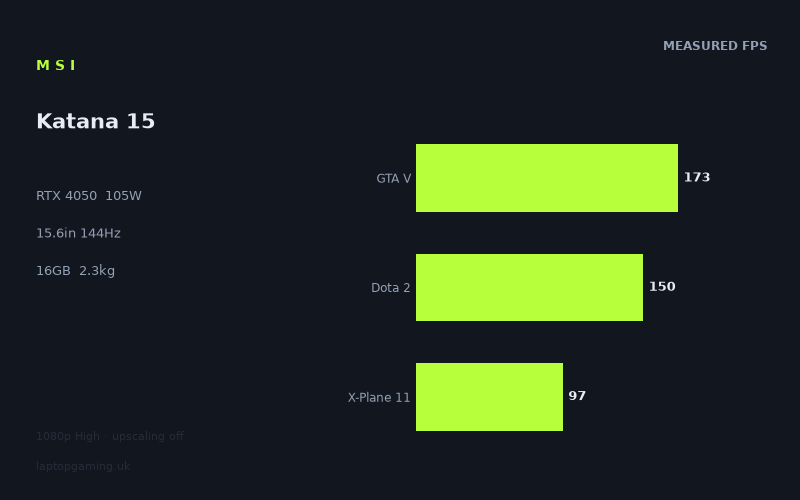
Frame rates
1920×1080, High preset, upscaling off.
Measured on this machine. Source: Notebookcheck, 2023-03-30.
Not scored: incomplete benchmark suite
Every scored laptop on this site is averaged over the same 5 games, and this one is short of Cyberpunk 2077, Baldur's Gate 3. A mean over 3 games is not comparable to a mean over 5, so we publish the figures we have and leave the score blank rather than rank it against machines tested on a different set. The numbers below are real - the suite is just incomplete.
How these numbers were produced
Frame rates here are not measured by us, and we label how each one was arrived at. A figure marked measured comes from a published run on that exact machine. A figure marked representative is derived from the GPU and its power limit (TGP) and cross-referenced against published reviews - a sound estimate of what that configuration delivers, but not a measurement of that specific laptop. Unless stated otherwise, numbers are 1920x1080, High preset, upscaling off. Where a laptop ships in several power configurations we use the wattage of the exact SKU listed, because a 140W RTX 5070 and a 115W one are not the same product.
In use
The short version
The MSI Katana 15 (B12VEK) is a straightforward Full HD gaming laptop built around an RTX 4050 running at a 105W GPU power limit, a Core i7-12650H, 16GB of memory and a 1TB SSD. Its published benchmark results show a machine that is very capable in a broad range of games at 1920x1080 on the High preset with upscaling disabled, but which does not turn every demanding modern game into a match for its 144Hz screen.
The important distinction is between games that are light enough, old enough or sufficiently CPU-limited to run far beyond the panel refresh rate, and the harder games that expose the limits of an RTX 4050 even at Full HD. Notebookcheck’s measured figures put GTA V and Strange Brigade at 173fps, The Witcher 3 at 161fps and Dota 2 at 150fps. Those are excellent results for a 144Hz display: the panel has enough refresh rate to show a meaningful proportion of that performance rather than becoming an immediate ceiling.
The picture changes in more demanding titles. Far Cry 5 reaches 126fps, which is still strong Full HD performance but below the screen’s maximum refresh rate. X-Plane 11 records 97fps, Final Fantasy XV reaches 83fps, and Dying Light 2 falls to 62fps. None of those figures suggests that the Katana 15 is incapable of gaming at its native resolution, but they do show why it should not be treated as a universal 144fps laptop simply because it has a 144Hz panel.
That is the central buying point. Buy the Katana 15 if the aim is to play at 1920x1080 with High settings and you value strong performance in esports-friendly, older or less demanding games, while accepting that more punishing titles will sit well below 144fps without changing settings or using an upscaling mode. It is not the machine to choose if the requirement is a measured 144fps-class result in every new demanding game at High settings with upscaling off.
The 105W RTX 4050 matters because this is not a low-power implementation of the GPU. The published results show that the Katana can generate very high frame rates in several titles, and it is substantially ahead of the MSI Thin GF63 in the shared-game comparison. However, its result against the 55W RTX 4050 inside the Lenovo Yoga Pro 7 14IRH G8 is effectively level across the shared games, while the RTX 4080 Asus Zenbook Pro 16X is also effectively level in that same limited comparison. That does not mean that GPU power and GPU class do not matter. It means that the particular shared 1080p games used for those comparisons are light enough to become CPU-bound, compressing genuine GPU differences.
There is no confirmed UK price for this configuration. That prevents a final value judgement. A laptop with this performance can be a sensible buy at one price and a poor one at another, particularly when the market includes other RTX 4050 machines with very different power limits and form factors. Until there is a confirmed UK price, the safer conclusion is that the Katana 15 has a credible performance case, but not yet a complete value case.
There is also no complete scoring-suite result. We have measured figures for GTA V, Dota 2 and X-Plane 11, but not for Cyberpunk 2077 or Baldur’s Gate 3. Every scored laptop is averaged across the same five games, so it would be misleading to rank this Katana against fully scored machines using only a partial set. The available benchmark data is useful, but it must be read as a detailed performance profile rather than a final league-table position.
Performance
What the measured figures say
Notebookcheck measured the MSI Katana 15 at 1920x1080, using the High preset with upscaling turned off. That last point is important. These are not figures helped by an upscaling mode, so they give a clear view of what the laptop can do at native Full HD under the stated settings.
- GTA V: 173fps
- Strange Brigade: 173fps
- The Witcher 3: 161fps
- Dota 2: 150fps
- Far Cry 5: 126fps
- X-Plane 11: 97fps
- Final Fantasy XV: 83fps
- Dying Light 2: 62fps
Across GTA V, Dota 2 and X-Plane 11, the three currently available scoring-suite games, the mean is 140fps. That is a good indication of the Katana’s potential at 1080p, but it is not a substitute for a full five-game average. The missing Cyberpunk 2077 and Baldur’s Gate 3 results matter because demanding games can change the overall picture significantly. The available figures already demonstrate why: the gap between 173fps in GTA V and 62fps in Dying Light 2 is large enough that no single average can describe the experience in every game.
The benchmark spread is the real story of this laptop. A buyer looking only at the 140fps mean from the available scoring games could conclude that the 144Hz panel will always be fully used. The individual results show otherwise. GTA V, Strange Brigade, The Witcher 3 and Dota 2 are all at or above the panel’s 144Hz refresh rate. Far Cry 5 is close but below it. X-Plane 11, Final Fantasy XV and Dying Light 2 are progressively further away.
That does not make the lower results poor. A measured 97fps in X-Plane 11, 83fps in Final Fantasy XV and 62fps in Dying Light 2 remain playable-looking headline figures for a High-preset Full HD run with upscaling off. What they do not support is a claim that the Katana is a 144fps machine in all circumstances. The screen is fast enough to reward high frame rates where the game and settings allow them; it cannot make the harder titles run at its maximum refresh rate.
The games that suit the Katana best
GTA V at 173fps is one of the clearest examples of the Katana 15 matching its screen well. The measured figure is above 144fps, meaning the laptop has more output than the panel can refresh in a single second. For someone who spends most of their time in games with this kind of performance demand, the 144Hz display is an appropriate pairing rather than an aspirational specification.
Strange Brigade produces the same 173fps result. That reinforces the point that the Katana is not merely capable of briefly touching the panel’s refresh rate in one favourable title. Under the published conditions it can exceed 144fps in more than one game. A buyer whose library includes titles of similar weight should expect the laptop’s display refresh rate to be relevant.
The Witcher 3 at 161fps also clears the 144Hz threshold. There is enough headroom above the screen’s maximum refresh rate to show that the system is not balancing precisely on the edge. It is a strong result at the stated 1920x1080 High setting and, like the GTA V and Strange Brigade figures, supports the case for a high-refresh Full HD display.
Dota 2 reaches 150fps. This is only modestly above 144fps, but it is still above it. For Dota 2 specifically, the measured result says the laptop can broadly supply the display’s maximum refresh rate under the benchmark conditions. It is also one of the three scoring-suite games, so it contributes to the available 140fps mean.
These results matter particularly for buyers who do not buy a gaming laptop solely for the newest and hardest-running releases. A machine that can deliver 150fps, 161fps or 173fps in the games a person actually plays may be more useful than a more expensive system with theoretical potential that does not materially improve what appears on a 144Hz panel. The Katana’s strongest results are therefore not incidental: they define a credible use case for the laptop.
Where the 144Hz target starts to slip
Far Cry 5 at 126fps is the first result that clearly sits below the panel’s 144Hz limit without dropping into a low-frame-rate range. This is still a high result. It is close enough to 144fps that the machine remains well suited to a fast Full HD panel, but it is not enough to describe the game as running at the display’s full refresh rate under these settings.
That distinction is useful because it avoids treating 144Hz as a binary success-or-failure threshold. The difference between 126fps and 144fps does not turn Far Cry 5 into an unsuitable game for the Katana. Rather, it shows that the screen has some performance headroom which this particular game does not completely fill at the tested High preset. Buyers who want the highest possible frame rates may choose to alter settings, but this review cannot state what result that would produce because the fact sheet contains no alternative-settings measurements.
X-Plane 11 is measured at 97fps. This is a noticeably different class of result from the games above 144fps. The Katana is still producing close to a hundred frames per second, but the 144Hz display is no longer being fully driven under the benchmark conditions. For a buyer focused on this game, it would be wrong to purchase the Katana on the assumption that its panel specification guarantees 144fps. The benchmark data says otherwise.
Final Fantasy XV at 83fps continues the downward pattern. Again, the number is not evidence that the laptop cannot handle the game at Full HD High. It is evidence that the RTX 4050, even at a 105W power limit, has a finite ceiling when the game demand rises. This is exactly why specification lists alone are not enough: a 144Hz display, an RTX 4050 and a Core i7 processor do not automatically translate to identical outcomes across every game.
Dying Light 2, at 62fps, is the sternest result in the available list. It remains above a conventional baseline associated with smooth gaming, but it is far from the 144Hz target. This is the clearest measured warning against buying the Katana 15 for uncompromised High-preset performance in demanding games while expecting a frame rate that matches the panel refresh rate. The screen remains usable; the game simply does not produce enough measured frames under these conditions to exploit it fully.
What the 105W GPU power limit means in practice
The RTX 4050 in this Katana 15 has a 105W GPU power limit. In practical terms, the benchmark data shows a laptop that can deliver very high Full HD frame rates in some games but cannot erase the normal difference between lighter and more demanding workloads. The power limit is a relevant part of the configuration, not a decorative line in a specification table, because laptops using the same GPU can be configured differently.
The comparison with the MSI Thin GF63 demonstrates that point most clearly. The Katana averages 52fps more across three shared games. That is a substantial gap, and it supports the view that this Katana is the more performance-oriented RTX 4050 option of the two based on the available shared-game evidence. There is no confirmed UK price for the Thin GF63, so it is not possible to say whether the Katana is better value. Performance, though, is not close in that comparison.
At the other end, the Katana is level across three shared games with the Lenovo Yoga Pro 7 14IRH G8, despite that Lenovo using an RTX 4050 at 55W. The result is real, but it should not be overinterpreted as proof that a 105W RTX 4050 is no more capable than a 55W RTX 4050 in every game. The shared set is at 1080p and includes lighter titles where CPU limits can compress genuine GPU gaps. In other words, the comparison says that the available games do not expose a meaningful difference; it does not establish that the difference cannot appear elsewhere.
The same caution applies to the Asus Zenbook Pro 16X with an RTX 4080. The Katana is also level across three shared games. It would plainly be unreasonable to read that as an RTX 4050 matching an RTX 4080 in general gaming performance. The supplied comparison context explains why the gap can disappear: at 1080p, lighter shared titles can become CPU-bound. When the CPU or another part of the system becomes the limiting factor, extra GPU capability cannot translate into proportionately higher frame rates.
The Katana’s own game list supports that wider interpretation. It reaches 173fps in GTA V and Strange Brigade, then falls to 62fps in Dying Light 2. In the games where frame rates are already very high, there is less room for a stronger GPU to distinguish itself. In the harder titles, GPU capability is more likely to become visible. We do not have the specific shared-game results required to quantify that difference for every rival, so the responsible conclusion is limited: the 105W setting gives the Katana a strong Full HD profile, but it should not be judged solely through very high-frame-rate, potentially CPU-bound games.
The CPU, memory and storage context
The Katana 15 uses a Core i7-12650H alongside 16GB of memory and a 1TB SSD. The fact sheet does not provide separate processor, memory or storage benchmarks, so there is no basis for claims about component-level performance beyond the published game results. What can be said is that these components form the tested configuration behind the frame rates listed above.
That matters because benchmark results belong to a complete laptop configuration, not merely a graphics-chip label. The 173fps GTA V figure, the 150fps Dota 2 result and the 62fps Dying Light 2 result are figures for this MSI Katana 15 configuration with its Core i7-12650H, 16GB of memory, 1TB SSD and 105W RTX 4050. They should not be assumed to transfer directly to every other RTX 4050 laptop.
The 1TB SSD is a useful capacity on paper, but the fact sheet does not contain storage-speed measurements or usable-capacity details. Similarly, 16GB of memory is specified, but there is no information here about memory configuration, upgradeability or performance testing. Prospective buyers who need confirmation of those details should seek documentation specific to the B12VEK rather than infer them from the benchmark list.
The screen
The Katana 15 has a 15.6in IPS display with a 1920x1080 resolution and a 144Hz refresh rate. This is a sensible gaming-oriented specification in one important respect: the resolution is aligned with the level of performance demonstrated by the RTX 4050. The measured games are all at the panel’s native Full HD resolution, and several of them achieve frame rates at or above the refresh-rate ceiling.
A 1920x1080 panel makes the 105W RTX 4050 more useful than a higher-resolution screen would for buyers who prioritise frame rate. The published results show 173fps in GTA V, 173fps in Strange Brigade, 161fps in The Witcher 3 and 150fps in Dota 2. Those figures make direct use of a 144Hz display. There is little sense in pairing these results with a low-refresh panel; here, the display has the speed to show the laptop’s best-case performance.
It is equally important not to confuse the panel’s refresh rate with an assurance of 144fps. Far Cry 5 reaches 126fps, X-Plane 11 reaches 97fps, Final Fantasy XV reaches 83fps and Dying Light 2 reaches 62fps. In those games, the display’s maximum refresh rate is available but not fully supplied by the system under the tested settings.
This is not a criticism unique to the Katana. A 144Hz panel is often a useful choice because game demand varies. It allows lighter games to run at high frame rates while retaining a conventional gaming experience in harder titles that do not reach the same level. The important thing for a buyer is to understand that the screen gives the laptop headroom; it does not remove the need to choose settings realistically in demanding games.
The IPS panel type is listed, but the fact sheet does not provide measured brightness, contrast, colour coverage, response-time or outdoor-visibility data. There is therefore no evidence here to call the display bright, dim, colour-accurate, wide-gamut or especially fast in pixel response. Nor is there information about adaptive-sync support. The safe conclusion is confined to what is specified and measured: it is a 15.6in, 1920x1080, 144Hz IPS panel, and the laptop can make good use of 144Hz in several measured games.
For buyers choosing between screen priorities, this is a performance-first Full HD arrangement. It is not presented here as a high-resolution creative display, because no such display information is supplied. It is presented as a panel whose resolution and refresh rate are practical matches for the machine’s demonstrated gaming behaviour. In high-frame-rate games, it has the refresh capacity required. In demanding games, Full HD keeps the workload at the resolution used for the published benchmarks.
Build, size and portability
The MSI Katana 15 weighs 2.282kg. That places it firmly in the category of a laptop intended to move between locations rather than disappear into a bag unnoticed. It can be transported, but it should be approached as a 15.6in gaming machine with a meaningful carrying weight, not as a lightweight ultraportable.
The useful interpretation of 2.282kg depends on how the machine will be used. For a buyer who mainly keeps the laptop on a desk and occasionally takes it to another room, another home, university accommodation or a workplace, the weight is a practical compromise for a gaming-focused system. For someone carrying it every day for long periods, the weight should be considered carefully. The fact sheet does not list the charger weight, so there is no total travelling weight to quote.
No dimensions are supplied. That means we cannot state how wide, deep or thick the Katana 15 is, and we cannot make a measured claim about bag fit beyond the fact that it has a 15.6in screen and weighs 2.282kg. There is also no information about chassis materials, keyboard layout, ports, webcam, speakers, cooling-system design, fan noise, surface temperatures or battery life. Those are significant ownership details, but they are not available in the supplied fact sheet and should not be guessed.
The lack of battery data is especially worth stating plainly. A gaming laptop can be used away from mains power, but this review has no battery-life figure and cannot say how long the Katana 15 lasts in light work, video playback, gaming or any other workload. Likewise, no noise or temperature measurements are provided, so there is no basis to call it quiet, loud, cool-running or hot-running.
What is known is sufficient to frame the mobility decision at a basic level. The Katana is a 2.282kg, 15.6in machine with hardware and measured Full HD gaming performance that point towards desk-first use with occasional transport. Buyers who want a gaming laptop that feels more like an everyday carry machine should compare it carefully with lighter alternatives, but the supplied information does not give weights for the listed rivals, so no direct portability ranking can be made here.
How it compares
Against the MSI Thin GF63
The MSI Thin GF63 is the clearest performance win for the Katana 15 among the listed comparison machines. Both use an RTX 4050, but the Katana averages 52fps more across three shared games. That is not a marginal difference or benchmark noise. It is a major advantage in the games available for comparison.
For a buyer deciding between these two MSI models primarily on gaming performance, the published figures favour the Katana strongly. The result also reinforces why laptop GPU names are incomplete descriptions. Two machines carrying RTX 4050 graphics can produce very different results, and the Katana’s 105W GPU power limit is part of the context for its stronger showing.
There is no confirmed UK price for the Thin GF63 and no confirmed UK price for the Katana 15. Without those prices, value cannot be settled. If the Thin were much cheaper, the decision would be more complicated; if pricing were close, the Katana’s shared-game advantage would be difficult to ignore. The benchmark evidence answers the performance question, but not the final buying-value question.
Against the Lenovo Yoga Pro 7 14IRH G8
The comparison with the Lenovo Yoga Pro 7 14IRH G8 is more revealing than it first appears. The Lenovo has an RTX 4050 at 55W, while the Katana has an RTX 4050 at 105W. Yet the Katana averages 0fps more across three shared games. In practical terms, the available shared results are level.
It would be easy but wrong to use that outcome to dismiss the Katana’s higher GPU power limit. The comparison is specifically constrained to shared games, and the context supplied for these rival comparisons is important: at 1080p, lighter titles in the shared set can become CPU-bound and compress genuine GPU gaps. Once a game is limited elsewhere, additional GPU capacity will not necessarily produce a visible frame-rate lead.
The proper reading is that the Katana does not establish a measurable lead over the Lenovo in this particular three-game comparison. It does not establish that the two laptops will remain equal in every game, every setting or every workload. Buyers deciding between them should not assume that a 105W RTX 4050 guarantees superiority in all benchmark lists, but nor should they conclude that 55W and 105W are interchangeable from this narrow result alone.
Neither machine has a confirmed UK price in the supplied information. There is therefore no price-based recommendation between them. The Katana’s advantage is that it has a conventional 15.6in, 144Hz Full HD gaming-screen specification and the detailed individual game results listed above. The Lenovo comparison, meanwhile, is a reminder to examine actual benchmark data rather than buying solely on a higher power-limit label.
Against the Asus Zenbook Pro 16X
The Asus Zenbook Pro 16X uses an RTX 4080, yet the Katana is level with it across three shared games, averaging 0fps behind. This is the most dramatic example of a narrow benchmark comparison producing a result that cannot be generalised carelessly.
An RTX 4050 laptop should not be described as equivalent to an RTX 4080 laptop on the basis of this limited shared-game average. The supplied comparison notes explain why the difference can vanish: the shared games at 1080p are light enough that CPU limits can compress genuine GPU gaps. When both systems are already operating in a high-frame-rate part of the performance range, stronger graphics hardware may not translate into higher measured output in the same proportion.
The Katana does deserve credit for being level in the available comparison. It shows that, in those three shared games and at the stated resolution, buyers may not gain a practical frame-rate advantage from much stronger graphics hardware. But the Katana’s own 62fps Dying Light 2 result shows why this does not settle the broader question. Demanding games can expose limits that lighter titles conceal.
There is no confirmed UK price for the Zenbook Pro 16X. Price, screen specification, portability and non-gaming requirements would all matter in a real purchase decision, but the supplied facts do not provide enough information to resolve those areas. The defensible conclusion is narrow: the Katana matches it in the limited shared-game set, while no broad GPU-equivalence claim should be made.
Against the Asus ROG Strix Scar 17
The Asus ROG Strix Scar 17, equipped with an RTX 4090, is the listed machine that beats the Katana by the largest margin. The Katana averages 59fps less across three shared games. Unlike the effectively level results against the Lenovo and Zenbook, this comparison shows a clear gap that survives the shared-game conditions.
The Scar 17 costs £4,883. That is the only confirmed UK price among the comparison machines, and it puts the size of the purchasing decision in context. The Scar has substantially stronger shared-game performance according to the supplied figures, but it is also positioned at a price level far beyond what can be assessed against the Katana because the Katana’s UK price is not confirmed.
For a buyer with the budget for the Scar 17 and the need for the highest possible frame rates, the published gap is meaningful. For a buyer seeking capable Full HD gaming without entering that price territory, the Katana’s own results remain relevant: 173fps in GTA V and Strange Brigade, 161fps in The Witcher 3, 150fps in Dota 2 and 126fps in Far Cry 5 are not weak results. The Scar is faster in the shared comparison, but that does not negate the Katana’s suitability for a different budget and performance target.
The right conclusion is not that the Katana competes directly with the Scar 17. It does not, based on the 59fps shared-game deficit and the Scar’s £4,883 price. The useful comparison is one of priorities. The Scar represents the option for buyers prepared to pay far more for substantially greater performance. The Katana represents a Full HD RTX 4050 configuration that performs strongly in many games, provided the buyer accepts its more limited result in the hardest titles measured.
Who it’s for
Buy the Katana 15 if these are your priorities
The MSI Katana 15 makes the most sense for a buyer who wants a 15.6in Full HD gaming laptop and values actual measured performance over assumptions based on a GPU name. Its RTX 4050 runs at 105W, and the available Notebookcheck figures show substantial performance in several games without upscaling.
It suits players whose regular games resemble GTA V, Strange Brigade, The Witcher 3 or Dota 2 more than Dying Light 2 in performance demand. In those first four games, the Katana reaches 173fps, 173fps, 161fps and 150fps respectively. The 144Hz IPS panel is not wasted in that situation. It has enough refresh rate to make the laptop’s high-frame-rate output useful.
It also suits someone happy with a realistic Full HD target rather than a blanket promise of maximum-refresh gaming. Far Cry 5 at 126fps, X-Plane 11 at 97fps and Final Fantasy XV at 83fps show that the Katana still delivers substantial frame rates when it does not reach 144fps. A buyer who understands that game performance varies and does not expect identical results from every title can make good use of this machine.
The Katana is also the more persuasive choice over the MSI Thin GF63 if the choice is driven primarily by shared-game performance. The 52fps average advantage across three shared games is large enough to matter. Subject to eventual pricing, that is a strong reason to prefer the Katana for gaming rather than treating both RTX 4050 laptops as interchangeable.
Finally, it suits someone whose laptop will spend much of its time on a desk but may need to travel occasionally. At 2.282kg, it is transportable, but it is not presented by the available facts as a featherweight machine. A buyer who has a stable place to use it and accepts the weight should find that compromise easier to justify than somebody carrying it every day.
Buy something else if these are your priorities
Buy something else if the requirement is a measured 144fps or higher in every demanding modern game at 1920x1080 High with upscaling off. Dying Light 2 at 62fps is the decisive counterexample. Final Fantasy XV at 83fps and X-Plane 11 at 97fps further show that the 144Hz panel is not a guarantee of 144fps when game demand rises.
Buy something else if you need a confirmed value verdict now. The Katana’s UK price is not confirmed. Without it, no responsible review can say whether this configuration is cheap, fairly priced or expensive. The performance data is detailed enough to explain what the laptop can do, but a purchase recommendation involving money must remain conditional until a UK price is available.
Buy something else if you need a complete five-game score comparison against ranked laptops. The Katana currently lacks figures for Cyberpunk 2077 and Baldur’s Gate 3. Its available scoring-suite mean is 140fps across GTA V, Dota 2 and X-Plane 11, but that partial result cannot be ranked against laptops measured across all five scoring games. Anyone shopping by a complete, like-for-like ranking should wait for the missing data rather than infer a position that the evidence does not support.
Buy something else if low carrying weight is the dominant concern. The Katana weighs 2.282kg, before any charger weight that is not specified here. It may be portable enough for occasional movement, but there is no basis to portray it as an especially light laptop. Buyers carrying a machine daily should treat the weight as a central specification, not an afterthought.
Buy something else if display quality beyond resolution, refresh rate and panel type is essential to your work. The fact sheet does not include brightness, colour, contrast or response measurements. The screen may be entirely adequate for the intended use, but this review cannot verify creative-work suitability, outdoor use, colour-critical work or pixel-response behaviour from the supplied data.
Buy something else if the goal is simply the highest available gaming performance and the budget can reach the Asus ROG Strix Scar 17. The Scar’s RTX 4090 configuration averages 59fps ahead across three shared games. At £4,883 it is in a very different spending category, but the performance lead is clear. The Katana is the better fit for a buyer who wants strong Full HD gaming rather than the maximum performance represented by that rival.
The MSI Katana 15 is therefore best understood as a capable, performance-led 1080p laptop with a properly useful 144Hz screen, not as an all-settings, all-games 144fps solution. The 105W RTX 4050 helps it produce excellent results in several measured titles, and its lead over the MSI Thin GF63 confirms that not all RTX 4050 laptops belong in the same performance bracket. Its limitations are equally clear in the harder games, and its missing UK price prevents a final judgement on value. If the eventual price is sensible, the benchmark evidence gives it a strong case for buyers focused on Full HD gaming.