Review
MSI Raider 18 HX review
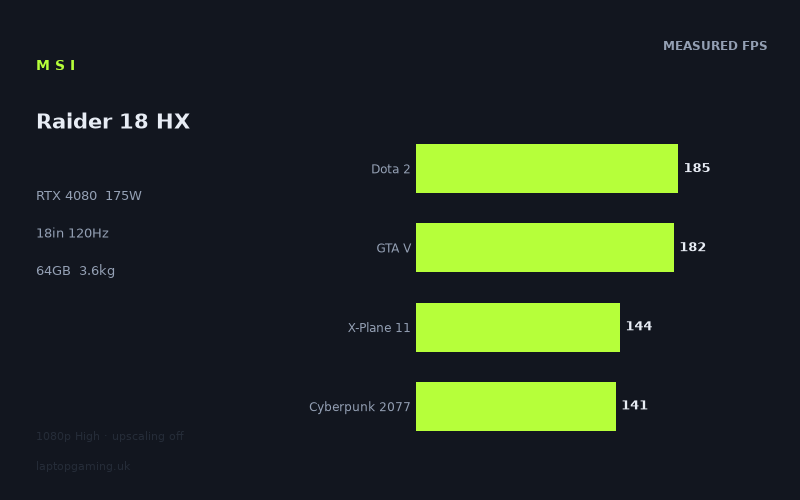
Frame rates
1920×1080, High preset, upscaling off.
Measured on this machine. Source: Notebookcheck, 2024-09-03.
Not scored: incomplete benchmark suite
Every scored laptop on this site is averaged over the same 5 games, and this one is short of Baldur's Gate 3. A mean over 4 games is not comparable to a mean over 5, so we publish the figures we have and leave the score blank rather than rank it against machines tested on a different set. The numbers below are real - the suite is just incomplete.
How these numbers were produced
Frame rates here are not measured by us, and we label how each one was arrived at. A figure marked measured comes from a published run on that exact machine. A figure marked representative is derived from the GPU and its power limit (TGP) and cross-referenced against published reviews - a sound estimate of what that configuration delivers, but not a measurement of that specific laptop. Unless stated otherwise, numbers are 1920x1080, High preset, upscaling off. Where a laptop ships in several power configurations we use the wattage of the exact SKU listed, because a 140W RTX 5070 and a 115W one are not the same product.
In use
The short version
The MSI Raider 18 HX is a very expensive desktop-replacement gaming laptop built around an RTX 4080 running at a 175W GPU power limit, a Core i9-14900HX, 64GB of memory and an 18in 3840x2400 display. Notebookcheck’s measured figures show that it is plainly fast at 1920x1080 on the High preset with upscaling off. It reaches or exceeds the screen’s 120Hz refresh rate in most of the games listed, including several demanding titles. That is the good news.
The difficult part is the price. At GBP 4,771, this is not a machine that can rely on being merely quick. It needs to offer a convincing reason to spend a very large amount of money, and the benchmark data gives a more mixed answer than the specification sheet might suggest. The Raider 18 HX has the hardware for very high frame rates at 1920x1080, but its display has a far higher 3840x2400 resolution and there are no supplied benchmark figures at that native resolution. It would therefore be wrong to assume that the measured 1920x1080 results translate directly to the panel’s native setting.
This is best understood as a powerful, heavy, large-screen machine for a buyer who values the 18in 3840x2400 display, wants 64GB of memory as part of the purchase, and is comfortable treating the laptop as a mostly fixed gaming setup rather than something to carry daily. The 175W RTX 4080 is not configured as a low-power compromise. The figures in the supplied benchmark set confirm that the Raider can deliver high refresh-rate gaming in a broad selection of titles at the tested settings.
It is not, however, an uncomplicated recommendation at GBP 4,771. The supplied comparison data shows it level with both an RTX 4090 MSI Titan GT77 HX and an RTX 4070 Razer Blade 18 RTX across their shared games. Those near-identical averages do not mean the GPUs are equivalent. They do mean that a buyer should not judge this Raider by its RTX 4080 label alone, nor assume that its high 175W power limit guarantees a decisive advantage in every game at 1920x1080.
Buy it if the attraction is the complete package: an 18in 3840x2400 screen, 120Hz refresh rate, Core i9-14900HX, 64GB of memory, a 175W RTX 4080 and strong measured 1920x1080 results. Do not buy it simply because you expect every title to sit at 120fps or above at the display’s native resolution. The available data does not establish that. It also should not be bought by anyone who needs a genuinely portable laptop: 3.557kg is substantial before considering any accessories, and no dimensions are supplied to soften that conclusion.
Performance
What the measured figures show
Notebookcheck measured the MSI Raider 18 HX at 1920x1080, using the High preset with upscaling off. Those settings matter. They provide a clean view of conventional rendering performance without an upscaling mode affecting the result, but they are not the same as gaming at the laptop’s 3840x2400 native display resolution. The results are therefore useful for showing how the machine behaves in the tested games, while leaving an important unanswered question about native-resolution performance.
The headline result is a mean of 163fps across the four supplied scoring-suite games: Dota 2, GTA V, X-Plane 11 and Cyberpunk 2077. That is a strong average, and it is above the panel’s 120Hz refresh rate. But an average is only a summary. It does not mean all games reached 120fps, and it does not tell a buyer which games are likely to make best use of the display’s refresh rate.
Dota 2 is measured at 185fps. GTA V reaches 182fps. Both are comfortably above 120fps at the tested settings, so the Raider’s 120Hz panel has enough refresh capacity to show a sustained high frame rate in those particular results. These are also two of the games where the comparison data can compress differences between machines. At 1920x1080, lighter titles in a shared game set can become CPU-bound, meaning the graphics hardware has less room to demonstrate its full potential. A close result in this kind of test should not be read as proof that every GPU configuration is identical.
X-Plane 11 reaches 144fps, again above the display refresh rate. This is useful because it shows that the Raider’s strong average is not built entirely from the very highest frame-rate results. Even a title measured lower than Dota 2 and GTA V still clears 120fps in this test. For someone playing at 1920x1080 on High settings with upscaling off, the measured number suggests enough performance to take advantage of the 120Hz screen in X-Plane 11 as well.
Cyberpunk 2077 is the important counterweight. It reaches 141fps, which remains above 120fps, but it is much closer to the panel’s refresh ceiling than Dota 2 or GTA V. That distinction matters more than the simple fact that it clears 120fps. The Raider has less headroom in Cyberpunk 2077 under the supplied test conditions. The benchmark does not tell us how it would behave at 3840x2400, with different quality options, or with ray tracing settings, because none of those figures are supplied. The safe conclusion is narrower: at 1920x1080 High with upscaling off, it is measured above 120fps.
The wider game list gives the Raider more context. Strange Brigade is the fastest supplied result at 378fps. F1 22 follows at 271fps. Tiny Tina’s Wonderlands reaches 203fps, Final Fantasy XV reaches 177fps, and Far Cry 5 reaches 163fps. These are not minor gains over 120fps. They show that the machine can produce far more frames than the built-in panel can display under the stated test conditions in several games.
That does not make the excess frame rate meaningless. It establishes substantial performance headroom at 1920x1080 High with upscaling off. But it does change the purchasing logic. A 120Hz panel cannot present 378fps as 378 distinct screen refreshes. In Strange Brigade, the frame-rate result is evidence of strong underlying performance rather than a reason to expect the display itself to show every generated frame. The same point applies, though less dramatically, to F1 22 at 271fps and Tiny Tina’s Wonderlands at 203fps.
Far Cry 5 at 163fps is especially close to the Raider’s four-game scoring-suite mean of 163fps. It is a useful reminder that the overall average is not inflated solely by the 378fps result in Strange Brigade or the 271fps result in F1 22, neither of which is part of the four-game scoring suite. The listed results show a machine that is generally quick at the tested settings, but they also show a range from 141fps in Cyberpunk 2077 to 378fps in Strange Brigade. That spread is large enough that buyers should think in terms of individual games, not just a single average.
The 175W RTX 4080 in practice
The RTX 4080 is configured here with a 175W GPU power limit. That is a meaningful part of the Raider’s identity because it tells a buyer that this is not an RTX 4080 installed primarily for a thin or light design. The laptop weighs 3.557kg, and the specification points towards a machine designed to make room for a high-power GPU configuration rather than prioritise mobility. The benchmark results are consistent with that intent: 163fps across the supplied scoring suite at 1920x1080 High with upscaling off is strong performance.
It is still important not to turn the 175W figure into a promise that the Raider will always outrun machines with different graphics labels or lower power limits. The rival data is very clear on this point. Across three shared games, the Raider averages the same result as the MSI Titan GT77 HX with an RTX 4090 at 150W. Across three shared games, it also averages the same result as the Razer Blade 18 RTX with an RTX 4070 at 140W. These are real results, not a reason to dismiss the benchmark data because it does not match a simple product hierarchy.
The supplied context explains why near-zero differences can occur. At 1920x1080, lighter titles in the shared set can be CPU-bound and compress genuine GPU gaps. In practical terms, once a game is limited more by the processor or other parts of the system than by the graphics hardware, adding more GPU capability may not produce a proportionate increase in the measured frame rate. The Raider’s Core i9-14900HX is therefore relevant to the result, especially in games where frame rates are already high.
This means the 175W RTX 4080 should be read as a strong foundation for the Raider’s measured performance, not as a shortcut around game-by-game analysis. Where a title is less restricted by GPU throughput at 1920x1080, high frame rates can make differing GPU configurations appear unusually close. Where a game places more graphics load on the system, differences between configurations may become clearer. The comparison data includes both types of outcome: ties against models carrying apparently very different GPU specifications, and a notable deficit against the Asus ROG Strix Scar 17 with an RTX 4090.
Notebookcheck’s 141fps result in Cyberpunk 2077 is particularly valuable in this respect. It is lower than the figures in Strange Brigade, F1 22, Tiny Tina’s Wonderlands, Dota 2, GTA V, Final Fantasy XV, Far Cry 5 and X-Plane 11. That does not make it poor performance; 141fps remains above the 120Hz display refresh rate at the stated test settings. It does show that a demanding title can reduce the Raider’s margin substantially compared with the very high results elsewhere in the list.
The practical lesson is that this laptop has enough measured performance for high-refresh gaming at 1920x1080 High in every supplied game. It is not demonstrated to have unlimited overhead. Cyberpunk 2077 is above 120fps, but not by the same margin as Strange Brigade, F1 22, Tiny Tina’s Wonderlands or even Dota 2. A buyer who mainly plays games that behave more like Cyberpunk 2077 should be more cautious about making assumptions beyond the exact benchmark conditions.
Making sense of the benchmark spread
The frame-rate spread is not an inconvenience in the data; it is the point of the data. Strange Brigade at 378fps and Cyberpunk 2077 at 141fps are both measured on the same laptop, at 1920x1080 High with upscaling off, yet they lead to very different conclusions about what the screen can show and how much spare performance is available. A review that simply called the Raider “a 163fps laptop” would conceal that difference.
In Strange Brigade, the result is far beyond the panel’s 120Hz refresh rate. The laptop has extensive headroom at the tested settings. In F1 22 at 271fps, the same broad conclusion applies. Tiny Tina’s Wonderlands at 203fps remains well above 120Hz, though with less margin. Dota 2 at 185fps and GTA V at 182fps are also safely above the refresh rate, while Final Fantasy XV at 177fps and Far Cry 5 at 163fps continue the pattern.
X-Plane 11 at 144fps and Cyberpunk 2077 at 141fps are the two listed results nearest to 120Hz. Both still clear the screen refresh rate in Notebookcheck’s measurements. However, they should not be grouped thoughtlessly with the 378fps result in Strange Brigade. A difference between 141fps and 378fps is a difference in available margin, not merely a difference in a benchmark chart. The Raider has considerably less space for higher rendering demands in the lower result than in the higher one.
That distinction becomes more important because the screen is 3840x2400, while every supplied frame-rate measurement is at 1920x1080. No native-resolution figures are provided. There is no measured basis for stating which of these games will sustain 120fps at 3840x2400, which will remain comfortably above 120fps, or which will need settings changes. The 1920x1080 figures establish strong performance at their own test conditions; they do not settle the native-panel question.
The use of High settings and disabled upscaling also deserves attention. These results are not based on an upscaling mode lifting a lower rendered image to a higher output resolution. That makes the figures straightforward within the test setup. Yet it also means they should not be used to claim what performance would be with upscaling enabled, because those figures are not supplied. The same caution applies to any other preset or display resolution not present in the fact sheet.
For a buyer choosing between the Raider and a machine with a lower-resolution display, the performance data should be read alongside the display specification, not separately from it. At 1920x1080, the Raider produces very high frame rates in the supplied list. Its own display is 3840x2400. That combination can be attractive for a buyer who wants a large, high-resolution screen and is willing to choose settings according to the game, but it is not evidence that every game will run at the panel’s native resolution and refresh rate simultaneously.
The screen
The MSI Raider 18 HX has an 18in display with a 3840x2400 resolution and a 120Hz refresh rate. Those are the screen facts available here. No panel type, brightness figure, colour information, response-time measurement or other display quality measurement is supplied, so no judgement should be made about those characteristics. The available information is enough to discuss the relationship between resolution, refresh rate and the published game results, but not enough to make claims about panel quality beyond the stated size, resolution and refresh rate.
The 18in size is central to the Raider’s appeal. This is a machine aimed at someone who wants a large integrated display rather than simply the smallest chassis capable of holding an RTX 4080. The 3840x2400 resolution reinforces that direction. It is a high-resolution screen paired with high-end components, substantial memory and a heavy chassis. That is a coherent specification, even if the benchmark evidence only covers 1920x1080.
The 120Hz refresh rate is well matched to the supplied 1920x1080 benchmark results. Every listed game is measured above 120fps: Cyberpunk 2077 at 141fps, X-Plane 11 at 144fps, Far Cry 5 at 163fps, Final Fantasy XV at 177fps, GTA V at 182fps, Dota 2 at 185fps, Tiny Tina’s Wonderlands at 203fps, F1 22 at 271fps and Strange Brigade at 378fps. At the tested settings, the Raider has enough performance to feed the panel at its maximum refresh rate in all of those games.
That statement needs its condition attached every time: it applies to 1920x1080, High settings and upscaling off. The panel is not 1920x1080. It is 3840x2400. The fact that the Raider exceeds 120fps at the benchmark resolution is encouraging, especially in the lower results of 141fps and 144fps, but it does not grant permission to claim the same at native resolution. There are no published figures here to support that leap.
This is where the Raider’s screen can be either a strength or a source of mismatch, depending on the buyer. Someone who wants the largest supplied display size and values 3840x2400 as part of the machine’s general-purpose appeal may see it as a major benefit. Someone whose only priority is driving every game at 120fps or above with no settings compromises should focus on the absence of native-resolution data. The supplied results show what the Raider can do at 1920x1080, not what it can guarantee at 3840x2400.
The benchmark spread also matters to how much confidence a buyer should have. Strange Brigade at 378fps and F1 22 at 271fps suggest much more 1920x1080 headroom than Cyberpunk 2077 at 141fps. It would be unreasonable to treat all titles as equally likely to retain the same margin once rendering demands change. The screen specification is excellent on paper for a buyer who values resolution and size, but the evidence supports a measured rather than absolute conclusion about gaming at its native setting.
The 120Hz ceiling also means that some of the very high 1920x1080 results should be seen as surplus performance rather than directly visible refresh-rate gains on the built-in screen. The 378fps Strange Brigade result is impressive, but the panel refreshes at 120Hz. The value of that result is that it indicates room above the panel’s limit under the tested conditions, not that the integrated screen can display 378 separate updates each second.
For the games nearer 120fps, the screen relationship is more direct. Cyberpunk 2077 at 141fps and X-Plane 11 at 144fps sit above 120Hz without the vast excess seen in Strange Brigade. At 1920x1080 High with upscaling off, those are the figures most relevant to a buyer who wants to know whether the panel’s refresh rate is realistically usable in demanding games. They indicate yes at the test setting, while leaving native-resolution behaviour unproven.
Build, size and portability
The supplied physical specification gives one very important number: 3.557kg. That places the MSI Raider 18 HX firmly in desktop-replacement territory. It is not a machine for someone who wants their gaming laptop to disappear into a bag or make regular travel easy. The 18in display, 175W GPU power limit, Core i9-14900HX and 64GB of memory already point towards a large, high-performance design; the weight confirms the practical consequence.
There are no dimensions in the supplied fact sheet, so it would be wrong to claim a footprint, thickness or bag compatibility. There is also no supplied information about charger size or weight. Those omissions matter for a portability discussion. The only firm conclusion is that the laptop itself weighs 3.557kg. That alone is enough to say it is a substantial object to transport regularly, but not enough to make detailed claims about its complete travel load.
This is a laptop best considered for a desk, a fixed room, or occasional movement between places rather than daily commuting. That is not a criticism in itself. A heavy chassis can be a sensible trade-off when the buyer wants an 18in screen and a 175W RTX 4080 configuration. The mistake would be expecting the same usage pattern as a more portable machine. At 3.557kg, the Raider is making a clear choice: performance hardware and display size take priority over lightness.
The 64GB memory configuration also fits that desktop-replacement character. It is part of the supplied specification, and it means the Raider is not presented as a minimally configured gaming machine. However, no application benchmarks are supplied, so it would be wrong to claim a particular professional-workload advantage or quantify how the memory affects gaming performance. What can be said is that the machine arrives with 64GB rather than a lower listed amount, and that buyers who specifically require that capacity do not need to treat it as an omitted part of the proposition.
The Core i9-14900HX similarly supports the Raider’s high-performance intent. The supplied comparison notes specifically warn that some shared 1920x1080 games can be CPU-bound, which is relevant to interpreting the Raider’s close results against other machines. A powerful CPU matters when frame rates are already high and the graphics hardware is not the only limiting factor. But there are no CPU benchmark figures in the fact sheet, so no stronger performance claim should be made about the processor in isolation.
For a buyer whose laptop mostly remains on a desk, the 3.557kg weight may be an acceptable price for the 18in 3840x2400 display and 175W RTX 4080 configuration. For a buyer moving between lectures, offices, client sites or trains, it is a major limitation. The Raider should be chosen because its bulk is acceptable, not because the buyer hopes the bulk will somehow be irrelevant in daily use.
No build-material information, keyboard information, port list, webcam information, thermal measurement or noise measurement is supplied. That means there is no basis here for declaring it quiet, loud, cool, hot, premium-feeling or especially well equipped for connectivity. At GBP 4,771, those are legitimate buying considerations, but the responsible position is to separate them from what the published specifications and Notebookcheck figures establish.
How it compares
The comparison data is useful precisely because it resists simplistic conclusions. The Raider 18 HX is compared with machines from the same GPU generation, using games both machines hold and preferring the scoring suite. The supplied figures cover two closest comparisons, the machine the Raider beats by the most, and the machine that beats it by the most. That provides a meaningful spread rather than a hand-picked comparison against only one conveniently weaker rival.
Against the Schenker XMG Apex 15
Against the Schenker XMG Apex 15 (Late 23), equipped with an RTX 4050 at 140W, the MSI Raider 18 HX averages 101fps more across four shared games. This is the largest stated advantage for the Raider in the supplied rival set, and it is substantial. It supports the straightforward conclusion that the Raider’s RTX 4080 at 175W delivers a much higher level of performance in the shared benchmark selection than this RTX 4050 rival.
There is no confirmed UK price for the Schenker XMG Apex 15 in the fact sheet, so this cannot become a value comparison. The Raider costs GBP 4,771, but without a confirmed UK price for the Schenker there is no responsible way to say whether the Raider’s 101fps average advantage is worth the additional spend. The performance gap is clear; the price relationship is not.
The comparison also shows why buyers should identify their performance target before spending. If the goal is maximum frame rate at 1920x1080 High with upscaling off, the Raider has a large measured lead in this shared set. If the buyer’s needs are less demanding, the comparison establishes that lower-tier hardware exists, but it does not provide enough price information to decide whether it is the better purchase.
Against the MSI Titan GT77 HX
The MSI Titan GT77 HX has an RTX 4090 at 150W, yet the Raider averages the same result across three shared games. This is one of the most important results in the rival list because it demonstrates the limits of judging laptops by GPU name alone. The Raider’s 175W RTX 4080 and Core i9-14900HX produce a shared-game outcome that is level with this RTX 4090 Titan in the supplied comparison.
That does not establish that the Raider and Titan are universally equal. The comparison covers three shared games, not every game, every resolution or every preset. The supplied guidance is explicit that lighter titles at 1920x1080 can become CPU-bound, compressing real GPU gaps. The correct reading is that the Raider is not behind in this specific shared-game average, not that an RTX 4080 is always interchangeable with an RTX 4090.
There is no confirmed UK price for the Titan GT77 HX. As with the Schenker, the absence of a price prevents a direct value judgement. It does, though, sharpen the case for looking beyond a specification badge. If a buyer is considering a Titan because of its RTX 4090 label, this shared-game tie shows why actual benchmark results should carry more weight than an assumed hierarchy.
Against the Razer Blade 18 RTX
The Razer Blade 18 RTX has an RTX 4070 at 140W, and the Raider again averages the same result across three shared games. At first glance, an RTX 4080 at 175W matching an RTX 4070 at 140W may look disappointing for the Raider. The supplied benchmark notes explain why the result should be interpreted carefully: 1920x1080 results in lighter shared titles can be CPU-bound, reducing the visible separation between GPU configurations.
This is a genuine near-zero result, not something to ignore because it conflicts with an expectation based on the component names. It says that in the specific shared game selection, at the specific measured conditions, the Raider did not create a measurable average lead. It does not say that the two graphics configurations offer identical performance under all conditions. The limited shared set and the tendency of high-frame-rate 1920x1080 titles to compress GPU gaps are both important context.
There is no confirmed UK price for the Razer Blade 18 RTX. As a result, there is no basis for saying which machine is better value. The Raider has an 18in 3840x2400 120Hz display, 64GB memory and a 3.557kg weight in the supplied specification, but there is no comparable display, memory or weight information for the Razer in this fact sheet. The only secure conclusion is the shared-game tie.
Against the Asus ROG Strix Scar 17
The Asus ROG Strix Scar 17, equipped with an RTX 4090, is the rival that beats the Raider by the most in the supplied comparison set. The MSI averages 29fps less across three shared games. Unlike the ties against the Titan GT77 HX and Razer Blade 18 RTX, this is a clear disadvantage for the Raider in the stated shared-game data.
The result is a useful corrective to any claim that the Raider’s 175W RTX 4080 makes it effectively equivalent to every RTX 4090 laptop. It does not. Against this RTX 4090 Asus rival, the Raider trails by 29fps across the three shared games. That is the comparison result available, and it should be taken seriously by a buyer whose priority is maximum measured gaming performance rather than the Raider’s particular screen, memory or form factor.
Again, no confirmed UK price is supplied for the Asus ROG Strix Scar 17. It is therefore impossible to say whether its 29fps advantage represents better value than the Raider at GBP 4,771. It may be a more compelling performance option, but the price question is unanswered. The important point is that the Raider is not the automatic performance winner simply because it is large, heavy and configured with a 175W RTX 4080.
Why the comparison results are not a ranking
The Raider does not receive a score here because the scoring suite is incomplete. There is no figure for Baldur’s Gate 3. Every scored laptop is averaged over the same five games, so a partial set cannot be ranked fairly against machines with a complete set. The four-game mean of 163fps is useful as a description of the available Raider data, but it must not be converted into a full ranking against scored laptops.
This matters because it is tempting to take a strong four-game average, combine it with a high-end specification, and declare the Raider’s standing settled. It is not. The missing Baldur’s Gate 3 result means the common scoring basis is incomplete. The specific rival comparisons remain useful because they use games both machines hold, but they are not a substitute for a complete five-game ranking.
The fairest conclusion is that the Raider is demonstrably strong in the available 1920x1080 High, upscaling-off results; dramatically ahead of the RTX 4050 Schenker in four shared games; level with the listed Titan and Razer models in their three-game shared sets; and behind the listed RTX 4090 Asus by 29fps in its three-game shared set. That is substantial evidence, but it is not a licence to invent a complete league table.
Who it’s for
The MSI Raider 18 HX is for the buyer who wants a large, high-resolution gaming laptop with strong published 1920x1080 results and accepts that the machine is built around desk use rather than mobility. The 18in 3840x2400 120Hz screen, Core i9-14900HX, 64GB memory and 175W RTX 4080 form a high-end package. Notebookcheck’s figures show that, at 1920x1080 High with upscaling off, the Raider exceeds 120fps in every supplied game.
It is especially suitable for someone who plays a broad mix of games and understands that performance varies considerably by title. Strange Brigade at 378fps, F1 22 at 271fps and Tiny Tina’s Wonderlands at 203fps show abundant headroom at the measured settings. Dota 2 at 185fps, GTA V at 182fps, Final Fantasy XV at 177fps and Far Cry 5 at 163fps are also clearly above the display’s refresh rate. X-Plane 11 at 144fps and Cyberpunk 2077 at 141fps demonstrate that even the lower supplied figures still clear 120Hz.
It is also for someone who specifically values the 64GB memory configuration. No workload measurements are available, so that should not be exaggerated into a claim about particular applications. But a buyer who knows they want 64GB does not have to begin from a smaller listed memory amount. That can be important when choosing a machine intended to remain useful as a primary desktop-style system rather than a casual travel laptop.
The Raider is not for a buyer who needs to carry their laptop frequently. At 3.557kg, it is too heavy to pretend otherwise. The fact sheet does not provide dimensions or charger information, so the full travel burden cannot be quantified, but the laptop weight alone is enough to make portability a serious compromise. Someone shopping for a machine used every day away from a desk should look elsewhere unless they are certain that this weight is acceptable.
It is not for someone who expects native 3840x2400 gaming results to be guaranteed by the supplied figures. There are no benchmarks at 3840x2400. The available data is at 1920x1080 High with upscaling off. A buyer who insists on knowing how games perform at the native display resolution should seek that evidence before spending GBP 4,771. The Raider may be capable of strong native-resolution performance, but the supplied data does not prove it.
It is not for a buyer who only wants the best possible performance regardless of the rest of the package. The Asus ROG Strix Scar 17 with an RTX 4090 leads the Raider by 29fps across three shared games. There is no confirmed UK price for that Asus, so the value decision cannot be completed here, but the performance comparison itself is unambiguous. Buyers pursuing maximum frame rate should take that result seriously.
It is also not for someone who assumes a 175W RTX 4080 will automatically dominate every lower-labelled GPU configuration. The shared-game tie with the RTX 4070 Razer Blade 18 RTX shows why measured results matter. The supplied context points to CPU-bound behaviour in lighter 1920x1080 titles as one reason genuine GPU gaps can be compressed. That does not make the Raider weak; it means that a buyer should pay for proven outcomes rather than presumed ones.
Finally, the Raider is not an easy value purchase at GBP 4,771. The published performance is strong, the screen is large and high resolution, the memory allocation is generous, and the 175W RTX 4080 is configured for serious gaming performance. But the price is high, the machine is heavy, native-resolution benchmark data is absent, and the rival results are mixed rather than dominant. This is a compelling specialist machine for the right buyer, not a blanket recommendation for anyone who wants an RTX 4080 laptop.