Review
HP Omen 17-ck1075ng review
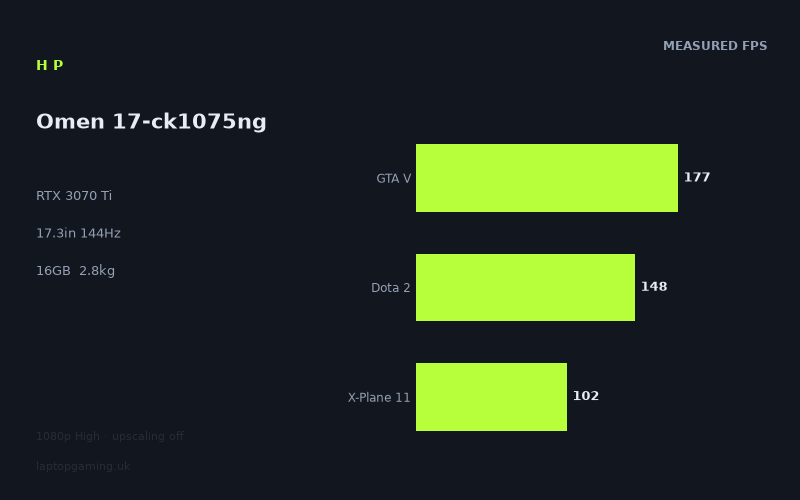
Frame rates
1920×1080, High preset, upscaling off.
Measured on this machine. Source: Notebookcheck, 2022-09-23.
Not scored: incomplete benchmark suite
Every scored laptop on this site is averaged over the same 5 games, and this one is short of Cyberpunk 2077, Baldur's Gate 3. A mean over 5 games is not comparable to a mean over 5, so we publish the figures we have and leave the score blank rather than rank it against machines tested on a different set. The numbers below are real - the suite is just incomplete.
How these numbers were produced
Frame rates here are not measured by us, and we label how each one was arrived at. A figure marked measured comes from a published run on that exact machine. A figure marked representative is derived from the GPU and its power limit (TGP) and cross-referenced against published reviews - a sound estimate of what that configuration delivers, but not a measurement of that specific laptop. Unless stated otherwise, numbers are 1920x1080, High preset, upscaling off. Where a laptop ships in several power configurations we use the wattage of the exact SKU listed, because a 140W RTX 5070 and a 115W one are not the same product.
In use
The short version
The HP Omen 17-ck1075ng is a large-screen gaming laptop built around an RTX 3070 Ti, a Core i7-12700H, 16GB of memory and a 17.3in 1920x1080 IPS display with a 144Hz refresh rate. On the available Notebookcheck benchmark data, it is a strong 1080p High-preset machine. The measured figures are particularly convincing in the less demanding and older games in the set, where it can exceed the screen’s refresh rate, while the tougher games show the more realistic limits of this configuration.
The benchmark data gives it a mean of 149fps across the scoring-suite games at 1920x1080, High settings and with upscaling disabled. That is a useful result for this particular display: it means the machine is broadly well matched to a 144Hz 1080p panel rather than being an obviously overpowered graphics configuration attached to a modest screen. Strange Brigade, GTA V and Dota 2 all clear the panel refresh rate in the measured figures. Final Fantasy XV and X-Plane 11 do not, and Metro Exodus sits further below it. The practical message is simple: this is capable of very high frame rates, but it is not a machine that makes 144fps automatic in every demanding game at High settings without help from upscaling or settings adjustments.
The Omen’s appeal is therefore fairly specific. It suits someone who wants a desktop-replacement-style gaming laptop with a genuinely large display and good measured 1080p performance, especially for games where high refresh is useful. It also suits a buyer who values a 17.3in panel more than low weight. At 2.801kg, this is not a machine to regard as an effortless daily carry. It can travel, but its design brief is much closer to moving a powerful gaming system between rooms, homes or occasional destinations than taking a compact computer everywhere.
There is no confirmed UK price for this exact configuration, so no value judgement can be made from the published price-based assessment. That is not a criticism of the laptop or an indication of an incomplete benchmark record: the benchmark suite is complete and the machine ranks normally on the frame-rate leaderboard. It simply means that a responsible buying recommendation has to stop short of calling it good or poor value until there is a confirmed UK price.
The most interesting part of the data is not just the Omen’s own frame-rate mean, but its position among laptops from the same GPU generation. It is massively ahead of the MSI Prestige 15 with its RTX 3050 Ti at 105W across the shared games, averaging 79fps more. Yet it is level in the listed shared-game comparison with both the RTX 3080 Ti Razer Blade 17 Early and the RTX 3060 Lenovo Legion 5 15IAH7H. That apparent contradiction is meaningful rather than erroneous. At 1080p, lighter titles can become CPU-bound, compressing the performance differences that GPU names alone suggest should exist. The MSI Raider GE77 HX, carrying an RTX 3080 Ti at 175W, provides the other side of that picture: it averages 20fps more across the shared games, demonstrating that faster hardware can still establish a useful lead when the workload exposes it.
Buy the Omen 17-ck1075ng for its combination of a large 144Hz 1080p screen and high measured frame rates, not because the RTX 3070 Ti label guarantees the same result in every game. Avoid treating it as a lightweight portable, avoid assuming it will sustain the panel maximum in all demanding releases, and do not make a value decision until a confirmed UK price is available.
Performance
What the measured figures say
Notebookcheck measured the HP Omen 17-ck1075ng at 1920x1080 using the High preset with upscaling off. That matters. These are not figures inflated by lowering the resolution or relying on an upscaling mode. They show what the laptop delivered at the native resolution stated for its display, using a setting level that remains relevant to buyers who want good image quality rather than merely the highest possible frame-rate counter.
The results cover a substantial range of game behaviour:
- Strange Brigade: 214fps
- The Witcher 3: 205fps
- GTA V: 177fps
- Ghostwire Tokyo: 152fps
- Dota 2: 148fps
- Far Cry 5: 146fps
- F1 2021: 139fps
- Final Fantasy XV: 103fps
- X-Plane 11: 102fps
- Metro Exodus: 97fps
The scoring-suite mean is 149fps across Strange Brigade, GTA V, Dota 2, Final Fantasy XV and X-Plane 11. A mean is useful as an overview, but it is not a promise of identical behaviour across genres. In this case, the gap between the fastest and slowest measured titles is large enough that the individual figures deserve more attention than the headline average. A person choosing a gaming laptop primarily for fast competitive or older games will take a different lesson from this table than someone whose library centres on visually demanding action games and simulations.
At the high end, Strange Brigade at 214fps and The Witcher 3 at 205fps show that the Omen has plenty of headroom in favourable workloads. GTA V reaches 177fps, which is also beyond the 144Hz screen refresh. Those figures support the idea of this laptop as a high-refresh 1080p machine in games that are lighter on the graphics subsystem or otherwise well suited to this combination of processor and GPU. The raw frame rates are not marginally above the panel capability: they are clearly beyond it.
That does not make the extra performance meaningless. A display cannot present more refreshes than its refresh rate, but frame-rate headroom can still be relevant to responsiveness and to maintaining high performance when a game’s workload becomes more demanding than its average benchmark sequence suggests. More importantly, the figures establish that the Omen does not merely reach 144fps in a narrow best-case scenario. In several measured titles, it has room above that threshold.
Ghostwire Tokyo at 152fps, Dota 2 at 148fps and Far Cry 5 at 146fps sit in a different but still positive part of the results. All are at or above the 144Hz target provided by the display. The margin is much smaller than it is in Strange Brigade, The Witcher 3 or GTA V, which means there is less scope to assume a fixed 144fps in every scene. Nevertheless, these figures show the screen and hardware working to the same general performance target. For buyers who want a panel whose refresh rate can be used rather than merely advertised, that alignment is important.
F1 2021 at 139fps is close to the 144Hz ceiling but does not quite reach it in the recorded run. This is a useful reminder that “close to the panel refresh rate” and “at the panel refresh rate” are different claims. It would be wrong to say that the Omen delivers 144fps in F1 2021 from the supplied data. It would also be unfair to present 139fps as a poor result. The sensible interpretation is that the machine is operating in the same high-refresh territory as its display, while falling slightly short of fully matching it at the stated settings.
Final Fantasy XV at 103fps, X-Plane 11 at 102fps and Metro Exodus at 97fps give the more demanding side of the picture. These are still high frame rates in ordinary laptop terms, but they are not 144Hz figures. A buyer who expects the RTX 3070 Ti badge to guarantee the screen maximum in every modern or demanding title should adjust that expectation. In the measured data, it does not. The Omen remains fast in these games, but the display’s full refresh capacity is not the natural outcome without changing something about the workload, such as the chosen game settings or the use of an upscaling option where a game offers one. The supplied benchmark data does not include those alternative settings, so no frame-rate claim should be made for them.
The benchmark spread matters more than a single average
The 149fps scoring-suite mean looks excellent in isolation, and it is. But it combines very different outcomes: Strange Brigade at 214fps, GTA V at 177fps, Dota 2 at 148fps, Final Fantasy XV at 103fps and X-Plane 11 at 102fps. That is precisely why buyers should not use a single average as a substitute for looking at the games closest to their own library.
A player focused on Dota 2 has strong evidence that the Omen is suited to the 144Hz panel. The measured 148fps is above the refresh rate, although only by a small amount. A player spending more time in Final Fantasy XV or X-Plane 11 should look instead at 103fps and 102fps. Those figures are still well beyond a basic 60Hz experience, but they put the laptop in a different class of expectation. The machine is providing smooth high-frame-rate gaming rather than saturating the screen refresh.
Metro Exodus at 97fps is similarly important because it is the lowest measured result in the supplied list. It demonstrates where the Omen’s 1080p High performance can land when the game is more demanding. That is not a reason to dismiss the laptop. It is evidence that the performance ceiling is real. A useful review should make that clear because it affects purchase decisions. Someone who mostly plays titles in the Strange Brigade, GTA V and Dota 2 part of the spread can reasonably prioritise the 144Hz screen. Someone buying mainly for games that behave more like Metro Exodus should regard the display as providing welcome headroom, but not as a target that will always be reached.
The Witcher 3 result of 205fps also deserves careful reading. It confirms very high performance in that particular measured workload, but it should not be stretched into a claim about every version, every graphics mode or every scene in that game. The available figure is for the stated Notebookcheck configuration: 1920x1080, High, with upscaling off. It is strong evidence for that benchmark condition and no more than that.
This distinction may sound cautious, but it is exactly what makes the results useful. A gaming-laptop review should not turn a favourable figure from one title into a universal performance promise. The Omen’s table provides a better story than that anyway. It shows a machine with substantial speed, enough to drive its own display very effectively in several games, while retaining a meaningful gap between light and heavy workloads.
What can and cannot be said about GPU power
The supplied specification identifies the GPU as an RTX 3070 Ti, but it does not provide a GPU power limit for this exact HP Omen configuration. That is an important omission when comparing gaming laptops. The same GPU name can appear in systems configured very differently, and the listed rivals themselves show why power context matters. The MSI Prestige 15 is identified as having an RTX 3050 Ti at 105W, while the MSI Raider GE77 HX is identified as having an RTX 3080 Ti at 175W. Those details help frame their positions, but there is no equivalent power figure in the fact sheet for this Omen.
It would therefore be wrong to state a specific wattage for the HP, or to attribute its measured frame rates to a particular GPU power setting. What can be said is more limited but still useful: the Notebookcheck figures show the end result of the complete laptop configuration, including its RTX 3070 Ti and Core i7-12700H, at the stated game settings. The results are strong. The mechanism behind each result cannot be reduced to a supplied wattage figure because no such figure is available here.
That limitation also helps explain why GPU names should not be treated as a league table on their own. The Omen matching a listed RTX 3080 Ti rival and a listed RTX 3060 rival across the shared games does not mean that all three GPUs are equivalent. It means that, across those particular games and under those comparison conditions, the measured averages came out level. At 1080p, lighter games can shift pressure away from the GPU and towards the processor or other parts of the system. When that happens, a larger theoretical GPU advantage may not translate into a larger observed frame-rate advantage.
The Core i7-12700H is part of the configuration, and its presence matters to that broader explanation, especially in games where the graphics card is not the sole limiting component. However, the supplied evidence does not isolate CPU behaviour game by game, so it would be overreach to declare a particular title CPU-bound in this specific laptop. The defensible point is that the shared-game comparisons include lighter 1080p workloads where CPU limits can compress genuine GPU differences. That is the context provided for the near-zero rival results, and it is the right context in which to read them.
High settings without upscaling
The fact that the figures were recorded with upscaling off is valuable. It leaves less ambiguity about what the hardware itself achieved at 1920x1080 and High settings. Upscaling can be a sensible feature to use, particularly in demanding games, but benchmark results obtained without it are easier to compare because they are not dependent on the quality mode or implementation chosen by a particular title.
For the Omen, the no-upscaling condition makes the results at the top of the table more impressive and the results at the lower end more informative. Strange Brigade at 214fps, The Witcher 3 at 205fps and GTA V at 177fps show high performance without relying on that additional aid. Metro Exodus at 97fps demonstrates that even without upscaling, the laptop remains capable of a high frame rate in a demanding game, though not one that fully uses the 144Hz display at the supplied settings.
The sensible practical conclusion is not that upscaling is needed across the board. The measured data shows that it plainly is not needed to reach very high frame rates in several games. Instead, it is a potential tool for someone whose priority is to move demanding games closer to the display’s refresh ceiling. Since no alternative figures are supplied, buyers should treat that as a possibility rather than a promised result.
The screen
A 17.3in 1080p high-refresh display
The Omen uses a 17.3in 1920x1080 IPS screen with a 144Hz refresh rate. The key advantage of this panel specification is not complexity; it is coherence with the measured performance. A large display at 1920x1080 avoids asking the RTX 3070 Ti to drive a higher-resolution panel, while 144Hz gives the system somewhere useful to put the frame rates it can achieve in much of the benchmark list.
That is a better match than a specification that pairs a powerful GPU with a refresh rate the hardware cannot meaningfully approach, or a screen resolution that turns a gaming laptop into a compromise from the outset. Here, the resolution is the one used in Notebookcheck’s figures, so there is a direct link between the screen specification and the performance evidence. There is no need to estimate what the laptop might do at some other native resolution because the supplied display resolution and the supplied benchmarks already align.
The IPS panel type is also part of the specification. Beyond identifying the panel technology, the fact sheet provides no measured brightness, contrast, colour coverage, response-time or outdoor-visibility figures. Those qualities should not be invented or inferred from the IPS label alone. Buyers who need the screen for colour-critical work, use in unusually bright environments, or a particular level of motion handling will need evidence beyond the supplied panel type and refresh rate.
Can the GPU use 144Hz?
Yes, in a meaningful selection of the measured games, but not universally. That is the honest answer.
Strange Brigade at 214fps is well above 144Hz. The Witcher 3 at 205fps is also well above it. GTA V at 177fps has clear headroom beyond the panel limit. Ghostwire Tokyo at 152fps, Dota 2 at 148fps and Far Cry 5 at 146fps are all above the refresh rate too, although with less margin. In these titles, the 144Hz display is not decorative specification-sheet material. The benchmark data indicates that it can be used.
F1 2021 at 139fps is close enough to show that the laptop is operating in high-refresh territory, but it is below the stated panel maximum. Final Fantasy XV at 103fps, X-Plane 11 at 102fps and Metro Exodus at 97fps are further away. These results make the 144Hz panel a ceiling rather than a guaranteed operating point in more demanding workloads.
This is not unusual for a gaming laptop, but it is worth stating plainly because high-refresh displays can create unrealistic expectations. The Omen’s screen is well selected for the faster half of the game list. In the tougher titles, it remains a good screen specification because it offers room above conventional frame rates, but buyers should not expect the hardware to pin every game to 144fps at the supplied settings.
The distinction becomes especially important if the buyer has a narrow game library. Someone interested primarily in Dota 2, GTA V, Strange Brigade, Far Cry 5 or similar workloads has clear evidence that high refresh is relevant. Someone interested mainly in demanding games closer to Metro Exodus should buy on the basis of strong 1080p performance rather than on an assumption of fully saturated 144Hz performance.
Why 1080p remains sensible here
At 1920x1080, the Omen has a display resolution that the measured hardware can drive at high frame rates. The evidence is in the 149fps scoring-suite mean and in the several games that exceed 144fps. That does not mean 1920x1080 is automatically right for every buyer. A person choosing a laptop primarily for desktop productivity, high-resolution media work or a different kind of visual preference may have other priorities. But for the gaming brief supported by these figures, the resolution avoids sacrificing frame rate for pixels that are not part of this machine’s stated display specification.
There is also a practical benefit to having the benchmark resolution match the screen. There is no uncertainty about whether the listed results rely on rendering below the panel’s native resolution. They do not: Notebookcheck’s numbers are stated at 1920x1080, matching the Omen display specification. That makes the result table directly useful to a buyer deciding whether this machine’s own panel is a good fit for the games listed.
Build, size and portability
This is a large laptop in the ways that matter
The Omen has a 17.3in display and weighs 2.801kg. Those facts are enough to define its role even though the supplied specification does not include physical dimensions. This is not a compact gaming laptop. A 17.3in screen is a deliberate choice for someone who values a larger built-in display, and a 2.801kg chassis makes clear that portability is not the central priority.
That does not mean it cannot leave a desk. It means the buyer should be realistic about how often and why it will move. It is suited to someone who wants a substantial screen for regular use in one main place, with the flexibility to relocate the laptop when necessary. It is less obviously suited to someone who carries a computer throughout the day, moves repeatedly between lectures, meetings or workplaces, or wants their gaming system to disappear into a bag with minimal thought.
No dimensions are supplied, so this review cannot responsibly describe its footprint, thickness or how easily it fits into a particular bag. No chassis-material details are supplied either, so there is no basis for claims about rigidity, finish, keyboard feel, port selection or hinge design. The correct conclusion from the available data is narrower: it is a 17.3in gaming laptop weighing 2.801kg, and that places it firmly on the larger, heavier side of gaming-laptop use rather than in the thin-and-light category.
Battery capacity is not battery life
The Omen is specified with a 78Wh battery. That is a capacity figure, not a measured endurance result. There is no battery-life figure in the supplied fact sheet, and it would be misleading to convert the 78Wh specification into an estimate for gaming, streaming, browsing or work use. Real battery life depends on workload, screen settings, power management and other factors that are not documented here.
The safe buying advice is simply that someone who needs proven long unplugged use should seek a measured battery result before committing. A buyer using the laptop mainly for gaming should also remember that the high frame rates in the supplied benchmarks are performance figures for the stated Notebookcheck test conditions, not evidence about battery gaming behaviour.
Memory and storage in context
The supplied configuration includes 16GB of memory and a 1TB SSD. These are useful, practical specifications for a gaming laptop, but the fact sheet does not provide memory speed, storage performance, upgrade information or internal layout details. It would therefore be wrong to make claims about loading times, expandability or how the machine behaves with a particular set of background applications.
For the purposes of this review, the important point is that the measured game results come from a configuration with 16GB of memory, a 1TB SSD, a Core i7-12700H and an RTX 3070 Ti. Buyers should not assume that every Omen carrying a similar name elsewhere will behave identically if it has a different GPU, processor, memory allocation or display.
How it compares
Against the MSI Prestige 15
The widest positive comparison in the supplied rival list is against the MSI Prestige 15, configured with an RTX 3050 Ti at 105W. Across the shared games, the HP Omen averages 79fps more. That is a substantial gap, not a rounding issue and not a difference that can be explained away by minor benchmark variation.
For a buyer deciding between these two classes of machine, the comparison reinforces the Omen’s role as a performance-focused large gaming laptop. The Omen’s own figures include 214fps in Strange Brigade, 177fps in GTA V, 148fps in Dota 2 and 103fps in Final Fantasy XV. The shared-game average advantage tells us that it establishes a clearly different performance tier from the RTX 3050 Ti Prestige 15 in the available comparison set.
The fact that the Prestige 15’s RTX 3050 Ti is listed at 105W is useful context, but the main purchasing conclusion comes from the observed result: the Omen is much faster across the games both hold. Someone choosing the HP for high-refresh 1080p gaming has evidence for that decision. Someone who does not need that performance may still have reasons to prefer a different type of laptop, but the gaming trade-off is clear.
Against the Razer Blade 17 Early
The Razer Blade 17 Early is listed with an RTX 3080 Ti and a UK price of £3,863. Across the shared games, the Omen averages the same frame rate. That near-zero difference needs explanation because the GPU labels alone invite a very different expectation.
The important caveat is that this comparison covers the shared games, not every possible title and not an abstract measure of GPU capability. The provided context explains that at 1080p the lighter titles in the shared set can be CPU-bound, compressing genuine GPU gaps. In other words, a faster GPU does not automatically create a higher average when the game is being held back elsewhere in the system. The level shared-game result should therefore be read as a result of these particular comparison conditions, not proof that an RTX 3070 Ti and RTX 3080 Ti are interchangeable.
For the Omen, though, it is still an impressive practical result. It means that a buyer looking at these shared 1080p game figures does not see the more expensive Razer establishing an advantage in the listed average. The Omen’s own 149fps scoring-suite mean supports the broader impression of very capable 1080p performance. What cannot be concluded is that the HP will match the Razer in every demanding game, every resolution or every setting combination. The data does not say that.
The Razer’s listed price should also not be turned into a value comparison against the Omen because there is no confirmed UK price for this exact HP configuration. The absence of one side of that calculation matters. The performance comparison can be made; a proper price-to-performance conclusion cannot.
Against the Lenovo Legion 5 15IAH7H
The Lenovo Legion 5 15IAH7H is listed with an RTX 3060 at 140W. Again, the Omen averages the same frame rate across the shared games. On paper, that is a surprising outcome because the Omen carries an RTX 3070 Ti. In practice, it is another example of why laptop GPU names and shared 1080p game averages need to be interpreted together rather than separately.
The shared set includes lighter titles where CPU limits can compress GPU differences. Once a game is no longer primarily limited by graphics performance, adding more GPU capability does not necessarily produce a proportional frame-rate gain. That makes a level result possible even when the graphics hardware categories differ. The conclusion is not that the Omen’s RTX 3070 Ti brings no advantage in general. The conclusion is that, across the listed shared games, neither machine establishes an average lead.
For someone who already owns a Legion 5 15IAH7H, this comparison is a warning against upgrading purely because the Omen has a higher GPU tier in its name. The listed shared-game data does not demonstrate an average gain. For a buyer choosing between them from scratch, the decision should rest on the full configuration and the individual games they play, as well as available confirmed pricing. Neither machine has a confirmed UK price in the supplied information, so there is no legitimate value verdict between them.
Against the MSI Raider GE77 HX
The MSI Raider GE77 HX, equipped with an RTX 3080 Ti at 175W, is the rival that beats the Omen by the largest margin in the supplied list. Across the shared games, the Omen averages 20fps fewer. Unlike the level outcomes against the Razer and Lenovo, this is a meaningful observed lead for the Raider.
The Raider comparison demonstrates the other side of the 1080p story. CPU limits can compress gaps in lighter games, but they do not erase them everywhere. When the comparison includes workloads where the additional graphics capability can be used, the Raider pulls ahead. The 175W GPU figure supplied for the Raider provides useful context for why it belongs in a higher-performing category, although the Omen’s own GPU power limit is not provided and should not be guessed.
A 20fps shared-game deficit does not make the Omen slow. Its own figures remain strong, including 214fps in Strange Brigade, 205fps in The Witcher 3 and a 149fps scoring-suite mean. Instead, the comparison establishes a hierarchy within this generation: the Omen can match some apparently stronger or weaker GPU-labelled systems in a light 1080p shared set, but it cannot match the Raider’s average across the listed games.
There is no confirmed UK price for the Raider in the supplied data, so this remains a performance comparison rather than a buying-value verdict. A faster laptop is not automatically the better purchase if its price, size or other properties differ, but no such conclusion can be supported here without confirmed price information for the relevant configurations.
What the rival results collectively show
Taken together, the rivals place the Omen in an interesting middle position. It is far ahead of the RTX 3050 Ti MSI Prestige 15. It is level across the shared games with the RTX 3080 Ti Razer Blade 17 Early and the RTX 3060 Lenovo Legion 5 15IAH7H. It trails the RTX 3080 Ti MSI Raider GE77 HX by 20fps across its shared games.
That is not a neat GPU-name ladder, and that is the point. Laptop performance is a property of the whole system and of the games selected. The Omen’s benchmark record says it is a strong 1080p performer. The comparisons say that its frame rates are competitive with some surprising rivals in a shared set, while a faster Raider still shows an advantage. Buyers should use that evidence to avoid both extremes: do not underrate the Omen because it lacks the highest GPU label in this group, and do not assume it can equal every RTX 3080 Ti laptop under every workload.
Who it’s for
Buy it if a large 1080p gaming screen is the priority
The clearest buyer for the HP Omen 17-ck1075ng is someone who wants a 17.3in gaming display and intends to use it primarily in places where its 2.801kg weight is acceptable. The combination of 1920x1080 and 144Hz is well supported by the benchmark data. Several games exceed the refresh rate, and the scoring-suite mean is 149fps.
It makes particular sense for players whose regular games resemble the faster portion of the measured list. Strange Brigade at 214fps, The Witcher 3 at 205fps, GTA V at 177fps, Ghostwire Tokyo at 152fps, Dota 2 at 148fps and Far Cry 5 at 146fps all demonstrate that the panel’s high refresh is relevant. This is the group most likely to benefit directly from the Omen’s combination of screen and performance.
It also suits a buyer who prefers substantial performance without moving to the fastest configuration in the rival set. The MSI Raider GE77 HX is faster across the shared games, but the supplied information gives no confirmed UK price for either machine. The Omen should therefore be chosen for the performance it demonstrably offers, not on an imagined saving or an assumed value advantage.
Buy something else if portability comes first
At 2.801kg, the Omen is not the right fit for a buyer who needs a laptop to be unobtrusive in daily travel. The 17.3in screen is part of its attraction, but it is also inseparable from its large-laptop character. Someone carrying a machine constantly should look for a system whose weight and display size better match that use, rather than buying the Omen and hoping that the size will stop mattering.
This is especially true if gaming is secondary to mobile work. The fact sheet does not provide dimensions, battery-life measurements, keyboard details or port information, so there is no evidence base for presenting the Omen as a mobile productivity specialist. Its strongest documented case is gaming performance on its own 1080p high-refresh screen.
Buy something else if 144fps in demanding games is non-negotiable
The Omen can exceed 144fps in several measured games, but it does not do so everywhere. F1 2021 is measured at 139fps, Final Fantasy XV at 103fps, X-Plane 11 at 102fps and Metro Exodus at 97fps. If a buyer’s requirement is a locked 144fps experience in demanding games at 1920x1080 High with upscaling off, this evidence does not support that expectation.
That buyer should either look for a faster system with benchmark evidence in the particular games they play, or be prepared to adjust settings and use game-supported features where appropriate. The supplied figures do not quantify the result of those adjustments on this Omen, so they should not be assumed to solve every case.
Do not choose on value until the price is known
The final caution is straightforward. This exact HP Omen configuration has no confirmed UK price in the supplied information. Performance can be assessed, and the evidence is good. Portability can be assessed from the 17.3in screen and 2.801kg weight. Value cannot be assessed responsibly without the missing price.
That leaves the Omen 17-ck1075ng as a convincing performance-led option rather than a complete value recommendation. If a confirmed UK price appears and is competitive, the strong 1080p High-preset figures, the 144Hz display match and the large-screen format give it a solid case. Until then, the correct verdict is more restrained: it is a fast, heavy, large-screen RTX 3070 Ti laptop with benchmark results that make good use of its display in many games, but its value remains unproven.