Review
Razer Blade 18 RTX review
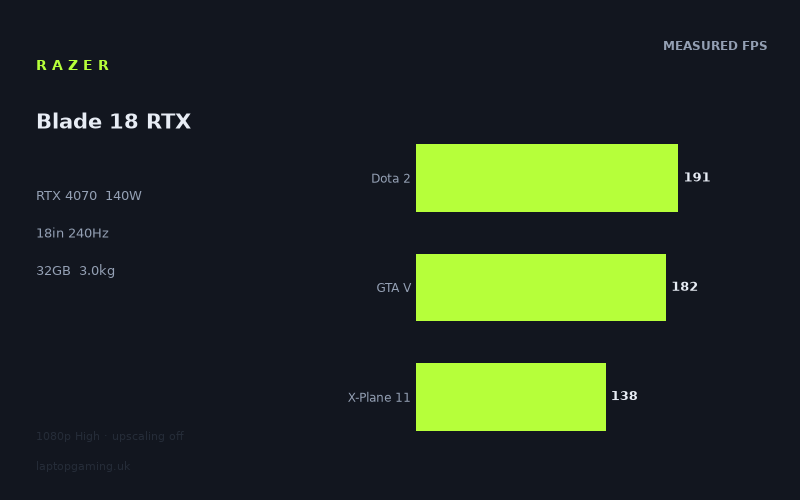
Frame rates
1920×1080, High preset, upscaling off.
Measured on this machine. Source: Notebookcheck, 2023-02-21.
Not scored: incomplete benchmark suite
Every scored laptop on this site is averaged over the same 5 games, and this one is short of Cyberpunk 2077, Baldur's Gate 3. A mean over 3 games is not comparable to a mean over 5, so we publish the figures we have and leave the score blank rather than rank it against machines tested on a different set. The numbers below are real - the suite is just incomplete.
How these numbers were produced
Frame rates here are not measured by us, and we label how each one was arrived at. A figure marked measured comes from a published run on that exact machine. A figure marked representative is derived from the GPU and its power limit (TGP) and cross-referenced against published reviews - a sound estimate of what that configuration delivers, but not a measurement of that specific laptop. Unless stated otherwise, numbers are 1920x1080, High preset, upscaling off. Where a laptop ships in several power configurations we use the wattage of the exact SKU listed, because a 140W RTX 5070 and a 115W one are not the same product.
In use
The short version
The Razer Blade 18 RTX is a large-format gaming laptop built around an RTX 4070 running at a stated 140W GPU power limit, a Core i9-13950HX, 32GB of memory and an 18in 2560x1600 IPS display with a 240Hz refresh rate. The published benchmark data is strong in absolute terms, particularly in older, lighter or less GPU-limited games, but it also makes clear that this is not a machine that can simply treat its 240Hz panel as a target in every demanding title.
Notebookcheck’s measured figures at 1920x1080, High preset and with upscaling off range from 243fps in Strange Brigade to 110fps in Metro Exodus. That is a broad spread, and it matters more than any single headline result. The Blade 18 can exceed the panel refresh rate in Strange Brigade and The Witcher 3, comes close in Hitman 3, and remains very fast in Dota 2 and GTA V. In the more demanding games in this data set, however, it is operating well below 240fps: Borderlands 3 reaches 132fps, Final Fantasy XV 115fps, Cyberpunk 2077 1.6 112fps and Metro Exodus 110fps.
That does not make the Razer slow. It makes it a laptop whose display specification is more ambitious than its measured results in the hardest games at the stated benchmark settings. There is a meaningful difference between buying an 18in machine with a 240Hz panel and buying one that can sustain 240fps in every type of game. The figures available here support the former, not the latter.
The benchmark data is especially useful because it shows the limits of relying on component labels alone. An RTX 4070 at 140W sounds straightforward, but the result is not one fixed level of performance. In the games that are lighter at 1080p, the Blade 18 reaches or passes 240fps. In the games that remain more demanding at the same settings, it sits much closer to the 110fps to 132fps range. Anyone considering this laptop should buy it for the combination of a large high-refresh display and strong high-setting gaming performance, not because the RTX 4070 badge implies a uniform 240fps experience.
It is also important to be honest about ranking. The scoring suite is incomplete for this machine: there are no figures here for Cyberpunk 2077 or Baldur’s Gate 3 within that suite. Every scored laptop is averaged over the same five games, so this Razer cannot be placed fairly into that ranking from the partial results available. There is a mean of 170fps across the three available scoring-suite games, but that is not equivalent to a complete like-for-like score against laptops with all five results.
For the right buyer, the Blade 18 RTX makes sense as a desktop-style gaming laptop that can deliver extremely high frame rates in the games where the panel can be properly exploited, while still producing solid results in more demanding titles. For someone focused primarily on the hardest games, or on matching 240Hz as consistently as possible, the available figures suggest caution. The display is capable of more than the GPU is shown delivering in the heavier games, and the benchmark comparison against specific rivals does not automatically establish a clear advantage for the Razer.
Performance
What the measured data says
All of the frame-rate figures discussed here were measured by Notebookcheck on 2023-02-21 at 1920x1080, High preset and with upscaling off. That consistent test setup is important. It gives a useful view of the Razer Blade 18 RTX’s performance across a varied group of games, but it is not a native-resolution test of the laptop’s 2560x1600 display. The measured figures should therefore be read as 1080p High results rather than assumed 2560x1600 results.
At the top end of the results, Strange Brigade reaches 243fps and The Witcher 3 reaches 241fps. Both sit above the laptop’s 240Hz refresh rate. In these two games, the available benchmark data indicates that the Blade 18 can supply enough frames to make full use of the panel’s maximum refresh rate at the tested settings. There is no need to soften that conclusion: 243fps and 241fps are directly in line with a 240Hz screen.
Hitman 3 follows at 208fps. That is below the panel’s 240Hz maximum, but it is still very close in practical terms to the display’s upper range. It means the Blade 18 does not quite meet a 240fps target in that game under the published settings, yet it remains far nearer to that target than to conventional lower-refresh gaming. The distinction matters because a laptop with a 240Hz panel can still look and feel exceptionally responsive below 240fps; the point is simply that the screen’s stated maximum is not fully fed by the measured frame rate in this title.
Dota 2 records 191fps and GTA V records 182fps. These are both high results, though neither reaches the screen’s 240Hz ceiling. They also form part of the three-game scoring-suite subset for which figures are available. Alongside X-Plane 11 at 138fps, they produce a mean of 170fps. That average is useful as a summary of those three games, but it should not be stretched beyond what it is. Dota 2, GTA V and X-Plane 11 are different workloads, and the spread between 191fps and 138fps is large enough to show why an average is never the whole story.
X-Plane 11’s 138fps result is particularly useful in understanding the system’s range. It is comfortably above 100fps, but it is much lower than the results in Strange Brigade, The Witcher 3, Hitman 3, Dota 2 and GTA V. The Blade 18 is therefore not simply a 180fps-to-240fps laptop at the tested settings. Some games run much faster than that, while others bring the measured result down into the low-100fps range. Buyers should expect game choice to shape the experience considerably.
Borderlands 3 produces 132fps. That is only modestly below X-Plane 11’s 138fps and reinforces the pattern seen elsewhere: the Blade 18’s RTX 4070 can generate a high frame rate in demanding games, but there is a clear gap between high frame rate and full 240Hz utilisation. A result of 132fps is not evidence that the machine struggles. It is evidence that the 240Hz panel has considerably more headroom than the measured performance in this game can fill at 1080p High with upscaling disabled.
Final Fantasy XV records 115fps, Cyberpunk 2077 1.6 records 112fps and Metro Exodus records 110fps. These are the lowest published results in the supplied set. They are tightly grouped, unlike the gap between the lighter games at the top of the table and the games in the middle. That clustering is useful because it shows a more demanding side of the Blade 18’s performance profile. In these titles, the machine remains over 100fps at the measured settings, but it is not close to 240fps.
The difference between 243fps in Strange Brigade and 110fps in Metro Exodus is substantial. It is not a contradiction in the data and it is not evidence that one of the figures is less relevant. It is exactly why a review should discuss the whole benchmark spread rather than relying on a mean alone. The Razer can look like a 240Hz-class laptop in one game and like a roughly 110fps-class laptop in another, with both observations being true at the tested settings.
The 140W GPU power limit in context
The Blade 18 RTX uses an RTX 4070 with a stated 140W GPU power limit. That is one of the most important specifications in the sheet because it establishes the configuration being benchmarked. An RTX 4070 name on its own is not enough to describe the laptop; the relevant published results belong to this RTX 4070 running at 140W alongside the Core i9-13950HX and 32GB of memory.
What the 140W limit means in practice, based on these numbers, is that the Blade 18 has enough available performance to produce very high 1080p High frame rates in several games. Strange Brigade at 243fps, The Witcher 3 at 241fps and Hitman 3 at 208fps are not borderline results. They show that the hardware can operate at a level suited to a high-refresh display when the game allows it.
At the same time, the 140W configuration does not erase the divide between lighter and heavier games. The results in Borderlands 3, Final Fantasy XV, Cyberpunk 2077 1.6 and Metro Exodus show that the RTX 4070 still has a distinct ceiling in more demanding workloads at these settings. The measured data does not support presenting the Blade 18 as a machine that will hold its panel’s maximum refresh rate across the board. It supports presenting it as a machine with a wide performance range depending on the title.
This is also where the 1080p test resolution needs to remain front and centre. The Blade 18’s display is 2560x1600, while Notebookcheck’s results are at 1920x1080. There are no supplied native-resolution frame rates, so it would be wrong to invent an estimate for 2560x1600 or to state a likely result as fact. What can be said is that the published figures demonstrate the system’s behaviour at 1080p High with upscaling off, and that the higher native display resolution is a separate demand not directly covered by the available measurements.
That limitation does not make the benchmark data unusable. Far from it: the 1080p results establish the relative pattern between games very clearly. The Blade 18 is shown exceeding 240fps in two titles, approaching that level in another, producing high results in several more, and landing around 110fps to 115fps in the hardest titles listed. But a buyer who intends to play at the panel’s native 2560x1600 resolution should not assume that the exact 1080p figures will carry over unchanged. No corresponding measurements are provided here.
Comfortable frame rates versus the 240Hz target
The 240Hz IPS panel creates a simple question for every result: can the laptop actually provide 240fps? In Strange Brigade, the answer is yes at 243fps. In The Witcher 3, it is also yes at 241fps. These are the strongest matches between the display specification and the benchmark results. The laptop’s panel is not just a theoretical feature in these games; the measured frame rates are sufficient to reach its stated refresh rate.
Hitman 3 at 208fps is the next-closest result. It falls short of 240fps, but not by a dramatic amount. It still makes a much stronger case for the screen’s high-refresh focus than a result around 110fps would. The point is not to treat 208fps as inadequate. It is to be precise: it is very fast, but it does not fully meet the screen’s maximum refresh rate under the test conditions.
Dota 2 at 191fps and GTA V at 182fps remain well suited to a high-refresh display, even though they do not reach 240fps in the published data. They offer frame rates that are clearly higher than the 110fps to 138fps group. This difference is visible in the numbers themselves. A purchaser whose regular games resemble Dota 2 or GTA V has a more persuasive reason to value the 240Hz panel than someone whose gaming is dominated by Cyberpunk 2077 1.6 or Metro Exodus at the tested settings.
X-Plane 11 at 138fps and Borderlands 3 at 132fps occupy a middle position. These are still strong figures, but they do not make the same case for a 240Hz display as 243fps, 241fps or 208fps. They show that the panel’s refresh rate can exceed the game’s measured output by a large margin. That is not inherently wasted: a 240Hz panel does not stop being a high-quality specification because a game runs below 240fps. But it does mean buyers should distinguish between a screen’s maximum capability and the frame rate a given game is shown delivering.
The same applies even more clearly to Final Fantasy XV at 115fps, Cyberpunk 2077 1.6 at 112fps and Metro Exodus at 110fps. The Blade 18 remains above 100fps in each case, which is a meaningful result at 1080p High without upscaling. Yet these figures are less than half the panel’s 240Hz maximum. Buyers looking primarily at the display’s refresh rate should not read “240Hz” as a promise of 240fps in these games. Notebookcheck’s figures say otherwise.
The practical conclusion is straightforward. The Razer Blade 18 RTX is best understood as a system that can fully exploit its 240Hz panel in selected games, get close in some others, and deliver high but substantially lower frame rates in the most demanding titles listed. That is a more useful conclusion than calling it either a 240Hz gaming laptop without qualification or dismissing the panel because every game does not reach its maximum.
Why the game-to-game spread matters
The measured frame-rate spread is not a minor detail. It should shape the purchase decision. A buyer who mainly plays Strange Brigade and The Witcher 3 is looking at 243fps and 241fps, with the panel’s 240Hz refresh rate properly matched. A buyer focused on Metro Exodus, Cyberpunk 2077 1.6 and Final Fantasy XV is looking at 110fps, 112fps and 115fps under the same broad test conditions. The experience implied by those two groups of numbers is different, even though it is the same laptop.
It is tempting to reduce the machine to the 170fps mean across Dota 2, GTA V and X-Plane 11, but that would obscure the more useful result: the Blade 18 performs very differently across the measured titles. The mean says the three available scoring-suite results are collectively high. The individual figures say Dota 2 is at 191fps, GTA V at 182fps and X-Plane 11 at 138fps. Anyone buying for one specific game should pay more attention to the relevant individual measurement than to the mean.
The same caution applies to the highest results. Strange Brigade at 243fps and The Witcher 3 at 241fps are excellent outcomes, but they do not establish that the RTX 4070 will deliver that level across the whole set. Borderlands 3 at 132fps, Final Fantasy XV at 115fps, Cyberpunk 2077 1.6 at 112fps and Metro Exodus at 110fps put a firm limit on that interpretation. The system is fast; it is not uniformly fast in the same way across all games.
This is also why upscaling being off matters. The figures are attributable to a clearly stated test condition rather than a mixture of settings. There is no need to speculate about what might happen with a different upscaling setting because no such measurements are supplied. The usable conclusion is simply that these are the results without upscaling, and that they show the laptop already exceeding 240fps in two games while remaining around 110fps in several others.
The screen
An 18in 2560x1600 IPS panel with a 240Hz refresh rate
The Blade 18 RTX has an 18in 2560x1600 IPS display with a 240Hz refresh rate. On specification alone, that is a screen aimed at a buyer who values both a large display area and very high refresh capability. The important question is not whether 240Hz is a good feature in isolation, but whether the measured performance makes effective use of it.
In Strange Brigade and The Witcher 3, the answer is clear. The 243fps and 241fps figures are enough to reach the display’s 240Hz maximum at the tested 1920x1080 High settings. This is the clearest use case for the screen: games where the system can produce frame rates at or above the panel’s refresh limit.
In Hitman 3, Dota 2 and GTA V, the match is still good but not complete. The measured results of 208fps, 191fps and 182fps are all high enough to make a 240Hz display relevant, but none reaches the maximum. These games are not evidence that the screen is excessive; they are evidence that the laptop can often operate in the high-refresh range without always fully saturating a 240Hz panel.
In X-Plane 11, Borderlands 3, Final Fantasy XV, Cyberpunk 2077 1.6 and Metro Exodus, the case changes. The figures of 138fps, 132fps, 115fps, 112fps and 110fps are still substantial, but they leave considerable space below 240Hz. Here, the display has a higher refresh capacity than the benchmarked game output. Buyers should see that as a headroom issue rather than a flaw in either the panel or the GPU: the panel is capable of 240Hz, but the measured games do not all deliver 240fps.
The resolution issue cannot be ignored
The panel’s 2560x1600 resolution is higher than the 1920x1080 resolution used for the published benchmark figures. This is not a small methodological detail. It means the available frame rates cannot be described as native-resolution results. There are no supplied measurements for Strange Brigade, The Witcher 3, Hitman 3, Dota 2, GTA V, X-Plane 11, Borderlands 3, Final Fantasy XV, Cyberpunk 2077 1.6 or Metro Exodus at 2560x1600.
As a result, the sensible buying advice is to separate what is known from what is not. It is known that the Blade 18 reaches 243fps in Strange Brigade and 241fps in The Witcher 3 at 1920x1080 High with upscaling off. It is known that it records 110fps in Metro Exodus and 112fps in Cyberpunk 2077 1.6 under those same stated conditions. It is not known from this fact sheet what those exact games achieve at the display’s native 2560x1600 resolution.
That uncertainty is especially important for anyone buying the Razer specifically for its native resolution. The higher-resolution panel is part of the appeal of an 18in laptop, but the attributable performance figures are from a lower resolution. There is no basis here for claiming a particular native-resolution frame rate, whether optimistic or pessimistic. A review should not turn an attractive display specification into an unsupported performance promise.
The best-supported interpretation is that the panel offers two distinct attractions. Its 18in size and 2560x1600 resolution are specification advantages for someone wanting a large display, while its 240Hz refresh rate is most directly supported by the 1080p results in the games that reach or approach 240fps. Those are related strengths, but the available data does not prove that both are fully realised together in every measured game.
Who benefits most from this display
The screen is best matched to buyers whose games are represented by the higher results in the benchmark set. Strange Brigade, The Witcher 3, Hitman 3, Dota 2 and GTA V all show the system operating from 182fps to 243fps. That is the part of the data where a 240Hz panel is easiest to justify. The frame rates are not merely above 100fps; they are high enough to make high refresh a central part of the machine’s proposition.
Buyers whose priority is the more demanding group should keep their expectations measured. Borderlands 3 at 132fps, Final Fantasy XV at 115fps, Cyberpunk 2077 1.6 at 112fps and Metro Exodus at 110fps are good results, but they are not results that turn a 240Hz screen into a 240fps experience. If those games are the main reason for buying the laptop, the display remains a premium specification, but the published data does not show it being fully driven at its maximum refresh rate.
The IPS panel type is stated in the specification, but there are no supplied measurements for brightness, contrast, colour coverage or response behaviour. It would therefore be wrong to claim anything about image quality beyond the confirmed panel type, size, resolution and refresh rate. The screen can be described accurately as an 18in 2560x1600 240Hz IPS panel. It cannot be credibly described as bright, colour-accurate, dim, fast in a particular response measurement or otherwise without data that is not present here.
Build, size and portability
The Razer Blade 18 RTX weighs 3.029kg. That figure alone places portability at the centre of the buying decision. This is not a lightweight gaming laptop in the ordinary sense of the term. It is an 18in machine with high-performance hardware and a stated weight of 3.029kg, so the realistic use case is likely to be more stationary than highly mobile.
That does not mean it cannot be moved. It means the buyer should make the distinction between transportable and convenient to carry. A 3.029kg laptop can be taken between locations, but the supplied weight supports viewing it as a substantial item rather than something chosen primarily for minimal carrying burden. The large 18in display reinforces that conclusion: the Blade 18’s core appeal is its large-screen format rather than compactness.
No dimensions are supplied in the fact sheet, so no claim can be made about footprint, thickness or how much desk space it requires. Likewise, there are no published figures here for battery life, charging hardware, keyboard, trackpad, ports, speakers, chassis materials, cooling noise or temperatures. Those omissions matter because they prevent a complete verdict on everyday usability. The performance data is strong enough to assess gaming behaviour, and the 3.029kg weight is enough to assess the broad portability position, but it is not enough to make unsupported claims about build quality or thermal behaviour.
The sensible reading of the available information is that the Blade 18 is best suited to a buyer who wants an 18in gaming system that can be moved when necessary but will spend much of its time in one place. It is less naturally suited to someone whose first requirement is a low-burden laptop for frequent travel. That conclusion comes directly from the 3.029kg weight and 18in display size, not from assumptions about chassis design that have not been documented here.
The same restraint applies to the laptop’s name. “Blade 18” identifies the machine, but no claim should be made about its construction or finish without supporting facts. Buyers should not confuse a familiar product line with evidence about this specific configuration. What is confirmed is the screen size, the internal specification, the GPU power limit and the weight. What is not confirmed should remain unclaimed.
How it compares
Against the MSI Thin GF63 with RTX 4050
Against the MSI Thin GF63 with an RTX 4050, the Razer Blade 18 RTX averages 83fps ahead across three shared games. This is the largest positive gap among the listed comparisons, and it gives the clearest indication of where the Blade 18 sits when compared with a lower-tier GPU configuration from the same generation.
An average advantage of 83fps across three shared games is meaningful, but it should still be read as a shared-game comparison rather than a universal claim about every game. The fact sheet does not provide the individual shared-game figures for this comparison, only the average difference. That is sufficient to say the Razer is substantially ahead across the available common results. It is not sufficient to invent which individual title created the largest gap.
The MSI Thin GF63 has no confirmed UK price, so this comparison cannot establish whether the Razer is better value. Performance is one part of the purchase decision, but price is essential for a value argument, and the required price information is missing for both machines. The defensible conclusion is performance-led: the Blade 18’s available shared-game advantage over the RTX 4050 MSI is large.
Against the MSI Raider 18 HX with RTX 4080 at 175W
The comparison with the MSI Raider 18 HX is more revealing. The Raider has an RTX 4080 at 175W and is listed at GBP 4,691, yet the Blade 18 averages +0fps against it across three shared games. A near-zero difference is a real result, but it must be explained carefully rather than treated as proof that the two machines are identical in all circumstances.
The supplied comparison notes explain why this can happen: at 1080p, lighter titles in the shared set are CPU-bound and compress genuine GPU gaps. In other words, the shared-game average is not saying that GPU specification and power limit do not matter. It is saying that, in these particular shared 1080p results, the games do not create enough separation for the listed GPU difference to show as a meaningful average advantage.
This is exactly why component comparisons need benchmark context. The Razer’s RTX 4070 runs at 140W, while the Raider’s RTX 4080 is stated at 175W. It would be easy, but wrong, to assume that the component labels must produce a large visible gap in every shared 1080p game. The available figures instead show a +0fps average across three shared games, with the provided explanation that CPU-bound lighter titles can compress GPU differences at this resolution.
That result should not be used to claim that the Razer matches the Raider in all gaming scenarios. The shared set is limited, the test context is 1080p, and the available comparison is an average across three games. It does, however, warn against paying attention only to GPU names. In the specific shared-game data supplied, the Blade 18 does not trail the RTX 4080 Raider on average.
The Raider’s GBP 4,691 price is confirmed, while the Razer Blade 18 RTX has no confirmed UK price. That means there is no responsible way to state which is better value. If the Razer’s price were known, the performance and price relationship could be discussed directly. Without it, the comparison should remain where the data is strongest: the Razer is level on average across the three shared 1080p games, despite the Raider’s higher-listed GPU tier and 175W limit.
Against the MSI Titan GT77 HX with RTX 4090 at 150W
The MSI Titan GT77 HX presents a similar result. It uses an RTX 4090 at 150W, but the Blade 18 averages +0fps against it across three shared games. Again, that near-zero result is not a typo to be glossed over and not evidence that the RTX 4070 and RTX 4090 configurations are interchangeable. It is a specific outcome from the shared games at 1080p.
The explanation is the same as for the Raider comparison. At 1080p, lighter titles in the shared set can become CPU-bound, compressing genuine GPU gaps. That is important because it stops the comparison becoming misleading in either direction. It would be misleading to dismiss the Razer because the Titan has an RTX 4090 label; it would be equally misleading to claim that the Razer has proved itself equal to every RTX 4090 laptop in every game and setting.
What the shared data does show is that there are situations in which the Blade 18’s RTX 4070 at 140W produces an average result indistinguishable from the listed RTX 4090 Titan across the three common games. That is a useful result for buyers playing games that resemble those shared titles at 1080p. It is not a complete description of broader performance, particularly given the large game-to-game spread already visible in the Razer’s own benchmark results.
The MSI Titan GT77 HX has no confirmed UK price in the supplied information. The Razer also has no confirmed UK price. Therefore, there is no price-based verdict to make. No claim about value should be attached to this comparison without prices. The only supported conclusion is that the shared 1080p average is level, and that the stated CPU-bound behaviour of lighter titles explains why a more powerful GPU configuration may not show a larger average gap in that narrow comparison.
Against the Asus ROG Strix Scar 17 with RTX 4090
The Asus ROG Strix Scar 17 with an RTX 4090 is the rival that beats the Razer Blade 18 RTX by the largest listed margin. The Razer averages 29fps behind it across three shared games. Unlike the level comparisons with the Raider and Titan, this is a visible negative gap in the available shared data.
The Scar 17 is listed at GBP 4,883. The Razer’s UK price is not confirmed, so the performance deficit cannot be turned into a full value judgement. A 29fps average gap may or may not be worth the difference in purchase cost, but that comparison cannot be made without a Razer price. What can be said is that the Asus is materially faster on the shared-game average supplied here.
This comparison also helps put the Razer’s strong individual figures in perspective. The Blade 18 can reach 243fps in Strange Brigade and 241fps in The Witcher 3, but it is still 29fps behind the RTX 4090 Scar 17 on average across the three shared games. That is not inconsistent. Performance leadership depends on the games being compared, the resolution and the degree to which the workload exposes GPU differences.
Buyers should therefore resist two simplistic conclusions. The first would be that the Blade 18 is automatically outclassed because an RTX 4090 rival is faster on average. The second would be that the Blade 18 is effectively equal to all higher-tier machines because it draws with the Raider and Titan in other three-game comparisons. The evidence supports neither extreme. It shows a Razer that can be level with certain higher-tier rivals in CPU-bound shared 1080p results, while trailing the Asus ROG Strix Scar 17 by a meaningful 29fps average across its own shared set.
What the rival spread tells us
The listed rivals are useful precisely because they do not all tell the same story. The Razer is well ahead of the RTX 4050 MSI Thin GF63 by 83fps on average across three shared games. It is level with the RTX 4080 MSI Raider 18 HX and the RTX 4090 MSI Titan GT77 HX across their respective three-game shared comparisons. It trails the RTX 4090 Asus ROG Strix Scar 17 by 29fps on average across three shared games.
That spread should make buyers cautious about treating a GPU label as a complete buying guide. The Blade 18’s RTX 4070 at 140W is clearly not represented by one universal relationship to every other laptop. The data shows a large advantage over the RTX 4050 MSI, level results against two higher-tier configurations in limited 1080p shared sets, and a clear deficit against the RTX 4090 Asus.
The reason supplied for the level comparisons is particularly valuable: lighter titles at 1080p can be CPU-bound, compressing genuine GPU gaps. This means the +0fps averages are informative but narrow. They tell prospective owners something real about the tested shared games. They do not remove the need to consider the Blade 18’s own lower results in Cyberpunk 2077 1.6 and Metro Exodus, where the laptop is measured at 112fps and 110fps.
There is also no confirmed UK price for the Blade 18 RTX. That omission prevents the most important final comparison: value. The Raider and Scar have listed prices of GBP 4,691 and GBP 4,883 respectively, while the MSI Thin GF63 and MSI Titan GT77 HX have no confirmed UK prices. Without a Razer price, it would be irresponsible to call it good value, poor value, cheaper, expensive or a bargain against any of them. Performance can be compared; value cannot.
Who it’s for
Buy the Razer Blade 18 RTX if this performance profile fits your games
The Razer Blade 18 RTX is for the buyer who wants a large 18in gaming laptop with a 2560x1600 240Hz IPS screen, 32GB of memory, a Core i9-13950HX and an RTX 4070 configured at 140W, and who understands that the highest refresh capability will be most relevant in selected games rather than every game.
It is a strong fit for someone whose regular games resemble Strange Brigade or The Witcher 3 under the published test conditions. At 243fps and 241fps respectively, those games can reach the panel’s 240Hz refresh rate at 1920x1080 High with upscaling off. Hitman 3 at 208fps, Dota 2 at 191fps and GTA V at 182fps also make a compelling case for the high-refresh display, even though they do not fully reach 240fps.
It also suits a buyer who values consistently high measured results without needing a fixed 240fps target. X-Plane 11 at 138fps, Borderlands 3 at 132fps, Final Fantasy XV at 115fps, Cyberpunk 2077 1.6 at 112fps and Metro Exodus at 110fps show that the Blade 18 still produces strong frame rates in the more demanding part of the data set. A buyer satisfied with that range in those games has a reasonable case for choosing the Razer.
The machine is also more sensible for someone who treats it as a substantial, largely stationary laptop. At 3.029kg, it is not the natural choice for a buyer prioritising low weight. It is better suited to someone who wants an 18in system for a desk, a fixed gaming space or occasional transport between locations, rather than someone looking for the least burdensome machine to carry frequently.
Buy something else if your priorities are different
Buy something else if your main requirement is evidence of 240fps in demanding games. The Blade 18’s panel is 240Hz, but the measured results in Borderlands 3, Final Fantasy XV, Cyberpunk 2077 1.6 and Metro Exodus are 132fps, 115fps, 112fps and 110fps. Those are strong results, but they do not support a claim that the laptop can drive its 240Hz panel to the maximum in the heavier games listed.
Buy something else if native 2560x1600 performance is the deciding factor and you need attributable frame-rate data before spending. The supplied benchmark results are all at 1920x1080. There are no figures here at the laptop’s native 2560x1600 resolution. It would be better to wait for directly relevant measurements than to make a purchase based on assumptions about how the 1080p figures will translate.
Buy something else if portability is the primary concern. The confirmed 3.029kg weight and 18in display make this a substantial system. There is no need to present that as a defect; it is simply a different category of laptop from one designed around minimum carrying weight. Anyone regularly carrying a laptop should give that figure serious weight in the decision.
Buy something else if you are choosing solely by value and need a confirmed UK price. The Razer Blade 18 RTX has no confirmed UK price in the supplied information. That makes it impossible to judge whether its performance is appropriately priced against the MSI Raider 18 HX at GBP 4,691, the Asus ROG Strix Scar 17 at GBP 4,883, or the rivals with no confirmed UK price. Until the Razer price is confirmed, a value verdict would be speculation.
Finally, buy something else if you need a complete cross-laptop benchmark ranking from the scoring suite. This Blade 18 has published scoring-suite figures for Dota 2, GTA V and X-Plane 11, producing a mean of 170fps across those three games. But the suite is incomplete because there are no figures for Cyberpunk 2077 or Baldur’s Gate 3. Since scored laptops are averaged across the same five games, this partial set cannot be ranked fairly against them.
The honest final position is that the Razer Blade 18 RTX is an impressive high-refresh 18in laptop where the evidence is strongest in its individual results: 243fps in Strange Brigade, 241fps in The Witcher 3, 208fps in Hitman 3 and high results across the rest of the measured set. Its limitation is not lack of speed. Its limitation is that the 240Hz display specification should not be mistaken for a universal 240fps result, particularly in the more demanding games and particularly when the available benchmarks are at 1920x1080 rather than the screen’s native 2560x1600 resolution.