Review
Acer Predator Helios 18 review
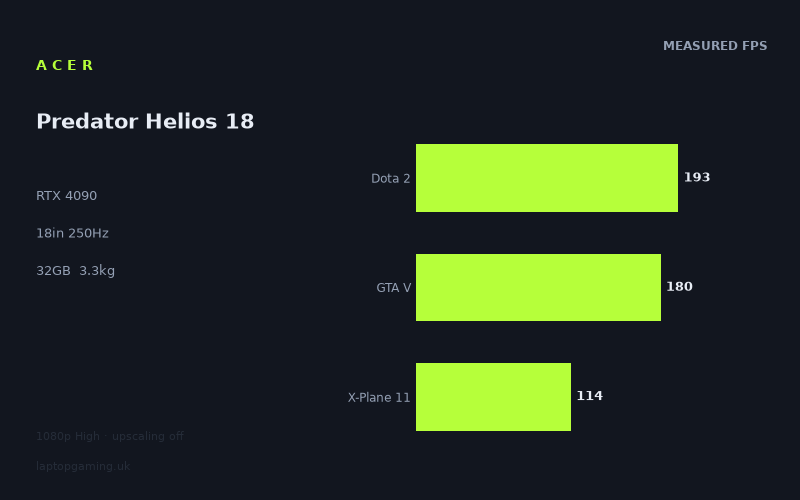
Frame rates
1920×1080, High preset, upscaling off.
Measured on this machine. Source: Notebookcheck, 2024-03-02.
Not scored: incomplete benchmark suite
Every scored laptop on this site is averaged over the same 5 games, and this one is short of Cyberpunk 2077, Baldur's Gate 3. A mean over 3 games is not comparable to a mean over 5, so we publish the figures we have and leave the score blank rather than rank it against machines tested on a different set. The numbers below are real - the suite is just incomplete.
How these numbers were produced
Frame rates here are not measured by us, and we label how each one was arrived at. A figure marked measured comes from a published run on that exact machine. A figure marked representative is derived from the GPU and its power limit (TGP) and cross-referenced against published reviews - a sound estimate of what that configuration delivers, but not a measurement of that specific laptop. Unless stated otherwise, numbers are 1920x1080, High preset, upscaling off. Where a laptop ships in several power configurations we use the wattage of the exact SKU listed, because a 140W RTX 5070 and a 115W one are not the same product.
In use
The short version
The Acer Predator Helios 18 in this configuration is a flagship on paper and behaves like one in the measurements, but the most useful thing our data shows about it is not how fast it is. It is how little of that speed the standard benchmark set is able to expose. An RTX 4090 paired with a Core i9-14900HX, 32GB of memory and an 18in 2560x1600 panel at 250Hz, in a 3.278kg chassis with a 90Wh battery, is about as much laptop hardware as this generation offered. Notebookcheck's numbers at 1920x1080 confirm it is quick and then, across three shared games, place it level with a Lenovo Legion Pro 5 carrying an RTX 4070 at 140W.
That result is not evidence that a 4090 is no better than a 4070. It is evidence that at 1080p, a graphics card this fast finishes its work and waits, and what gets measured instead is the processor. The comparison set makes the point twice over: against an MSI Thin GF63 with an RTX 4050 this machine is 75fps ahead across three shared games, which is an enormous margin, and against an Asus ROG Strix Scar 17 with another RTX 4090 it is 37fps behind. The instrument has plenty of range. It simply cannot find much daylight between the top of this GPU stack and a well-configured tier below when the resolution is this low.
The raw figures are what you would hope for. Sixteen games measured, running from Prince of Persia The Lost Crown at 357fps down to The Crew Motorfest at 60fps. The three scoring-suite games we hold average 162fps: Dota 2 at 193fps, GTA V at 180fps and X-Plane 11 at 114fps. Fourteen of the sixteen titles run above 87fps. This is a machine that plays essentially anything from its era at 1080p without a moment's hesitation.
Several things our record does not hold are worth stating at the top, because on a machine of this class they matter. We have no GPU power limit for it, which is unfortunate given that the power limit is the single variable most likely to explain the 37fps gap to the other 4090 in the comparison set. We have no panel type, so we cannot tell you whether that 250Hz display is IPS or a mini-LED unit. We have no storage capacity. And we have no confirmed UK price, which on a machine of this kind is the most consequential absence of the four.
There is no score on this page. Our scoring suite is five games and we hold three: Dota 2, GTA V and X-Plane 11. We have no Cyberpunk 2077 and no Baldur's Gate 3 figure. Ranking a three-game average against every other machine's five-game average would quietly corrupt the leaderboard, so we publish nothing.
Buy it if you want an 18in screen, a very large amount of GPU headroom for future titles and native-resolution play, and you have no intention of carrying it anywhere. Look elsewhere if your reasoning is "the biggest GPU means the biggest frame rates in the games I play", because at 1080p that reasoning breaks down in exactly the way the comparison data below demonstrates.
Performance
The power limit we do not have
Nvidia sells its laptop GPUs with configurable power limits rather than fixed ones, and the manufacturer picks a point in that band according to what the chassis can cool. This is the most consequential variable in laptop gaming and the least advertised, because the performance range within one GPU model across its configuration band regularly exceeds the gap between adjacent models. It is why a well-fed RTX 4060 can match a starved 4070, and it is why two laptops carrying the same RTX 4090 can be meaningfully different products.
Our record holds no power limit for this machine. That is a genuine gap and we are not going to fill it with an estimate, because an estimate here would be doing the reader's reasoning for them with a number we made up.
What can be said without estimating is contextual, and it points in an encouraging direction. This is an 18in chassis weighing 3.278kg. Cooling capacity is a function of the volume available for fans, heat pipes and exhaust, and there is a great deal of volume here — an 18in machine over three kilograms has more of every relevant dimension than the 15in and 16in laptops that make up most of this generation. Machines of this size and weight are built precisely so that manufacturers can configure GPUs aggressively, and there would be little point building one otherwise. The measured results are consistent with a well-fed 4090.
They are also consistent with a 4090 that is not the fastest in our data, which is the interesting part and is dealt with in the comparison section.
Working through the measured spread
Sixteen games at 1920x1080 on the High preset with upscaling off, spanning 357fps to 60fps — a range of just under six to one. That width is a property of the test set rather than the machine: it contains everything from a stylised side-scrolling action game to some of the heaviest open-world releases of its era, and the machine's behaviour changes accordingly.
The top — Prince of Persia The Lost Crown at 357fps, Strange Brigade at 329fps, Counter-Strike 2 at 234fps — is where the hardware is not being asked a serious question at all. Prince of Persia is not a GPU test in any meaningful sense. Strange Brigade is a Vulkan title used in benchmark suites for years because it scales cleanly. Counter-Strike 2 at 234fps is more interesting than either, because Counter-Strike is a competitive title where high frame rates genuinely matter and where the limit is usually the processor rather than the graphics card. The Core i9-14900HX is producing a very good number there.
The upper band — Lies of P at 208fps, Last Epoch at 203fps, Dota 2 at 193fps, Atlas Fallen at 182fps, GTA V at 180fps — includes two of our three scoring-suite results, and both need reading with care. GTA V leans heavily on single-thread processor performance and stopped being GPU-limited on hardware anywhere near this class years ago; 180fps is a statement about the 14900HX. Dota 2 at 193fps is the same phenomenon more starkly, because Dota 2 does not trouble any RTX 40-series card whatsoever. Neither number tells you much about the RTX 4090.
This is the crux of the whole review, so it is worth putting plainly: two of the three scoring games we hold for this machine cannot measure its graphics card, because its graphics card is not the limiting component in them. Any comparison built on that basis will compress GPU differences to nothing, and that is exactly what happens below.
The middle — Final Fantasy XV at 157fps, Far Cry 5 at 146fps, EA Sports WRC at 135fps, Skull & Bones at 133fps, X-Plane 11 at 114fps, Armored Core 6 at 109fps — is comfortable throughout. X-Plane 11 at 114fps is the third scoring-suite result and the third one that is not primarily a GPU test; its simulation loop is famously processor-heavy and largely indifferent to graphics hardware. That all three of our scoring games fall into the processor-bound category is unfortunate for this particular machine, and it is the single biggest reason the comparison figures look the way they do.
The bottom — Lords of the Fallen at 87fps and The Crew Motorfest at 60fps — is where the GPU finally becomes the constraint, and where the 4090 has something to say. Lords of the Fallen at 87fps is a solid result for a demanding title. The Crew Motorfest at 60fps is the outlier of the entire set and deserves a paragraph of its own.
The Crew Motorfest, and what an outlier means
60fps at 1080p on High with upscaling off, on an RTX 4090 driven by a Core i9-14900HX, is a strange number. It is less than a fifth of the machine's top result and well below every other title in a sixteen-game set. There are only a few explanations for a gap that shape, and none of them is "the hardware is slow".
The plausible readings are a game with an unusual bottleneck — a streaming or simulation subsystem that does not scale with graphics hardware — or a title in a state at the time of measurement that did not represent its eventual performance. Games measured close to release frequently sit well below where they end up after patches. We hold one measurement from one date and we cannot distinguish between those possibilities.
What we can say is what a buyer should do with it. A single title that far below the rest of a set is a fact about that title, not a fact about the machine, and it should not shift the assessment of hardware that produced 87fps or better in every other game measured. If The Crew Motorfest specifically is important to you, that number is the one you should plan around and it is worth seeking a more recent measurement. If it is not, treat the result as the anomaly it appears to be.
Why there is no score, and why it matters more here than usual
We hold three of our five scoring games: Dota 2 at 193fps, GTA V at 180fps and X-Plane 11 at 114fps, averaging 162fps. We have no Cyberpunk 2077 result and no Baldur's Gate 3 result, so the machine cannot be ranked against laptops averaged over the full five.
The composition of what is missing is the problem, not just the count. Cyberpunk 2077 and Baldur's Gate 3 are the two most GPU-bound titles in the suite — they are the games where an RTX 4090 would have the clearest opportunity to separate itself from everything below it. What we are left with is three titles where the graphics card is largely idle waiting on the processor. The three-game average we do hold is therefore close to a measurement of the Core i9-14900HX with a 4090 attached, and it systematically understates the machine relative to any rival with a weaker GPU.
That is not a reason to publish the partial average anyway. It is a reason to explain why the comparison numbers below look the way they do, and to be clear that the missing data is the specific data that would have shown this machine at its best.
What the frame rates mean in practice
At 1080p, in the games measured, this machine has no weaknesses worth planning around. Fourteen of sixteen titles clear 87fps and eight clear 157fps. The single exception discussed above aside, there is nothing in the data suggesting a scenario where the hardware struggles.
The useful way to think about a machine like this is not what it does at 1080p, where it is comprehensively overqualified, but what that overqualification buys. Two things, mainly: headroom at the panel's native resolution, which is dealt with below, and durability as games get heavier. A GPU with this much capacity in reserve at 1080p is a GPU that will still be producing acceptable frame rates several years of software releases later. That is the real argument for the top of a GPU stack, and it is one the 1080p benchmark set is structurally unable to demonstrate.
The screen
18in at 2560x1600
The panel is 18in at 2560x1600 — a 16:10 ratio — refreshing at 250Hz. As a piece of hardware it is the most distinctive thing about the machine. An 18in display is substantially larger than the 16in panels that dominate this generation, and at that diagonal 1600p is the right resolution: enough pixel density for text and detail to hold up, without the enormous GPU cost of 4K for a difference few people can resolve at laptop viewing distance.
The measurement caveat applies as it does everywhere in our data, but the conclusion is unusually favourable here. Every frame rate in this review was measured at 1920x1080; the panel carries roughly twice as many pixels. On most machines that gap is a serious problem, because the demanding titles are already GPU-limited at 1080p and a doubling of pixel count lands directly on them.
On this machine it is much less of a problem, for a reason the data makes clear. The titles at the top and middle of the table are limited by the processor, not the graphics card — the GPU is finishing early and waiting. Raising the resolution gives that idle capacity something to do, and the frame rate falls far less than the pixel count would suggest. It is only the genuinely GPU-bound titles at the bottom of the table where a doubling of pixels costs close to what the arithmetic implies.
We hold no native-resolution measurements and will not estimate them. But the directional point is important and it is the strongest argument for this machine: an RTX 4090 that is comprehensively overqualified at 1080p is the right hardware for a 1600p panel, and the 1080p figures in this review understate its advantage over lesser machines precisely because they are 1080p figures. A buyer choosing between this and a 4070 laptop on the basis of the comparison data below would be making a decision at the one resolution where the difference is smallest.
250Hz against what the GPU produces
Two of the sixteen measured games exceed 250fps at 1080p: Prince of Persia The Lost Crown at 357fps and Strange Brigade at 329fps. Counter-Strike 2 at 234fps comes close without getting there, which is notable because Counter-Strike is exactly the kind of game a 250Hz panel is fitted for. Everything else falls below, most of it well below.
So the refresh rate is aspirational in the measured set, as it is on almost every laptop that carries a number that high. At the panel's native 1600p it will be further out of reach still.
That said, this is the machine in our data with the best claim to a panel like this. A competitive player running Counter-Strike 2 at reduced settings rather than the High preset used here would plausibly reach frame rates that use a meaningful part of that refresh rate, and this is the hardware capable of it. The measured 234fps at High is already close.
And the secondary benefit applies regardless of frame rate. A high-refresh panel lowers the persistence blur and input latency floor at any rate, not only above its own number — a game at 146fps on a 250Hz panel with variable refresh is smoother and more responsive than the same 146fps on a slower display, where it would tear or be capped. Most of these results sit in that band and the panel is doing real work there.
What our record does not tell us about the display
Our record does not hold a panel type for this machine. That is a significant gap on a laptop of this class, because by this point in the generation the 18in flagships were split between conventional IPS panels and mini-LED backlit units, and the difference between them is large — mini-LED brings a contrast and highlight performance that a standard IPS panel structurally cannot approach, and it is often the single most expensive component in the machine.
We are not going to guess which one this is. We also hold no brightness figure, no colour gamut coverage and no pixel response time. On a machine whose main selling point is an unusually large, unusually fast screen, those are exactly the measurements a buyer would want, and their absence is the most frustrating gap in our record for this laptop. Anyone for whom display quality is the deciding factor should treat all of it as an open question.
Build, size and portability
3.278kg, and what an 18in machine actually is
At 3.278kg this is a desktop replacement in the literal sense: a computer that replaces a desktop, in a room, and moves rarely. That figure is the laptop alone. A machine feeding an RTX 4090 and a Core i9-14900HX requires a very substantial power adapter, and while our record does not hold its weight, it will not be modest. The realistic carrying weight is well beyond three and a half kilograms.
This is not a criticism, because the weight is the reason the machine works. The chain runs directly from chassis volume to cooling capacity to sustained GPU power to frame rate, and an 18in shell at this weight is what allows a manufacturer to commit to a top-tier GPU without throttling it. Nobody buys an 18in laptop by accident, and nobody who has decided they want one is going to be dissuaded by the mass.
What the size does rule out is any pretence of mobility. An 18in machine will not fit most backpacks designed for laptops, will not fit a tray table, and will overhang many desks. It also rules out casual use — this is a machine that gets set up rather than opened. If it is going to live in one place and occasionally travel by car, all of that is irrelevant. If it needs to move regularly, this is emphatically the wrong category, and the comparison data below shows a 16in machine matching it in three shared games.
The 90Wh battery
90Wh is a large battery in absolute terms and close to the practical ceiling that aviation rules impose on lithium cells in cabin baggage. In the context of this machine it is also, unavoidably, a small one. There is no meaningful sense in which a 90Wh pack sustains an RTX 4090 and a Core i9-14900HX at anything resembling their plugged-in draw, and no laptop battery could.
Our record holds no measured runtime, so we will not state one. The structural point is that a machine of this class is designed around mains power and its battery exists to move it between sockets and to handle light work. That is not a flaw specific to this laptop; it is what the category is. A buyer expecting meaningful unplugged gaming from an 18in 4090 machine has misunderstood the product, and a buyer who wants a large screen and long endurance should be looking at an entirely different kind of computer.
Memory, and what our record omits
32GB of memory is generous and correct for this class. It is enough for gaming with a wide margin, enough for the content creation work that an 18in high-resolution machine invites, and it removes the single specification most likely to feel constrained on lesser laptops. This is the right amount.
Our record holds no storage capacity for this configuration, which is an odd gap and one worth flagging rather than glossing over. On a machine of this class a large SSD is the expectation, and 18in chassis normally have room for more than one drive, but neither of those is a fact about this specific configuration and we are not going to assert either. It is worth confirming at the point of purchase, along with whether the memory is expandable.
How it compares
Four rivals from the same GPU generation, compared only on games both machines hold, with the scoring suite preferred. None has a confirmed UK price in our record, and neither does this machine, so every comparison here is about performance alone. Each of the four rests on three shared games, which is a thin base and should temper how much weight the near-ties carry.
MSI Thin GF63 (RTX 4050) — 75fps ahead across three games
The control result, and the widest margin in this comparison set. The GF63 carries an RTX 4050, the entry point of this GPU generation, and loses by an average of 75fps across three shared games.
Its function is to establish that the shared-game comparison is a functioning instrument with a wide dynamic range. Any suggestion that the near-ties below are simply the benchmark failing to distinguish machines is refuted here — the same method, on the same kind of three-game basis, produces a 75fps separation. When a comparison of this type returns no difference, that is a finding about the two machines rather than a limitation of the method.
The result also quantifies something worth knowing: even in a set of games weighted towards processor-bound titles, the distance between the top and bottom of this GPU generation is enormous. The compression discussed throughout this review is real but it is not total, and it does not survive a gap this large.
Lenovo Legion 9 16IRX9 (RTX 4090) — one frame ahead across three games
Same GPU, no measurable difference across three shared games. Taken on its own this is the least surprising result in the set: two RTX 4090 laptops producing identical frame rates in games where neither GPU is the limiting component is exactly what should happen.
It becomes interesting alongside the Scar 17 result below. Here we have three machines all carrying an RTX 4090, and they do not form a single group — two are level and the third is well ahead. That tells you the near-tie is not simply "all 4090s are the same". Something distinguishes the Scar 17, and this comparison is the baseline against which that something has to be explained.
For a buyer the practical reading is narrow: in the games measured, these two machines perform identically, and the choice between them should be made on screen size, chassis, thermals, keyboard and price rather than on frame rates. The Legion 9 is a 16in machine and this is an 18in one, which is a more consequential difference than anything in the benchmark data.
Lenovo Legion Pro 5 (RTX 4070 at 140W) — one frame behind across three games
The result that most needs explaining, and the one a prospective buyer is most likely to misread. The Legion Pro 5 carries an RTX 4070 configured at 140W — two tiers below this machine's GPU — and across three shared games it is a single frame per second ahead.
The explanation is not that the two graphics cards are equivalent. It is that at 1920x1080, in titles where the frame rate is set by the processor rather than the graphics card, an RTX 4090 has nothing to demonstrate. The GPU renders the frame and waits for the next one to be prepared. A 140W RTX 4070 is also fast enough to finish early in those games, so both machines converge on the same ceiling, and that ceiling is a property of the processors and the game engines rather than of the graphics hardware.
The evidence for this reading is sitting in the same comparison set. Those same three-game comparisons found 75fps between this machine and a 4050 — so a large enough GPU deficit does show up. The 4070 at 140W is simply not deficient enough, at this resolution, in these titles, to be separated.
Two things follow, and they point in opposite directions. The first is a genuine caution: if you play at 1080p, in games of the kind that dominate this shared set, a well-configured RTX 4070 laptop will give you the same experience for substantially less money, and that is a real conclusion from real data rather than a debating point. The second is the counterweight: this comparison is conducted at the one resolution where a 4090's advantage is smallest, on three games that happen to be the least GPU-bound in the suite, and the two genuinely GPU-bound scoring titles are missing from our record for this machine. At the panel's native 1600p, in Cyberpunk 2077 or Baldur's Gate 3, the gap would open. We cannot show you by how much, and we are not going to invent a figure.
Asus ROG Strix Scar 17 (RTX 4090) — 37fps behind across three games
The Scar 17 carries the same RTX 4090 and beats this machine by an average of 37fps across three shared games. Our record holds no power limit for the Scar 17's GPU, and it holds none for this machine either, so we cannot attribute the gap to configuration — that is precisely the field that would explain it, and it is empty on both sides.
What can be said is that the gap is real and substantial. 37fps is not measurement noise, and it is far too large to be dismissed as a matter of which three games overlapped. Two laptops with identical graphics silicon are producing meaningfully different frame rates, which is the ordinary state of affairs in this generation and the reason model numbers are such a poor guide to performance.
The possible explanations are the usual ones: a different sustained power limit, different cooling behaviour, a different processor pairing, or different measurement conditions and dates. We hold measurements from March 2024 for this machine and cannot see the Scar 17's methodology from here. We are not going to pick between those explanations without evidence.
The honest summary is that this is a fast RTX 4090 laptop but not the fastest RTX 4090 laptop in our data, and the difference is large enough to matter to someone spending flagship money. That is a meaningful caveat on a machine whose entire proposition is being at the top of the stack.
Reading the four together
Enormous win against the bottom of the generation. Dead heat against another 4090. Dead heat against a 140W 4070. Substantial loss to a third 4090. The coherent story is that at 1080p in this shared game set, everything from a well-configured 4070 upwards converges on a processor-imposed ceiling, with the single exception of the Scar 17, whose margin suggests it is doing something the others are not.
For a buyer, the sharpest way to put it is this: the comparison data cannot justify this machine's GPU, and that is a limitation of measuring at 1080p rather than a verdict on the hardware. The justification for a 4090 lives at native resolution, in genuinely GPU-bound titles, and in the years of headroom it holds as games get heavier — none of which this data set is designed to capture.
Who it's for
The case for buying it
This machine suits someone who wants an 18in screen and has decided that is worth building a computer around. That is a small group and it is a legitimate one. An 18in 2560x1600 display is a genuinely different working and playing experience from the 16in panels that dominate this generation, and it is the one thing here that no amount of GPU discussion changes.
It suits someone who intends to play at the panel's native resolution rather than 1080p. That is where the RTX 4090 earns its place, and where the near-tie against a 4070 laptop above would be expected to break down. The 1080p comparison figures in this review are, if anything, the least flattering way to look at this hardware.
And it suits someone buying for the long term. A GPU with this much capacity in reserve is one that continues producing acceptable frame rates several years of software releases later. Fourteen of sixteen measured titles above 87fps at 1080p is not the point — the point is what that headroom becomes when games get heavier.
The case against
Do not buy it if you play at 1080p. This is the most concrete conclusion in the review and it comes directly from the data: across three shared games this machine is level with a Legion Pro 5 carrying a 140W RTX 4070, and level with another 4090 laptop. At this resolution you are paying for capability you cannot use.
Do not buy it if it has to move. 3.278kg plus a substantial adapter in an 18in footprint is a machine that gets set up, not carried. There are 16in laptops in this comparison set matching it frame for frame in the games we can compare.
Do not buy it for the 250Hz panel alone. Two of sixteen measured games exceed that rate at 1080p, and at native resolution none will. It is genuinely useful for competitive play at reduced settings — more so here than on any lesser machine — but it is not the reason to choose this laptop.
Do not buy it assuming all RTX 4090 laptops are equivalent. The 37fps deficit to the Scar 17 across three shared games is the clearest evidence in this review that they are not, and our record cannot tell you why, because it holds no power limit for either machine.
What would change the analysis
Four gaps in our record would materially sharpen this page. A GPU power limit would explain the 37fps gap to the other 4090 in one line, and it is the single most valuable missing field. Cyberpunk 2077 and Baldur's Gate 3 figures would let us score the machine and, more usefully, would add the two genuinely GPU-bound titles to a scoring set currently composed entirely of processor-bound ones — the exact games where this hardware should separate itself. Native 1600p measurements would let the panel be judged rather than reasoned around. And a confirmed UK price would turn a performance analysis into a purchasing recommendation, which is what a buyer at this level actually needs.
Until those exist, the position is this: unambiguously fast, comfortably ahead of the bottom of its generation, comprehensively overqualified for the resolution it was measured at, not the quickest example of its own GPU in our data, and built around an 18in screen that is the real reason to want it.