Performance analysis
Hitman 3 (2021): what it takes to run it
Measured on 9 gaming laptops at 1920×1080, High preset, upscaling off.

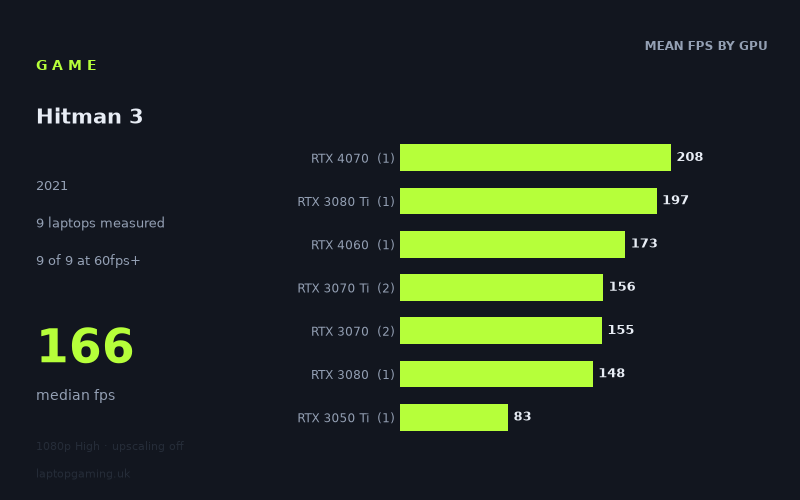
Every laptop we have figures for
Frame rates measured by Notebookcheck.
What it asks of a laptop
At the measured 1,920 x 1,080 High preset with upscaling off, Hitman 3 looks relatively forgiving for a gaming laptop in this particular sample. Notebookcheck’s numbers cover nine laptops, and every one of them exceeded 60fps. The recorded range is substantial, from 83fps to 208fps, but even the slowest machine in the list delivered a clearly playable average frame rate at these settings.
That said, this is a small nine-laptop sample rather than a complete map of laptop performance. The figures show what these specific machines achieved, not a guarantee that every laptop carrying the same GPU name will do the same. Laptop graphics chips can be configured differently, and the results here demonstrate why the GPU badge alone is not a complete performance prediction.
The median result is 166fps, while seven of the nine measured laptops reached at least 144fps. That suggests Hitman 3 does not require a top-end gaming laptop for smooth 1080p High play, but it can make meaningful use of faster hardware if the aim is to feed a high-refresh display.
The separation between the measured machines is most apparent at the lower end. The Asus ROG Strix G17 with an RTX 3050 Ti at 95W returned 83fps, whereas the other eight laptops, fitted with RTX 4060, RTX 4070, RTX 3070-series or RTX 3080-series GPUs, ranged from 140fps to 208fps. In other words, the game remains playable on the lowest-tier GPU represented here, but higher-tier machines create considerably more headroom for consistently high refresh-rate gaming.
The ordering is not a simple generation-by-generation ladder. For example, the RTX 3080 laptop in this group recorded 148fps, below the 173fps of the RTX 4060 laptop, while the two RTX 3070 machines ranged from 140fps to 170fps. Those are measured outcomes for these individual laptops, and are a useful reminder to compare actual results rather than buying solely on the GPU model number.
What runs it
For 60fps: all nine measured laptops cleared the target. The entry point in this data is the Asus ROG Strix G17, whose RTX 3050 Ti at 95W achieved 83fps. It was the only result below 100fps, but it still sat 23fps above 60fps at 1080p High with upscaling disabled. On the evidence available, this specific machine is sufficient for a conventional 60Hz gaming experience.
For 100fps: eight of the nine laptops cleared the mark. The closest qualifying result was the Medion Erazer Beast X20 with an RTX 3070 at 140W, at 140fps. The MSI Stealth GS66 with an RTX 3070 Ti reached 146fps, while the Lenovo Legion 7 16ACHg6 with an RTX 3080 at 120W delivered 148fps. These figures indicate that the measured RTX 3070-class and above laptops have ample headroom for 100fps at the tested settings.
For 144fps: seven of the nine machines met or exceeded the target. The MSI Stealth GS66 narrowly cleared it at 146fps, and the Lenovo Legion 7 was also above it at 148fps. Notebookcheck’s two RTX 3070 Ti results averaged 156fps, comprising 166fps from the Aorus 17 XE4 and 146fps from the Stealth GS66. The two RTX 3070 laptops averaged 155fps, although their individual results differed: 170fps for the Schenker XMG Apex 17 M21 and 140fps for the Medion Erazer Beast X20.
The MSI Katana 17 with an RTX 4060 recorded 173fps, placing it comfortably over both 100fps and 144fps. Above that, the MSI GE76 Raider with an RTX 3080 Ti at 175W reached 197fps, while the Razer Blade 18 RTX, fitted with an RTX 4070 at 140W, led this set at 208fps.
- 60fps: 9 of 9 measured laptops.
- 100fps: 8 of 9 measured laptops.
- 144fps: 7 of 9 measured laptops.
- Fastest measured result: Razer Blade 18 RTX, RTX 4070 at 140W, 208fps.
- Slowest measured result: Asus ROG Strix G17, RTX 3050 Ti at 95W, 83fps.
The cheapest laptop that handles it
Only two prices are provided in the fact sheet, so it would not be reliable to claim a definitive cheapest option across all nine laptops. Of the specifically priced machines, the Asus ROG Strix G17 costs £1,167 and is the lower-priced option. Its RTX 3050 Ti at 95W produced 83fps, making it the least expensive listed machine with a measured figure and still a sound fit for 60fps play at the tested 1080p High settings.
The other priced laptop is the MSI Stealth GS66 at £2,688. Its RTX 3070 Ti result of 146fps is 63fps ahead of the Asus and just clears the 144fps threshold. That is useful if a 144Hz display is the priority, but the supplied figures do not establish whether it is good value against the unpriced laptops, several of which posted similar or faster results.
What this means if you’re buying
If your target is simply smooth 1080p High gaming without upscaling, the measured data says you do not need to buy at the top of the gaming-laptop market specifically for Hitman 3. The £1,167 Asus ROG Strix G17 managed 83fps, and every laptop in the sample cleared 60fps.
For a 100Hz or faster screen, the evidence favours the measured RTX 3070, RTX 3070 Ti, RTX 3080, RTX 4060, RTX 3080 Ti and RTX 4070 machines. All of those specific laptops exceeded 100fps, with the lowest such result being 140fps.
For a 144Hz panel, check the individual laptop result rather than assuming a GPU tier will automatically be enough. The Medion RTX 3070 result of 140fps fell just short, while the MSI Stealth RTX 3070 Ti reached 146fps. The RTX 4060 Katana, RTX 3080 Ti GE76 Raider and RTX 4070 Razer Blade 18 all offered more substantial 144fps headroom in Notebookcheck’s numbers.
How these numbers were produced
Frame rates here are not measured by us, and we label how each one was arrived at. A figure marked measured comes from a published run on that exact machine. A figure marked representative is derived from the GPU and its power limit (TGP) and cross-referenced against published reviews - a sound estimate of what that configuration delivers, but not a measurement of that specific laptop. Unless stated otherwise, numbers are 1920x1080, High preset, upscaling off. Where a laptop ships in several power configurations we use the wattage of the exact SKU listed, because a 140W RTX 5070 and a 115W one are not the same product.