Performance analysis
Forza Horizon 5 (2021): what it takes to run it
Measured on 18 gaming laptops at 1920×1080, High preset, upscaling off.

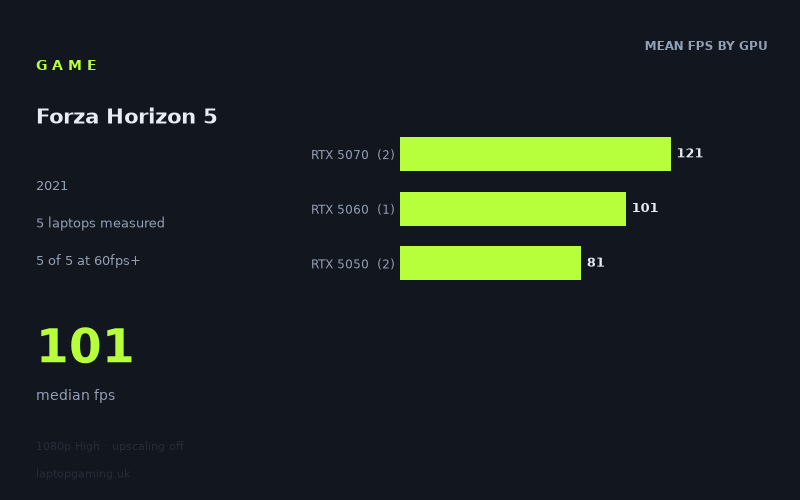
Every laptop we have figures for
Frame rates measured by Notebookcheck.
What it asks of a laptop
The single most useful number here is the spread: 80fps at the bottom, 126fps at the top. That is a 58 per cent gap between the slowest and fastest machines in the sample — wide enough to matter, but narrow in the way that only happens when a game is comfortably within reach of everything being tested. Nothing in this group is struggling. The weakest laptop on the list, an RTX 5050 running at 75W in a £799 chassis, still returns 80fps at 1080p on the High preset with upscaling switched off. That is not a survival result; that's a comfortable one.
So the honest framing is that Forza Horizon 5 is a forgiving game by 2025 laptop standards. The question is not whether your machine will run it, but which refresh rate ceiling you are actually going to feed. And that reframing matters, because this is a driving game on laptops that ship with high-refresh panels. A 60fps result and a 120fps result feel very different when you're at speed with a lot of horizontal motion on screen, and the measured figures are spread almost exactly across that band.
Where does the difficulty come from? Almost entirely from GPU tier, and cleanly so. The tier means line up in an unusually tidy staircase: RTX 5050 at 81fps, RTX 5060 at 101fps, RTX 5070 at 121fps. That is roughly a 25 per cent jump from 5050 to 5060, and another 20 per cent from 5060 to 5070. There is no plateau, no point where the extra silicon stops paying, and no sign of a CPU wall inside this sample — if the test were CPU-limited, the top tier would flatten against the middle one, and it doesn't. The workload is scaling with raster throughput the whole way up.
The second variable worth flagging is power. The two RTX 5070 laptops are the same GPU on paper and 10fps apart: 126fps for the HP OMEN 16 at 140W, 116fps for the Acer Nitro V16 at 115W. That's an 8.6 per cent gain for 25W more board power. It's a real difference and it's consistent with what you'd expect, but it is not a difference that changes which bracket you land in — both machines clear 100fps and neither approaches 144fps. Power tuning here adjusts the result; it doesn't relocate it.
What runs it
The 60fps line is irrelevant in this sample. Five out of five laptops clear it, and the slowest does so with a 33 per cent margin. There is no configuration here that needs to reach for upscaling or drop off the High preset just to hit a playable baseline at 1080p. If your target is 60fps at 1080p and you're shopping anywhere in this class, the decision is already made.
The 100fps line is the one that actually sorts the field. Three of five clear it, and the split is exactly along GPU tier. Both RTX 5070 machines sail through — 126fps and 116fps. The single RTX 5060, the Acer Nitro V 15 at 115W, lands on 101fps, which is over the line but sitting right on it. Treat that as a threshold result rather than a cushioned one: it clears 100fps in the measured scenario, but it has no headroom for a heavier preset, a higher resolution, or anything else you might layer on. Both RTX 5050 laptops miss it, at 82fps and 80fps.
The 144fps line is empty. Zero of five. The fastest laptop in the group falls 18fps short, and that's an RTX 5070 running at 140W — the most favourable configuration on the list. If you have bought a 144Hz or 165Hz panel and you want to saturate it at these settings, the measured data does not contain a machine that does it. Getting there would mean either upscaling, a lower preset, or hardware above the tier ceiling represented here, and none of that is something these figures can speak to.
So the practical bracket map, at 1080p High with upscaling off:
- RTX 5050 (75W): 80–82fps. Well clear of 60, well short of 100.
- RTX 5060 (115W): 101fps. Just over 100, with nothing to spare.
- RTX 5070 (115–140W): 116–126fps. Comfortably triple figures, short of 144.
The cheapest laptop that handles it
If the bar is 60fps, the answer is the HP Victus 15 at £799, with an RTX 5050 at 75W returning 80fps. It is the cheapest machine on the list and it is the slowest, and those two facts arrive together in the right order. Nothing else in this sample offers a cheaper route to a comfortably playable result.
If the bar is 100fps, the answer is more interesting: the Acer Nitro V 15 at £931, RTX 5060 at 115W, 101fps. It is the second-cheapest laptop in the group and it is the only one below £1,000 that crosses triple figures. For £132 over the Victus you gain 21fps — a 26 per cent uplift for a 17 per cent price rise, which is one of the better-value steps on this list.
The awkward machine is the ASUS TUF Gaming A14 at £1,007. It is an RTX 5050 at 75W returning 82fps — 2fps faster than the £799 Victus, for £208 more, and 19fps slower than the £931 Nitro V 15. On this workload alone, its price is being justified by something other than frame rate.
At the top, the HP OMEN 16 at £1,375 is the fastest at 126fps, but the Acer Nitro V16 at £1,199 gets you 116fps for £176 less. That's 92 per cent of the performance for 87 per cent of the money.
What this means if you're buying
Do not buy hardware for this game specifically. The measured figures show a title that every tier in this sample handles at 1080p High without compromise, which means Forza Horizon 5 should be a sanity check on your shortlist rather than the thing that decides it.
The useful conclusion is about panels. If you're pairing a purchase with a high-refresh screen and you care about feeding it, an RTX 5050 at 75W will sit around 80fps and leave a fast panel underused at these settings. The RTX 5060 is the entry point to triple figures, and the RTX 5070 is where you get triple figures with margin. Nothing here reaches 144fps, so budget for the refresh rate you'll realistically hit, not the one printed on the spec sheet.
How these numbers were produced
Frame rates here are not measured by us, and we label how each one was arrived at. A figure marked measured comes from a published run on that exact machine. A figure marked representative is derived from the GPU and its power limit (TGP) and cross-referenced against published reviews - a sound estimate of what that configuration delivers, but not a measurement of that specific laptop. Unless stated otherwise, numbers are 1920x1080, High preset, upscaling off. Where a laptop ships in several power configurations we use the wattage of the exact SKU listed, because a 140W RTX 5070 and a 115W one are not the same product.