Performance analysis
Halo Infinite (2021): what it takes to run it
Measured on 8 gaming laptops at 1920×1080, High preset, upscaling off.

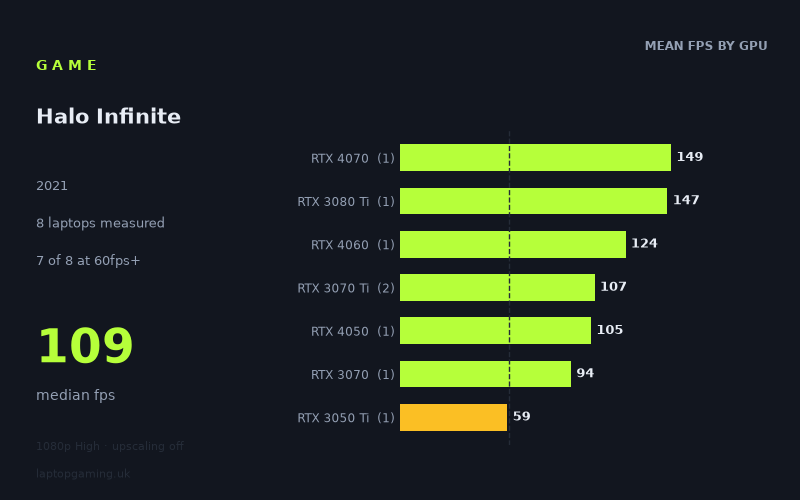
Every laptop we have figures for
Frame rates measured by Notebookcheck.
What it asks of a laptop
Halo Infinite's measured laptop performance at 1,920 × 1,080 on the High preset, with upscaling off, spans from 59fps to 149fps. That is a substantial 90fps gap between the slowest and fastest machines, but the important point is that seven of the eight measured laptops reached 60fps or more. The median result is 109fps, so this does not look like an unusually punishing game for modern dedicated-GPU gaming laptops at these settings.
There is an important sample-size warning, though: these figures cover only eight laptops, and several GPU tiers are represented by a single machine. They show what these particular laptops achieved, not a guarantee that every laptop carrying the same GPU will perform identically. Power limits matter in the supplied results: for example, the RTX 4070 result comes from a 165W Asus ROG Strix G18, while the RTX 4050 figure is from a 100W Medion Erazer Scout E20 and the RTX 3050 Ti result is from a 75W HP Victus 16-e0145ng.
The separation between the measured machines suggests that Halo Infinite rewards stronger graphics hardware if a high refresh-rate target matters. The top two systems, with RTX 4070 and RTX 3080 Ti graphics, are the only laptops to clear 144fps. Below that, the measured RTX 4060 machine still delivers 124fps, while the two RTX 3070 Ti laptops sit at 101fps and 113fps. That makes 100fps achievable on several upper-mid-range and older high-end GPUs in this small sample.
The more modest end is less clear-cut. The RTX 4050 laptop reached 105fps, ahead of the measured RTX 3070 laptop at 94fps. This is a useful reminder not to rank laptop GPUs by name alone: the individual laptop configuration can matter, and there is only one measured result for each of those two tiers. The RTX 3050 Ti laptop is the outlier at 59fps, missing the 60fps mark by 1fps.
What runs it
For a 60fps target at the measured 1080p High settings, seven of the eight laptops clear the line:
- Asus ROG Strix G18, RTX 4070 at 165W: 149fps.
- MSI GE76 Raider, RTX 3080 Ti at 175W: 147fps.
- MSI Katana 17, RTX 4060: 124fps.
- Aorus 17 XE4, RTX 3070 Ti at 130W: 113fps.
- Medion Erazer Scout E20, RTX 4050 at 100W: 105fps.
- MSI Stealth GS66, RTX 3070 Ti: 101fps.
- Gigabyte A5 X1, RTX 3070 at 140W: 94fps.
The HP Victus 16-e0145ng with RTX 3050 Ti at 75W recorded 59fps. That is close to 60fps, but it is still the only measured laptop below that threshold. On the evidence available, it is the machine with the least headroom at this preset and resolution.
For a 100fps target, six of eight measured laptops qualify. Those are the RTX 4070 ROG Strix G18 at 149fps, RTX 3080 Ti GE76 Raider at 147fps, RTX 4060 Katana 17 at 124fps, RTX 3070 Ti Aorus 17 XE4 at 113fps, RTX 4050 Medion Erazer Scout E20 at 105fps, and RTX 3070 Ti Stealth GS66 at 101fps.
The Gigabyte A5 X1's RTX 3070 result of 94fps falls short of 100fps, while the RTX 3050 Ti Victus reaches 59fps. The distinction is meaningful if buying specifically for consistently high frame-rate play at these settings: the RTX 3070 result here is 7fps below 100fps, whereas the measured RTX 4050 result is 5fps above it. With just one RTX 3070 and one RTX 4050 laptop in the data, however, that is a comparison between these machines rather than a universal verdict on the GPU classes.
Only two laptops reach 144fps: the Asus ROG Strix G18 at 149fps and the MSI GE76 Raider at 147fps. They clear the target by only 5fps and 3fps respectively. The RTX 4060 Katana 17 at 124fps is the nearest of the remaining systems, 20fps short. If 144fps is the aim at 1080p High without upscaling, the measured figures support looking at these top two specific machines rather than assuming a lower tier will suffice.
The cheapest laptop that handles it
The fact sheet does not provide prices for seven of the eight laptops, so it cannot establish which machine is the cheapest option for Halo Infinite. It would be misleading to label any of the unpriced machines as a budget choice.
The only supplied price is for the MSI Stealth GS66 with RTX 3070 Ti, listed at £2,688. It recorded 101fps, making it one of the six measured laptops above 100fps, but its listed price does not make it possible to identify it as the cheapest capable model.
Among the specifically named machines, the HP Victus 16-e0145ng is the closest to a 60fps result at the lower end of the measured performance range, with 59fps, but no price is given. The Medion Erazer Scout E20 is the lowest-performing machine in the data to exceed 100fps, at 105fps, and again no price is supplied. Performance alone therefore cannot answer the value question.
What this means if you're buying
For 1080p High with upscaling disabled, the measured data says that a laptop capable of around 100fps is a realistic target rather than an extreme one. The RTX 4060 Katana 17, RTX 3070 Ti Aorus 17 XE4 and Stealth GS66, and RTX 4050 Medion Erazer Scout E20 all exceed 100fps in these figures. That is the broadest useful performance band in the sample, although the individual results range from 101fps to 124fps.
If the priority is simply clearing 60fps, nearly every measured dedicated-GPU laptop does so. The exception is the 75W RTX 3050 Ti Victus, at 59fps. Buyers considering hardware around that level should treat the result as close to the line rather than comfortably above it.
For a 144fps target, the evidence is narrower. Only the 165W RTX 4070 ROG Strix G18 and 175W RTX 3080 Ti MSI GE76 Raider make it, at 149fps and 147fps respectively. The limited sample means this is not proof that every similarly labelled laptop will achieve the same result, but these are the two measured machines that meet that target at the stated settings.
How these numbers were produced
Frame rates here are not measured by us, and we label how each one was arrived at. A figure marked measured comes from a published run on that exact machine. A figure marked representative is derived from the GPU and its power limit (TGP) and cross-referenced against published reviews - a sound estimate of what that configuration delivers, but not a measurement of that specific laptop. Unless stated otherwise, numbers are 1920x1080, High preset, upscaling off. Where a laptop ships in several power configurations we use the wattage of the exact SKU listed, because a 140W RTX 5070 and a 115W one are not the same product.