Performance analysis
Yakuza Like a Dragon (2020): what it takes to run it
Measured on 11 gaming laptops at 1920×1080, High preset, upscaling off.

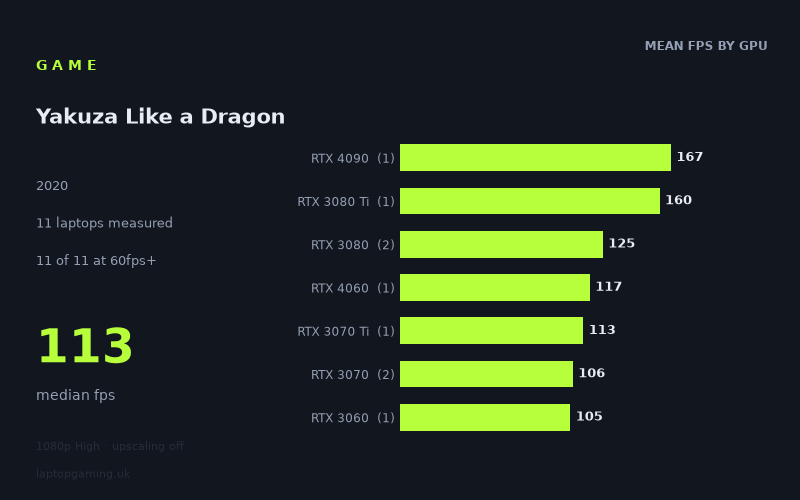
Every laptop we have figures for
Frame rates measured by Notebookcheck.
What it asks of a laptop
At 1920x1080 using the High preset with upscaling off, Yakuza Like a Dragon looks relatively forgiving for the gaming laptops represented here. Notebookcheck’s measured figures span from 72fps on the HP Omen 15-en0375ng with an RTX 2060 to 167fps on the Medion Erazer Beast X40 with an RTX 4090. Every one of the 11 laptops recorded cleared 60fps, while nine reached 100fps or better.
That is an encouraging result for anyone with an older or lower-mid-range dedicated GPU. The slowest measured system still delivered 72fps, leaving some headroom over a 60fps target at these settings. The median result was 113fps, which means the middle result in this sample was already comfortably above 100fps.
The game does still distinguish clearly between laptop GPU classes, particularly at the top end. The RTX 4090-equipped Medion reached 167fps and the 175W RTX 3080 Ti in the MSI GE76 Raider managed 160fps. Those are the only two measured laptops to exceed 144fps. This matters if you are buying a laptop for a 144Hz-class display and want the measured result to sit above that refresh rate at High settings without upscaling.
Below that top pair, the results compress somewhat. The two RTX 3080 laptops averaged 125fps, though their individual figures differed: the Lenovo Legion 7 16ACHg6 with a 120W RTX 3080 reached 138fps, while the Asus ROG Zephyrus G15 with an RTX 3080 recorded 112fps. The RTX 4060 MSI Katana 17 delivered 117fps, while the RTX 3070 Ti MSI Stealth GS66 reached 113fps. That overlap is a useful reminder that the GPU name alone is not the entire performance picture, especially when the supplied results cover different laptop designs and, in some cases, different stated GPU power levels.
The lower end of the sample remains solid rather than disastrous. The RTX 3050 Ti Schenker XMG Focus 15 achieved 76fps and the RTX 2060 HP Omen achieved 72fps. Based on these measured figures, the main challenge is not getting the game to run at 1080p High: it is deciding whether you want a straightforward 60fps experience, a 100fps-plus result, or enough performance to make strong use of a 144Hz display.
What runs it
For 60fps, all 11 measured laptops cleared the target. The entry point in this data set is the HP Omen 15-en0375ng with RTX 2060 at 72fps. Slightly ahead is the Schenker XMG Focus 15 with a 75W RTX 3050 Ti at 76fps. These are the two slowest results, but both remain above 60fps at 1920x1080 High with upscaling disabled.
For 100fps, nine of the 11 laptops made it. The measured threshold begins with the Acer Predator Helios 300, whose 100W RTX 3070 reached exactly 100fps. The Schenker XMG Core 17 (Early 2021), fitted with a 130W RTX 3060, was slightly faster at 105fps. That is notable within this limited sample: this particular RTX 3060 laptop outperformed the measured 100W RTX 3070 machine by 5fps.
The RTX 3070 results varied between the two laptops tested. The Acer Predator Helios 300 reached 100fps, while the 140W RTX 3070 in the Medion Erazer Beast X20 reached 113fps. The RTX 3070 Ti in the MSI Stealth GS66 also delivered 113fps. The MSI Katana 17 with RTX 4060 recorded 117fps, putting it above those measured RTX 3070 and RTX 3070 Ti examples.
The RTX 3080 pair averaged 125fps across two laptops. The Lenovo Legion 7 16ACHg6 reached 138fps, which is close to a 144fps target but does not clear it in the recorded result. The Asus ROG Zephyrus G15 reached 112fps. Neither should be treated as a universal RTX 3080 prediction: there are only two RTX 3080 laptops in the figures, and their 26fps gap makes the importance of the specific machine clear.
For 144fps, only two of the 11 measured machines cleared the line. The MSI GE76 Raider with a 175W RTX 3080 Ti reached 160fps, and the Medion Erazer Beast X40 with RTX 4090 reached 167fps. The Legion 7’s 138fps is the nearest result below that threshold. If a consistent 144fps-plus result at these exact settings is your priority, the measured evidence supports those two specific laptops, but the sample is only one laptop each for RTX 3080 Ti and RTX 4090.
- 60fps or more: 11 of 11 measured laptops.
- 100fps or more: 9 of 11 measured laptops.
- 144fps or more: 2 of 11 measured laptops.
The cheapest laptop that handles it
The fact sheet does not provide prices for most of the laptops, so it cannot identify the cheapest machine in pounds sterling. It would be misleading to infer pricing from GPU tier alone, particularly when the measured performance varies between laptops carrying similar graphics chips.
The only listed price is £2,688 for the MSI Stealth GS66 with RTX 3070 Ti. It achieved 113fps, comfortably clearing both 60fps and 100fps in Notebookcheck’s figures. However, this is not evidence that it was the cheapest suitable laptop; it is simply the only machine in the supplied list with a price attached.
If the question is instead which measured laptop represents the lowest performance level that still handles the game well at 1080p High, the HP Omen 15-en0375ng with RTX 2060 posted 72fps. The Schenker XMG Focus 15 with 75W RTX 3050 Ti followed at 76fps. Neither has a supplied price, so neither can be called the budget choice in GBP terms.
What this means if you’re buying
For a buyer targeting 1920x1080 High without upscaling, the measured data says you do not need top-end hardware merely to achieve a playable result. Even the RTX 2060 and RTX 3050 Ti examples remained above 60fps. A laptop around that level may therefore be enough if your priority is a 60fps experience rather than maximising a high-refresh display.
For a 100fps target, the evidence is stronger from the RTX 3060 level upwards in this particular group of machines: the measured RTX 3060, RTX 3070, RTX 3070 Ti, RTX 4060, RTX 3080, RTX 3080 Ti and RTX 4090 systems all reached at least 100fps. But this should not be read as a blanket rule for every laptop using those GPUs. Most GPU tiers here are represented by only one machine, while the two RTX 3080 and two RTX 3070 results show meaningful variation.
For buyers focused on a 144Hz screen, be more cautious. Only the specific RTX 3080 Ti MSI GE76 Raider and RTX 4090 Medion Erazer Beast X40 exceeded 144fps in the available figures. The RTX 3080 Lenovo Legion 7 came close at 138fps, but close is not the same as clearing the target. On this evidence, 144fps-plus at these settings is a high-end result rather than the expected outcome from every modern gaming laptop.
How these numbers were produced
Frame rates here are not measured by us, and we label how each one was arrived at. A figure marked measured comes from a published run on that exact machine. A figure marked representative is derived from the GPU and its power limit (TGP) and cross-referenced against published reviews - a sound estimate of what that configuration delivers, but not a measurement of that specific laptop. Unless stated otherwise, numbers are 1920x1080, High preset, upscaling off. Where a laptop ships in several power configurations we use the wattage of the exact SKU listed, because a 140W RTX 5070 and a 115W one are not the same product.