Performance analysis
Hogwarts Legacy (2023): what it takes to run it
Measured on 17 gaming laptops at 1920×1080, High preset, upscaling off.

Every laptop we have figures for
Frame rates measured by Notebookcheck.
What it asks of a laptop
The spread here is the story. Notebookcheck's measured figures at 1920x1080, High preset with upscaling switched off, run from 106fps at the top to 60fps at the bottom — a factor of roughly 1.77 between the fastest and slowest machine in the sample. That is a wide gap for a five-laptop set, and it tells you this is a game that scales hard with GPU power rather than levelling off early.
But the headline number is more forgiving than the spread suggests: all five laptops clear 60fps. Even the slowest configuration in the set, an RTX 5050 held to 75W, lands on 60fps exactly. So the entry bar for a playable experience at native 1080p on High is low — every current mainstream gaming laptop in this sample gets there. What's much harder is going beyond that. Only one machine of five breaks 100fps, and nothing in the sample reaches 144fps. That's the shape of the difficulty: the floor is easy, the ceiling is expensive.
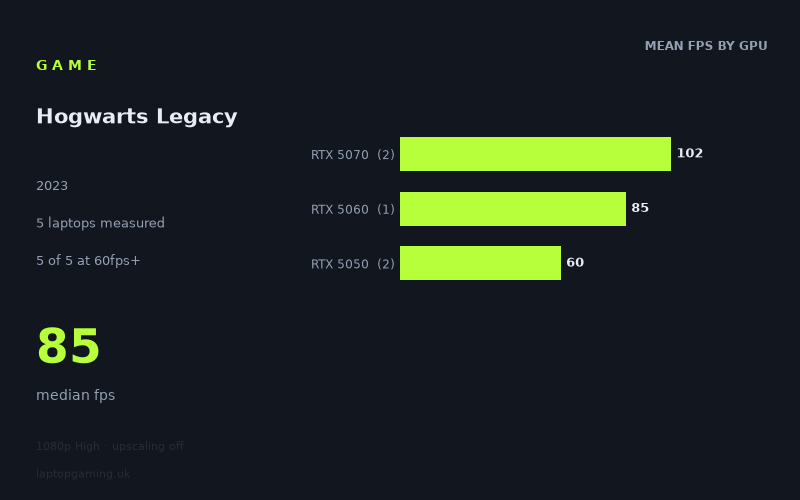
Look at how the figures separate by GPU tier and the pattern is unambiguous. The RTX 5070 averages 102fps across two laptops, the RTX 5060 manages 85fps, and the RTX 5050 sits at 60fps across two laptops. The jump from 5050 to 5060 is the brutal one — roughly 42 per cent more frames for one tier of GPU. The step from 5060 to 5070 is a comparatively modest 20 per cent. In other words, the 5050 is the tier where this game genuinely bites, and the 5060 is where it stops being a struggle.
Power delivery matters too, but less than tier does. The two RTX 5070 laptops differ by 25W of GPU power — 140W against 115W — and that buys 8fps, 106 against 98. That's about 8 per cent for 22 per cent more wattage, which is a familiar diminishing return. Meanwhile the two RTX 5050 laptops, both at 75W, land within a single frame of each other at 61fps and 60fps. That consistency is useful: it means the 5050 result isn't a chassis or cooling fluke, it's what the silicon does at that power level in this game. You can predict a 75W 5050 will give you roughly 60fps here regardless of which badge is on the lid.
What runs it
Working through the tiers with the measured numbers:
- RTX 5050 (75W): 60-61fps. Clears 60fps, but only just. Both laptops in the sample land on the line rather than comfortably above it. This is a locked-60 experience at native 1080p High, with no headroom for a higher preset or a stray demanding scene.
- RTX 5060 (115W): 85fps. Comfortably past 60fps with genuine margin, and the best value point in the sample. Doesn't reach 100fps, but 85fps native at High is a solid result for a 120Hz or 144Hz panel.
- RTX 5070 (115-140W): 98-106fps. The only tier that touches triple figures, and only the 140W configuration actually crosses 100fps. The 115W version at 98fps is functionally identical in feel.
- 144fps: nothing. No laptop in this sample gets there at native 1080p High. If you own a 165Hz or 240Hz panel and want to feed it, the measured figures say you will not do it natively on any of these machines — you'd be relying on upscaling, which was switched off for these tests, or on dropping the preset.
The cheapest laptop that handles it
The absolute cheapest machine that clears 60fps is the HP Victus 15 at £799, with an RTX 5050 at 75W returning 60fps. It works out at roughly £13 per frame, and it does technically hit the target — but it hits it exactly, with nothing spare.
The better answer is the Acer Nitro V 15 at £931, RTX 5060 at 115W, 85fps. For £132 more than the Victus you gain 25fps — a 42 per cent uplift for a 17 per cent price increase. On a cost-per-frame basis it's the strongest machine in the entire sample at about £11 per frame, and it's the only laptop here that gives you real headroom over 60fps without stepping into four-figure 5070 territory.
Above that, the Acer Nitro V16 at £1,199 (RTX 5070, 115W, 98fps) and the HP OMEN 16 at £1,375 (RTX 5070, 140W, 106fps) are the only routes to near-100fps and above. The £176 gap between them buys 8fps, which is a poor trade in isolation — though a 140W chassis usually brings other benefits the frame counter doesn't show.
The outlier is the ASUS TUF Gaming A14 at £1,007, which returns 61fps from a 75W RTX 5050. That's £16.50 per frame — the worst ratio in the sample by a clear margin, and it's more expensive than the 85fps Nitro V 15. Whatever you're paying for in that machine, on these numbers it isn't Hogwarts Legacy performance.
What this means if you're buying
If your only goal is to play this game at 1080p on High, the measured data says almost any current gaming laptop will do it. That's a genuinely low bar and it should stop you overspending. A £799 Victus 15 gets you to 60fps.
The problem with buying to that bar is that 60fps is the floor, not a cushion. The 5050 laptops have no margin left — any heavier scene, any higher preset, any move to a 1440p panel, and you're below the line with nowhere to go but upscaling. If you already own an RTX 5050 machine, you're fine; the numbers say you'll play this comfortably at native 1080p High. If you're buying one now with several years of releases ahead of you, the 42 per cent gap to the 5060 tier is the single most consequential number on this page.
For high-refresh panels, temper expectations. 100fps is a £1,199-and-up proposition on these figures, and 144fps native isn't available at all in this sample. Buying a 240Hz screen for this game specifically makes no sense given what the hardware actually delivers at native settings.
The recommendation the data supports is the RTX 5060 tier: the Nitro V 15 at £931 for 85fps is where the price-to-performance curve is steepest, and it's the cheapest machine here with room to spare rather than room to lose.
How these numbers were produced
Frame rates here are not measured by us, and we label how each one was arrived at. A figure marked measured comes from a published run on that exact machine. A figure marked representative is derived from the GPU and its power limit (TGP) and cross-referenced against published reviews - a sound estimate of what that configuration delivers, but not a measurement of that specific laptop. Unless stated otherwise, numbers are 1920x1080, High preset, upscaling off. Where a laptop ships in several power configurations we use the wattage of the exact SKU listed, because a 140W RTX 5070 and a 115W one are not the same product.