Performance analysis
Battlefield 2042 (2021): what it takes to run it
Measured on 6 gaming laptops at 1920×1080, High preset, upscaling off.

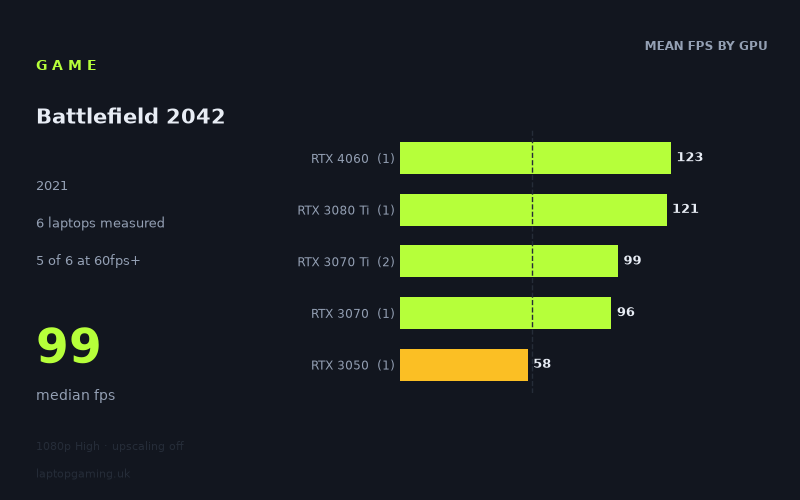
Every laptop we have figures for
Frame rates measured by Notebookcheck.
What it asks of a laptop
At 1920 × 1080 on the High preset with upscaling off, Battlefield 2042 is demanding enough to separate gaming-laptop GPUs clearly, but it is not unmanageable for most of the dedicated graphics machines in this six-laptop sample. Notebookcheck’s measured figures range from 58fps to 123fps, with a median of 99fps. Five of the six laptops reached at least 60fps, while three reached 100fps or more. None reached 144fps.
That is a useful but limited sample: these are figures from six specific laptops, not a guarantee for every machine using the same GPU name. Power limits matter here. The RTX 3080 Ti was measured in a 175 W MSI GE76 Raider, the RTX 3070 Ti appeared in both a 130 W Aorus 17 XE4 and an MSI Stealth GS66 with no power figure supplied, while the RTX 307 ran at 140 W in the Gigabyte A5 X1. The RTX 3050 result came from a Lenovo Yoga Slim 7 Pro X 14IAH7 with a notably low 35 W GPU.
The spread suggests that the game scales reasonably well across gaming hardware, but the target frame rate matters. A 60fps aim is within reach for the tested RTX 3070-class and better systems, and even the low-power RTX 3050 came close at 58fps. Moving from 60fps towards 100fps requires substantially stronger hardware in these measurements: the RTX 3070 Ti pair averaged 99fps, while the fastest results came from the RTX 4060 and 175 W RTX 3080 Ti laptops. A 144fps target is more difficult. None of the measured laptops achieved it at these settings.
The GPU-tier figures also show a fairly orderly progression, albeit with only one machine represented in most tiers. The single RTX 3050 system returned 58fps, the RTX 3070 reached 96fps, the two RTX 3070 Ti systems averaged 99fps, and the single RTX 3080 Ti and RTX 4060 systems managed 121fps and 123fps respectively. The large gap between the 35 W RTX 3050 and the higher-tier, higher-power gaming GPUs is the main dividing line in this data.
What runs it
For a 60fps-class experience, five of the six measured laptops cleared the mark. The Gigabyte A5 X1 with an RTX 3070 at 140 W reached 96fps. Both RTX 3070 Ti machines also did so: the Aorus 17 XE4 at 130 W recorded 101fps, while the MSI Stealth GS66 recorded 97fps. Above them, the MSI GE76 Raider with its 175 W RTX 3080 Ti managed 121fps, and the MSI Katana 17 with an RTX 4060 led the sample at 123fps.
The exception was the Lenovo Yoga Slim 7 Pro X 14IAH7, whose 35 W RTX 3050 produced 58fps. That is close to 60fps rather than dramatically below it, but it did not meet the threshold in Notebookcheck’s measured result. This is also a reminder not to treat every RTX 3050 laptop as identical: this particular result is from a low-power implementation in a slim machine.
For 100fps or better, three of the six laptops made the cut. The MSI Katana 17’s RTX 4060 delivered 123fps, the MSI GE76 Raider’s 175 W RTX 3080 Ti delivered 121fps, and the Aorus 17 XE4’s 130 W RTX 3070 Ti delivered 101fps. The MSI Stealth GS66, also using an RTX 3070 Ti, fell just short at 97fps, while the RTX 3070 Gigabyte A5 X1 returned 96fps.
For 144fps, there is no qualifying result in this dataset. The best measured figure is 123fps from the RTX 4060-equipped MSI Katana 17, followed closely by the RTX 3080 Ti MSI GE76 Raider at 121fps. Buyers specifically shopping for a 144fps result should not assume that the tested High preset with upscaling disabled will deliver it, even from the quickest laptop represented here.
- RTX 4060: 123fps across one laptop; above 60fps and 100fps, below 144fps.
- RTX 3080 Ti: 121fps across one 175 W laptop; above 60fps and 100fps, below 144fps.
- RTX 3070 Ti: 99fps mean across two laptops; both exceeded 60fps, with one reaching 101fps and one recording 97fps.
- RTX 3070: 96fps across one 140 W laptop; comfortably above 60fps, below 100fps.
- RTX 3050: 58fps across one 35 W laptop; close to, but below, 60fps.
The cheapest laptop that handles it
The fact sheet does not provide prices for most of the measured laptops, so it cannot identify the cheapest option overall. The only listed price is £2,688 for the MSI Stealth GS66, which recorded 97fps with an RTX 3070 Ti. It clearly handles the game at the measured 1080p High settings, sitting well above 60fps and narrowly below 100fps.
That does not mean the Stealth GS66 is the least expensive capable choice. The Gigabyte A5 X1, Aorus 17 XE4, MSI Katana 17 and MSI GE76 Raider also all exceeded 60fps, but no prices are supplied for them. Equally, the Lenovo Yoga Slim 7 Pro X 14IAH7 may be a less expensive type of laptop, but its measured 58fps means it cannot be counted as a 60fps result on these exact settings.
What this means if you’re buying
If your priority is simply running Battlefield 2042 at 1080p High without upscaling, the measured results suggest that a properly configured RTX 3070-class gaming laptop is a strong starting point. The 140 W RTX 3070 Gigabyte A5 X1 delivered 96fps, and both RTX 3070 Ti systems were around the 100fps mark. Those are specific results, rather than a promise for every laptop carrying those GPU labels.
For a measured result above 100fps, the available evidence points to the MSI Katana 17 with RTX 4060, the MSI GE76 Raider with 175 W RTX 3080 Ti, and the Aorus 17 XE4 with 130 W RTX 3070 Ti. However, the sample is too small to claim that every RTX 4060, RTX 3080 Ti or RTX 3070 Ti laptop will perform in the same way. Check the individual laptop’s graphics power configuration rather than buying on GPU name alone.
Finally, avoid treating 144fps as assured at these settings. The fastest measured machine stopped at 123fps. For buyers choosing between a 120Hz-class display and a 144Hz panel specifically for this game, Notebookcheck’s figures show that even the strongest machines in this sample did not fully reach 144fps at 1920 × 1080, High, with upscaling disabled.
How these numbers were produced
Frame rates here are not measured by us, and we label how each one was arrived at. A figure marked measured comes from a published run on that exact machine. A figure marked representative is derived from the GPU and its power limit (TGP) and cross-referenced against published reviews - a sound estimate of what that configuration delivers, but not a measurement of that specific laptop. Unless stated otherwise, numbers are 1920x1080, High preset, upscaling off. Where a laptop ships in several power configurations we use the wattage of the exact SKU listed, because a 140W RTX 5070 and a 115W one are not the same product.