Performance analysis
GRID 2019 (2019): what it takes to run it
Measured on 5 gaming laptops at 1920×1080, High preset, upscaling off.
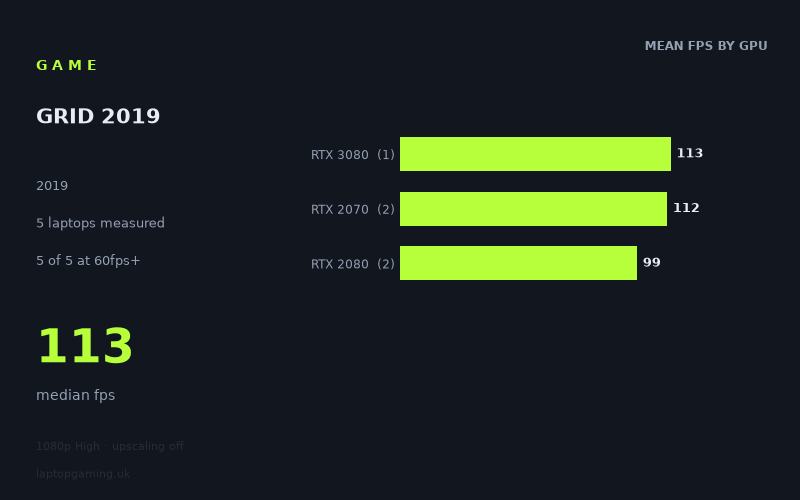
Every laptop we have figures for
Frame rates measured by Notebookcheck.
What it asks of a laptop
At 1920×1080 on the High preset with upscaling off, GRID 2019 looks relatively forgiving for the five gaming laptops covered by Notebookcheck’s measured figures. Every machine in this small sample exceeded 60fps, the slowest result was still 78fps, and the median was 113fps. For a player targeting a conventional 60Hz display, these numbers suggest that High settings are not an especially severe demand for the tested hardware.
That said, there is a meaningful gap between the fastest and slowest machines. Notebookcheck’s numbers range from 78fps on the Acer Predator Triton 500 with an RTX 2080 to 120fps on the Asus Strix Scar 17, also with an RTX 2080: a 42fps spread. This is an important reminder that the GPU name alone does not explain the result. Two laptops carrying the same RTX 2080 differed by 42fps in this particular test, while the two RTX 2070 laptops were much closer together at 104fps and 119fps.
The GPU-tier averages reinforce that point. The lone RTX 3080 laptop recorded 113fps, while the two RTX 2070 systems averaged 112fps and the two RTX 2080 systems averaged 99fps. That does not mean an RTX 2070 is inherently faster than an RTX 2080, nor that an RTX 3080 should be expected to run at exactly 113fps. It means these five specific laptop configurations did not sort themselves neatly by GPU label in this benchmark.
For 60fps play, the measured results are reassuring. For high-refresh gaming, GRID 2019 is more dependent on the particular laptop: four of the five machines broke 100fps, but none reached 144fps at the tested 1080p High configuration without upscaling.
What runs it
All five tested laptops cleared 60fps. The lowest measured result was the Acer Predator Triton 500 with an RTX 2080 at 78fps. Above it came the Gigabyte Aero 17 HDR XB with an RTX 2070 at 104fps, the Asus ROG Zephyrus G15 with an RTX 3080 at 113fps, the MSI GE66 Raider with an RTX 2070 at 119fps, and the Asus Strix Scar 17 with an RTX 2080 at 120fps.
- RTX 3080: The Asus ROG Zephyrus G15 produced 113fps. It cleared both 60fps and 100fps, but not 144fps.
- RTX 2070: The MSI GE66 Raider reached 119fps and the Gigabyte Aero 17 HDR XB managed 104fps. Both cleared 60fps and 100fps. Their measured average was 112fps.
- RTX 2080: Results were less consistent in this sample. The Asus Strix Scar 17 reached 120fps, while the Acer Predator Triton 500 recorded 78fps. Both exceeded 60fps, but only the Strix Scar 17 exceeded 100fps. The tier average was 99fps.
The practical dividing line in these figures is therefore not simply “RTX 2070 versus RTX 2080 versus RTX 3080”. Every listed GPU tier has at least one machine that provides more than 100fps, while the RTX 2080 tier also contains the only result below 100fps. Buyers should assess the exact laptop model and its measured performance rather than assuming that a higher-numbered GPU guarantees a higher frame rate in GRID 2019.
No laptop in the supplied results reached 144fps. The closest was the Asus Strix Scar 17 at 120fps, followed by the MSI GE66 Raider at 119fps. A 144Hz laptop screen can still be useful with results in this range, but the measured figures do not support claiming a locked or consistent 144fps experience at 1920×1080 High with upscaling disabled.
The cheapest laptop that handles it
No laptop prices are included in the fact sheet, so it is not possible to identify the cheapest tested machine in GBP. The performance data can establish which systems handled the game, but not which represented the lowest-cost purchase.
On performance alone, the Acer Predator Triton 500 is the lowest-scoring tested laptop at 78fps, yet it still cleared 60fps. The Gigabyte Aero 17 HDR XB was the next step up at 104fps and was the lowest measured system to clear 100fps. The MSI GE66 Raider, Asus ROG Zephyrus G15 and Asus Strix Scar 17 delivered 119fps, 113fps and 120fps respectively, but without prices there is no basis for calling any of them better value or cheaper.
What this means if you’re buying
If your target is a smooth 60fps experience at 1920×1080 High without upscaling, the measured sample is encouraging: 5 out of 5 laptops achieved it, including both RTX 2070 and RTX 2080 machines as well as the single RTX 3080 result. GRID 2019 does not appear to require the fastest laptop in this group merely to stay above 60fps.
If you want performance above 100fps, the picture remains positive but less universal. Four of the five laptops reached 100fps or more. The measured examples doing so were the Gigabyte Aero 17 HDR XB, Asus ROG Zephyrus G15, MSI GE66 Raider and Asus Strix Scar 17. The Triton 500’s 78fps result shows why it would be unwise to buy purely on the RTX 2080 badge.
For buyers specifically shopping around a 144Hz target, the supplied numbers call for caution. None of these five laptops reached 144fps in the stated test. The best result was 120fps, so the available evidence supports high-refresh performance but not a firm 144fps expectation at High settings with upscaling off. Check measured results for the exact laptop configuration under consideration, particularly where two machines with the same GPU can differ as widely as the two RTX 2080 examples here.
How these numbers were produced
Frame rates here are not measured by us, and we label how each one was arrived at. A figure marked measured comes from a published run on that exact machine. A figure marked representative is derived from the GPU and its power limit (TGP) and cross-referenced against published reviews - a sound estimate of what that configuration delivers, but not a measurement of that specific laptop. Unless stated otherwise, numbers are 1920x1080, High preset, upscaling off. Where a laptop ships in several power configurations we use the wattage of the exact SKU listed, because a 140W RTX 5070 and a 115W one are not the same product.