Performance analysis
Escape from Tarkov (2020): what it takes to run it
Measured on 6 gaming laptops at 1920×1080, High preset, upscaling off.
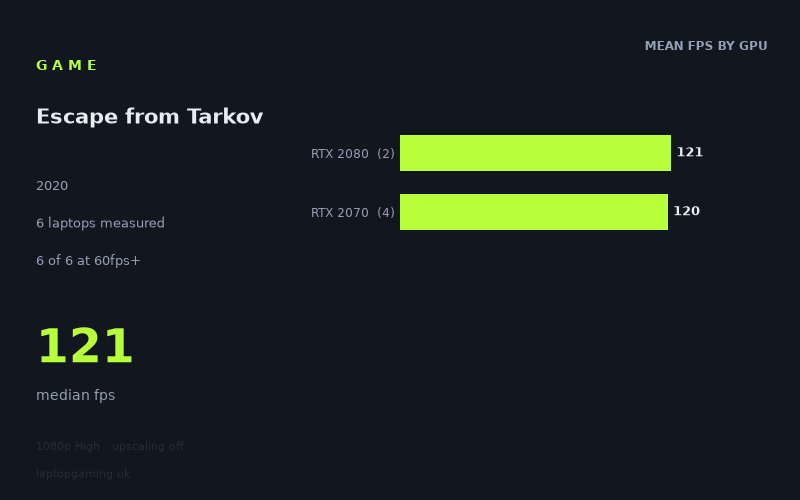
Every laptop we have figures for
Frame rates measured by Notebookcheck.
What it asks of a laptop
Notebookcheck’s measured figures cover six laptops only, so this is a useful but limited sample rather than a complete map of Escape from Tarkov performance across modern gaming laptops. All six results use 1,920 x 1,080, the High preset and upscaling disabled.
Within that sample, Escape from Tarkov looks relatively forgiving for the hardware represented. The fastest result is 121fps and the slowest is 116fps: a narrow 5fps spread across six machines. Every laptop cleared 60fps and 100fps, while none reached 144fps.
The particularly telling point is how little the results separate by GPU tier. The two RTX 2080 laptops averaged 121fps, while the four RTX 2070 machines averaged 120fps. That 1fps difference is too small to make a meaningful buying distinction from these figures alone. In these specific measurements, moving from an RTX 2070 to an RTX 2080 did not produce a visibly higher frame-rate tier at 1080p High.
That does not mean graphics hardware is irrelevant, nor does it prove every RTX 2070 or RTX 2080 laptop will perform identically. Laptop performance can vary with cooling, power limits and the rest of the system, and this dataset does not provide enough machines to separate those factors. It does show that the six tested RTX 2070 and RTX 2080 laptops were tightly grouped at roughly 120fps under the same test conditions.
For a laptop owner targeting a conventional 60Hz display, the measured results leave a large margin. For a 100Hz or 120Hz screen, the sample is also encouraging: all six machines reached at least 116fps. A 144Hz target is less clear-cut. The measured figures sit below 144fps on every tested laptop, so these results do not support treating 144fps as assured at 1080p High with upscaling off.
What runs it
RTX 2080 laptops
The two measured RTX 2080 machines both recorded 121fps:
- Asus Strix Scar 17 — 121fps
- Acer Predator Triton 500 — 121fps
Both therefore cleared 60fps and 100fps comfortably in Notebookcheck’s test. Neither reached 144fps. Their shared result also matches the overall median of 121fps.
RTX 2070 laptops
The four measured RTX 2070 laptops ranged from 116fps to 121fps, with a 120fps mean:
- MSI GS66 Stealth — 121fps
- MSI GE66 Raider — 121fps
- Schenker XMG Apex 15 — 120fps
- Gigabyte Aero 17 HDR XB — 116fps
Again, all four cleared 60fps and 100fps. None cleared 144fps. The slowest measured machine, the Gigabyte Aero 17 HDR XB, was only 5fps behind the fastest results, which reinforces how closely grouped this particular selection is.
What the thresholds say
- 60fps: 6 of 6 measured laptops reached it.
- 100fps: 6 of 6 measured laptops reached it.
- 144fps: 0 of 6 measured laptops reached it.
On the available evidence, both tested GPU tiers are suitable for 1080p High if your aim is 60fps or 100fps-class performance. The numbers do not establish a clear advantage for the RTX 2080 over the RTX 2070 in this game and test configuration. Nor do they establish that either tier can hold 144fps under these conditions.
The cheapest laptop that handles it
No laptop prices are included in the fact sheet, so it is not possible to identify the cheapest option from the measured group in GBP. It would be misleading to nominate one based on model name alone, particularly as laptop configurations and retail pricing can vary considerably.
What can be said is that every named laptop in the dataset handled the test at more than 100fps. If comparing these specific models in the used or retail market, price should therefore be a major deciding factor, because the recorded performance differences are small: 116fps to 121fps across the entire group.
The MSI GS66 Stealth, MSI GE66 Raider and Schenker XMG Apex 15 are especially notable in the figures because they show that the RTX 2070 machines were not materially behind the RTX 2080 entries in this sample. However, without prices, this is a performance observation rather than a value verdict.
What this means if you’re buying
If Escape from Tarkov is your main concern and you are choosing between laptops represented here, the measured figures suggest that an RTX 2070-class machine can be enough for 1080p High at well above 100fps, at least on the four tested examples. The RTX 2080 results are effectively the same in this dataset, so paying extra solely for the measured difference between these two GPU tiers would be difficult to justify.
A laptop with a 60Hz panel has more performance than it needs for this specific test. A 100Hz or 120Hz display is a better fit for the recorded 116fps-to-121fps range, although the figures do not demonstrate a guaranteed 120fps minimum. For a 144Hz panel, expect the laptop to be capable of making good use of a high-refresh screen, but do not buy on the assumption that 144fps will be reached at 1080p High with upscaling disabled: none of the six measured systems did so.
The safest conclusion is narrow but useful. These six RTX 2070 and RTX 2080 laptops all ran Escape from Tarkov strongly at the tested settings, with remarkably little separation between them. Choose between them on price, condition, display and the rest of the laptop specification rather than expecting a substantial Escape from Tarkov advantage from the RTX 2080 results shown here.
How these numbers were produced
Frame rates here are not measured by us, and we label how each one was arrived at. A figure marked measured comes from a published run on that exact machine. A figure marked representative is derived from the GPU and its power limit (TGP) and cross-referenced against published reviews - a sound estimate of what that configuration delivers, but not a measurement of that specific laptop. Unless stated otherwise, numbers are 1920x1080, High preset, upscaling off. Where a laptop ships in several power configurations we use the wattage of the exact SKU listed, because a 140W RTX 5070 and a 115W one are not the same product.