Performance analysis
Battlefield V (2018): what it takes to run it
Measured on 13 gaming laptops at 1920×1080, High preset, upscaling off.

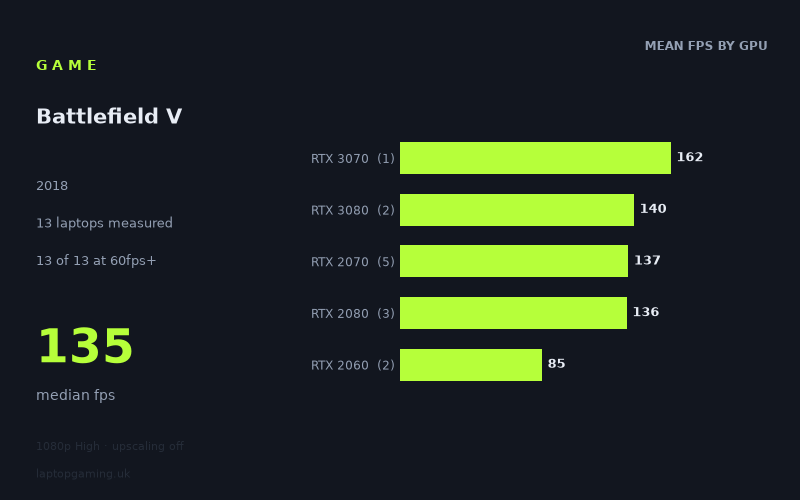
Every laptop we have figures for
Frame rates measured by Notebookcheck.
What it asks of a laptop
At 1,920 x 1,080 on the High preset, with upscaling disabled, Battlefield V is relatively forgiving for the laptops represented in Notebookcheck’s figures. All 13 measured machines reached at least 60fps, the slowest result was 68fps, and the median was a notably high 135fps.
That does not mean every gaming laptop will perform identically. The measured range is substantial: from 68fps on the Schenker XMG Core 15 with an RTX 2060 to 162fps on the Schenker XMG Neo 17 with an RTX 3070. The 94fps gap shows that laptop configuration matters, even when machines carry graphics chips from broadly similar generations.
The separation is clearest at the lower end. The two RTX 2060 laptops averaged 85fps, but their individual results were very different: the HP Omen 15-en0375ng managed 102fps, while the Schenker XMG Core 15 recorded 68fps. That is a useful warning against treating a GPU name as a complete performance specification. These are laptop GPUs, and the measured figures show that two RTX 2060 machines can deliver markedly different results in the same game and settings.
Above that level, the results bunch together. The measured RTX 2070 laptops averaged 137fps across five machines, while the RTX 2080 group averaged 136fps across three. The two RTX 3080 laptops averaged 140fps. In this sample, therefore, moving from an RTX 2070 to an RTX 2080 or RTX 3080 does not automatically translate into a dramatic Battlefield V advantage at 1080p High. Individual laptop design and configuration appear to matter at least as much as the GPU badge in these results.
There are only 13 laptops in the data, including just one RTX 3070 system, so these figures should be read as results from specific machines rather than a guarantee for every laptop using the same graphics hardware. Still, the overall picture is clear: 1080p High is within reach of every measured laptop here, while very high-refresh gaming is more dependent on the particular machine.
What runs it
For a 60fps target, every measured laptop clears the line. The Schenker XMG Core 15, the slowest system in the sample, still delivered 68fps. The HP Omen 15-en0375ng with RTX 2060 reached 102fps, making it the other measured RTX 2060 option and a considerably faster result. Based on these two machines, RTX 2060 laptops can handle Battlefield V at 1080p High, but their performance can vary enough that 100fps should not be assumed.
For 100fps, 12 of the 13 measured laptops qualify. The exception is the 68fps Schenker XMG Core 15. The HP Omen 15-en0375ng is just over the threshold at 102fps. Every listed RTX 2070, RTX 2080, RTX 3080 and RTX 3070 laptop also exceeded 100fps.
- RTX 2060: 68fps on the Schenker XMG Core 15 and 102fps on the HP Omen 15-en0375ng; 85fps mean across two laptops.
- RTX 2070: 121fps to 152fps across five laptops; 137fps mean.
- RTX 2080: 127fps to 153fps across three laptops; 136fps mean.
- RTX 3080: 131fps and 149fps across two laptops; 140fps mean.
- RTX 3070: 162fps on one Schenker XMG Neo 17; this is a one-laptop result, not a tier-wide conclusion.
For 144fps, only four of the 13 measured laptops made the cut. They were the Schenker XMG Neo 17 with RTX 3070 at 162fps, Asus Strix Scar 17 with RTX 2080 at 153fps, MSI GE66 Raider with RTX 2070 at 152fps, and Gigabyte Aero 17 HDR YC with RTX 3080 at 149fps.
The next closest result was the Gigabyte Aero 15 OLED with RTX 2070 at 139fps, followed by the Schenker XMG Apex 15 at 136fps and Gigabyte Aero 17 HDR XB at 135fps, both also using RTX 2070 graphics. These are high frame rates, but they are below a measured 144fps average. If a consistent 144fps result is your priority, the dataset supports choosing one of the four named machines rather than relying on GPU tier alone.
The cheapest laptop that handles it
The fact sheet provides a price for only one laptop: the Asus ROG Zephyrus G15 with RTX 3080, listed at £2,196. Notebookcheck’s measured figure for that machine is 131fps at 1080p High.
That makes the Zephyrus G15 a clearly capable option for Battlefield V, comfortably above 100fps, but the supplied information does not establish that it is the cheapest laptop in the list. No prices are given for the other 12 machines, including the 68fps Schenker XMG Core 15 and the 102fps HP Omen 15-en0375ng. It would therefore be misleading to present the £2,196 Zephyrus as the budget choice or as the lowest-cost route to acceptable performance.
If “handles it” means maintaining at least 60fps in these measured settings, every listed machine qualifies. If it means exceeding 100fps, the HP Omen 15-en0375ng is the lowest measured result that does so, at 102fps, but its price is not supplied.
What this means if you’re buying
For a buyer targeting a standard 60Hz display, the measured numbers suggest Battlefield V does not require an especially high-performing laptop from this group. Even the weakest result was 68fps at 1080p High with no upscaling. The key caveat is that the two RTX 2060 results differed by 34fps, so it is sensible to seek performance figures for the exact laptop rather than buying solely on the graphics label.
For a 100Hz or 120Hz-class display, the measured RTX 2070, RTX 2080, RTX 3080 and RTX 3070 machines are all strong candidates, while the two RTX 2060 systems need more caution. One cleared 100fps only narrowly and the other did not.
For a 144Hz screen, the available figures support only four specific laptops at or above 144fps: the Schenker XMG Neo 17, Asus Strix Scar 17, MSI GE66 Raider and Gigabyte Aero 17 HDR YC. Several other systems came close, but the measured data does not show them reaching 144fps on average at these settings.
How these numbers were produced
Frame rates here are not measured by us, and we label how each one was arrived at. A figure marked measured comes from a published run on that exact machine. A figure marked representative is derived from the GPU and its power limit (TGP) and cross-referenced against published reviews - a sound estimate of what that configuration delivers, but not a measurement of that specific laptop. Unless stated otherwise, numbers are 1920x1080, High preset, upscaling off. Where a laptop ships in several power configurations we use the wattage of the exact SKU listed, because a 140W RTX 5070 and a 115W one are not the same product.