Performance analysis
Assassin´s Creed Odyssey (2018): what it takes to run it
Measured on 4 gaming laptops at 1920×1080, High preset, upscaling off.
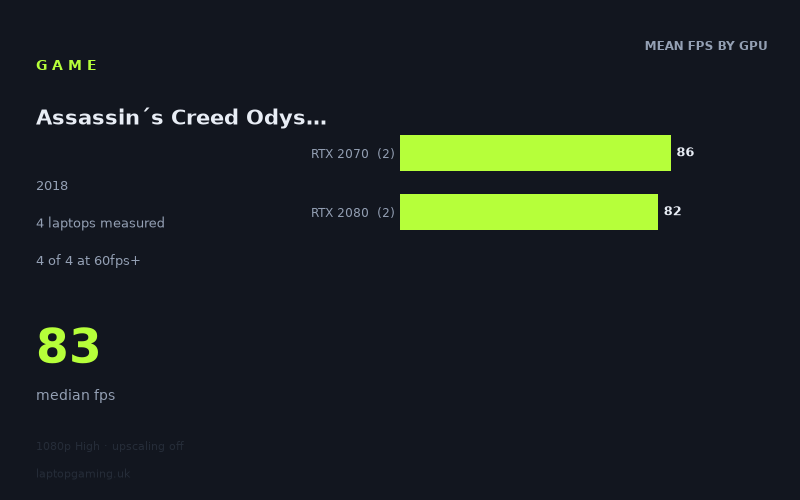
Every laptop we have figures for
Frame rates measured by Notebookcheck.
What it asks of a laptop
Assassin’s Creed Odyssey produced consistently strong results in the available Notebookcheck figures, but the sample is small: just four laptops, all measured at 1920×1080 using the High preset with upscaling disabled. That is enough to show what these particular machines achieved, but not enough to make broad claims about every laptop carrying the same GPU name.
Across those four systems, the measured frame-rate range is relatively narrow: 78fps to 90fps, with a median of 83fps. All four laptops cleared 60fps, while none reached 100fps or 144fps. On this evidence, the game is not especially punishing for the tested RTX 2070- and RTX 2080-equipped machines at 1080p High, but it is also not a game that these laptops drove into high-refresh-rate territory with this test configuration.
The narrow 12fps gap between the fastest and slowest result is notable. The MSI GE66 Raider with an RTX 2070 was the quickest recorded machine at 90fps, while the Acer Predator Triton 500 with an RTX 2080 was the slowest at 78fps. That result alone is a reminder that laptop performance cannot be judged purely by the GPU label. These figures do not identify why the ordering differs, so it would be wrong to assume that an RTX 2070 is generally faster than an RTX 2080 in this game.
The tier averages support that caution. The two RTX 2070 laptops averaged 86fps, while the two RTX 2080 laptops averaged 82fps. With only two examples of each GPU tier, this is not a reliable hierarchy between the two GPUs. What it does show is that the measured machines sit in a similar performance bracket here, with all four delivering a comfortably above-60fps experience at the stated settings.
What runs it
For a 60fps target at 1920×1080 High with upscaling off, every laptop in the measured group succeeded. The four recorded results were:
- MSI GE66 Raider, RTX 2070: 90fps
- Asus Strix Scar 17, RTX 2080: 85fps
- Gigabyte Aero 17 HDR XB, RTX 2070: 81fps
- Acer Predator Triton 500, RTX 2080: 78fps
That makes the RTX 2070 and RTX 2080 groups equally successful for the basic 60fps threshold in this limited set of measurements. The RTX 2070 entries were measured at 90fps and 81fps, while the RTX 2080 entries managed 85fps and 78fps. In practical terms, the measured figures suggest that any of these specific laptops has headroom above 60fps at the tested preset, rather than merely scraping past the target.
For a 100fps target, however, the answer is different. None of the four measured laptops reached 100fps. The closest was the MSI GE66 Raider at 90fps, leaving it 10fps short. The other three machines ranged from 78fps to 85fps. If a buyer specifically wants a sustained triple-digit result at 1080p High without upscaling, these Notebookcheck numbers do not identify a suitable laptop among the four tested systems.
The same is true for 144fps. Zero of four laptops reached 144fps, and the fastest result, 90fps, remained 54fps below that mark. A 144Hz display could still be useful for other games or lighter settings, but these measured results do not support buying one of these machines on the expectation of 144fps in Assassin’s Creed Odyssey at the stated 1080p High configuration.
The cheapest laptop that handles it
No laptop prices are included in the fact sheet, so it is not possible to identify the cheapest measured machine or make a GBP value comparison between them. The available data can only establish which named systems cleared the target.
For a 60fps goal, all four named laptops handled the game in the test:
- MSI GE66 Raider with RTX 2070: 90fps
- Asus Strix Scar 17 with RTX 2080: 85fps
- Gigabyte Aero 17 HDR XB with RTX 2070: 81fps
- Acer Predator Triton 500 with RTX 2080: 78fps
Without prices, the sensible buying conclusion is not that one is the cheapest option, but that all four have demonstrated 60fps-capable performance under the same recorded conditions. Price, condition and the wider specification would need to be checked separately before choosing between them.
What this means if you’re buying
If your target is a straightforward 60fps experience at 1920×1080 on High with upscaling disabled, the measured evidence is encouraging. Every laptop in the four-machine sample exceeded that threshold, and even the slowest result was 78fps. Based on these specific results, the game appears to leave a useful margin above 60fps on the tested RTX 2070 and RTX 2080 laptops.
Do not treat the GPU averages as a rule that the RTX 2070 is the better choice. The RTX 2070 mean of 86fps versus the RTX 2080 mean of 82fps comes from only two machines per tier, and the individual laptop results overlap heavily. The stronger conclusion is that the tested systems performed similarly, not that one GPU tier decisively wins.
Buyers chasing 100fps or 144fps should be more cautious. Notebookcheck’s numbers show no measured laptop reaching either target at High settings with upscaling off. The data therefore supports these machines as solid options for a 60fps-focused purchase, rather than as proven high-refresh Assassin’s Creed Odyssey machines at the recorded settings.
How these numbers were produced
Frame rates here are not measured by us, and we label how each one was arrived at. A figure marked measured comes from a published run on that exact machine. A figure marked representative is derived from the GPU and its power limit (TGP) and cross-referenced against published reviews - a sound estimate of what that configuration delivers, but not a measurement of that specific laptop. Unless stated otherwise, numbers are 1920x1080, High preset, upscaling off. Where a laptop ships in several power configurations we use the wattage of the exact SKU listed, because a 140W RTX 5070 and a 115W one are not the same product.