Performance analysis
Darksiders III (2018): what it takes to run it
Measured on 4 gaming laptops at 1920×1080, High preset, upscaling off.

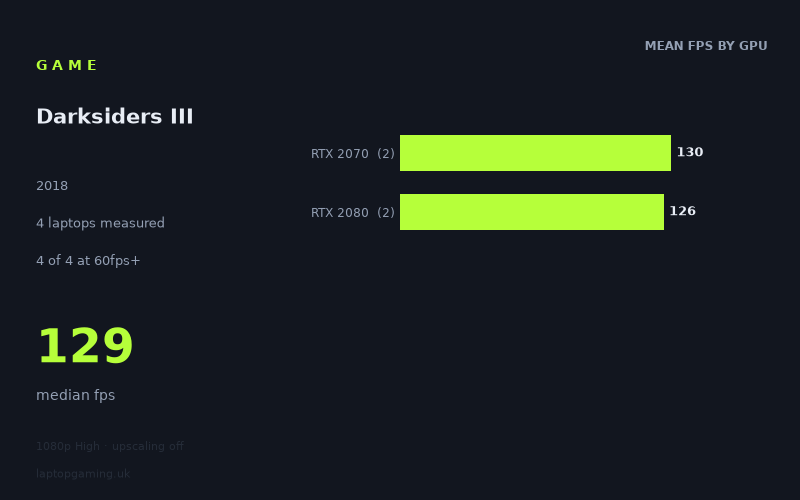
Every laptop we have figures for
Frame rates measured by Notebookcheck.
What it asks of a laptop
Darksiders III looks relatively forgiving in this particular set of measurements, but the evidence is limited: Notebookcheck’s numbers cover only four laptops, all tested at 1,920 × 1,080 on the High preset with upscaling off. Those are useful results for the machines listed below, but they are not enough to make broad promises about every laptop with the same GPU name.
Within that small sample, all four machines delivered comfortably playable performance. The slowest result was 109fps, the fastest was 143fps, and the median was 129fps. That is a 34fps gap between the fastest and slowest laptop, yet even the bottom result remains well above 60fps. On these systems, then, Darksiders III did not appear especially difficult to run at 1080p High.
The GPU-tier results are particularly worth treating with care. The two RTX 2070 laptops averaged 130fps, while the two RTX 2080 laptops averaged 126fps. The ostensibly lower GPU tier therefore produced the higher average in this sample. That does not mean an RTX 2070 is inherently faster than an RTX 2080; it means that laptop performance is affected by more than the GPU badge, and that two results per tier are far too few to establish a reliable hierarchy.
The individual figures make this clearer. The Asus Strix Scar 17 with an RTX 2080 was the fastest machine at 143fps, but the Acer Predator Triton 500, also with an RTX 2080, was the slowest at 109fps. Meanwhile, the two RTX 2070 laptops landed between them at 141fps and 118fps. The variation between these specific laptop implementations is greater than the difference suggested by the tier averages.
For a buyer, the practical reading is simple: at 1080p High without upscaling, the measured RTX 2070 and RTX 2080 laptops all had substantial headroom over 60fps. The data does not show Darksiders III demanding an exceptionally expensive gaming laptop for this target, but it also does not provide results for lower-end GPUs, integrated graphics, newer entry-level parts, or resolutions above 1080p.
What runs it
Every laptop in the supplied Notebookcheck sample cleared both the 60fps and 100fps marks. None quite reached a measured 144fps result, although one came very close.
RTX 2070 laptops
- MSI GE66 Raider — 141fps. This was the second-fastest result in the sample. It was well beyond 60fps and 100fps, but remained 3fps short of 144fps.
- Gigabyte Aero 17 HDR XB — 118fps. This also cleared 60fps and 100fps with room to spare. It was 26fps below 144fps.
Across the two measured RTX 2070 machines, the average was 130fps. That is a strong result for 1080p High in this game, but the 23fps difference between the MSI and Gigabyte results is a reminder not to assume that every RTX 2070 laptop will behave identically.
RTX 2080 laptops
- Asus Strix Scar 17 — 143fps. This was the best result recorded and was only 1fps below 144fps. It easily exceeded 60fps and 100fps.
- Acer Predator Triton 500 — 109fps. This was the lowest result in the group, though it still exceeded 100fps and sat 49fps above 60fps.
The two RTX 2080 laptops averaged 126fps. Again, that average should not be used as a purchase guarantee: the 34fps spread between the two RTX 2080 systems is the largest within either tier. What the figures do show is that both measured RTX 2080 laptops were more than adequate for a 60fps or 100fps target at the tested settings.
60fps, 100fps and 144fps targets
- 60fps: 4 of 4 measured laptops reached or exceeded it. The lowest result was 109fps.
- 100fps: 4 of 4 measured laptops reached or exceeded it. The lowest result was still 109fps.
- 144fps: 0 of 4 measured laptops reached it. The Asus Strix Scar 17 came closest at 143fps.
If your display is 60Hz, all four measured systems provide considerably more performance than is necessary to maintain 60fps in this test. For a 120Hz or similar high-refresh display, the recorded results are also encouraging, although the 109fps Acer result falls below that level. A 144Hz screen is a less certain fit at High settings: the best measured result narrowly missed 144fps, while the others were further away.
The cheapest laptop that handles it
The fact sheet provides no laptop prices, so it is not possible to identify the cheapest option from these measurements. It would be misleading to invent a price comparison or claim that one of these machines offers the lowest-cost route to acceptable performance.
What can be said is that all four named laptops handled the tested configuration well above 60fps: the Asus Strix Scar 17 (RTX 2080) at 143fps, MSI GE66 Raider (RTX 2070) at 141fps, Gigabyte Aero 17 HDR XB (RTX 2070) at 118fps, and Acer Predator Triton 500 (RTX 2080) at 109fps. If choosing between these specific systems, price, condition, cooling configuration and display specification would matter, but the supplied data contains only the game-performance figures.
What this means if you’re buying
For Darksiders III at 1080p High with upscaling disabled, the measured figures suggest that the listed RTX 2070 and RTX 2080 laptops are comfortably capable. All four delivered at least 109fps, so a 60fps target is not the concern within this sample. Even a 100fps target was met by every measured machine.
Do not buy on the assumption that a higher-numbered GPU tier will automatically deliver the better Darksiders III result. Here, the RTX 2070 average was slightly higher than the RTX 2080 average, and the fastest and slowest systems carried the same RTX 2080 label. For this game, these four results point to laptop-specific implementation mattering at least as much as the small difference between the two GPU tiers.
A buyer seeking a dependable 144fps experience at the tested settings should be more cautious. Notebookcheck’s fastest recorded result was 143fps, and that was the only figure close to the target. The sensible conclusion is not that 144fps is impossible, but that these four measurements do not demonstrate a guaranteed 144fps result. For 60fps and 100fps gaming, however, every laptop in the sample has already shown that it can do the job.
How these numbers were produced
Frame rates here are not measured by us, and we label how each one was arrived at. A figure marked measured comes from a published run on that exact machine. A figure marked representative is derived from the GPU and its power limit (TGP) and cross-referenced against published reviews - a sound estimate of what that configuration delivers, but not a measurement of that specific laptop. Unless stated otherwise, numbers are 1920x1080, High preset, upscaling off. Where a laptop ships in several power configurations we use the wattage of the exact SKU listed, because a 140W RTX 5070 and a 115W one are not the same product.