Performance analysis
God of War (2022): what it takes to run it
Measured on 15 gaming laptops at 1920×1080, High preset, upscaling off.

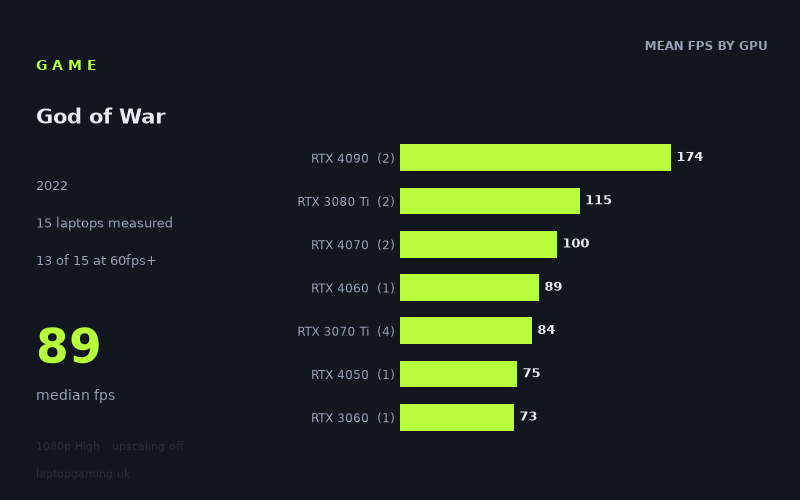
Every laptop we have figures for
Frame rates measured by Notebookcheck.
What it asks of a laptop
At 1,920 × 1,080 using the High preset with upscaling disabled, God of War is broadly manageable on gaming laptops, but it still rewards stronger GPUs heavily. Notebookcheck’s measured figures span from 45fps on the Acer Aspire 5 with an RTX 2050 at 35W to 180fps on the MSI Titan GT77 HX with an RTX 4090 at 150W: a fourfold difference between the slowest and fastest recorded machines.
The median result is 89fps, and 13 of the 15 measured laptops reached at least 60fps. That makes this a relatively forgiving result for a modern gaming laptop at 1080p High, provided the machine has a reasonably capable dedicated GPU. It is not, however, a game where every RTX-branded laptop produces the same experience. The bottom two machines, the RTX 3050 Ti-equipped HP Victus 16-e0145ng and RTX 2050-equipped Acer Aspire 5, returned 50fps and 45fps respectively.
The numbers separate fairly cleanly by graphics tier. RTX 4090 laptops were far ahead, averaging 174fps across the two tested machines. RTX 3080 Ti systems averaged 115fps, while the two RTX 4070 laptops averaged exactly 100fps. Below that, the measured RTX 4060 result was 89fps, the four RTX 3070 Ti machines averaged 84fps, and the RTX 4050 and RTX 3060 entries managed 75fps and 73fps.
That pattern suggests the game scales well across a wide range of laptop GPUs, but high-refresh-rate performance is much more demanding than simply reaching a playable 60fps. The gap between 73fps on the RTX 3060 laptop and 174fps on the RTX 4090 pair is substantial. A lower-mid-range gaming laptop can run the game well at these settings, while premium hardware is principally buying headroom for high-refresh displays rather than basic playability.
There is a useful caution here. Although the overall sample contains 15 laptops, several GPU tiers are represented by only one or two machines. The RTX 4060, RTX 4050, RTX 3060, RTX 3050 Ti and RTX 2050 results are each single-laptop figures, while the RTX 4070 and RTX 3080 Ti results come from two laptops each. These are measured outcomes for those specific laptops, not guarantees for every machine carrying the same GPU name. Laptop cooling, power limits and wider system design can matter.
What runs it
For 60fps at 1080p High without upscaling, the measured threshold is around the RTX 3060/RTX 4050 level in this sample. The Schenker XMG Core 15 with an RTX 3060 at 140W achieved 73fps, while the Schenker XMG Apex 15 with an RTX 4050 at 140W reached 75fps. The sole RTX 4060 machine, Acer’s Predator Helios 16 with a 140W RTX 4060, delivered 89fps.
The four RTX 3070 Ti laptops sit in a close band from 77fps to 92fps:
- Aorus 17X XES: 92fps
- Aorus 17 XE4 with RTX 3070 Ti at 130W: 85fps
- Asus ROG Flow X16 with RTX 3070 Ti at 125W: 84fps
- MSI Stealth GS66: 77fps
Those figures make the RTX 3070 Ti group a solid fit for a 60Hz or 75Hz display at the tested settings, with the faster examples also offering useful room above that target. The RTX 4060 result is similar rather than decisively faster, at 89fps, but that tier has only one measured laptop here.
At the lower end, neither of the two weakest GPUs recorded a 60fps result. The HP Victus 16-e0145ng with an RTX 3050 Ti at 75W managed 50fps, and the Acer Aspire 5 with an RTX 2050 at 35W managed 45fps. Based on these figures, these are the laptops most likely to need reduced settings or upscaling if a consistent 60fps is the aim, though this data set does not include measured results for those adjusted settings.
For 100fps, the measured results become more selective. Five of the 15 laptops reached that mark. The two RTX 4090 systems did so comfortably: 180fps for the MSI Titan GT77 HX and 167fps for the Aorus 17X AZF. Both RTX 3080 Ti machines also cleared 100fps, with 119fps from the MSI GE76 Raider and 111fps from the Schenker XMG Neo 17 M22.
The HP Omen 17-db0079ng with RTX 4070 reached 105fps, but the MSI Stealth 16 Studio with an RTX 4070 at 105W recorded 96fps. The RTX 4070 average is therefore 100fps across two machines, but the individual figures show why it would be wrong to treat 100fps as assured from that GPU label alone.
For 144fps, only the two RTX 4090 laptops made it in the measured figures. The Titan GT77 HX reached 180fps and the Aorus 17X AZF reached 167fps. The next fastest result, 119fps from the RTX 3080 Ti-equipped GE76 Raider, is well short of 144fps. A 144Hz laptop display can still be useful below 144fps, but these results do not support treating 144fps at the tested settings as a realistic expectation below the two measured RTX 4090 systems.
The cheapest laptop that handles it
Price information is incomplete, so the figures cannot identify the cheapest laptop overall. Only two of the listed machines have GBP prices: the Acer Predator Helios 16 with RTX 4060 at 140W is listed at £1,868, while the MSI Stealth GS66 with RTX 3070 Ti is listed at £2,688.
Of those priced entries, the Predator Helios 16 is both less expensive and faster in Notebookcheck’s figures, delivering 89fps against the Stealth GS66’s 77fps. It is therefore the best-value option among the laptops with supplied prices, and it handles 1080p High comfortably above 60fps. It cannot be called the cheapest qualifying laptop in the complete 15-machine list, because no prices are provided for the RTX 4050, RTX 3060, RTX 3050 Ti or several other models.
What this means if you’re buying
If your target is simply a good 1080p High experience without upscaling, the measured data points towards an RTX 4050, RTX 3060, RTX 4060 or RTX 3070 Ti laptop as viable territory. The specific RTX 4050 and RTX 3060 machines recorded 75fps and 73fps respectively, while the RTX 4060 and RTX 3070 Ti results ranged from 77fps to 92fps.
For a 100Hz-class display, aim higher and check reviews of the exact laptop rather than relying on the GPU badge. The measured RTX 3080 Ti laptops both exceeded 100fps, while the RTX 4070 pair split either side of the line at 105fps and 96fps. For a 144Hz target at these settings, the available figures point directly to the RTX 4090 laptops, with no other recorded system reaching 144fps.
In short: God of War does not require flagship hardware for a satisfying 60fps result at 1080p High, but a high-refresh target changes the buying calculation sharply. The £1,868 Acer Predator Helios 16 is the strongest priced example supplied, while lower-cost contenders may exist in the unpriced RTX 4050 and RTX 3060 group; the fact sheet simply does not provide enough pricing data to rank them.
How these numbers were produced
Frame rates here are not measured by us, and we label how each one was arrived at. A figure marked measured comes from a published run on that exact machine. A figure marked representative is derived from the GPU and its power limit (TGP) and cross-referenced against published reviews - a sound estimate of what that configuration delivers, but not a measurement of that specific laptop. Unless stated otherwise, numbers are 1920x1080, High preset, upscaling off. Where a laptop ships in several power configurations we use the wattage of the exact SKU listed, because a 140W RTX 5070 and a 115W one are not the same product.