Performance analysis
Serious Sam 4 (2020): what it takes to run it
Measured on 5 gaming laptops at 1920×1080, High preset, upscaling off.

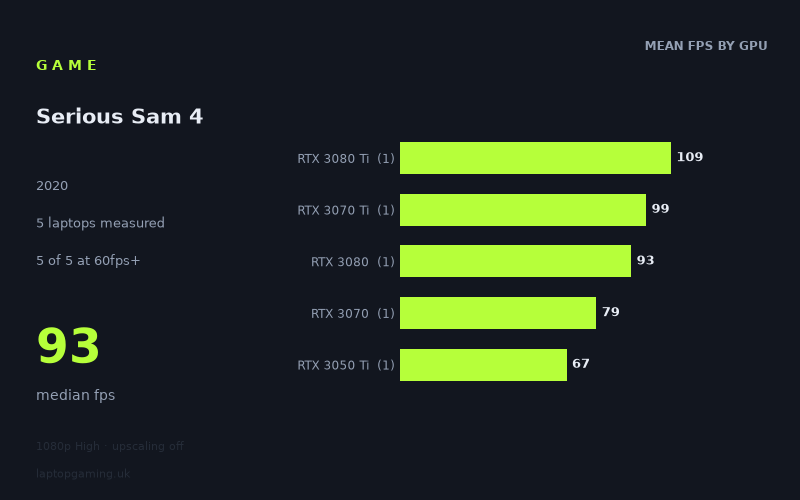
Every laptop we have figures for
Frame rates measured by Notebookcheck.
What it asks of a laptop
At 1,920 x 1,080 using the High preset with upscaling off, Serious Sam 4 looks relatively forgiving on the five laptops represented by Notebookcheck’s measured figures. Every machine in this small sample cleared 60fps, including the lowest-ranked GPU here, an RTX 3050 Ti running at 75W.
That conclusion needs the usual sample-size caution. These are results from five specific laptops, not a complete map of every gaming laptop configuration. GPU power limits, cooling and other hardware differences matter, particularly once comparing models carrying broadly similar graphics chips. Still, the available numbers provide a useful indication of the game’s GPU demand at this particular 1080p High setting.
The measured range runs from 67fps to 109fps, with a median of 93fps. That is a 42fps gap between the fastest and slowest systems, so extra GPU performance is clearly useful, but it does not turn the game from unplayable to playable. Instead, it shifts the experience from a solid 60fps-class result towards higher-refresh-rate territory.
The separation between the GPUs is orderly in this set. The RTX 3050 Ti laptop recorded 67fps; the RTX 3070 at 100W reached 79fps; the RTX 3080 managed 93fps; the RTX 3070 Ti recorded 99fps; and the RTX 3080 Ti at 175W led at 109fps. Serious Sam 4 therefore rewards more capable graphics hardware, but the measured numbers suggest that 1080p High is not exclusively the preserve of expensive top-end machines.
There is a more important distinction between aiming for 60fps and aiming to make full use of a fast laptop display. All five measured systems met the former target. Only one met 100fps, and none reached 144fps. A laptop that is entirely adequate for a 60Hz or 75Hz display is therefore not necessarily one that will keep a 144Hz panel fully fed at these settings.
What runs it
For a 60fps target, every laptop in the measured sample succeeded. The Schenker XMG Focus 15, fitted with an RTX 3050 Ti at 75W, is the lowest result at 67fps. That leaves a modest 7fps margin over 60fps at the stated settings. It is a usable result, but not one that supports broad claims about every RTX 3050 Ti laptop: this is one 75W machine, measured in one game configuration.
The Acer Predator Helios 300 with an RTX 3070 at 100W delivered 79fps. In this sample, that provides more room above 60fps than the RTX 3050 Ti result, while remaining below the figures from the RTX 3080-class and RTX 3070 Ti systems. It is the measured option to look at if the goal is a more comfortable 60fps-plus outcome rather than chasing triple-digit frame rates.
Above that, the Asus ROG Zephyrus G15 with an RTX 3080 achieved 93fps. The MSI Stealth GS66 with an RTX 3070 Ti reached 99fps. Both are clearly fast enough for 60fps in Notebookcheck’s figures and are close to 100fps, but neither actually clears that threshold in this data.
For 100fps, only one of the five measured laptops qualifies. The MSI GE76 Raider, equipped with an RTX 3080 Ti at 175W, recorded 109fps. That makes it the only tested system above 100fps, although its 9fps margin means it should be described as a measured 100fps-class result rather than evidence that all RTX 3080 Ti laptops will deliver the same outcome.
For 144fps, none of the measured laptops qualifies at 1080p High with upscaling off. The GE76 Raider’s 109fps is the closest result, but remains 35fps short of 144fps. Buyers considering a 144Hz laptop screen should not assume that Serious Sam 4 will run at a locked 144fps on the High preset simply because the laptop has a high-refresh panel.
- RTX 3050 Ti at 75W: 67fps in the Schenker XMG Focus 15; above 60fps.
- RTX 3070 at 100W: 79fps in the Acer Predator Helios 300; above 60fps.
- RTX 3080: 93fps in the Asus ROG Zephyrus G15; above 60fps, below 100fps.
- RTX 3070 Ti: 99fps in the MSI Stealth GS66; above 60fps, just below 100fps.
- RTX 3080 Ti at 175W: 109fps in the MSI GE76 Raider; above 60fps and 100fps, below 144fps.
The cheapest laptop that handles it
The fact sheet does not provide enough pricing information to identify the cheapest laptop that handles Serious Sam 4. Only one price is supplied: the MSI Stealth GS66 with RTX 3070 Ti, listed at £2,688. It recorded 99fps, making it comfortably capable of the 60fps target and narrowly short of 100fps in Notebookcheck’s numbers.
That price should not be read as a value recommendation against the other four machines, because no prices are given for the MSI GE76 Raider, Asus ROG Zephyrus G15, Acer Predator Helios 300 or Schenker XMG Focus 15. The Schenker is the least powerful measured configuration and still reached 67fps, but the available data does not say what it cost.
What this means if you’re buying
If your requirement is simply to play at 1,920 x 1,080 on High without upscaling and stay above 60fps, the measured figures are encouraging. Even the XMG Focus 15’s RTX 3050 Ti result cleared that line. For this specific target, paying for the highest-end GPU represented here is not necessary on the evidence available.
If you want more headroom above 60fps, the RTX 3070 result of 79fps and the RTX 3080 result of 93fps show the benefit of moving up the measured stack. For a near-100fps result, the RTX 3070 Ti-equipped Stealth GS66 reached 99fps, while the 175W RTX 3080 Ti GE76 Raider was the sole machine over 100fps at 109fps.
For a 144Hz-focused purchase, however, the figures advise restraint. None of these five laptops reached 144fps at the stated settings. Choose a laptop based on its wider performance needs rather than expecting Serious Sam 4 at 1080p High, with upscaling disabled, to saturate a 144Hz display according to these measurements.
How these numbers were produced
Frame rates here are not measured by us, and we label how each one was arrived at. A figure marked measured comes from a published run on that exact machine. A figure marked representative is derived from the GPU and its power limit (TGP) and cross-referenced against published reviews - a sound estimate of what that configuration delivers, but not a measurement of that specific laptop. Unless stated otherwise, numbers are 1920x1080, High preset, upscaling off. Where a laptop ships in several power configurations we use the wattage of the exact SKU listed, because a 140W RTX 5070 and a 115W one are not the same product.