Performance analysis
Star Wars Squadrons (2020): what it takes to run it
Measured on 8 gaming laptops at 1920×1080, High preset, upscaling off.

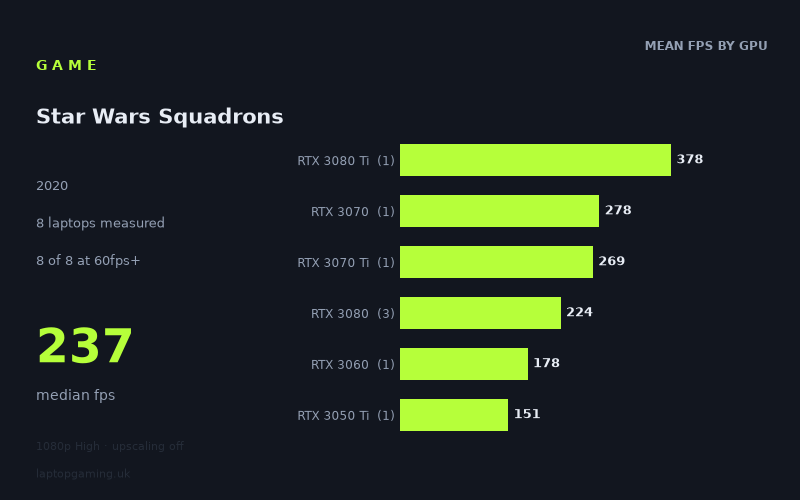
Every laptop we have figures for
Frame rates measured by Notebookcheck.
What it asks of a laptop
At the measured 1,920 × 1,080 High preset with upscaling off, Star Wars Squadrons looks very forgiving for the eight gaming laptops in Notebookcheck’s figures. Every machine cleared 60fps, 100fps and 144fps, including the slowest result: 151fps from the Schenker XMG Focus 15 with an RTX 3050 Ti running at 75W.
That matters because this is not a set of results where only the top-end machines are comfortably playable. The recorded range is 151fps to 378fps, while the median is 237fps. Even the lower end of this particular sample has substantial headroom above a 144Hz display’s refresh rate at these settings.
There is still a large numerical gap between the machines. The MSI GE76 Raider with a 175W RTX 3080 Ti reached 378fps, 227fps ahead of the RTX 3050 Ti Schenker. However, the gap is mainly about achieving extremely high frame rates rather than moving from poor performance to acceptable performance. Based on these figures, the game does not appear especially difficult to run at 1080p High without upscaling on the laptops represented here.
The GPU tiers do separate in the expected broad direction, but the sample size needs care. There are single-laptop results for the RTX 3080 Ti, RTX 3070, RTX 3070 Ti, RTX 3060 and RTX 3050 Ti, and three RTX 3080 laptops. That is enough to show what these specific laptops achieved, but not enough to treat each number as a guarantee for every laptop carrying the same GPU name.
Power limits and laptop design appear relevant in the measured list. The RTX 3080 Ti result comes from a 175W MSI GE76 Raider and is the clear leader at 378fps. Meanwhile, the 95W RTX 3080 in the MSI GS76 Stealth recorded 228fps. Both are very fast results, but the difference is a useful reminder that a GPU label alone is not the whole buying decision.
What runs it
All eight measured laptops clear 60fps. More notably, all eight also clear 100fps and 144fps in Notebookcheck’s 1080p High, no-upscaling test. If those settings match how you intend to play, there is no measured example here that needs a lower preset simply to reach a conventional smooth-performance target.
RTX 3050 Ti and RTX 3060
The lowest GPU tier represented is the RTX 3050 Ti. The Schenker XMG Focus 15, with its RTX 3050 Ti specified at 75W, achieved 151fps. That is above 144fps, making it the slowest measured laptop but still one that exceeded every threshold listed in the fact sheet.
The HP Victus 16-e0179ng, equipped with an RTX 3060 at 95W, recorded 178fps. That is 27fps ahead of the measured RTX 3050 Ti machine and again above 144fps. For a 60Hz, 100Hz or 144Hz 1080p screen, both of these specific laptops have measured performance headroom at High.
RTX 3070, RTX 3070 Ti and RTX 3080
The Schenker XMG Neo 17, listed with an RTX 3070 and a 5800H, reached 278fps. The MSI Stealth GS66 with an RTX 3070 Ti reached 269fps. Both comfortably clear 144fps and sit well above the sample median of 237fps.
The three RTX 3080 laptops averaged 224fps, but their individual figures are more useful than the mean given the small group: 246fps for the Gigabyte Aero 17 HDR YC, 228fps for the MSI GS76 Stealth with its 95W RTX 3080, and 198fps for the Asus ROG Zephyrus G15. Each clears 144fps, although the RTX 3080 group also demonstrates why buyers should avoid assuming that every higher-labelled GPU will necessarily outrun every lower-labelled one in a laptop.
RTX 3080 Ti
The single RTX 3080 Ti result is the MSI GE76 Raider at 378fps, using a 175W GPU. It is the fastest laptop in this set by a wide margin. It is also only one laptop, so it should be read as a result for that high-power GE76 Raider configuration rather than a universal RTX 3080 Ti expectation.
The cheapest laptop that handles it
The fact sheet does not provide enough prices to identify the cheapest measured laptop overall. It gives a price for only one machine: the MSI Stealth GS66 with RTX 3070 Ti, listed at £2,688. Its measured result was 269fps, easily above 60fps, 100fps and 144fps.
That does not make the GS66 the cheapest option; it is simply the only measured laptop here with a stated price. The Schenker XMG Focus 15 is the lowest-performing listed machine at 151fps and therefore proves that a lower GPU tier can still handle the game very well at the tested settings, but no price is supplied for it. Buyers should not infer a specific cheapest purchase from this data alone.
What this means if you’re buying
For Star Wars Squadrons at 1080p High with upscaling off, these numbers suggest that you do not need an unusually powerful gaming laptop to achieve high-refresh-rate performance. The measured RTX 3050 Ti laptop reached 151fps, while the RTX 3060 model reached 178fps. On the evidence available, those specific machines are already sufficient for a 144Hz target.
If your aim is simply a stable-feeling 60fps or 100fps experience at the tested settings, every laptop in the sample has far more than the required measured performance. Spending more on an RTX 3070-class, RTX 3080-class or RTX 3080 Ti laptop is therefore not necessary on these results for those targets alone.
For buyers pursuing the highest possible frame rates, the faster machines do offer clear gains: 269fps to 278fps from the measured RTX 3070 Ti and RTX 3070 systems, and 378fps from the 175W RTX 3080 Ti GE76 Raider. But this is a small eight-laptop sample, with most GPU tiers represented by only one model. Treat the figures as useful examples of these configurations, and check the exact laptop’s GPU power specification rather than buying on the GPU name alone.
How these numbers were produced
Frame rates here are not measured by us, and we label how each one was arrived at. A figure marked measured comes from a published run on that exact machine. A figure marked representative is derived from the GPU and its power limit (TGP) and cross-referenced against published reviews - a sound estimate of what that configuration delivers, but not a measurement of that specific laptop. Unless stated otherwise, numbers are 1920x1080, High preset, upscaling off. Where a laptop ships in several power configurations we use the wattage of the exact SKU listed, because a 140W RTX 5070 and a 115W one are not the same product.