Performance analysis
Outriders (2021): what it takes to run it
Measured on 11 gaming laptops at 1920×1080, High preset, upscaling off.

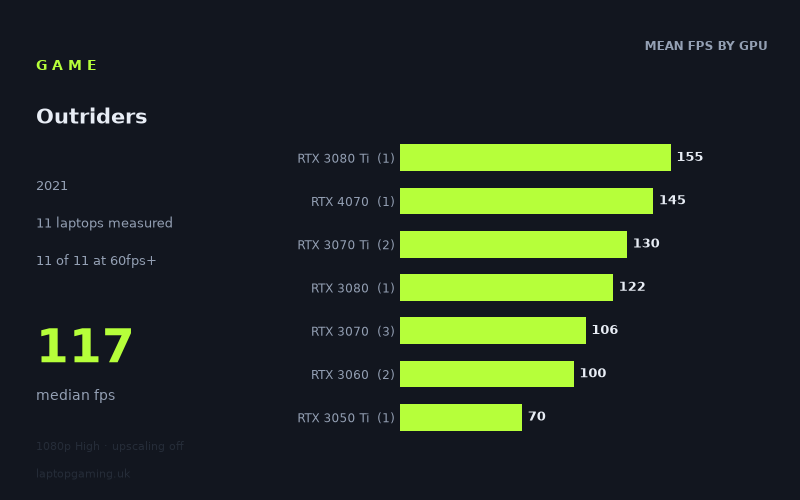
Every laptop we have figures for
Frame rates measured by Notebookcheck.
What it asks of a laptop
Outriders looks relatively forgiving on the measured evidence, at least at 1,920 × 1,080 using the High preset with upscaling disabled. All 11 laptops in Notebookcheck’s figures cleared 60fps, including the slowest result: 70fps from the Schenker XMG Focus 15 with a 75W RTX 3050 Ti. The full spread runs from 70fps to 155fps, while the median is 117fps.
That is a healthy result for a game tested at High rather than a reduced-quality preset. It suggests that a gaming laptop does not need an upper-tier GPU to reach a conventional 60fps target in this particular test. The important qualification is that these are results from 11 named laptops, not a universal guarantee for every machine carrying the same graphics label. Laptop GPU power limits, cooling and the rest of the system can matter considerably.
The measured figures do show a broadly sensible separation between GPU tiers, although there are enough overlaps to make wattage and laptop design important. The RTX 3050 Ti result sits clearly behind the rest at 70fps. RTX 3060 machines reached 99fps and 100fps, while the three RTX 3070 laptops ranged from 94fps to 117fps. Above that, the RTX 3070 Ti machines delivered 124fps and 136fps, while the RTX 4070 result reached 145fps and the RTX 3080 Ti result hit 155fps.
There is also a useful reminder not to buy on the GPU name alone. The 100W RTX 3070 in Acer’s Predator Helios 300 recorded 94fps, behind both measured RTX 3060 laptops: 100fps from the 95W HP Victus 16-e0179ng and 99fps from the 130W Schenker XMG Core 17. Meanwhile, the 140W RTX 3070 in the Medion Erazer Beast X20 reached 108fps. Those figures do not prove that every higher-power version will outperform every lower-power alternative, but they do show why the individual laptop matters.
What runs it
For a 60fps target at the tested 1080p High settings, every laptop in the sample succeeded. The entry point among the measured machines was the Schenker XMG Focus 15, whose 75W RTX 3050 Ti returned 70fps. That gives it 10fps of headroom over 60fps, rather than a huge surplus, but it is still the lowest-performing tested laptop and remained above the target.
RTX 3060 systems were close to 100fps. The HP Victus 16-e0179ng, fitted with a 95W RTX 3060, measured exactly 100fps. The Schenker XMG Core 17 (Early 2021), with a 130W RTX 3060, measured 99fps. Taken together, those two results make RTX 3060 laptops the most clearly represented route to approximately 100fps in this set, although only one of the two actually met or exceeded 100fps.
The RTX 3070 results were less consistent. The 100W Acer Predator Helios 300 achieved 94fps, whereas the Schenker XMG Apex 17 M21 reached 117fps and the 140W Medion Erazer Beast X20 achieved 108fps. The tier average is 106fps across three laptops, but the 23fps gap from the slowest to fastest RTX 3070 machine is substantial. For a buyer seeking a firm 100fps result, these numbers support checking the performance of the exact model rather than assuming an RTX 3070 badge is enough.
Both measured RTX 3070 Ti laptops cleared 100fps comfortably: 136fps on the HP Omen 16-b1090ng and 124fps on the MSI Stealth GS66. Their mean is 130fps across two laptops. The Lenovo Legion 7 16ACHg6, using an RTX 3080 at 120W, recorded 122fps, putting it in a similar part of the chart.
High-refresh 144fps is a more selective target. Only two of the 11 measured laptops reached it: the Asus ROG Strix G18 with an RTX 4070 at 165W managed 145fps, and the MSI GE76 Raider with a 175W RTX 3080 Ti reached 155fps. The RTX 4070 result only clears 144fps by 1fps, so it should be read as a result for that specific ROG Strix G18 configuration, not as proof that every RTX 4070 laptop will sustain 144fps under the same conditions.
The cheapest laptop that handles it
The fact sheet provides a price for only one of the measured laptops: the MSI Stealth GS66 at £2,688. It achieved 124fps with its RTX 3070 Ti, so it handles Outriders very comfortably at the tested 1080p High settings and clears 100fps.
However, that does not establish it as the cheapest laptop capable of running the game. No prices are supplied for the other 10 machines, including the 70fps Schenker XMG Focus 15 and the 99–100fps RTX 3060 systems. On the available information, the only defensible conclusion is that the £2,688 MSI Stealth GS66 is a priced example that performs well; it cannot be compared on value against the rest of the sample.
What this means if you’re buying
If your priority is simply playing at 1080p High at 60fps without upscaling, the measured figures are encouraging. Every tested machine reached that mark, from the 75W RTX 3050 Ti system at 70fps through to the 175W RTX 3080 Ti machine at 155fps. Based on these numbers, there is little reason to buy a top-tier laptop solely to meet a 60fps target in Outriders.
For roughly 100fps, the results point towards the measured RTX 3060 laptops and above, but the boundary is close: one RTX 3060 produced 100fps and the other 99fps. RTX 3070 laptops can also land either side of that target depending on the specific machine, with measured results from 94fps to 117fps. Buyers targeting a 100Hz display should therefore favour a laptop with published performance data for its exact configuration.
For a 144Hz screen, the evidence is narrower. Only the RTX 4070 Asus ROG Strix G18 and RTX 3080 Ti MSI GE76 Raider reached 144fps or more, at 145fps and 155fps respectively. With just one laptop represented for each of those GPU tiers, that is not enough data to make a broad buying promise. It does show that 144fps is possible at the tested settings, but it remains a high-end result rather than the expectation across this 11-laptop sample.
How these numbers were produced
Frame rates here are not measured by us, and we label how each one was arrived at. A figure marked measured comes from a published run on that exact machine. A figure marked representative is derived from the GPU and its power limit (TGP) and cross-referenced against published reviews - a sound estimate of what that configuration delivers, but not a measurement of that specific laptop. Unless stated otherwise, numbers are 1920x1080, High preset, upscaling off. Where a laptop ships in several power configurations we use the wattage of the exact SKU listed, because a 140W RTX 5070 and a 115W one are not the same product.