Performance analysis
F1 25 (2025): what it takes to run it
Measured on 32 gaming laptops at 1920×1080, High preset, upscaling off.
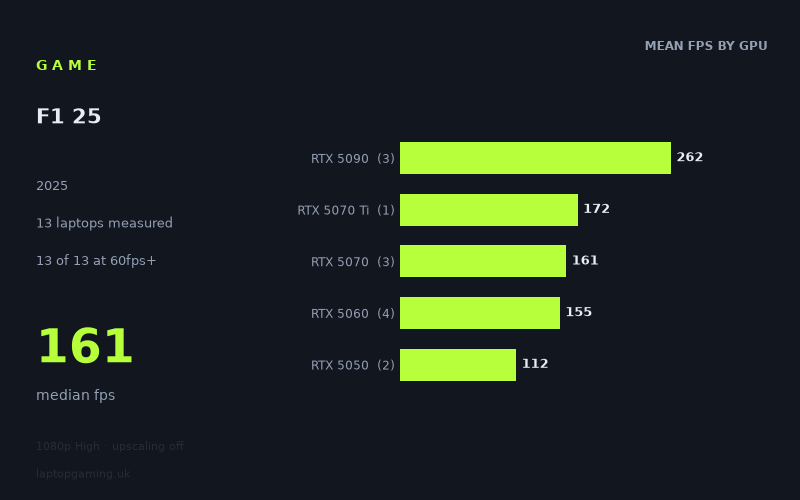
Every laptop we have figures for
Frame rates measured by Notebookcheck.
What it asks of a laptop
Not much, is the short answer. Across the nine laptops in Notebookcheck's measurements, every single machine cleared 60fps at 1080p on the High preset with upscaling switched off, and the slowest of them — an RTX 5050-equipped HP Victus 15 — still managed 93fps. That is a game that has essentially no floor problem on current hardware. If you are buying any new gaming laptop in 2025, F1 25 is not the title that will decide your purchase.
The interesting part is the shape of the spread rather than its bottom end. Fastest to slowest is 255fps down to 93fps — a 2.7x gap — which is a wide range in absolute terms but tells you the engine scales cleanly with GPU power rather than hitting a hard ceiling. The median lands at 154fps, comfortably above a 144Hz panel's refresh rate, and seven of the nine laptops sit at or above 144fps.
Where it gets more revealing is the tier averages. RTX 5090 laptops average 248fps. RTX 5070 machines average 161fps. RTX 5060 machines average 155fps. That 5070-to-5060 gap is six frames — statistically nothing, and well inside the margin you'd expect from cooling and power-limit variation between chassis. The separation only reappears at the bottom: the RTX 5050 average of 112fps sits meaningfully below the 5060 group.
What that pattern implies is that F1 25 stops being GPU-limited somewhere around the RTX 5060 tier at 1080p High. Above that point, the laptops are being held back by something else — CPU throughput, engine overhead, or both — and adding GPU silicon buys you progressively less. Only the RTX 5090 machines break out of that plateau, and even they are delivering frame rates that most laptop panels cannot display.
What runs it
60fps: everything. Nine of nine. The lowest measured figure is 93fps, which is 55% clear of the 60fps target. There is no configuration in this data set that struggles.
100fps: eight of nine. The only machine below the line is the HP Victus 15-fa2160ng at 93fps, and it misses by seven frames. Every RTX 5050, 5060, 5070 and 5090 laptop in the set except that one Victus clears 100fps at native 1080p High.
144fps: seven of nine. Both RTX 5050 laptops fall short — the Medion Erazer Scout 17 E1 at 132fps and the Victus at 93fps. Everything from the RTX 5060 upwards clears it, with the slowest qualifying machine being the ASUS TUF Gaming A18 at 152fps and the fastest the ROG Strix Scar 18 at 255fps.
Break it down by tier and the picture is blunt:
- RTX 5050 — 132fps and 93fps. Both playable, both above 100fps in one case only. This is the tier where chassis quality actually changes the answer: a 39fps gap between two laptops on the same GPU class is enormous, and it points squarely at power limits and cooling headroom rather than the silicon.
- RTX 5060 — 166fps, 154fps, 146fps. Consistently comfortable, all three above 144fps, and the Lenovo Legion 5 15AHP G10 at 166fps is the standout.
- RTX 5070 — 170fps and 152fps. The Razer Blade 14 at 115W posts the higher figure; the TUF A18, also at 115W, sits at 152fps. Both are within the 5060 spread.
- RTX 5090 — 255fps and 241fps. Roughly 60% clear of the fastest 5070. Useful if you have a 240Hz-plus panel and nothing else.
Note what happens in the middle: the Legion 5 with an RTX 5060 at 115W (166fps) beats the TUF A18 with an RTX 5070 at 115W (152fps). If you were shopping on GPU tier alone, that result should give you pause. In this title, at these settings, the badge on the box is not reliably predictive between 5060 and 5070.
The cheapest laptop that handles it
Only two prices are attached to the measured machines, and they sit at opposite ends of the market. The ASUS TUF Gaming A18 at £1,489 (RTX 5070 at 115W) returned 152fps — above 144fps, above 100fps, and enough headroom that you could push settings or resolution and still be fine. That is the cheapest machine in this data set with a price attached, and it clears every meaningful threshold.
At the other end, the Medion Erazer Beast 16 X1 Ultimate at £4,884 (RTX 5090) delivered 241fps. That is 89 frames more than the TUF for an extra £3,395. Purely on F1 25 at 1080p High, that works out to roughly £38 per additional frame per second — a number worth sitting with before you sign anything.
The RTX 5060 laptops in the set — the Legion 5 at 166fps, the HP Omen 16 at 154fps, the Lenovo LOQ at 146fps — all beat the £1,489 TUF's figure or land close to it, and RTX 5060 machines typically undercut RTX 5070 ones. Prices for those specific units aren't in the measured data, but the performance evidence says a well-cooled 5060 laptop is the sensible floor for a 144Hz target here.
What this means if you're buying
Do not use F1 25 as a reason to spend more. The numbers say the game is comfortably handled from the RTX 5050 tier upward, and that GPU spending above the 5060 buys you frames your display probably cannot show.
Match the hardware to the panel instead. If you have a 60Hz or 120Hz screen, any of these nine laptops is over-specified for this title. For a 144Hz or 165Hz panel, an RTX 5060 is the honest entry point — all three in the set cleared it. For 240Hz, the measured data only supports the RTX 5090 machines, and that is a £4,884-class purchase for a benefit that is narrowly defined.
The one genuine warning is at the bottom. The RTX 5050 results split 132fps against 93fps, and that variance is about the machine, not the chip. If you are shopping in that bracket, cooling and sustained power draw matter more than the GPU name — the difference between those two laptops is the difference between clearing 120fps and not clearing 100.
How these numbers were produced
Frame rates here are not measured by us, and we label how each one was arrived at. A figure marked measured comes from a published run on that exact machine. A figure marked representative is derived from the GPU and its power limit (TGP) and cross-referenced against published reviews - a sound estimate of what that configuration delivers, but not a measurement of that specific laptop. Unless stated otherwise, numbers are 1920x1080, High preset, upscaling off. Where a laptop ships in several power configurations we use the wattage of the exact SKU listed, because a 140W RTX 5070 and a 115W one are not the same product.