Performance analysis
Resident Evil Requiem (2026): what it takes to run it
Measured on 2 gaming laptops at 1920×1080, High preset, upscaling off.
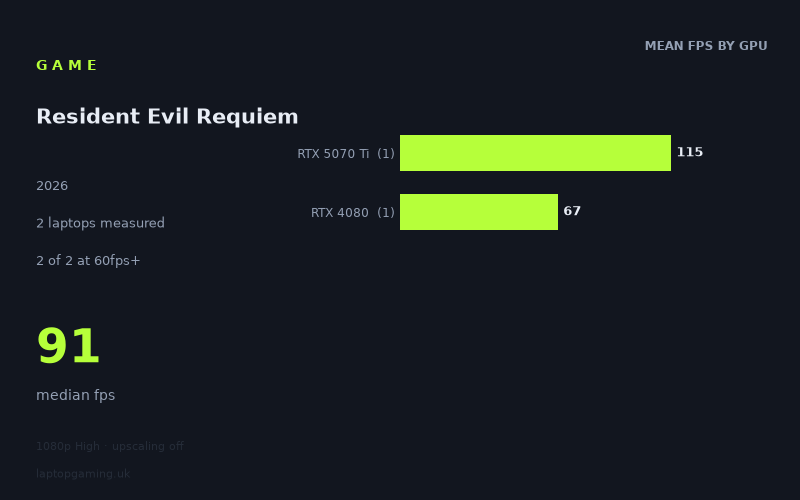
Every laptop we have figures for
Frame rates measured by Notebookcheck.
What it asks of a laptop
Resident Evil Requiem has only a very small set of available laptop results: two machines, both measured by Notebookcheck at 1,920 x 1,080 using the High preset with upscaling disabled. That is enough to show what these specific laptops achieved, but not enough to make broad claims about every configuration carrying the same GPU name.
Within that limited sample, the game looks reasonably demanding at native 1080p High. Both tested laptops cleared 60fps, but neither reached 144fps. The measured range runs from 67fps on the Razer Blade 16 Early with an RTX 4080 at 175 W to 115fps on the Chuwi Gamebook R9 with an RTX 5070 Ti at 140 W. The median is 91fps.
That 48fps spread is substantial. It means the available numbers do not point to a game that simply runs at extremely high frame rates on any premium gaming laptop. Instead, it appears to reward a faster machine clearly: the RTX 5070 Ti-equipped Chuwi recorded 115fps, while the RTX 4080-equipped Razer recorded 67fps under the same stated resolution, preset and upscaling conditions.
However, there are only one result for each GPU tier, and these are different laptop models with different power limits. It would be unsafe to interpret the figures as a universal ranking of RTX 5070 Ti versus RTX 4080 laptops. What can be said is that these particular configurations are separated sharply in Resident Evil Requiem, despite both being high-end gaming laptops.
The game’s practical difficulty, based on these measurements, is therefore less about reaching a playable 60fps at 1080p High on the two systems tested and more about sustaining a higher-refresh experience. Native-resolution High settings were sufficient for 60fps on both machines, but only one of the two reached 100fps, and neither delivered 144fps.
What runs it
The measured figures give a clear, if narrow, picture for the two tested GPU tiers.
- RTX 5070 Ti: The Chuwi Gamebook R9, using an RTX 5070 Ti rated at 140 W, averaged 115fps. This is the only RTX 5070 Ti result in the data, so 115fps should be treated as the result for that specific laptop rather than a guarantee for all RTX 5070 Ti machines. It cleared 60fps and 100fps, but not 144fps.
- RTX 4080: The Razer Blade 16 Early, using an RTX 4080 rated at 175 W, averaged 67fps. Again, this is one laptop result rather than a tier-wide verdict. It cleared 60fps, but did not reach 100fps or 144fps.
Looking at the stated performance targets, the two tested laptops break down as follows:
- 60fps: 2 of 2 measured laptops achieved this. The slowest result was 67fps, leaving a modest 7fps margin above the target on the Razer Blade 16 Early.
- 100fps: 1 of 2 measured laptops achieved this. The Chuwi Gamebook R9 reached 115fps, while the Razer Blade 16 Early measured 67fps.
- 144fps: 0 of 2 measured laptops achieved this. Even the fastest recorded system, the Chuwi Gamebook R9, stopped at 115fps.
For a buyer whose priority is a conventional 60fps experience at 1080p High without upscaling, both measured machines have evidence in their favour. For someone buying specifically for a 100fps-plus result, the Chuwi is the only system in this data set that does so. There is no measured evidence here for a laptop that can deliver a 144fps average at these settings.
It is also worth keeping the test conditions in mind. These are native 1080p results with upscaling off, rather than figures obtained by reducing image quality through an upscaling mode. That makes the 67fps and 115fps readings directly useful for buyers targeting 1,920 x 1,080 High, but the figures do not tell us how either laptop performs at other presets, resolutions or upscaling settings.
The cheapest laptop that handles it
The fact sheet does not provide UK prices for either tested laptop, so it is not possible to identify the cheapest machine that handles Resident Evil Requiem without inventing pricing information.
The two named laptops with measured 60fps-plus results are:
- Chuwi Gamebook R9: 115fps at 1,920 x 1,080, High preset, upscaling off, with an RTX 5070 Ti at 140 W.
- Razer Blade 16 Early: 67fps under the same measured settings, with an RTX 4080 at 175 W.
Both meet the 60fps threshold in Notebookcheck’s numbers, but no price comparison can be made from the supplied data. The Chuwi provides the higher measured frame rate, while the Razer is the lower-performing of the two tested systems but still remains above 60fps.
What this means if you’re buying
If Resident Evil Requiem is one of the games shaping your laptop purchase, the available evidence supports buying for the frame-rate target you actually want rather than assuming that a premium GPU label alone settles the question.
For 1080p High at around 60fps with upscaling disabled, both of the measured laptops are viable. The Razer Blade 16 Early is the closer call at 67fps: it is above the target, but its headroom is limited compared with the Chuwi’s 115fps. The measured numbers therefore make the Razer result suitable evidence for a 60fps-oriented buyer, not for someone expecting a consistently high-refresh result at the same settings.
For a 100fps target, the Chuwi Gamebook R9 is the only laptop in the supplied figures that qualifies. Its 115fps average gives it a 15fps margin over 100fps, although it remains 29fps short of 144fps. Buyers shopping for a 120Hz or 144Hz-class experience should therefore be careful: the fastest available result is high enough to make use of a high-refresh display, but it does not demonstrate a 144fps average at native 1080p High.
Most importantly, do not extrapolate too far from two data points. The RTX 5070 Ti result is faster than the RTX 4080 result here, but each tier is represented by only one laptop. These figures describe the Chuwi Gamebook R9 and Razer Blade 16 Early as tested, including their stated 140 W and 175 W GPU configurations. They do not establish that every RTX 5070 Ti laptop will beat every RTX 4080 laptop in Resident Evil Requiem.
On the evidence available, native 1080p High is achievable at 60fps on both tested systems. A 100fps-plus target requires the faster of the two measured machines, while 144fps has not been demonstrated by either.
How these numbers were produced
Frame rates here are not measured by us, and we label how each one was arrived at. A figure marked measured comes from a published run on that exact machine. A figure marked representative is derived from the GPU and its power limit (TGP) and cross-referenced against published reviews - a sound estimate of what that configuration delivers, but not a measurement of that specific laptop. Unless stated otherwise, numbers are 1920x1080, High preset, upscaling off. Where a laptop ships in several power configurations we use the wattage of the exact SKU listed, because a 140W RTX 5070 and a 115W one are not the same product.