Performance analysis
Black Myth: Wukong (2024): what it takes to run it
Measured on 22 gaming laptops at 1920×1080, High preset, upscaling off.

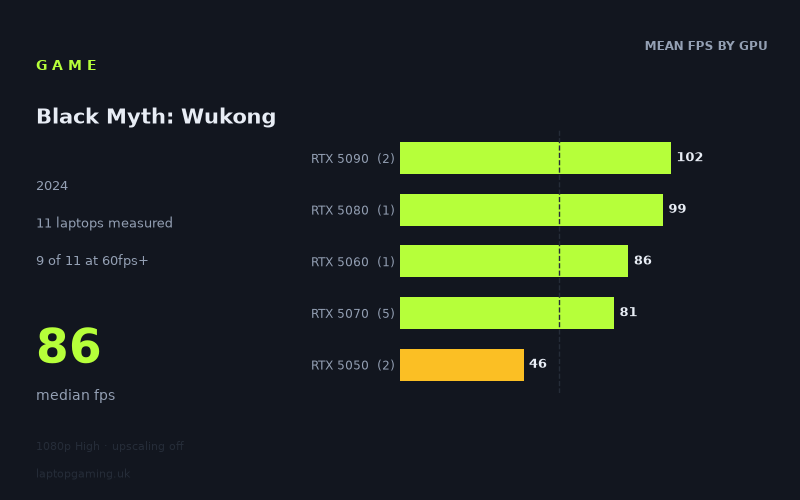
Every laptop we have figures for
Frame rates measured by Notebookcheck.
What it asks of a laptop
The spread here is the story: 110fps at the top, 46fps at the bottom, with a median of 97fps across nine machines at 1920x1080, High preset, upscaling switched off. That is a factor of 2.4 between fastest and slowest, which is a wide gap by the standards of our suite, and almost all of it opens up at the bottom of the stack rather than the top.
Look at how the tier averages fall. RTX 5090 laptops average 102fps. RTX 5080 lands on 99fps. RTX 5070 averages 92fps. RTX 5060 manages 86fps. Then the RTX 5050 collapses to 46fps. The first four tiers are separated by 16fps in total — a rounding error spread across three generations of silicon tier — and then the floor drops out by 40fps in a single step.
That shape tells you two things. First, at 1080p High this game runs into a ceiling well before it runs out of GPU. Nothing in the measured set clears 144fps, and the fastest result comes from an RTX 5070 at 140W in the HP OMEN 16 (110fps), which edges out an RTX 5090 at 175W in the ROG Strix Scar 18 (107fps). A mid-tier card beating a flagship is not a mid-tier card being fast; it is the workload being limited by something other than raw shader throughput at this resolution — CPU, frame delivery, or engine overhead. Buying up beyond the 5070 tier buys you nothing at 1080p High.
Second, and this is the important half: the difficulty is genuinely real for entry-level hardware. The two RTX 5050 machines, both running at 75W, sit at 47fps and 46fps. They are not close to 60. This is a game that is trivially easy for the middle of the market and outright hard for the bottom of it, with very little in between.
What runs it
Working through the tiers against the measured figures:
- RTX 5090 — 107fps (Asus ROG Strix Scar 18, 175W) and 97fps (Razer Blade 16, Core Ultra 9). Both clear 60fps comfortably, both are at or near 100fps, neither approaches 144fps. The Blade's 97fps is the lower of the two, which is what a thin 16in chassis does to a 5090.
- RTX 5080 — 99fps (Lenovo Legion Pro 7i 16 Gen 10, 175W). Effectively identical to the 5090 results. Comfortably above 60, a whisker short of 100.
- RTX 5070 — the most interesting tier, and the widest. 110fps in the HP OMEN 16 at 140W, 100fps in the Acer Nitro V16 at 115W, and just 65fps in the HP Omen 17z-db100. That is a 45fps range within one GPU name. Power delivery and chassis cooling are doing more work here than the model number is.
- RTX 5060 — 86fps (Acer Nitro V 15, 115W). Clears 60fps with a healthy margin and beats one of the three 5070 laptops outright.
- RTX 5050 — 47fps (ASUS TUF Gaming A14, 75W) and 46fps (HP Victus 15, 75W). Neither clears 60fps at these settings.
Tallied up: seven of nine laptops clear 60fps, three of nine clear 100fps, and none clear 144fps. If you have a high-refresh 165Hz or 240Hz panel, nothing in this measured set feeds it at 1080p High with upscaling off. The realistic ceiling is around 110fps.
The cheapest laptop that handles it
On the measured numbers, the answer is the Acer Nitro V 15 with an RTX 5060 at 115W, at £931, delivering 86fps. That is the cheapest machine in the set that clears 60fps, and it does so with roughly 40 per cent of headroom in hand — enough that a dip during a heavy encounter shouldn't drag you under.
The two cheaper or similarly priced options both fail. The HP Victus 15 at £799 manages 46fps and the ASUS TUF Gaming A14 at £1,007 manages 47fps, both on 75W RTX 5050s. The TUF is the sharper warning here: it costs £76 more than the Nitro V 15 and delivers 45 per cent fewer frames. You are paying for the 14in chassis, not the performance.
If you want to be safely into three figures, the Acer Nitro V16 at £1,199 hits exactly 100fps on a 115W RTX 5070. The HP OMEN 16 at £1,375 is the fastest machine measured at 110fps, courtesy of that 140W power limit. Above that, the numbers stop improving: the Legion Pro 7i at £3,662 returns 99fps and the Razer Blade 16 at £4,979 returns 97fps. Both are slower than a laptop costing under a third as much.
What this means if you're buying
Three things follow from these figures.
Do not buy a 75W RTX 5050 for this game. Both examples land in the mid-40s. You would be turning settings down or leaning on upscaling from day one, and that is at 1080p, the least demanding resolution on the table.
The RTX 5060 is the value floor and the RTX 5070 is the value ceiling. £931 buys 86fps; £1,375 buys 110fps, the fastest result recorded. Everything past that point is spending money on a workload that isn't asking for it.
Watch the wattage, not the model number. The RTX 5070 results range from 65fps to 110fps depending on the machine. A 140W 5070 in a well-cooled 16in chassis is a genuinely fast configuration for this title; a poorly-fed one sits below an RTX 5060. Check the stated TGP before you check the GPU name — on this evidence it is the better predictor of what you'll actually get.
How these numbers were produced
Frame rates here are not measured by us, and we label how each one was arrived at. A figure marked measured comes from a published run on that exact machine. A figure marked representative is derived from the GPU and its power limit (TGP) and cross-referenced against published reviews - a sound estimate of what that configuration delivers, but not a measurement of that specific laptop. Unless stated otherwise, numbers are 1920x1080, High preset, upscaling off. Where a laptop ships in several power configurations we use the wattage of the exact SKU listed, because a 140W RTX 5070 and a 115W one are not the same product.