Performance analysis
Ghost of Tsushima (2024): what it takes to run it
Measured on 14 gaming laptops at 1920×1080, High preset, upscaling off.

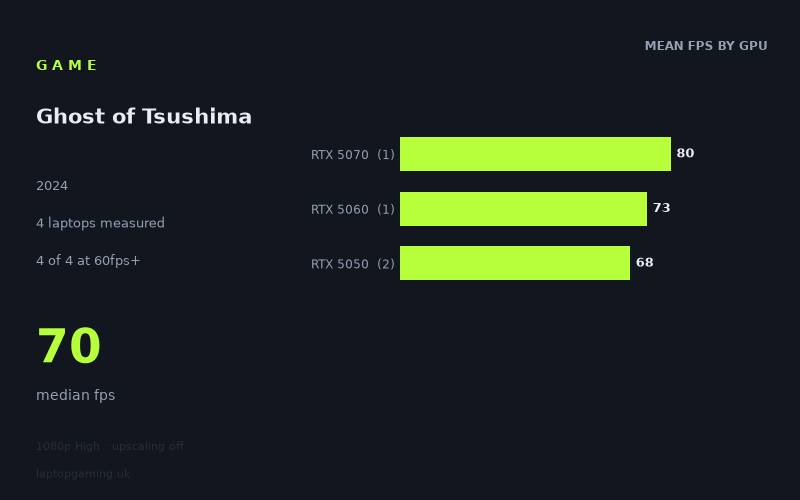
Every laptop we have figures for
Frame rates measured by Notebookcheck.
What it asks of a laptop
The most useful thing about Notebookcheck's Ghost of Tsushima numbers isn't the top figure — it's how little distance there is between the top and the bottom. Four laptops, all measured at 1920x1080 on the High preset with upscaling switched off, land between 68fps and 80fps. That's a 12fps spread, or roughly 18% from slowest to fastest, across a hardware range that spans an RTX 5050 all the way to an RTX 5070.
That compression tells you more than any single result. On a genuinely GPU-bound title at 1080p, you would expect a 5070 to pull away from a 5050 by a far wider margin than eight to twelve frames. Here it doesn't. The scaling by tier is almost flat: RTX 5050 averages 68fps, RTX 5060 manages 73fps, and the RTX 5070 tops out at 80fps. Each step up the stack buys you around five frames. That is not the signature of a game that is starving the graphics card.
What it looks like instead is a title whose 1080p frame rate is being governed by something other than raw GPU throughput — CPU-side work, engine overhead, or simply a well-optimised renderer that isn't asking enough of a modern discrete GPU to separate the tiers at this resolution. Whatever the cause, the practical consequence is the same: at 1080p High, buying a bigger GPU is a poor way to buy frames in this game. The measured figures show diminishing returns immediately, from the very bottom of the current RTX 50-series laptop range upwards.
The flip side is that this is a forgiving game by the standards of recent releases. Every one of the four machines cleared 60fps without upscaling assistance. There is no entry-level cliff here, no tier at which the game becomes a slideshow. The floor is high and the ceiling is low.
What runs it
60fps: everything measured
4 of 4 laptops cleared 60fps. The slowest results in the data set — 68fps on both the Acer Nitro V 16 AI (RTX 5050 at 115W) and the Medion Erazer Scout 17 E1 (RTX 5050) — still sit eight frames clear of the 60fps line. That's a meaningful buffer, not a marginal pass. It means a 5050 machine holds 60fps with room to absorb dips in heavier scenes, at High settings, with no upscaling doing the heavy lifting.
Note also that the two RTX 5050 laptops returned identical 68fps figures despite one being explicitly listed at a 115W power target. When a power-configured chip and its sibling land on the same number, that's another sign the GPU isn't the constraint. Chassis and cooling quality, which usually separate identically-specced laptops in demanding titles, made no difference here.
100fps: none of them
0 of 4 laptops reached 100fps. The fastest result in the entire data set is 80fps from the MSI Katana 17 HX with an RTX 5070 — twenty frames short. Given how flat the tier scaling is below it, there is nothing in these figures to suggest a modest step up would close that gap. On this preset, at this resolution, with upscaling off, 100fps is not on the table for any of the four measured machines.
144fps: not close
0 of 4. The median across the set is 70fps, less than half the refresh rate of the 144Hz panels fitted to most gaming laptops in this price bracket. If you have bought, or are about to buy, a high-refresh screen specifically to feed it with this game at native 1080p High, the measured numbers say you will be leaving most of that panel unused.
One caveat worth holding onto: these runs were captured with upscaling disabled. They are unassisted, native-resolution figures. Nothing in the data tells us what happens with upscaling engaged, so we won't guess — but it does mean 68fps on a 5050 represents the harder of the two cases, not the easier one.
The cheapest laptop that handles it
The only price in the data set is the MSI Katana 17 HX (RTX 5070) at £2,312, and it is also the fastest machine measured, at 80fps. That makes it the clearest illustration of the problem: it costs the most and it delivers twelve frames more than the cheapest silicon in the group.
The Acer Nitro V 16 AI (RTX 5050 at 115W) and the Medion Erazer Scout 17 E1 (RTX 5050) both hit 68fps. Neither has a price in the measured data, so we won't put a figure on them — but the RTX 5050 sits at the entry point of the current mobile range, and both machines are clearly positioned well below the Katana. The Lenovo LOQ (RTX 5060 at 115W) splits the difference at 73fps.
On the evidence available, the sensible recommendation is the cheapest RTX 5050 laptop you can find with adequate cooling. It delivers 85% of the frame rate of the £2,312 machine in this particular title. If you can stretch to an RTX 5060 like the LOQ, you gain five frames — useful for stability margin, not transformative.
What this means if you're buying
- Don't buy up for this game. The measured tier scaling — 68fps to 73fps to 80fps — means each GPU step returns around five frames at 1080p High. If Ghost of Tsushima is the title driving your purchase, an RTX 5050 machine already clears 60fps comfortably and the money is better spent elsewhere.
- Do buy up for other games. The flat scaling here is a property of this title, not of the hardware. A 5070 that is only 18% faster in this game will not be only 18% faster everywhere. Judge the GPU on your wider library.
- Treat 60Hz as the realistic target. With a 70fps median and nothing in the set above 80fps, a high-refresh panel is not being fed by this game at native 1080p High. That's a reason to weight panel spend towards colour and brightness rather than refresh rate, if this is representative of what you play.
- The 115W figures didn't matter. Two RTX 5050 laptops, one explicitly power-configured, returned the same 68fps. Cooling and power headroom are worth paying for in demanding titles — this isn't one of them.
How these numbers were produced
Frame rates here are not measured by us, and we label how each one was arrived at. A figure marked measured comes from a published run on that exact machine. A figure marked representative is derived from the GPU and its power limit (TGP) and cross-referenced against published reviews - a sound estimate of what that configuration delivers, but not a measurement of that specific laptop. Unless stated otherwise, numbers are 1920x1080, High preset, upscaling off. Where a laptop ships in several power configurations we use the wattage of the exact SKU listed, because a 140W RTX 5070 and a 115W one are not the same product.