Performance analysis
Civilization 7 (2025): what it takes to run it
Measured on 10 gaming laptops at 1920×1080, High preset, upscaling off.

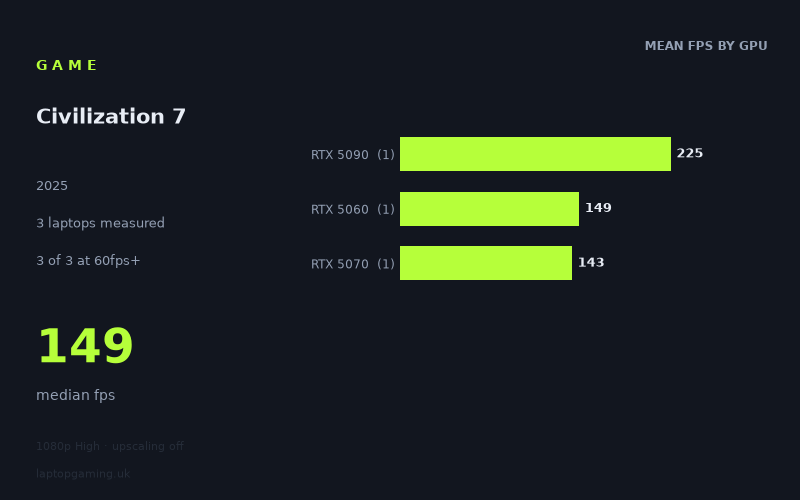
Every laptop we have figures for
Frame rates measured by Notebookcheck.
What it asks of a laptop
Start with the caveat, because it matters here: we have measured figures for exactly three laptops. Three data points, one per GPU tier, at 1080p on the High preset with upscaling switched off. That is enough to establish a rough shape and nothing more. Treat everything below as "here is what these three machines did", not as a verdict on every laptop carrying the same silicon.
With that said, the shape is unusually clear. All three machines cleared 100fps. The slowest of them managed 143fps. There is no struggling end of this sample — the gap between "fastest" and "slowest" is the gap between a very comfortable frame rate and an extremely comfortable one.
The numbers:
- 225fps — Medion Erazer Beast 16 X1 Ultimate, RTX 5090
- 149fps — Lenovo LOQ, RTX 5060 at 115W
- 143fps — MSI Katana 17 HX, RTX 5070
The detail worth pausing on is the middle of that list. The RTX 5060 machine posted a higher figure than the RTX 5070 machine — 149fps against 143fps. That is a six-frame difference, which at these speeds is close to noise, but it is the wrong way round if you assume GPU tier dictates outcome. With one laptop per tier we cannot say why. It could be CPU differences between the two chassis, it could be run-to-run variance, it could be power and thermal behaviour in two very different laptops. What it does tell you is that the RTX 5060 and RTX 5070 landed in the same performance band at 1080p High, and that whatever separates them in more demanding titles did not separate them here.
Meanwhile the RTX 5090 pulled clear at 225fps — roughly 51% ahead of the 5060 result and 57% ahead of the 5070 result. So the top of the stack does scale. The plausible reading, and it is a reading rather than a finding, is that at 1080p High this game does not saturate mid-tier hardware, so the 5060 and 5070 bunch up against some other limit, while the 5090 has enough headroom to push past it. A single 5090 data point cannot confirm that, but it is consistent with a game that is light on GPU load relative to what modern mobile silicon offers.
What runs it
Working through the thresholds with the figures actually in hand:
- 60fps: 3 of 3. Every machine cleared it by a very wide margin. The slowest result is more than double 60fps.
- 100fps: 3 of 3. Again, not close — the lowest figure is 43% above the 100fps line.
- 144fps: 2 of 3. The RTX 5090 (225fps) and the RTX 5060 laptop (149fps) cleared it. The RTX 5070 laptop landed at 143fps, one frame short. Calling that a meaningful failure would be silly; it is a rounding error against a 144Hz panel and would sit essentially at the refresh ceiling in practice.
By tier, then: the RTX 5060 at 115W was sufficient for a high-refresh 1080p experience in this sample. The RTX 5070 delivered effectively the same. The RTX 5090 delivered a lot more headroom than 1080p High requires, and its 225fps figure is the one that suggests room for higher resolutions or heavier settings — though we have no measured figures at any other resolution or preset, so that is an inference, not a benchmark.
What we cannot tell you, because nobody in this sample tested it: how anything below an RTX 5060 behaves, how the game responds at 1440p or 4K, how much upscaling recovers, or what happens on a late-game map with a full turn of AI processing. The measured figures are one preset, one resolution, three machines.
The cheapest laptop that handles it
Of the three machines with figures, the Lenovo LOQ with an RTX 5060 at 115W is the obvious value pick — and it is also the second-fastest result in the set at 149fps. No price is listed for it in the source figures, but the LOQ line is Lenovo's budget gaming range and sits well below the other two machines here.
The MSI Katana 17 HX at £2,312 returned 143fps with an RTX 5070. Against the LOQ's 149fps, that is more money for no measured gain in this specific title. If Civ 7 is the primary reason you are buying, the Katana's price is being spent on capability this game did not ask for.
The Medion Erazer Beast 16 X1 Ultimate at £4,884 is the RTX 5090 machine at 225fps. That is 76 frames a second more than the cheapest laptop in the sample, at a price that is a multiple of it. For this game at 1080p High, that money buys frames past the point where most panels can display them.
What this means if you're buying
Do not buy a laptop for Civilization 7. That is the honest summary of three data points that all land between 143 and 225fps. Every machine here was comfortably beyond playable, and the cheapest one was the second-fastest.
If you already own something in the RTX 5060-and-up bracket, the evidence here suggests you are fine at 1080p High without touching upscaling. If you are shopping and this game is on your list among others, buy for the other games — pick the machine that handles your most demanding title, and Civ 7 will come along for free.
Two practical notes. First, with all three results at or near 144fps or above, a 144Hz panel is the sensible target rather than something faster; only the 5090 machine produced figures that a 240Hz screen would meaningfully use. Second, and this is a limit of the data rather than a recommendation: strategy games place load on the CPU during turn processing in ways a frame-rate benchmark does not capture. The measured figures tell you the game renders quickly on these three laptops. They do not tell you how long a late-game turn takes. Nobody has measured that here, so we are not going to pretend otherwise.
How these numbers were produced
Frame rates here are not measured by us, and we label how each one was arrived at. A figure marked measured comes from a published run on that exact machine. A figure marked representative is derived from the GPU and its power limit (TGP) and cross-referenced against published reviews - a sound estimate of what that configuration delivers, but not a measurement of that specific laptop. Unless stated otherwise, numbers are 1920x1080, High preset, upscaling off. Where a laptop ships in several power configurations we use the wattage of the exact SKU listed, because a 140W RTX 5070 and a 115W one are not the same product.