Performance analysis
Horizon Forbidden West (2024): what it takes to run it
Measured on 17 gaming laptops at 1920×1080, High preset, upscaling off.

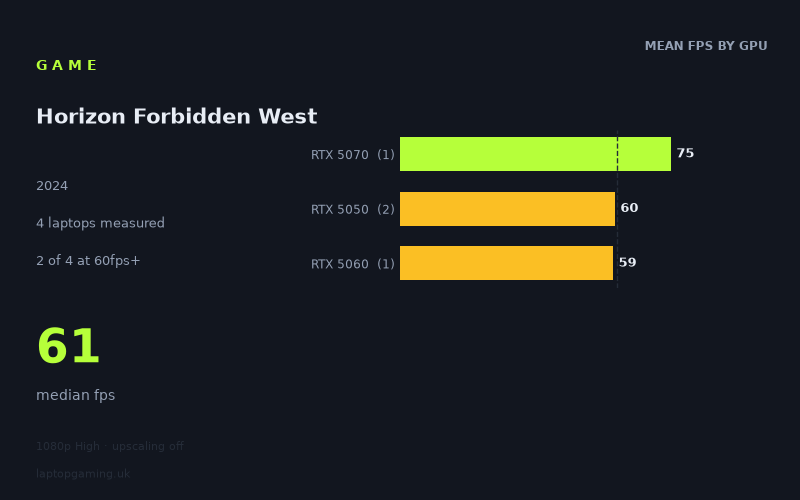
Every laptop we have figures for
Frame rates measured by Notebookcheck.
What it asks of a laptop
The headline number from Notebookcheck's testing is the spread: 75fps at the top, 55fps at the bottom, with a median of 61fps. That is a narrow band in absolute terms — a 20fps gap from the fastest machine to the slowest — but it sits in exactly the wrong place. Every laptop in the sample lands in the 55-75fps window at 1080p on the High preset with upscaling switched off. Nothing gets near 100fps. Nothing gets remotely near 144fps.
That shape tells you something specific. A game that scales cleanly with GPU power tends to produce a wide, fanned-out set of results, where the top card runs two or three times the frame rate of the entry-level one. Horizon Forbidden West does not do that here. The RTX 5070 machine posts 75fps; the slowest RTX 5050 machine posts 55fps. That is roughly a 36 per cent gain for a substantially more expensive GPU tier, and it still does not clear a comfortable margin above 60fps.
Look at the tier averages and the picture gets stranger. The RTX 5050 laptops average 60fps across two machines. The single RTX 5060 result is 59fps. On the measured figures, the 5060 sample is slower than the 5050 average. That is not how GPU tiers are supposed to work, and it is the most useful thing in the dataset.
There are two readings, and they are not mutually exclusive. The first is that this is a heavily CPU-bound workload at 1080p, so once you have enough GPU to feed the frame, additional shader throughput stops buying you frames and the bottleneck moves to the processor and memory subsystem. The second is that chassis-level factors — sustained power limits, cooling headroom, how aggressively a given laptop lets its GPU boost — matter more than the sticker on the box. The Lenovo LOQ's 5060 is noted as running at 115W, which is not a generous allocation for that tier, and it lands at 59fps. Meanwhile one RTX 5050 machine, the Medion Erazer Scout 17 E1, manages 64fps.
The clearest evidence for the chassis argument is inside the 5050 tier itself. Two laptops, the same GPU, and results of 64fps and 55fps. That is a 16 per cent gap between identical silicon, which is the same order of magnitude as the gap between the 5050 average and the 5070. If you take nothing else from these numbers, take that: the specific laptop matters roughly as much as the GPU tier here.
What runs it
60fps at 1080p High: two of the four measured laptops clear it. The MSI Katana 17 HX with the RTX 5070 does so comfortably at 75fps. The Medion Erazer Scout 17 E1 with an RTX 5050 clears it at 64fps. The Lenovo LOQ's RTX 5060 at 115W misses by a single frame at 59fps, which in practice is indistinguishable from hitting it. The HP Victus 15-fa2160ng at 55fps is the only machine meaningfully below the line.
100fps at 1080p High: nothing in the sample gets there. Not the 5070, which is 25fps short. On these settings, with upscaling off, a high-refresh experience is not on the table for any of the four laptops measured.
144fps at 1080p High: not remotely. The fastest machine is running at roughly half that. If you have bought a 165Hz or 240Hz panel and you intend to feed it at native resolution on High, these figures say you will not, on any of this hardware.
The obvious caveat is that all of this is measured with upscaling switched off. That is the honest way to compare GPUs, because it removes a variable, but it is not how most people will actually play. Notebookcheck's numbers do not include upscaled results, so we cannot put a figure on the gain — but the general principle holds that if a game is GPU-limited, upscaling helps, and if it is CPU-limited, it helps a great deal less. Given how tightly the results cluster regardless of GPU tier, temper your expectations about how much headroom you can buy back that way.
The cheapest laptop that handles it
Only one price is given in the measured set: the MSI Katana 17 HX (RTX 5070) at £2,312. It is also the fastest machine at 75fps, and the only one with genuine breathing room above 60fps.
But it is not the value pick on this evidence. The Medion Erazer Scout 17 E1, running the far cheaper RTX 5050, posts 64fps — 85 per cent of the Katana's frame rate from a considerably lower GPU tier. It clears 60fps and it does so without a £2,300 outlay. On the measured figures, that is the machine that answers the question most efficiently.
The two to be careful with are the Lenovo LOQ (RTX 5060 at 115W) at 59fps and the HP Victus 15-fa2160ng (RTX 5050) at 55fps. Neither is unplayable — 55fps is a perfectly usable frame rate in a game of this kind — but neither gives you anything to spend on higher settings or a higher resolution.
What this means if you're buying
Do not pay for GPU tier expecting proportional frames in this title. The measured spread says a 5070 buys you 75fps where a well-implemented 5050 gives you 64fps, and a poorly-fed 5060 gives you 59fps. The tier ordering breaks down entirely in the middle of this dataset.
What to check instead: sustained GPU power limits and cooling. The 115W figure attached to the LOQ's 5060 is the sort of detail that explains a 59fps result, and the nine-frame gap between two 5050 laptops is the sort of thing that only chassis design explains. Read the wattage figures on the spec sheet, not just the GPU name.
And set your expectations for the panel accordingly. On these numbers, at 1080p High with upscaling off, this is a 60fps game across the board — a comfortable one at the top of the range, a marginal one at the bottom. A 144Hz or higher display will not be doing anything useful here at native resolution. Budget for a machine that holds 60fps reliably rather than one that promises a refresh rate the frame rate cannot reach.
How these numbers were produced
Frame rates here are not measured by us, and we label how each one was arrived at. A figure marked measured comes from a published run on that exact machine. A figure marked representative is derived from the GPU and its power limit (TGP) and cross-referenced against published reviews - a sound estimate of what that configuration delivers, but not a measurement of that specific laptop. Unless stated otherwise, numbers are 1920x1080, High preset, upscaling off. Where a laptop ships in several power configurations we use the wattage of the exact SKU listed, because a 140W RTX 5070 and a 115W one are not the same product.