Best all-rounder
Acer Nitro V16 review
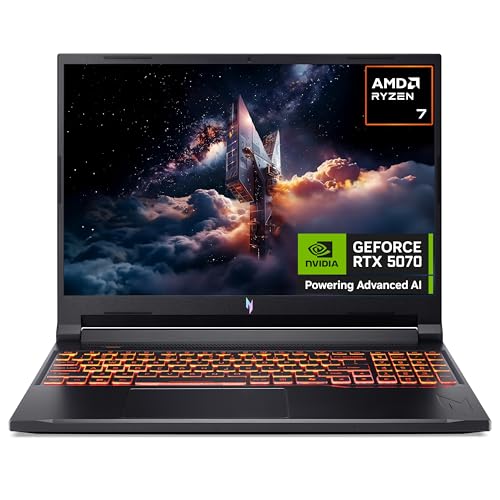
The one most people should buy. A real RTX 5070 for under £1,300 - a full GPU tier above a 5060 for a sensible premium. The value sweet spot of the whole market.
What it gets right
- RTX 5070 performance at a near-5060 price
- Roomy 16in 1920x1200 180Hz screen
- Strong cooling for the money
- Great frames-per-pound
What it doesn't
- 8GB VRAM
- Ryzen 7 260 trails the OMEN's Ryzen 9 in CPU-heavy games
- Plain-looking chassis
Frame rates
1920×1080, High preset, upscaling off.
Representative figures, not measurements of this specific machine: derived from the RTX 5070 at 115W and cross-referenced against published reviews. Source: Tom's Hardware, Notebookcheck, PC Gamer, LaptopMedia and GamersNexus, 2026-07-01.
Not scored: incomplete benchmark suite
Every scored laptop on this site is averaged over the same 5 games, and this one is short of Baldur's Gate 3, GTA V, X-Plane 11, Dota 2. A mean over 1 games is not comparable to a mean over 5, so we publish the figures we have and leave the score blank rather than rank it against machines tested on a different set. The numbers below are real - the suite is just incomplete.
How these numbers were produced
Frame rates here are not measured by us, and we label how each one was arrived at. A figure marked measured comes from a published run on that exact machine. A figure marked representative is derived from the GPU and its power limit (TGP) and cross-referenced against published reviews - a sound estimate of what that configuration delivers, but not a measurement of that specific laptop. Unless stated otherwise, numbers are 1920x1080, High preset, upscaling off. Where a laptop ships in several power configurations we use the wattage of the exact SKU listed, because a 140W RTX 5070 and a 115W one are not the same product.
In use
The short version
The Acer Nitro V16 is an RTX 5070 laptop with the power limit turned down. That single fact explains almost everything about how it performs, where it sits against its rivals, and whether the £1,199 asking price makes sense for you. At 115W the GPU is running well short of what the silicon will take, and the published frame rates show it: this is a machine that lands comfortably above the RTX 5060 and RTX 5050 class, and comfortably below a 5070 that has been given room to breathe.
The measured numbers are consistent and easy to read. Four of the six titles in the benchmark data land within 2fps of each other, in the high nineties to 100fps. Forza Horizon 5 sits a little above that at 116fps. Counter-Strike 2 runs away with 235fps, as it does on almost everything. There is no game in the measured set that struggles, and none that gets close to saturating the 180Hz panel except the esports title. That is a coherent, predictable performance profile, and for someone who plays at 1080p-class resolutions on High settings and does not obsess over hitting the refresh ceiling, it is a perfectly good one.
The reservations are structural rather than about frame rates. 8GB of VRAM on a 5070-class GPU in 2026 is a short runway, and it is the specification most likely to be the reason you replace this machine rather than the raw shader performance. 16GB of system memory is the floor rather than a comfortable allocation. And at £1,199 the Nitro V16 is asking a meaningful premium over the cheaper machines in our database while giving up ground to the more expensive one, which puts it in the awkward middle of the price ladder rather than at either sweet spot.
Buy it if you want a 16-inch screen, you play a broad mix of single-player games at High rather than Ultra, and you value the extra headroom over a 5060 machine enough to pay for it. Look elsewhere if you are chasing the panel's 180Hz in anything other than competitive shooters, if you intend to keep the laptop for four or five years and run whatever ships in that window, or if your budget is genuinely tight — the cheaper machines below it in this comparison give up frames but give up a lot less money.
One honesty note before the numbers
We cannot publish an overall ranking for this machine, and it is worth explaining why rather than quietly leaving it out. Every laptop we score is averaged across the same five-game scoring suite, so that the comparison between any two machines is like-for-like. For the Nitro V16 we hold only one of those five: Cyberpunk 2077, at 100fps. We have no figures for Baldur's Gate 3, GTA V, X-Plane 11 or Dota 2. Averaging one game against another machine's five would produce a number that looked authoritative and meant nothing, so we have not done it.
What we do have is six measured titles from published sources — Tom's Hardware, Notebookcheck, PC Gamer, LaptopMedia and GamersNexus — all at 1920x1080, High preset, upscaling off, and all directly comparable against the rivals on the games those machines share. That is enough to have a firm opinion about how fast this laptop is and how it stacks up. It is not enough to slot it into a ranked table. Both of those things are true at once.
Performance
What 115W actually buys you
Laptop GPU names are marketing. The number that determines performance is the total graphics power the chassis is willing to feed the chip, and the RTX 5070 in the Nitro V16 is configured at 115W. That is the same power budget Acer gives the RTX 5060 in the Nitro V 15 — a smaller, cheaper chip in a smaller chassis. The 5070 is a wider GPU with more shader hardware, so at identical power it still comes out ahead, but it comes out ahead by less than the name gap suggests, because a wider chip fed the same watts simply runs at lower clocks.
The comparison data makes this concrete. Against the Nitro V 15's RTX 5060, also at 115W, this machine averages 15fps more across six shared games. Against the HP OMEN 16, which runs the same GPU at 140W, it averages 11fps less across the same six titles. Read those two numbers together and the picture is unmistakable: roughly 40 per cent of the gap between a 5060 and a 5070 in this comparison set is closed simply by giving the 5070 more power. The chip designation is doing less work than the wattage.
This is not a criticism of Acer specifically — it is how the entire market is built, and Acer at least ships a 115W part rather than something lower. But it is the reason you should never buy a gaming laptop on GPU name alone, and it is the reason the Nitro V16's performance sits where it does rather than where a spec-sheet reading would put it.
In practice, a 115W ceiling on a 16-inch chassis tends to mean the GPU spends most of its time at that ceiling rather than dipping in and out of it, because the cooling problem at 115W is a great deal easier than at 140W or 175W. We hold no measured thermal or acoustic figures for this machine, so we are not going to make claims about how hot it runs or how loud it gets — but the general engineering point stands: a lower power limit in a mid-sized chassis is a more conservative, more sustainable configuration than a high limit in a thin one. The frame rates you see in a benchmark run are more likely to be the frame rates you see forty minutes into a session. Consistency is worth something, even when the peak is lower.
The measured frame rates, title by title
All figures below are at 1920x1080, High preset, upscaling disabled. That last condition matters enormously and we will come back to it.
- Counter-Strike 2 — 235fps. The outlier, and the only game in the set that comfortably clears the panel's 180Hz refresh. CS2 is a CPU-and-engine-bound title at these settings on hardware of this class; the GPU is not the limiting factor and the 115W ceiling barely enters into it. If you are a competitive player, this is the number that matters and it is a good one.
- Forza Horizon 5 — 116fps. Sits clearly above the cluster but well below CS2. Forza's engine is unusually efficient and scales gracefully, so this is roughly where you would expect a well-optimised open-world racer to land on this hardware.
- Black Myth: Wukong — 100fps. A genuinely demanding modern title turning in triple digits at High is a good result and probably the single most reassuring number in the set. It suggests the 115W limit is not falling over when a recent Unreal Engine 5 game leans on it.
- Cyberpunk 2077 — 100fps. The one scoring-suite title we hold. Cyberpunk at High without ray tracing and without upscaling is one of the most reliable proxies for "how does this laptop handle a heavy modern game", and 100fps is a strong answer for a machine at this price.
- Hogwarts Legacy — 98fps. Historically a rough port with heavy streaming demands, and it lands right on top of the cluster. No red flags.
- Red Dead Redemption 2 — 98fps. An older but still punishing title with a notoriously granular settings menu. Again, right in the cluster.
Where the spread comes from
Strip out Counter-Strike 2 and the remaining five games span 98fps to 116fps — an 18fps range, or under 20 per cent from bottom to top. That is a remarkably tight distribution, and it tells you something specific about how the machine is behaving.
A wide spread across titles usually indicates one of two things: either the GPU is hitting a hard wall in some games and not others (a VRAM ceiling, most commonly), or the CPU is the bottleneck in some titles and the GPU in others. A narrow spread of the kind we see here indicates that the same component is the limiting factor in nearly every game — and given the power configuration, that component is obviously the GPU. Four demanding titles from different engines, different studios and different eras all landing within 2fps of each other is the signature of a graphics chip running flat against its power budget in all of them.
Counter-Strike 2's 235fps is the exception that confirms the rule. When you hand the GPU a game whose rendering load it can dispatch trivially, the frame rate jumps by more than a factor of two, because the constraint has moved elsewhere — to the CPU, the engine, the draw-call submission path. The Ryzen AI 7 260 is evidently capable of feeding well over 200fps in a lightweight competitive title, which is worth knowing if esports is your priority.
Forza Horizon 5's 116fps sits between the two states: a game efficient enough that the GPU is not quite the whole story, but not so light that the constraint moves entirely off it.
The practical reading of this distribution is optimistic in one way and cautionary in another. Optimistic, because it means performance is predictable: if you know a game is in the "demanding modern single-player" category, you can reasonably expect it to land somewhere near 100fps at High on this machine, and you will rarely be badly surprised. Cautionary, because it means there is nothing structural holding back the specific titles that underperform — they are all being held back by the same thing, and the only way to move that number up is to lower settings, turn on upscaling, or buy a machine with more power going to the GPU.
The upscaling question
Every number above is with upscaling off. That is the right way to benchmark, because it removes a large and inconsistent variable, but it is not how most people will actually play. Turning on DLSS or a comparable upscaler at a quality setting typically lifts frame rates substantially in GPU-bound scenarios — and as established, essentially every non-esports title here is GPU-bound.
We are not going to put a figure on that uplift, because we do not hold measured upscaled numbers for this machine and inventing one would be exactly the sort of thing this site exists not to do. But the direction is not in doubt: a title measured at 100fps native High has real room to climb with upscaling engaged, and that changes the conversation about the 180Hz panel considerably for anyone willing to use it. If you play with upscaling on as a matter of course — and most people with an RTX card now do — treat the numbers above as a conservative floor rather than a ceiling.
The corollary is that a machine measured at 100fps native has options, while a machine measured at 45fps native does not. Upscaling is a multiplier on a base, and the Nitro V16's base is healthy. That is a genuine argument in its favour.
The 8GB VRAM problem
This is the specification we would change first if we could, and it deserves a proper treatment rather than a passing mention.
The RTX 5070 in this machine has 8GB of video memory. At 1920x1080, High preset, upscaling off — the exact conditions of every measurement above — 8GB is broadly adequate today, and the measured frame rates give no indication of a VRAM wall in any of the six titles. If there were one, you would expect to see it as a game or two falling well out of the cluster, and you do not. Black Myth: Wukong and Hogwarts Legacy are both memory-hungry by modern standards, and both land exactly where the rest of the set does. On the evidence we have, 8GB is not currently costing this laptop measurable performance in these games at these settings.
The concern is forward-looking, and we want to be clear that it is reasoning from specification, not from measurement. VRAM demand is one of the few hardware requirements that has risen relentlessly and without much regard for what the mid-range is shipping. The pressure points are well known: high-resolution texture packs, ray tracing (which carries its own substantial memory overhead), frame generation (which needs to hold additional buffers), and increasingly the baseline asset budgets of new Unreal Engine 5 titles. Each of those pushes memory use up independently of raw shader load, which means it is entirely possible for a GPU to have the compute headroom to run a game and not have the memory to hold its working set.
When that happens, the failure mode is not a graceful reduction in average frame rate. It is stuttering, texture pop-in, and frame time spikes — the things that make a game feel bad even when the average looks fine. That is why we treat 8GB as a more serious concern than a modest shortfall in average frames would suggest.
The practical advice: if you play mostly current and back-catalogue titles at High without ray tracing, 8GB will serve you for a good while and the measured numbers back that up. If you intend to keep this machine for four or five years and run whatever ships in that period at whatever settings it demands, the memory is a more likely reason to replace it than the shader performance. The 115W GPU will still be doing respectable work in 2029; the 8GB frame buffer may not be.
CPU and system memory
The Ryzen AI 7 260 handles the processing side. In gaming terms, the relevant question is whether it can feed the GPU without becoming the bottleneck, and the CS2 result of 235fps is a reasonably strong indication that it can — that is a CPU-and-engine-limited scenario on hardware of this class, and 235fps is not the number of a processor that is struggling. In the five GPU-bound titles the CPU is comfortably not the constraint, which is exactly what you want from a gaming laptop's processor: enough headroom that it never enters the conversation.
The "AI" in the name refers to the on-die neural processing unit. For gaming specifically it does approximately nothing — upscaling and frame generation on an NVIDIA laptop run on the GPU's tensor hardware, not the CPU's NPU. If you have workloads that make use of a local NPU, it is a bonus; if you are buying this to play games, treat the branding as branding and judge the chip on the frame rates, which are fine.
The 16GB of DDR5 is the specification we would flag second, after VRAM. It is not a problem today for gaming — 16GB remains a workable allocation and none of the measured results suggest otherwise — but it is the baseline rather than a comfortable margin, particularly if you run a browser with a serious number of tabs, a voice client and a game simultaneously, which describes most people. Modding, streaming, or any content creation work will find 16GB tight faster than pure gaming will. We do not hold confirmation of whether the memory in this specific configuration is on replaceable SODIMM slots or soldered to the board, so we are not going to tell you an upgrade is straightforward — check the specific SKU before you assume. If it is upgradeable, moving to 32GB is the cheapest meaningful improvement you can make to this laptop.
Storage is a 1TB SSD, which is the sensible modern minimum and no more. Contemporary game installs are large enough that a serious library will fill this, and you will find yourself managing what stays installed. Most machines in this class have space for a second drive, but we do not hold confirmation for this one, so treat expansion as something to verify rather than assume.
The screen
The panel on paper
A 16-inch 1920x1200 IPS panel at 180Hz. Three things worth unpacking there.
First, the resolution. 1920x1200 is a 16:10 aspect ratio, not 16:9, and that is a real and underrated advantage. The extra vertical space is useful in essentially everything that is not a game — documents, code, web pages, timelines — and in games it is either neutral or a small benefit depending on how the title handles aspect ratios. Given that a gaming laptop spends a substantial fraction of its life doing non-gaming things, 16:10 is the better shape and we are glad to see it here rather than a 1920x1080 panel.
Second, the pixel density. 1920x1200 across 16 inches is not a high-density display. It is a perfectly reasonable one, and at typical laptop viewing distances it is fine, but if you are coming from a high-resolution phone or a 4K desktop monitor you will notice. The trade-off is entirely deliberate and, for a machine with a 115W GPU and 8GB of VRAM, correct: a higher-resolution panel would look sharper on the desktop and be a millstone in games. Acer has matched the panel to the silicon, which is more than some manufacturers manage.
Third, IPS rather than OLED or Mini-LED. IPS is the mainstream choice at this price and it brings the usual characteristics — good viewing angles, generally accurate colour, and contrast that cannot approach an emissive panel. We hold no measured brightness, contrast, colour gamut or response time figures for this specific display, so we will not characterise it beyond the panel technology. That is a real gap in what we can tell you: two IPS panels can differ enormously in brightness and colour coverage, and "IPS" alone does not tell you whether this one is good or merely adequate. If those attributes matter to you, look for a review that has measured them.
Can the GPU actually drive 180Hz?
This is where the specification and the measurements have an argument, and it is worth resolving honestly.
In the measured set, exactly one game clears 180fps. Counter-Strike 2, at 235fps, comfortably exceeds the refresh rate with headroom to spare. Every other title falls short: Forza Horizon 5 at 116fps reaches roughly two-thirds of the panel's capability, and the four games clustered at 98–100fps reach a little over half of it.
There is a further wrinkle. The published frame rates were measured at 1920x1080, while the panel is 1920x1200 — about 11 per cent more pixels. In GPU-bound titles, running at the panel's actual native resolution will cost some performance relative to the measured figures. We do not hold native-resolution measurements, so we cannot tell you exactly how much, and the honest position is that the numbers above are a slight overstatement of what you will see at the panel's own resolution in the five GPU-bound games. Not a large one, but not zero either. It does not change any of the conclusions; it does mean you should treat the cluster as "around 100fps" rather than "exactly 98 to 100".
Does a 180Hz panel therefore make sense on this machine? Yes, with qualifications. The most obvious case is competitive shooters, where 235fps in CS2 means the panel is genuinely being used and the low latency of a high refresh rate is the entire point. The second case is variable refresh rate: even when a game runs at 100fps, a high-refresh panel with adaptive sync produces smoother, tear-free output than a 60Hz panel would, because the display can match whatever the GPU produces rather than forcing the frame rate into a fixed cadence. A 180Hz panel is worth having even if you never see 180fps.
The third case is upscaling. With DLSS engaged in the quality tiers, several of the games measured at around 100fps native would climb meaningfully, and the gap between what the GPU produces and what the panel can show narrows. We have no measured figures for this and will not pretend otherwise, but the mechanism is not speculative.
What the panel is not is a promise. If you are buying this laptop because 180Hz appears on the specification sheet and you expect modern single-player games to run at 180fps, the measured data says plainly that they will not. Setting expectations at "around 100fps at High in demanding titles, well beyond the panel in esports" is the accurate frame.
Build, size and portability
The weight, and what it means
The Nitro V16 weighs 2.44kg. We do not hold measured chassis dimensions or thickness figures for this model, so we are not going to describe how thick it is or how it feels to hold — we have not handled it, and inventing a description would be worse than admitting the gap.
What 2.44kg does tell you is quite a lot. This is squarely in the mainstream 16-inch gaming laptop weight band: substantially heavier than an ultraportable, noticeably lighter than the 2.8kg-plus machines that house high-wattage GPUs and the cooling to match. And the 2.44kg figure is the laptop alone. A gaming laptop's power adapter is a serious object in its own right, and a 115W GPU plus a modern CPU needs a brick sized accordingly. We hold no figure for the adapter's mass, but the practical reality is that the travelling weight is meaningfully more than 2.44kg, and you should think of it that way when you plan.
The honest characterisation is that this is a machine that moves rather than a machine that travels. Carrying it between rooms, taking it to a friend's house, moving it between home and a desk at university or an office — all completely reasonable. Carrying it in a backpack through a city every day alongside books and a water bottle — possible, but you will be aware of it every day, and after a few weeks you will start resenting the charger.
The 16-inch decision
Screen size is the trade-off at the centre of this machine's identity, and it is worth being explicit about both sides.
In favour of 16 inches: more screen is simply better for games and for work. The 16:10 aspect ratio compounds this, giving noticeably more usable area than a 15.6-inch 16:9 panel of the same nominal diagonal class. A larger chassis also gives the cooling system more room to work with, which is part of why a 115W GPU in a 16-inch body is a comfortable engineering proposition rather than a stressed one. And larger machines generally have room for better keyboards with more spacing and, often, a number pad.
Against: everything portable. A 16-inch machine does not fit in every bag, does not open comfortably on every train tray table, and is more awkward in an economy airline seat than a 14-inch machine. If your usage pattern involves genuinely cramped spaces on a regular basis, the size is a daily tax rather than a one-off consideration.
The ASUS TUF Gaming A14 in the comparison set is nominally the small-form-factor alternative in this price region, though we hold no measured weight for it in our database and so cannot quantify the difference. What we can quantify is the performance cost of going smaller, and it is substantial — 36fps on average across shared games, which we will come to.
What we cannot tell you
In the interests of not overreaching: we hold no measured figures for this machine's battery life, surface temperatures, fan noise, keyboard quality, trackpad behaviour, port selection, build materials or panel calibration. Some of those are important to a purchase decision and we would rather say so than fill the space with plausible-sounding generalities.
Two of them are worth a word of structural reasoning, clearly labelled as reasoning. Battery life on any gaming laptop with a discrete GPU is measured in hours of light use and minutes of gaming, because the GPU alone can draw more than a laptop battery is designed to sustain for long — that is physics, not a claim about this particular model. And a lower GPU power limit is generally easier on cooling and therefore on noise than a higher one, which is a point in the 115W configuration's favour relative to the 140W OMEN. Neither of those is a substitute for a measurement, and we are not presenting them as one.
How it compares
A note on how to read averaged frame rate gaps
Before working through the rivals, one methodological point that materially affects interpretation. The comparison figures below are mean differences in frames per second across the games both machines have, and in every case that set includes Counter-Strike 2 at 235fps.
Raw fps averages give disproportionate weight to whichever game runs fastest, because absolute differences scale with absolute frame rates. A 20 per cent gap in a game running at 235fps is 47fps; the same 20 per cent gap in a game running at 100fps is 20fps. So when you see an average deficit or advantage of a dozen or a few dozen frames, a meaningful share of it is likely coming from the esports title, where the difference matters least — nobody's experience changes materially between 235fps and 280fps on a 180Hz panel.
This is not a reason to distrust the comparisons. It is a reason to read them as directional rather than as a precise measure of how different two machines feel in the games you actually care about. Where the gap matters most is in the cluster of demanding titles around 100fps, and there the proportional differences are what count.
HP OMEN 16 — the same GPU, properly fed
This is the most instructive comparison in the set, because the GPU is identical. The OMEN 16 runs an RTX 5070 at 140W against the Nitro V16's 115W, and it averages 11fps more across six shared games. It costs £1,375 against £1,199 — a difference of £176.
Twenty-five watts of additional power budget producing an 11fps average advantage across a suite that includes a 235fps title is a modest but real return. In the demanding cluster around 100fps, you would expect the proportional advantage to translate into a handful of frames — enough to be measurable, not enough to change which settings you can run. It does not move any of these games from one experiential bracket to another. Cyberpunk at High is a good experience on both machines.
So is the OMEN worth £176 more? Our reading: only if the extra power buys you something beyond the frame rates. The frames alone are not compelling value at that price gap — you are paying roughly 15 per cent more for a single-digit percentage improvement in the games that matter. But a higher power limit generally travels with a more substantial cooling system, and if the OMEN's build, panel or thermal behaviour is better in ways our frame rate data does not capture, the calculus changes. We do not hold those measurements for either machine, so we cannot make that argument for you.
What we can say with confidence is that the Nitro V16 is the better value of the two on frame rates per pound, and that anyone choosing the OMEN should do so for reasons other than raw speed. Both share the same fundamental limitation: an RTX 5070 with 8GB of VRAM. Paying more does not solve that.
Acer Nitro V 15 — the sibling that undercuts it
The most awkward comparison for the Nitro V16, and the one that most deserves your attention. The Nitro V 15 runs an RTX 5060 at the same 115W, costs £931, and gives up 15fps on average across six shared games.
That is £268 — a little over 28 per cent more money — for an average 15fps. Framed as a proportion of the shared-game average, that is somewhere in the region of a tenth more performance for a quarter more money. On pure frames per pound, the Nitro V 15 wins clearly, and anyone shopping strictly on value should look at it hard.
Three things push back on that conclusion, and they are not trivial.
The first is the screen. The V16's 16-inch 1920x1200 panel is a materially different and better proposition than a 15-inch display for both games and work, and a chunk of the £268 is buying screen rather than silicon. Whether that is worth it depends entirely on how much time you spend looking at it, which is to say: a lot.
The second is the shape of the performance gap. Because the average includes CS2, the 15fps figure is inflated relative to what you would see in the demanding cluster. In practical terms the two machines are closer in Cyberpunk-class titles than the headline number implies. That argues for the cheaper machine, not against it.
The third, and the one we would weight most heavily, is longevity. The 5070 at 115W sits above the 5060 at 115W in raw capability, and that margin is the difference between a game being playable at High and needing to drop to Medium three years from now. If you replace laptops every two years, the Nitro V 15 is the sharper buy. If you keep them for four, the extra headroom in the V16 has a longer time to pay off.
Our overall read: the Nitro V 15 is the better pure value proposition, and the V16 is defensible mainly on the screen and on headroom rather than on frames per pound. If neither of those arguments moves you, the money saved is real.
ASUS TUF Gaming A14 — a different set of priorities
The TUF A14 runs an RTX 5050 at 75W, costs £1,007, and trails the Nitro V16 by 36fps on average across six shared games.
That is a large performance gap for a price difference of only £192 — the Nitro V16 is roughly 19 per cent more expensive and substantially faster. On a straight frames-per-pound basis this is the comparison the Nitro V16 wins most decisively in the entire set, and it is the clearest case in this review where paying more clearly buys more.
The counter-argument is form factor. The A14's name points at a 14-inch chassis, and a 75W GPU is the kind of configuration that goes into a machine designed to be genuinely portable. We do not hold a measured weight or dimensions for it in our database, so we cannot quantify how much smaller or lighter it actually is, and we are not going to guess. If it is meaningfully more portable, that is a real benefit that frame rates do not measure, and someone who carries their laptop daily may reasonably conclude the trade is worth it.
But be clear about the scale of the trade. Losing 36fps on average from a base where the demanding titles sit around 100fps is not a marginal concession — it is the difference between comfortable triple digits and something considerably closer to the 60fps floor in the heaviest games. If gaming performance is your primary criterion and you can live with a 16-inch machine, the Nitro V16 is the substantially better buy for a modest premium. If portability is genuinely non-negotiable, verify the A14's actual weight before deciding, because the performance you are giving up is significant and you should be certain you are getting something concrete in return.
HP Victus 15 — the budget floor
The Victus 15 runs an RTX 5050 at 75W, costs £799, and trails by 39fps on average across six shared games.
This is the cleanest comparison in the set because the trade is entirely legible: £400 less money, 39fps less performance. The Nitro V16 costs 50 per cent more and is comfortably faster in every measured title.
The interesting comparison here is not actually Victus-versus-Nitro V16 — it is Victus-versus-TUF A14. Both run an RTX 5050 at 75W. The Victus is £208 cheaper and trails the Nitro V16 by only 3fps more on average. On our data, the Victus 15 looks like the considerably better value of the two 5050 machines, and if you are shopping at the budget end that is where we would start looking rather than at the A14. The A14 needs to justify £208 on form factor and build alone.
Against the Nitro V16 directly, the Victus is a legitimate alternative for a specific buyer: someone whose budget genuinely stops around £800, who plays a mix of esports and older or less demanding titles, and who would rather have a working gaming laptop now than stretch to something faster. The performance gap is real and it will show — the Victus will be dropping settings in demanding modern games where the Nitro V16 holds High comfortably — but £400 is £400, and a machine you can afford beats a machine you cannot.
Where that leaves the Nitro V16 on value
Pulling the four comparisons together: the Nitro V16 sits in the middle of the price ladder and the middle of the performance ladder, and its position is defensible rather than commanding.
It beats both 5050 machines convincingly on frames per pound — those comparisons are wins. It loses to its own 5060-equipped sibling on frames per pound, and that comparison is the one that should give a value-focused buyer pause. Against the OMEN 16 it is the better-value machine but the slower one, and the £176 premium the OMEN asks for 11 average frames is not obviously good money.
At £1,199, then, this is a fair price rather than a bargain. Nothing about it is outrageous; nothing about it is a steal. Watch it. Gaming laptop prices move week to week, and a Nitro V16 at meaningfully under £1,100 would look considerably more attractive against the Nitro V 15 than one at £1,199 does. Equally, if the V 15 drops further, the argument for the larger machine weakens.
Who it's for
Buy it if
- You play a wide mix of demanding single-player games at High and want consistency. The tight 98–116fps cluster across four very different engines is the strongest thing in this laptop's data. You can predict what a new release will do on it, and the prediction will usually be right.
- You want a 16-inch 16:10 screen and consider it worth paying for. This is the most concrete thing the extra £268 over the Nitro V 15 buys, and for anyone who works as well as plays on the machine it is a real, daily benefit.
- You play competitive shooters and also want a proper single-player machine. 235fps in CS2 genuinely exercises the 180Hz panel, and 100fps in Cyberpunk means you are not compromising on the other half of your library. Not every machine at this price does both well.
- You use upscaling as a matter of course. A base of around 100fps native in demanding titles gives you real room to climb, and the panel's refresh headroom stops being decorative.
- Your laptop mostly stays put but occasionally moves. 2.44kg is fine for a machine that lives on a desk and travels for the holidays. It is not fine for a machine that commutes daily.
- You are replacing on a two-to-three-year cycle. Within that window, the 8GB VRAM concern is much less likely to bite.
Buy something else if
- You are keeping this laptop for four or five years. The 8GB frame buffer is our single biggest reservation, and it is a specification you cannot upgrade. If longevity is the priority, put your money toward more VRAM rather than more shader performance — that is where the wall arrives first.
- Your budget is genuinely constrained. The HP Victus 15 at £799 gives up 39fps on average and saves £400. That is a serious amount of money for someone at that end of the market, and the Victus plays modern games — it just plays them with the settings turned down.
- You are buying strictly on frames per pound. The Acer Nitro V 15 at £931 gives up 15fps on average for £268 less. Unless the 16-inch screen matters to you specifically, the arithmetic favours the smaller machine.
- You expect 180fps in modern games. The measured data is unambiguous: only Counter-Strike 2 clears the panel's refresh rate. If a high-refresh experience across your whole library is the goal, no machine at this price will deliver it and you should adjust either the budget or the expectation.
- You carry a laptop every single day. 2.44kg plus a substantial power adapter is a genuine burden over a daily commute. The A14 is the nominal alternative, but verify its actual weight before committing, because you are giving up 36fps on average for it.
- You want maximum performance and the budget stretches. The OMEN 16's 140W configuration is faster, and if £1,375 is comfortable and the extra cooling headroom appeals, it is a legitimate step up — just not a transformative one, and it carries the same 8GB limitation.
- You need 32GB of memory for creative work or heavy multitasking. 16GB is the floor. Check whether this specific SKU's memory is user-upgradeable before you buy, and factor an upgrade into the price if it is.
The final read
The Nitro V16 is a competent, predictable, well-matched machine. The GPU, the power limit, the resolution and the panel are all specified in proportion to each other, which is more than can be said for plenty of laptops that pair a starved GPU with a display it cannot drive. The published frame rates show a laptop that handles everything measured comfortably, clusters tightly enough to be predictable, and has genuine headroom once upscaling enters the picture.
What holds it back from a stronger recommendation is not performance but positioning. Its own cheaper sibling undercuts it on value; its more expensive rival beats it on speed; and the 8GB VRAM specification puts a ceiling on how confidently we can recommend it as a long-term purchase. At £1,199 it is priced about right and not a penny better than that.
If the 16-inch 16:10 screen is what you want, and around 100fps at High in demanding games is what you need, this is a sensible machine bought at a fair price. If either of those is negotiable, the money is better spent elsewhere in this comparison set — down at £931, or down at £799. And we would repeat the caveat we opened with: we hold only one of the five scoring-suite games for this laptop, so we cannot rank it against the machines we have scored in full. Everything above is what six measured titles and a specification sheet will honestly support, and no more.