Performance analysis
Monster Hunter Stories 2 (2021): what it takes to run it
Measured on 5 gaming laptops at 1920×1080, High preset, upscaling off.

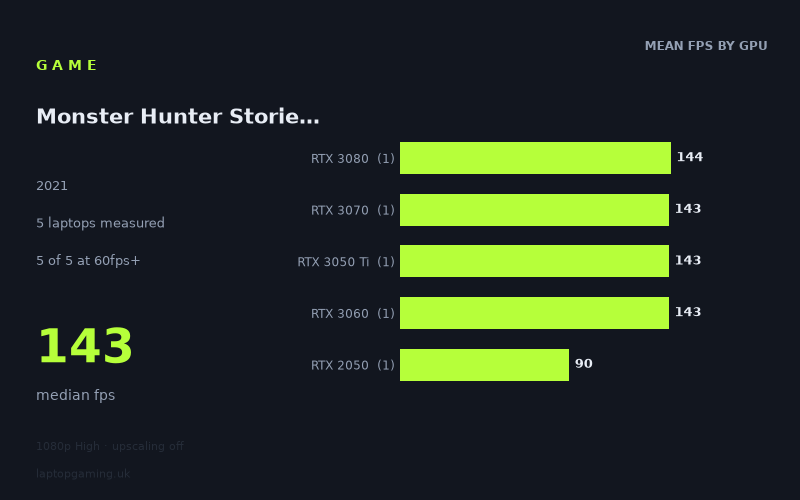
Every laptop we have figures for
Frame rates measured by Notebookcheck.
What it asks of a laptop
Monster Hunter Stories 2 looks unusually forgiving in this small set of Notebookcheck measurements. At 1,920 × 1,080 on the High preset with upscaling disabled, all five laptops cleared 60fps, and the slowest recorded result was still 90fps. The spread runs from 90fps to 144fps, while the median is 143fps.
That is a very tight group at the top end: four of the five machines returned either 143fps or 144fps. Those machines span an RTX 3050 Ti, RTX 3060, RTX 3070 and RTX 3080, with the RTX 3050 Ti result matching the RTX 3060 and RTX 3070 figures in this particular data set. It would be wrong to read that as proof that these GPUs perform identically in every laptop or in every game. Each GPU tier is represented by only one machine, and laptop power limits, cooling and other components can matter.
What the numbers do show is that, under this specific 1080p High test, the game does not scale in a straightforward way with the GPU names represented here. The higher-tier GPUs do not pull far ahead of the RTX 3050 Ti laptop: all four sit at effectively the same measured level. That may suggest that performance is being limited by something other than raw graphics horsepower in these systems, or that the tested configuration is approaching a practical ceiling. The measured figures alone cannot establish the reason, but they do show that spending more on a faster GPU did not produce a meaningful frame-rate lead in these five results.
The only clear step down is the RTX 2050 result. Even there, the HP Envy 17-cr0079ng recorded 90fps, which remains comfortably above a 60fps target. On the evidence available, this is not a game that requires a high-end gaming laptop for smooth 1080p High performance.
What runs it
The sample is limited to five laptops, with one result for each listed GPU tier. Treat these as results for those specific machines rather than universal guarantees for every laptop using the same graphics chip.
- 60fps: all five measured laptops cleared it. The RTX 2050-powered HP Envy 17-cr0079ng was the slowest system at 90fps. The RTX 3050 Ti, RTX 3060, RTX 3070 and RTX 3080 systems were all measured at 143fps or 144fps.
- 100fps: four of five laptops cleared it. The Schenker XMG Focus 15 with an RTX 3050 Ti at 75W reached 143fps; the HP Victus 16-e0179ng with an RTX 3060 at 95W reached 143fps; the Schenker XMG Apex 17 M21 with an RTX 3070 reached 143fps; and the MSI GS76 Stealth with an RTX 3080 at 95W reached 144fps. The RTX 2050 HP Envy result, at 90fps, did not reach 100fps.
- 144fps: one of five laptops reached this exact mark: the MSI GS76 Stealth, equipped with an RTX 3080 at 95W, at 144fps. Three other laptops were only 1fps behind at 143fps, so the distinction is negligible in practical terms, but the measured threshold is still only met by one system.
The notable result is the Schenker XMG Focus 15. Its RTX 3050 Ti at 75W recorded 143fps, the same figure as the tested RTX 3060 and RTX 3070 machines. That makes it the most useful data point for buyers considering a lower graphics tier, although it remains a single-laptop result rather than evidence that every RTX 3050 Ti laptop will do the same.
The cheapest laptop that handles it
No laptop prices are included in the supplied fact sheet, so it is not possible to identify the cheapest measured machine or attach a GBP price to one without guessing.
In performance terms, the lowest-result machine that still handled the game comfortably was the HP Envy 17-cr0079ng with RTX 2050, which recorded 90fps at 1,920 × 1,080 High with upscaling off. It is the only measured RTX 2050 laptop, so this should not be treated as a blanket recommendation for every RTX 2050 system, but it establishes that this particular laptop had substantial headroom over 60fps.
If the aim is to target roughly 140fps rather than simply clear 60fps, the measured options begin with the Schenker XMG Focus 15 with RTX 3050 Ti at 75W, at 143fps. The data does not include prices, however, so it cannot show whether that machine was better value than the RTX 3060, RTX 3070 or RTX 3080 laptops.
What this means if you’re buying
For a buyer focused specifically on Monster Hunter Stories 2 at 1080p High, the measured numbers suggest that expensive graphics hardware is not necessary for a good experience. The RTX 2050 HP Envy 17-cr0079ng delivered 90fps, while the RTX 3050 Ti-based Schenker XMG Focus 15 reached 143fps. Based on these figures, a laptop capable of matching the latter class of result should have ample performance for a high-refresh-rate display in this game.
There is little evidence here that moving from an RTX 3050 Ti to an RTX 3060, RTX 3070 or RTX 3080 improves performance in a useful way in the tested scenario. The respective measured results were 143fps, 143fps, 143fps and 144fps. Buyers choosing between those laptops should therefore avoid assuming that the more powerful GPU will materially improve this game’s 1080p High result.
The sensible conclusion is narrow but clear: all five measured laptops run the game above 60fps, four are around 143–144fps, and the lowest recorded result is 90fps. That makes Monster Hunter Stories 2 a relatively light demand for the specific laptops tested, but the small sample means purchasers should use these figures as guidance for comparable machines, not as a promise of identical performance from every laptop carrying the same GPU label.
How these numbers were produced
Frame rates here are not measured by us, and we label how each one was arrived at. A figure marked measured comes from a published run on that exact machine. A figure marked representative is derived from the GPU and its power limit (TGP) and cross-referenced against published reviews - a sound estimate of what that configuration delivers, but not a measurement of that specific laptop. Unless stated otherwise, numbers are 1920x1080, High preset, upscaling off. Where a laptop ships in several power configurations we use the wattage of the exact SKU listed, because a 140W RTX 5070 and a 115W one are not the same product.